25667449_the-lonely-city
by Olivia Laing
Loneliness isn't a personal failure—it's a political and biological force that reshapes how we perceive threat, accelerates disease, and drives us toward…
In Brief
Loneliness isn't a personal failure—it's a political and biological force that reshapes how we perceive threat, accelerates disease, and drives us toward connection tools that secretly replicate isolation. Olivia Laing traces this condition through artists like Andy Warhol and Henry Darger, revealing how making something from loneliness can transform it into unexpected intimacy.
Key Ideas
Felt insufficiency, not social contact quantity
Loneliness is not caused by a deficit of social contact — it's possible to be acutely lonely in a relationship or a crowd, while people who live alone are not necessarily lonely. The condition is about felt insufficiency of closeness, not headcount.
Loneliness creates self-perpetuating biological feedback loop
The physiology of loneliness is self-reinforcing: it triggers hypervigilance for social threat, making lonely people more likely to expect and remember rejection, which produces more rejection. Recovery produces amnesia, which is why the cured tend to blame the still-lonely.
Social rejection measurably degrades immune function
Stigma operates biologically, not just socially. UCLA research found that HIV-positive people subject to social rejection experienced accelerated HIV progression — the immune system degrades under chronic stress from exclusion. Loneliness at this scale is a public health emergency, not a personal failing.
Isolation remedies replicate loneliness structures
The tools people build to manage loneliness — Warhol's tape recorder, the internet's promise of connection without exposure — tend to replicate the structure of loneliness rather than dissolve it: visibility without intimacy, presence without risk.
Isolated art achieves timeless human connection
Art made in isolation reaches across time in a way that a crowded room often cannot. What Darger, Wojnarowicz, and Leonard shared was a practice of making something from their condition — not to cure it, but to make it legible to someone they'd never meet.
Loneliness requires political not personal solutions
The 'gentrification of the emotions' — treating loneliness, anxiety, and depression as chemistry problems requiring individual solutions — obscures their structural causes: stigma, racism, homophobia, healthcare abandonment. Naming these causes is the beginning of the political argument loneliness actually requires.
Who Should Read This
Readers who connect with first-person stories about Memoir and Social Issues and want to see the world through someone else's eyes.
The Lonely City
By Olivia Laing
14 min read
Why does it matter? Because the loneliness you feel in a crowded city is not a personal failure — it's a political condition with a body count.
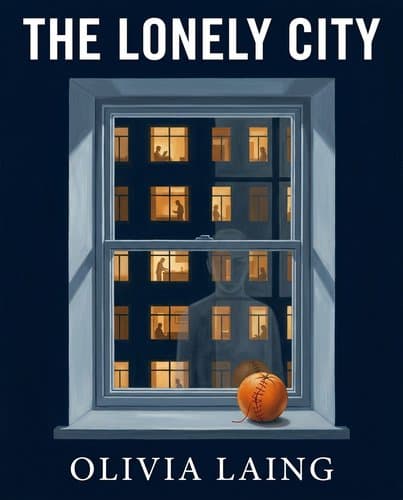
Picture someone at a high window, watching lit apartments across the dark — close enough to see strangers moving through their private hours, too far to reach them. That gap, visible and unbridgeable, is the exact texture of loneliness. But here's what Olivia Laing wants to ask: what if that feeling isn't evidence of something wrong with you? What if it's a signal about what human beings actually require from each other — and about the systems, cities, and silences that consistently fail to provide it? To answer that, she follows four artists who lived inside loneliness so completely they made it into art — Edward Hopper, Andy Warhol, Henry Darger, David Wojnarowicz — and in doing so mapped terrain most people can't even bring themselves to name. What they found, paradoxically, is that the most isolating experience a person can have turns out to be the one everyone is secretly having.
The City Is Full of People You Cannot Reach
Picture yourself at a window on the forty-third floor, watching the city arrange itself into a grid of lit rectangles. Inside each one, people move through their private hours. You can see them. You cannot reach them. Olivia Laing spent a period in New York after a man she'd fallen for abruptly changed his mind, and this window-watching became her daily experience — not the soothing urban solitude of the confirmed introvert, but something that felt, as she put it, like being hungry while everyone around you is readying for a feast.
The paradox she kept returning to is this: the city doesn't cure loneliness. It concentrates it. Physical proximity to millions of people turns out to have almost no bearing on whether you feel connected to any of them. Loneliness, in the way researchers now define it, isn't about being alone — it's about a gap between the closeness you have and the closeness you want. You can suffer it acutely in a marriage, at a party, in the middle of a crowd.
What makes this more than an uncomfortable feeling is what the psychologist John Cacioppo discovered about its mechanics. Loneliness triggers a state of hypervigilance for social threat — an unconscious shift in how the brain processes other people. Lonely people begin to expect rejection and remember it more vividly than kindness. The bias compounds: you withdraw slightly, people read you as cold, you receive the rejection you feared, you withdraw further. Loneliness grows like mould, Laing writes, a self-reinforcing seal around the person who most needs contact. A 2010 study found that chronic loneliness predicts early death with the reliability of other established risk factors. The feeling itself is the stressor, not the mere fact of being physically alone.
Hopper understood the architecture of this trap without having access to the science. At the Whitney, standing in front of Nighthawks, Laing counted the contents of his famous late-night diner: three salt shakers, two napkin dispensers, four people who weren't speaking or looking at each other. Then a tour guide stopped the room with a single observation. There is no door. From the street, the diner is sealed — an illuminated glass cell, its curved window the only instance in all of Hopper's work where he painted glass itself rather than simply a hole in a wall. Simultaneously solid and transparent, it merges in one image the two experiences that define loneliness: being trapped, and being exposed. You can see the warmth inside. You cannot get to it. Which raises the harder question: if loneliness reshapes the brain to expect rejection and withdraw from contact, can you actually decide to stop?
Loneliness Is Not a Feeling. It Is a Physiological Emergency.
Robert Weiss noticed something that explains why loneliness has historically been ignored as both a medical and a political problem: recovering from it produces its own amnesia. People who emerge from chronic loneliness cannot retrieve what it felt like. They regard those still in it with irritation rather than recognition — as people who must be choosing this, who must be getting something from it. The cured forget the disease. Which is why the lonely have always been blamed for a condition that is, by design, nearly impossible to escape from the inside.
The body, meanwhile, is running an alarm it cannot sustain. Sleep degrades. Blood pressure climbs. A 2010 study found that chronic loneliness predicts early death more reliably than obesity does — not isolation as a fact, but the subjective feeling itself as cause of death. And because the amnesia is so reliable, because everyone who gets out forgets what it cost to be in, that finding lands in the medical literature with almost no political weight behind it. The lonely are just people who haven't tried hard enough. Ask anyone who recovered.
Every Machine Warhol Built Was a Shield Against Being Known
Think of someone who fills every room they enter — entourage in tow, camera always running, always the center and never quite present. What looks like sociability might actually be its opposite: a precision instrument for staying near people without ever becoming reachable by them.
Andy Warhol was born into the wrong language. His mother, Julia, had emigrated from Slovakia and was by all accounts a gifted, voluble storyteller who spent her American life marooned in a tongue she could manage only in broken fragments. Her youngest son absorbed both the hunger and the obstruction. At art school, Warhol's teachers documented his English as a series of 'mutilations'; he borrowed classmates to ghost-write his essays. He couldn't reliably make himself understood, and the experience left a mark that no amount of fame would fully erase.
His solution was to stop trying to close the gap and start designing it. After one session with a psychiatrist, he detoured through Macy's and came home with a nineteen-inch television — and discovered something he described as like magic: if it was on while people talked, it protected him from getting too absorbed in them. The television became a blueprint. When a tape recorder arrived years later, a gift from its manufacturer, he named it his wife. The relationship, he said, had finished off whatever emotional life he still had — and he was glad. Every problem transformed into a recording was no longer a problem; it was material.
The Silver Factory, the foil-walled studio Warhol filled with the most electrically talkative people he could find — speed users, performers, runaways, people who spoke in unbroken torrents — ran on this logic. He sat in the corner and taped them. His nickname there was Drella, a portmanteau of Cinderella, always left behind when the ball began, and Dracula, who feeds on the living without giving anything back that could be used against him. The Factory looked like radical openness. It functioned as a one-way mirror: he consumed the voices, preserved them on magnetic tape, turned them into art. He remained, as a friend put it, carefully unseeable — the artifact extended forward, the man held back.
Laing finds something besides damage in this. The same loneliness that drove Warhol to hide behind machines also drove him to build Interview magazine — a publication structured entirely around listening, where celebrities were handed the microphone and transcribed almost verbatim, their words reproduced at length and without reduction. The format was Warhol's tape-recorder logic applied to print: capture the voice, don't editorialize, stay out of the way. Someone who understood exactly what a heard voice costs, and what its absence does, built a magazine whose entire premise was that being listened to was enough.
Henry Darger never had a tape recorder, a Factory, or a room full of people to absorb. He had a sealed apartment on the North Side of Chicago and sixty years of work no one ever saw.
Darger's Secret World Was Not a Symptom. It Was a Solution.
What do you make of a man who spends six decades alone in a single room, producing a 15,145-page illustrated novel that no one will ever see? The obvious answer is that something went badly wrong. The more honest answer is that something went remarkably right.
Henry Darger was a Chicago janitor who lost his mother at four, was committed to an asylum for troubled children at eight, and emerged at seventeen into a life of ceaseless, menial labor. His one genuine friend died in 1959; Darger wrote to the man's sister to grieve — 'He was like a brother to me. Now nothing matters to me at all' — and the letter came back stamped RETURNED. He never tried again. Instead, his room on Webster Street filled up across four decades with hundreds of paintings, thousands of manuscript pages, and meticulous folders of traced and clipped images organized by category: clouds, girls, disasters, butterflies. All of it made in secret, none of it shown.
Harlow's experiments with rhesus monkeys clarify something about how Darger got there. Infant monkeys separated from their mothers and offered a choice between a wire surrogate fitted with a milk bottle and a cloth surrogate with nothing to offer chose the cloth one — clung to it, raced back to it after feeding. When Harlow built surrogates armed with brass spikes or air-blasters, the infants kept clinging anyway, pressing against the thing that hurt them because the alternative was holding on to nothing at all. The need for attachment is more powerful than self-protection. Darger, in his memoir, called the abusive institution where he was confined as a child 'a sort of Heaven,' and went on wondering whether he might be fool enough to run away from heaven if he got there. The attachment logic is identical: when the closest thing you have to a home is also the source of harm, you cling.
Monkeys isolated long enough and then reintroduced to a group were immediately rejected or attacked — their damage had made them socially unreadable, which generated more rejection, which deepened the damage. Darger's memoir is full of rehearsed grievances against people who cheated or belittled him; he describes wanting to kill his accusers and counting them as enemies even after death. This is not a character flaw. It is precisely what chronic early isolation produces.
So what do you do with that, if you are Henry Darger, and you have no one, and the world keeps confirming that this is your correct position in it? You build a counter-world. Melanie Klein called the impulse reparative — the drive to gather what's broken and press it back into coherence. Darger's collage method was literally this: cutting fragments from newspapers and magazines, tracing and retracing the same figures through carbon paper, inserting a girl with a bucket and her finger in her mouth into scene after scene across hundreds of paintings. He paid $3 to $5 each for photographic enlargements at the corner drugstore in an era when his annual salary never exceeded $3,000. Priorities declare themselves in spending. He was not a sad eccentric leaking compulsion onto paper. He was someone doing the only integration available to him, in the only medium he could afford.
Stigma Doesn't Just Wound — It Gets Inside the Immune System
Page Wood had known Klaus Nomi for years. At a dinner party, he moved toward him to give the usual European greeting — a kiss on each cheek — and stopped. He didn't know if the disease was contagious. He hesitated, visibly, until Nomi reached out and placed his hand quietly on Wood's chest and said: it's alright, don't worry about it. That moment — Nomi absorbing the flinch of someone who loved him, reassuring him — is what the AIDS crisis looked like from the inside. Not just illness but the constant experience of your body being treated as a source of danger by the people closest to you.
We tend to think of stigma as social cruelty — painful, unjust, but finally separable from the physical disease. UCLA psychologists dismantled that separation: HIV-positive people who experienced social rejection showed accelerated disease progression, moving to full-blown AIDS faster and dying sooner than those who weren't subject to chronic exclusion. The mechanism is the same one that makes loneliness lethal more generally — sustained stress suppresses immune function. Being abandoned by the group gets into the cells. Wood wasn't just being cruel. At that biological level, he was a form of harm.
Between 1981 and 1996, more than 66,000 people died of AIDS in New York City alone, many of them in conditions of extraordinary abandonment. Patients were left on gurneys in hospital corridors. Nurses refused treatment. Funeral homes turned away the bodies. One of those bodies was a man named Emilio Cubeiro, a dancer, who died alone in a ward where staff left food trays outside the door rather than enter the room. Politicians blocked funding while preachers announced that the dying deserved what they were getting.
David Wojnarowicz, diagnosed in 1988, put it most clearly: learning he had the virus, he quickly understood he had contracted a diseased society as well. What his work kept insisting on was that this wasn't misfortune distributed at random. Loneliness at this scale was something a society chose to inflict on particular bodies — the gay, the poor, the already marginalised — by withholding education, funding, and the basic human contact that might have slowed the dying. The withholding was active: Reagan did not say the word AIDS in public until 1987, six years into the epidemic and fifty thousand American deaths in. The virus had no moral agenda. The people in power did.
Technology Promised Connection and Delivered a More Efficient Loneliness
The proof arrived before the platforms existed.
In December 1999, a dotcom millionaire named Josh Harris filled a Tribeca warehouse with sixty volunteers and an elaborate infrastructure of mutual surveillance. Participants in his experiment, which he called Quiet, wore grey shirts and orange trousers. They slept in a single dormitory. The shower had glass walls, positioned so the entire dining hall could watch. Cameras ran in the toilets. Everything was free — food, alcohol, guns in the basement shooting range — and everything was recorded. The price of entry was your privacy, signed away on arrival. As strangers drew closer under these conditions, Harris observed, the more intimate the knowledge became, the more isolated each person felt. Giuliani's police shut it down at midnight on New Year's Day, 2000.
What Harris had built wasn't a party or a prison, though it resembled both. It was a working model of what the internet would become: a space where visibility and exposure arrive as the same event, where you can be watched by everyone and protected by nothing. The feedback loops Quiet generated in physical bodies — voyeurism, performance, the compulsive checking to see who was watching you — would become, within a decade, the basic grammar of daily life online.
Laing knew this grammar from the inside. She describes her own internet use with the precision of someone who has studied a bad habit long enough to understand its actual function: she wanted to drown out her own anxiety with data, to become empty, to annihilate the self that felt so acutely its own incompleteness — and simultaneously to broadcast that self, to declare her continued existence to strangers, to earn the brief flicker of recognition that a stranger's approval could give. The contradiction wasn't incidental. It was the whole mechanism. The screen offered the appearance of contact without the exposure real contact requires, and the appearance of privacy without any of its actual protection. You perform for an audience that can vanish the moment attention shifts elsewhere. The architecture of social media was never going to cure loneliness. It was built to replicate the conditions that produce it.
Art Made in Isolation Can Reach Across Time and Make You Less Alone
One morning Zoe Leonard ate two oranges, looked at the torn peels in front of her, and couldn't bring herself to throw them away. So she sewed them back shut. She wasn't thinking about art. She was thinking, she said later, about not wasting things — about a need to sew herself back up. The act was instinctive, barely conscious, the kind of thing grief makes you do without explanation.
Those two orange peels became Strange Fruit: 302 sutured citrus fruits and avocados, their contents eaten, their skins dried and stitched back together with thread, wire, buttons, and zippers, then laid across gallery floors to continue their slow decomposition. The work memorializes David Wojnarowicz — the AIDS artist and activist who had been Leonard's close friend, her ACT UP comrade, a man whose own signature images involved stitching: a loaf of bread darned back together with scarlet thread, a photograph of his own face with lips sewn shut. That last image matters. Wojnarowicz spent his career being silenced — by censors, by the NEA, by a government that treated AIDS as a moral verdict — and the sewn mouth is what that looks like from the inside: not peaceful, not resolved, visibly and violently closed. Leonard's fruit are clearly from the same war. The word fruit was used as a slur for gay men; the title reaches back further to Billie Holiday's song about bodies hanging in Southern trees. Every stitch carries that history.
What makes Strange Fruit devastating rather than merely somber is the quality of the stitching — the inadequacy of it, the stubbornness of it. You look at a sutured orange and feel two things at once: the damage, and the refusal to leave the damage alone. The psychoanalyst D. W. Winnicott observed the same logic in a small boy who responded to his mother's hospital absences by tying all the furniture in his house together with string — tables to chairs, cushions to the fireplace, and eventually a length of cord around his infant sister's neck, not as an act of harm but as an extension of the project: the string had to reach everything, cover every gap. Not aggression, Winnicott concluded, but declaration. String joins things, holds unintegrated material together, extends across the gap where contact has failed. The boy was saying what he couldn't otherwise say. So was Leonard.
Laing came to understand this from the receiving end. What broke open her own loneliness during that year in New York wasn't meeting anyone, wasn't falling in love. It was handling the things other people had made — Strange Fruit, Darger's collages, Warhol's time capsules — and registering through them the evidence that other people had been exactly here: in this condition, making something from it, reaching forward through the object toward whoever would eventually find it. Art can't resurrect the dead or mend a fractured friendship or slow the pace of dying. But it transmits the fact of a shared condition across time, intact. You receive it and you are, for a moment, less alone — not because your circumstances have changed, but because the isolation you thought was yours turns out to have been everyone's.
What the Diner Without a Door Actually Means
Return to that diner on the corner of Greenwich and Seventh. No door on the street side. Four people bathed in light so complete it functions as exposure. Hopper didn't paint this as a lament — he painted it as a fact, which is different. The people in that glass cell are not waiting to be rescued. They are simply there, visible and unreachable.
What Laing found in a year of window-watching, and in the objects strangers left behind — the sutured fruit, the taped voices, the painted counter-worlds — wasn't a cure. It was something closer to accurate description. Zoe Leonard sewing orange peels back together wasn't solving grief; she was refusing to pretend the damage hadn't happened. That refusal, passed forward through the thing she made, arrived in someone else's hands and registered as recognition. Not connection exactly. But the next best thing: proof that the sealed room has other occupants, and that naming it together is, already, a way of making it less total.
Notable Quotes
“It's alright, don't worry about it,”
Frequently Asked Questions
- What is "The Lonely City" about?
- "The Lonely City" examines loneliness as a shared human condition rather than personal failure through the lives of artists including Andy Warhol, Henry Darger, and David Wojnarowicz. Olivia Laing draws on art history, neuroscience, and cultural criticism to reveal how loneliness has structural and political causes. Rather than treating loneliness as individual pathology, the book shows how facing it honestly produces real understanding of what people need from each other. It argues that loneliness is shaped by stigma, healthcare systems, and social structures—not simply insufficient social contact.
- How does "The Lonely City" define loneliness?
- According to the book, loneliness is not caused by a deficit of social contact but by felt insufficiency of closeness. Someone can be acutely lonely in a relationship or crowd, while people who live alone are not necessarily lonely. The book reveals loneliness is self-reinforcing: it triggers hypervigilance for social threat, making lonely people expect and remember rejection, which produces more rejection. Recovery produces amnesia, explaining why the cured tend to blame the still-lonely. This physiological cycle shows loneliness is far more complex than simple social isolation.
- What does "The Lonely City" reveal about stigma and loneliness?
- The book reveals that stigma operates biologically, not just socially. UCLA research found that HIV-positive people subject to social rejection experienced accelerated HIV progression — the immune system degrades under chronic stress from exclusion. This demonstrates that loneliness at this scale is a public health emergency, not a personal failing. Laing argues this reframes loneliness from individual pathology to a collective crisis. The connection between social exclusion and physical disease progression illustrates how structural conditions produce measurable biological harm, requiring systemic solutions.
- What is the political argument in "The Lonely City"?
- The book's political argument centers on recognizing structural causes of loneliness rather than treating it as individual pathology. Laing describes the 'gentrification of the emotions' — treating loneliness, anxiety, and depression as chemistry problems requiring individual solutions — which obscures their structural causes: stigma, racism, homophobia, healthcare abandonment. Naming these causes is the beginning of the political argument loneliness actually requires. The book demonstrates how tools built to manage loneliness, from Warhol's tape recorder to the internet, often replicate loneliness's structure rather than dissolving it.
Related Book Summaries

Read the full summary of 25667449_the-lonely-city on InShort