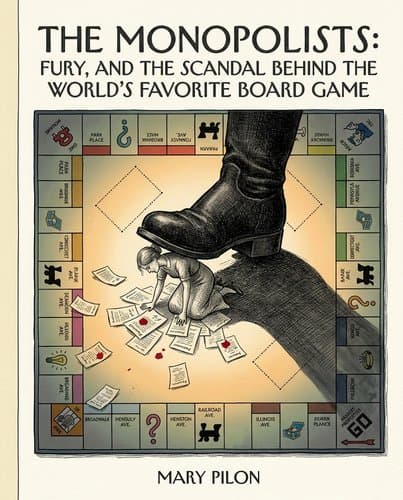
17978108_the-monopolists
by Mary Pilon
Monopoly was invented by a woman named Lizzie Magie to expose the dangers of unchecked capitalism—then stolen by a man who became a millionaire from it.
In Brief
Monopoly was invented by a woman named Lizzie Magie to expose the dangers of unchecked capitalism—then stolen by a man who became a millionaire from it. Pilon unravels the corporate cover-up that buried her for 80 years, revealing how power rewrites history to protect its own profits.
Key Ideas
Copied Errors Expose Intellectual Theft
The 'Marvin Gardens' misspelling on every Monopoly board is objective evidence of plagiarism — Darrow copied it from Charles Todd's handmade board, where it was already a mistake. Copied errors are one of the oldest tools for proving theft of intellectual work.
Satire Overshadowed by Capitalist Appeal
Lizzie Magie deliberately built two rule sets into the Landlord's Game — one where shared wealth rewarded everyone, one where crushing opponents won. The monopolist rules were the ones that caught on. A game designed to critique capitalism succeeded by making capitalism fun.
Corporate Money Silences Rival Claims
Corporate myth-making works by buying silence as well as rights: Parker Brothers purchased Magie's patent for $500, paid a Texas competitor $10,000 to drop a counterclaim and stay quiet, and bought 'Finance' from a rival manufacturer — covering every legal vulnerability before anyone could challenge the Darrow story.
Quaker Ethics Shape Monopoly Practice
The 'boring Monopoly problem' — games that drag on for six hours — traces directly to the Quaker community that localized the board. They removed the auction mechanic because loud bidding conflicted with their values. Those informal Quaker ethics survived in how people actually play, even as the official rules say otherwise.
Legal Victory Triggers Protective Legislation
Winning a legal battle over generic trademarks can backfire: Anspach's victory so alarmed major corporations that they lobbied Congress to pass legislation specifically nullifying the legal test he used. His win made the trademark system worse for everyone who came after him.
Absence of Records Erases History
When a company controls the official story of its own product, the absence of documentation is itself a tool — Magie's contributions were erased not by destroying evidence but by simply never creating any. In the age before digital records, corporate silence was sufficient to rewrite history.
Who Should Read This
History readers interested in World History and Economic History who want a deeper understanding of how we got here.
The Monopolists: Obsession, Fury, and the Scandal Behind the World's Favorite Board Game
By Mary Pilon
9 min read
Why does it matter? Because the story printed on every Monopoly box is a corporate lie designed to bury the woman who actually invented it.
You know the story. Unemployed man, Depression-era basement, a piece of oilcloth, and an idea that saved his family. Parker Brothers printed it on every box for decades, and why not — it's a perfect American myth. Except it was invented too, just like the game. The actual inventor was a woman named Lizzie Magie, a progressive rabble-rouser who designed the game in 1904 specifically to expose the cruelty of landlords and monopolists. Parker Brothers eventually found her, bought her patent for $500, buried her other games quietly, and let her die decades later as an anonymous government typist who told colleagues she'd once invented something. Meanwhile, Charles Darrow — the man in the basement — became a millionaire. The whole history of Monopoly is a Monopoly game, played at scale, with real consequences.
The Story in the Box Was Written by the Company That Benefited From It
Here's what you probably think you know about Monopoly: a desperate unemployed salesman named Charles Darrow, stuck in Depression-era Philadelphia with no prospects and a family to feed, invented the game at his kitchen table and sold it to Parker Brothers, who turned it into the bestselling board game in history. That story was printed inside every Monopoly box for decades. It is a fabrication — and the people selling it knew that from the start.
The proof is in what Robert Barton, the Harvard-trained lawyer who ran Parker Brothers, did immediately after purchasing Darrow's version of the game in 1935 for seven thousand dollars. Sensing that the game had been circulating informally for years before Darrow showed up with it, Barton commissioned a long handwritten account from Darrow documenting his 'invention.' He wasn't trying to learn the truth. He already suspected the truth, and the truth was a legal liability. What he needed was paper — a narrative built before anyone started asking questions. When those questions eventually arrived, under oath, Barton admitted he had never quite believed the Darrow story in the first place.
Meanwhile, Parker Brothers had quietly purchased the original patent from Lizzie Magie — the woman who had actually designed the game's core mechanics thirty years earlier — for five hundred dollars and no royalties. Darrow became famous. Magie's name vanished entirely from the box.
The Real Inventor Built the Game to Destroy Everything the Game Came to Celebrate
Magie was a progressive stenographer and writer living in Washington, D.C., in the early 1900s — a devoted follower of economist Henry George, who believed that land monopoly was the root cause of poverty. To spread that idea, Magie spent nights at her kitchen table designing what she called the Landlord's Game, patenting it in 1904. The board had railroads, utilities, a jail, and properties you could buy and sell — all the DNA of the game you know. But the mechanism she built it around was a lesson: every time a player paid rent to a landlord, everyone else at the table could see, in miniature, exactly how wealth concentrates. She designed it, in her own words, so that children would grow up understanding the injustice of the system and want to fix it.
The irony cuts deep when you look at what she actually built. Magie included two sets of rules. The first, the anti-monopolist set, rewarded every player when anyone created wealth — a rising-tide model. The second, the monopolist set, was a cautionary demonstration: crush your opponents, seize everything, grind the others into poverty. She included it to show how the system fails. It was the second set that people fell in love with.
The game spread through radical communities and left-wing university circles, passed hand to hand, redrawn on wood and cloth by people who believed exactly what Magie believed. And as it traveled, her name fell away from it. Scott Nearing, a socialist professor who taught the game at the Wharton School as early as 1910 and called it a tool to expose "the anti-social nature of monopoly," had no idea who had invented it.
The creator was already a ghost inside her own creation.
What survived was the monopolist rules — the part she'd built to serve as a warning — stripped of the warning entirely.
A Misspelled Street Name Is Evidence of Theft That Has Been on Every Board for 90 Years
Charles Todd made a single-letter mistake when he copied the Monopoly board in the early 1930s. The real estate development in Atlantic City sat between Margate and Ventnor, and its name — 'Marven Gardens' — was a combination of those two towns. Todd wrote 'Marvin Gardens' instead. Nobody caught it. When Darrow copied Todd's board to market as his own invention, he carried the error forward. It sits on every Monopoly board in production today.
Copied errors don't lie. When two texts share an identical mistake that couldn't have arisen independently, the explanation isn't parallel inspiration — it's transcription. Darrow didn't improve the game or reimagine it or arrive at the same place from a different direction. He traced it. The misspelling is the kind of evidence that forecloses debate, the detail a lawyer holds up at the end of a deposition because it needs no interpretation.
Darrow had been introduced to the game by his old school friend Charles Todd around 1932, playing it repeatedly with the Todds and their friends the Raifords, who had imported the Atlantic City version from a Quaker community that had localized and refined it over years. When Darrow asked Todd for a written copy of the rules — framing it as a favor so he could teach others — Todd had his secretary type up carbon copies, which the Raifords reviewed for accuracy. Those copies became the official rules of a game Darrow then copyrighted as his own creation in 1933. The design was complete. The mythology could begin.
Parker Brothers' acquisition of Lizzie Magie's original patent in 1935 — the document establishing her as the game's actual architect — cost the company five hundred dollars, no royalties, and a promise to publish a few of her other games, which quietly disappeared. Her name came off the box. Darrow's stayed on. The misspelled street in Atlantic City stayed too, right there in plain sight, for anyone who knew what they were looking at.
Parker Brothers Paid Lizzie Magie $500 for a Patent They Called 'Completely Worthless' — Then Used It to Destroy All Competition
In November 1935, George Parker made the trip from Salem, Massachusetts, to Arlington, Virginia, to visit a 70-year-old woman named Lizzie Magie. He told her that his company had come across her Landlord's Game — the board she'd designed in 1904 as a protest against land monopolists — and wanted to purchase her patent. He also promised to publish two more of her games, bringing her Georgist economic message to the mass audience she'd spent decades trying to reach. Magie was moved enough to write a farewell letter to her 'beloved brain-child,' handing it to a new guardian who would finally give it the life it deserved. She signed away everything for five hundred dollars. No royalties.
Parker Brothers published her additional games in editions so small they vanished without a trace. The company printed her original patent number on early Monopoly boxes — a legally prudent gesture that technically acknowledged her contribution — but gave her no credit and no money. The name on the box was Charles Darrow. When Robert Barton later testified under oath about the five-hundred-dollar payment, he explained it by saying Magie's patent had been 'completely worthless.' What he meant was that it was worth exactly what it cost to make it go away.
Parker Brothers didn't just buy a fraudulent product from Darrow and sell it. They identified the one document that could expose the fraud, purchased it for a pittance from an idealist they knew they could underpay, buried the games she'd extracted as her price, and then used the patent itself as a legal shield. The original inventor's own intellectual property became the instrument of her erasure. Magie built the game to show how wealth concentrates in the hands of a few at the expense of everyone else. She lived the demonstration.
A Professor With a Chopped Liver Sandwich Decided to Fight General Mills
In a conference room full of Parker Brothers lawyers, Ralph Anspach — economics professor, Anti-Monopoly creator, man with a grudge and a lunch bag — reached into his briefcase and unwrapped a chopped liver and onion sandwich. Then he started eating it. Slowly. The smell filled the room. The lawyers stared. Ralph answered questions between bites.
This is who Parker Brothers, then owned by General Mills, had decided to destroy in federal court.
The whole thing had started with his son William pointing out an obvious contradiction. In 1973, while Anspach was ranting at the breakfast table about OPEC and the evils of monopoly power, William interrupted to mention that he'd won a game of Monopoly the night before. So had he done something wrong? It was a reasonable question, and Anspach couldn't shake it. He created Anti-Monopoly — a game where players acted as trust-busters — financed the first print run on credit cards, and received a cease-and-desist letter from Parker Brothers claiming ownership of the word 'monopoly' itself. Rather than comply, he sued.
The disproportion was spectacular. On one side: a conglomerate with a fleet of corporate lawyers, a beloved American trademark, and decades of manufactured mythology to protect. On the other: a professor with mounting credit card debt who served as his own paralegal, cold-called elderly Quakers, and flew across the country to sit in strangers' living rooms and examine handmade game boards.
Then General Mills offered him five hundred thousand dollars — roughly two million dollars in today's terms — plus an executive position, to walk away. His lawyer urged him to take it. The offer required him to hand over Anti-Monopoly and stop production permanently. Anspach brought it home and the family said no. Parker Brothers had buried Lizzie Magie's name once before by acquiring what they needed and letting it disappear. Taking the money meant the same thing would happen again — the evidence he'd spent years assembling would vanish into a corporate archive, and the Darrow myth would remain intact on the box forever. The settlement collapsed. His lawyer eventually called the Anspachs 'crazy' from the witness stand and quit. Parker Brothers buried forty thousand of his games in a Minnesota landfill to demonstrate how the whole thing would end.
Anspach showed up to watch. Then he appealed.
Corporate Power Has a Specific Smell: 40,000 Board Games Rotting in a Minnesota Landfill
On July 5, 1977, with reporters watching, Parker Brothers sent representatives to a landfill in Mankato, Minnesota, and buried forty thousand Anti-Monopoly games in the ground. Not stored in a warehouse pending Anspach's appeal — buried. Warehousing would have been procedure. Burial was a message: we are not worried about your appeal, and neither should anyone else thinking about challenging us.
Anspach flew to Minnesota to watch. There wasn't anything else he could do.
Three years later, operating on legal momentum and sheer stubbornness, he came back to dig them up. A new attorney named Carl Person — Harvard-trained but perpetually disheveled, with a briefcase that rained papers every time he opened it — had joined the case and helped win a partial appellate ruling on the genericness question. Anspach believed he had a right to his games. He promoted the excavation publicly, called it an 'archeological spectacular,' and arrived at the frozen landfill in a coat too thin for a Minnesota winter while his friend Russ Foster, dressed for Siberia, trudged ahead of him through the stench. Reporters came. Onlookers came. Everyone left after six hours of finding nothing. A phone call later told Anspach he'd been thirty yards off. By the time the ground thawed, a developer had bought the land and started building houses on top of it. The forty thousand games are still there.
Corporate legal power doesn't always arrive as a ruling. Sometimes it arrives as a backhoe.
Anspach kept appealing anyway — and what he built in the courtroom would eventually do what the shovel couldn't.
Anspach Won — and Congress Immediately Rewrote the Law to Make Sure No One Could Do It Again
Anspach won, completely and on the merits — and then Congress made sure no one would ever win the same way again. The Supreme Court declined to hear Parker Brothers' appeal. Anspach received six-figure settlements that more than covered his legal fees and the forty thousand buried games. Anti-Monopoly stayed on shelves. After a decade of cold calls to elderly Quakers, frozen landfill searches, and watching his lawyer quit from the witness stand, he had beaten one of America's most powerful trademarks in federal court. The victory was real. It was also, almost immediately, sealed off from anyone who might follow him.
Within a year of the ruling, corporations terrified by the genericness decision — Procter and Gamble among them — lobbied Congress for a fix. Senator Orrin Hatch delivered it: the Trademark Clarification Act of 1984, drafted specifically to kill the 'consumer motivation test' that had handed Anspach his win. That test had asked buyers a direct question: are you purchasing this because you want Parker Brothers' product specifically, or because Monopoly is the only word you have for this kind of game? The answer came back: the second one. That answer had proved the trademark was generic in the minds of buyers. Congress made the question illegal. Anti-Monopoly survived only through a grandfather clause written for Anspach personally. The door he'd broken open was bricked over behind him.
Meanwhile, the official story stayed exactly where Parker Brothers had put it. Hasbro, which absorbed Parker Brothers in 1991, eventually conceded that Darrow had been 'inspired' by an earlier game — a careful word that implies improvement rather than theft. Lizzie Magie, who built the original in 1904 and sold it away for five hundred dollars and a broken promise, is buried in Virginia. Her headstone does not mention the game. The record was corrected. The legend proved more durable.
What the Typo on the Board Has Always Been Trying to Tell You
Every time you land on Marvin Gardens, you are touching the evidence. Not a reconstruction of it, not a historian's interpretation — the actual error, pressed into the board, shipped in the box, translated into dozens of languages, reproduced across hundreds of millions of copies without anyone stopping to ask why the name is wrong. It was never corrected because correcting it would require explaining where it came from. So the theft stayed, and the spelling stayed with it. Lizzie Magie's headstone in Arlington says nothing about a game. The Darrow story still circulates. The truth exists — it's in a federal ruling, and you won't find it in the box. You'll find it under your finger, one small misspelling, every time you play.
Notable Quotes
“likely to cause confusion, or to cause mistake, or to deceive,”
“Labor upon Mother Earth Produces Wages.”
“supposed to have performed so much labor upon Mother Earth”
Frequently Asked Questions
- What was the Landlord's Game and who invented it?
- Lizzie Magie created the Landlord's Game in the early 1900s as a tool designed to critique capitalism. The game featured two rule sets: one where shared wealth rewarded everyone, one where crushing opponents won. The monopolist rules were the ones that caught on. Parker Brothers later purchased Magie's patent for $500, effectively erasing her from the historical record. The Monopolists reveals how a game originally designed to critique capitalism instead succeeded by making capitalism fun, while its true originator remained largely unknown for decades.
- What does the Marvin Gardens misspelling prove about Monopoly's origins?
- The 'Marvin Gardens' misspelling is objective evidence of plagiarism. Charles Todd's handmade board already contained this error, and Charles Darrow copied it directly into his version. 'Copied errors are one of the oldest tools for proving theft of intellectual work.' This misspelling demonstrates that Darrow didn't create Monopoly independently but rather borrowed from an existing design. The fact that this error persists on millions of boards worldwide serves as an enduring testament to the plagiarism underlying the game's creation and commercial success.
- How did Parker Brothers consolidate control over Monopoly?
- Parker Brothers systematically eliminated competing claims to Monopoly. The company purchased Lizzie Magie's patent for $500, paid a Texas competitor $10,000 to drop a counterclaim and stay quiet, and bought 'Finance' from a rival manufacturer. This multi-pronged approach covered every legal vulnerability before anyone could challenge the Darrow story. 'Corporate myth-making works by buying silence as well as rights.' By acquiring both intellectual property and silence through strategic payments, Parker Brothers constructed a dominant narrative about Monopoly's origins that endured for decades.
- How does The Monopolists explain corporate myth-making and historical erasure?
- The Monopolists reveals that corporate myth-making erases history through silence. 'When a company controls the official story of its own product, the absence of documentation is itself a tool — Magie's contributions were erased not by destroying evidence but by simply never creating any. In the age before digital records, corporate silence was sufficient to rewrite history.' Parker Brothers employed this strategy effectively, purchasing Magie's patent while leaving no documentation of her original creation. This reveals how forgetting proves as effective as active denial.
Related Book Summaries


Read the full summary of 17978108_the-monopolists on InShort