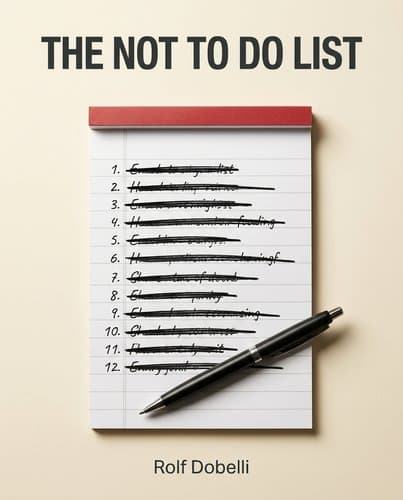
215587062_the-not-to-do-list
by Rolf Dobelli
Misery is easier to map than happiness—so instead of chasing an elusive formula for success, build a systematic defense against predictable, self-inflicted…
In Brief
Misery is easier to map than happiness—so instead of chasing an elusive formula for success, build a systematic defense against predictable, self-inflicted disasters. Dobelli's inversion method reveals that eliminating the finite set of bad decisions is the surest path to a genuinely good life.
Key Ideas
The Tomorrow Test for Commitments
Before accepting any future commitment, ask: would I do this if it were happening tomorrow? If no, the answer is no — regardless of how empty the calendar looks.
Reliability as Your Compounding Asset
Treat reliability as a compounding asset: it costs nothing to build, takes years to establish, and can be destroyed in seconds — which means protecting it deserves the same priority as protecting your finances.
Ask Why It Wasn't Worse
Apply the inversion method to any setback: don't just ask why something went wrong — ask why it only turned out that badly and not worse. The answer reveals what is actually working.
Accept People or Exit Entirely
Never try to motivate or fundamentally change another person's personality. Hire motivated people from the start; in relationships, accept or exit — renovation is not a viable strategy.
Subtract Three from Expectations Always
Calibrate your expectations deliberately downward before any first-time experience. The Bayesian brain fills knowledge gaps with inflated hopes; subtract three points from any anticipation score to build a realistic buffer.
Build Your Fuck You Fund
Build a 'fuck you' fund — 12 to 24 months of family expenses in savings — before the cost of living escalates. Financial security is not about consumption; it is the specific, measurable feeling of being able to walk away.
Guard Your Attention Like Buffett
Treat your attention the way Buffett treats his time: default to no, protect large blocks for deep work, and recognize that every distraction carries a hidden recovery cost of roughly ten times its apparent length.
You Are Ruining Your Life
When you catch yourself spiraling into self-pity or resentment, apply Munger's iron prescription: the moment you believe someone else is ruining your life, you are the one doing the ruining.
Who Should Read This
People working on personal growth in Self-Improvement and Decision Making, especially those tired of generic motivational advice.
The Not To Do List
By Rolf Dobelli
13 min read
Why does it matter? Because studying success is the wrong strategy.
Conventional self-help points at the winners and says: do what they did. But winners are noisy, random, and impossible to replicate — luck did most of the heavy lifting, and nobody on the podium can quite explain why they're there instead of someone else. Failure is different. Failure leaves evidence. It follows patterns, hits the same fault lines, makes the same recognizable sounds. Rolf Dobelli noticed this asymmetry and did something with it: rather than chasing the elusive formula for a great life, he mapped the finite, predictable catalog of ways people reliably destroy one. The result is less a self-help book than a field guide to human self-sabotage — sardonic, precise, and grounded in inversion logic: figure out what ruins a life, then don't do those things. Avoid the guaranteed disasters, and the reasonable path clears itself.
The Heroes Nobody Celebrates Are the Ones Who Prevented the Disaster
On August 14, 2018, a storm rolled over Genoa and the Morandi Bridge fell. Dozens of cars dropped forty meters when the central span gave way — a disaster announced years earlier by engineers who warned about corroding concrete and deteriorating stays. Nobody acted. What followed was rescue workers in rubble, an international news cycle, and a celebrated rebuilding supervised by Renzo Piano. Heroes were made.
That same Tuesday, in Bern, the Felsenau Viaduct did not collapse. It's a comparable structure in almost every way — similar age, similar design, similar traffic load, carrying Switzerland's most important highway a few kilometers from Dobelli's office. The difference was invisible: decades of meticulous, boring maintenance by engineers whose names appear nowhere.
That's the cognitive trap Dobelli is diagnosing. We're wired to celebrate the rescue and ignore the prevention. The surgeon who performs emergency bypass surgery gets praised; the GP who ran routine checks for twenty years and quietly kept the heart attack from happening gets nothing. Diplomats who hold the international order together through patient negotiation receive no medals, because their success is the absence of something — the war that never started, the crisis that never escalated. You can't photograph a non-event.
The practical implication is blunt. Dobelli compares good personal maintenance to how aviation engineers monitor jet engines — watching for the smallest deviations in temperature, pressure, or vibration, pulling a plane from service over a fluctuation most people would wave away. That level of attentiveness applied to your health, your relationships, and your work is unsexy, time-consuming, and completely uncelebrated. It also keeps everything from collapsing at once. Which raises the question of what kind of person actually sustains that attentiveness — and that's where reliability comes in.
Reliability Is Worth More Than Genius — and It's Free
Reliability is the most underrated tool for success in existence — and it costs nothing to use. Not intelligence. Not creativity. Not charisma. Those qualities feel decisive because they're vivid, because we can point to them. Reliability is invisible until it disappears.
Here's a test case that should unsettle anyone who has ever bet on brainpower. In 1998, a hedge fund called Long-Term Capital Management collapsed and nearly took the global financial system with it. The people running it were not ordinary. The management team included multiple Nobel Prize winners in economics and some of the most credentialed financial minds alive. Their models were extraordinary. Their IQs were, by any measure, exceptional. And yet: within four years of its founding, the fund lost nearly everything and required a Federal Reserve-orchestrated bailout to prevent wider contagion. Brilliance doesn't create a safety net. Reliability does — a reliable person isn't maintaining a web of overextended promises waiting to collapse. They do what they said they would do, and the whole architecture stays standing.
Dobelli makes a point that quietly stings: every successful person he can name is also, without exception, extraordinarily reliable. His go-to example is Roger Federer — not just the tennis, but the contracts honored, the appearances made, the sponsors who could set their watches by him. We attribute the success to the flashier trait. The reliability sits there, doing most of the actual work, unnoticed.
The compounding effect matters more than people realize. Reputation is what reliability builds over time, and your reputation is essentially the sum of every future opportunity that will or won't come your way because of how you've behaved in the past. In the digital age, that calculation has become punishing in one direction. It used to be possible to move to a new city and start fresh after burning your credibility somewhere. That exit no longer exists. A reputation takes roughly a decade to establish and can be gone in a single afternoon. The math on carelessness has never been worse. If you recognize yourself doing the thing Dobelli's satirical advice recommends — promising freely and delivering selectively — the unease you feel is the correct response. That's the bill arriving.
Your Expectations Are Mathematically Programmed to Make You Miserable
Picture a scale calibrated by hope. You're about to try a restaurant a friend raved about, and before you've tasted anything, the scale is already tilted. The food arrives. It's fine. Perfectly decent. But 'perfectly decent' doesn't register as good news, because you walked in expecting transcendence. The kitchen didn't fail you. Your expectations did.
When Warren Buffett was asked what sustained his 52-year marriage, he didn't reach for the obvious answers. He credited low expectations. The reasoning follows a simple equation: satisfaction equals reality minus expectations. Keep the denominator modest and almost anything can clear the bar. Inflate it, and almost nothing will.
Why do we keep inflating it? Your mind is constantly estimating probabilities and updating them as new evidence arrives. For routine events — whether a flushing toilet will work, whether your coffee will be hot — you've accumulated enough data that the forecast is accurate. But for genuinely novel experiences — a first marriage, a new career, a child — there's no prior data. The brain still has to generate an expectation, so it reaches for the next best thing: hope. And hope runs high almost by definition.
That structural inflation is worth sitting with, because it means the optimism you feel before something important isn't personality — it's a computational artifact, a bug dressed as a feature. Dobelli's corrective is almost insultingly simple: before any major new experience, score your anticipated satisfaction on a scale of zero to ten, then subtract three. That buffer won't eliminate disappointment, but it converts some of it into pleasant surprise.
The complication arrives immediately, in the form of Jensen Huang. The founder of NVIDIA — a Taiwanese immigrant who built one of the most valuable technology companies on earth — told Stanford students in 2024 that he hoped suffering would find them. His argument: greatness doesn't come from intelligence, it comes from character, and character only forms under pressure. People with high expectations and no scar tissue, he suggested, are the most fragile people in any room.
So here's the tension the reader gets to live with: calibrate your expectations downward and you'll suffer less day to day. But the people who built the most often suffered first and expected very little — not as a technique, but as a starting condition. The self-help formula that promises high expectations as motivation has it exactly backward. The formula that promises low expectations as contentment may be missing something too.
Show Me the Incentive and I'll Show You the Outcome
Why do smart, well-meaning professionals so often act against the interests of the people they're supposed to serve? The conventional answer reaches for character flaws, upbringing, greed. Charlie Munger had a cleaner answer: show him the incentive, and he'd show you the outcome. Dobelli takes that aphorism seriously enough to build an entire framework around it — roughly 90 percent of human behavior, he argues, is explained not by who people are but by the reward structures they're operating inside.
The academic world is the sharpest illustration. A researcher's career rises or falls on publication volume, journal prestige, and citation counts — not on whether the work actually advances human understanding. Which means a scientist who wants to do genuinely important, slow, difficult research faces a structural problem: the system doesn't pay for that. It pays for output. So researchers end up chasing the same metrics as the most hollow corners of social media — quantity, virality, engagement. Nobody in this story is villainous. The incentive system is doing all the work.
The practical upshot collapses into a single heuristic: don't ask your barber if you need a haircut. Their livelihood depends on one answer. This isn't a comment on barbers' honesty — it's a comment on the impossibility of objective advice when the advisor's income rides on your decision. The same logic applies to your banker encouraging you to trade frequently (each transaction generates fees), your lawyer billing more hours than a case requires, your doctor recommending a complex procedure. The right response to all of it isn't suspicion of the individual. It's recognition that the system has already written their answer before you walked through the door. Change the system, or at minimum, stop being surprised by its output. Which is where the next problem begins: if systems override individual will this reliably, why do we keep trying to fix behavior by changing the people inside them?
You Cannot Change Other People. Stop Trying.
You cannot change other people. This is not a relationship insight or a management philosophy — it's a finding from personality science, and it is brutally specific. Personality science has mapped the core traits of character, and they're largely fixed. You can move yourself along any of these dimensions through years of deliberate behavioral effort — an introvert forcing themselves to host parties, to be excruciating about it, 'faking it till making it' in the clinical language of behavioral therapy. Progress is possible. It is also, as the research is careful to note, incredibly slow and frustratingly incremental. And that's when the person doing the changing actually wants to change. When the pressure comes from outside — from you, from your love, your patience, your perfectly constructed incentive — it doesn't accelerate the process. It does nothing. The trait stays where it is.
Charlie Munger, who spent decades watching people make decisions they later regretted, distilled this into a single sentence: if you want to guarantee yourself a life of misery, marry someone with the intention of changing them. The quiet horror of that warning is how many people recognize themselves in it after the fact. The fixer who chose the project. The optimist who was sure this time would be different. The person who confused love with renovation.
Dobelli's strategic conclusion is ruthless in its clarity. In professional settings, replace the person or exit the situation. In relationships, accept who someone actually is or leave. With your children — who you cannot exit — tolerance is the only remaining option. There is one narrow exception: move a young person into a different peer group, and behavior can shift. But that window closes early, and you almost certainly missed it. The energy you've been spending on someone else's character is energy you could spend on the one project that can actually move: yourself.
The Self-Pity Trap Is the One Trap You Set for Yourself
You hit a post in the parking lot. Nobody saw it, but your first instinct is taxonomy: whose fault is this? The council placed the post irrationally. The car company skipped the parking sensor. Your boss has had you so stressed that your head was already halfway to the office. By the time you've finished the inventory, you feel considerably lighter — and that's exactly the problem.
The relief is real. That's what makes the victim mentality so sticky. Treating yourself as the product of other people's mistakes lifts the weight of responsibility off your shoulders in an instant, like a drug that works on the first dose. The trouble, as with most drugs, is what happens next. You start building mental scorecards — tracking every slight, cataloguing every instance of bias — and a life organized around that case is, reliably, an endlessly repeating car crash.
Here's the move that should stop you cold: Charlie Munger, who grew up in Depression-era Nebraska, developed what he called an iron prescription for himself. Whenever you catch yourself believing that some person or circumstance is ruining your life, he argued, you're the one doing the ruining. Not because the grievance is false — some grievances are entirely legitimate — but because the moment you hand the narrative to whoever wronged you, you hand them the controls. The victim mindset doesn't describe your situation accurately; it gives your situation away.
Here's the objection that always comes up — and why it doesn't hold. The victim framing feels like honesty. Yes, we are all downstream of circumstances we didn't choose: genetics, history, luck. True, and also completely useless. Knowing the Big Bang set everything in motion doesn't fix what's in front of you. The question was never whether you were wronged. The question is whether organizing your identity around the wrong leaves you more capable of living well, or less. It's always less. And once you've given away responsibility for your situation, you've given away any power to change it — they turn out to be the same thing.
Your Future Selves Have a Vote — and Suicide Casts It for All of Them
A few years ago, a friend of Dobelli's took his own life. He was a CEO — successful, athletic, admired by the people who worked for him. What destroyed him wasn't his career or his health. It was guilt from an affair, a private storm that had grown until it filled every corner of his thinking. Dobelli's assessment, looking back, is devastating in its simplicity: if the man had held on a few more weeks, the storm would have broken. He might have lived another forty years.
The real tragedy is that he was the worst possible judge of whether he should die. Harvard psychologist Dan Gilbert has documented the cognitive error at work: we are systematically incapable of accurately predicting how we'll feel in the future. When you're in genuine pain, your brain doesn't say 'this is temporary.' It says 'this is permanent.' It overestimates both how bad things will remain and how long they'll stay that way. The prediction feels like realism. It's closer to hallucination.
Dobelli pushes one step further, and this is where it gets uncomfortable. When you're forty and considering suicide, the person making that choice isn't the only person affected. The fifty-year-old you, the sixty-year-old you, the seventy-year-old you — these are distinct people, with different brain chemistry, different priorities, a fundamentally different relationship to whatever is breaking you today. You don't get their consent. You just cancel them. Killing yourself at forty isn't an escape; it's a decision made on behalf of people who haven't had a say.
The only person certain about your future is the one least qualified to predict it: the one in the worst pain right now.
Which raises a harder question — if the mind can't be trusted in its worst moments, what should you actually do instead?
'Really Successful People Say No to Almost Everything'
Imagine two people with identical calendars on January first. Both have fifty-two blank weeks ahead. One treats that blankness as freedom — and fills it, steadily, with every request that arrives, every favor asked, every invitation accepted because the date is far enough away that it doesn't feel real yet. The other treats that blankness as a budget, already spoken for by the work that matters most. By December, one person is exhausted and mediocre across twelve commitments. The other has done one or two things well enough to matter.
The error the first person made is one Dobelli identifies as almost universal: we experience future time as if it were a different, more abundant resource than present time. A calendar slot six months from now looks empty, so it feels cheap. But that slot will arrive as Tuesday — a Tuesday exactly as finite and contested as this one. Warren Buffett's instruction to his staff captures what it takes to resist this: reject all requests for appearances, endorsements, or intercessions, he told them, and when people push back with 'it can't hurt to ask,' the answer is still no. Buffett's definition of the gap between successful and truly successful people is narrow and specific: really successful people say no to almost everything.
The word 'almost' is doing real work there. Saying no to everything is just refusal as identity — its own kind of distraction. What Buffett is pointing at is more disciplined: every yes is a trade, and the price isn't money or effort, it's the best alternative use of that same hour. That's the opportunity cost framing, and it reframes generosity with your time from a virtue into a calculation. Dobelli's practical test for making the math visible: when a request comes in, don't consult your calendar. Ask instead whether you'd accept it if it were happening tomorrow. If the answer is no, the distance in time is just flattering the commitment — making it feel less real than it will be.
The 'five-second no' is how this becomes a habit rather than an agonizing negotiation every time. Five seconds of reflection, then a default refusal unless the request is genuinely unusual — delivered clearly, with a reason, without leaving a 'maybe' dangling as a door. What it needs to be is final.
All of this is harder than it sounds because the impulse to say yes is wired in, not chosen. We're cooperative animals who buy goodwill on credit, extending time in advance because belonging to the group once kept us alive. That instinct is what built human civilization. In a modern calendar, it's what makes sure the calendar never belongs to you.
Avoiding Stupidity Beats Chasing Brilliance
The most reliable path to a good life isn't figuring out what to do — it's identifying what not to do. That inversion sounds modest until you sit with it. The list of things guaranteed to ruin a life is finite and knowable. The recipe for greatness is infinite, contested, and mostly unavailable to you regardless. Which one would you rather work from?
Dobelli makes this concrete through what he calls the epilogue method: whenever something goes wrong, don't just ask why it failed — ask why it only failed that badly and not worse. A business that loses a major client: why didn't it lose three? That question forces you to locate what was actually working, the invisible structure quietly holding things together. Applied in reverse, it becomes diagnostic. What specific behaviors, if present, would have caused five additional collapses? Remove those, and you haven't optimized for brilliance — you've simply stopped detonating your own floor.
Benjamin Franklin ran exactly this logic, though he framed it as virtue. At twenty, he listed thirteen character traits he wanted to develop — industry, frugality, resoluteness, restraint in conversation — and rotated through them one week at a time, for decades. Most people read this as a story about ambition. It's actually a story about maintenance. Franklin wasn't trying to become a different person; he was treating character the way a careful engineer treats a bridge: inspect it systematically, note the weak points, return to them before they fail. He kept the cycle going his entire adult life not because he lacked self-knowledge but because he understood that character, left uninspected, quietly corrodes. The thirteen virtues weren't a ladder to climb. They were a schedule of returns.
The practical takeaway is almost embarrassingly simple. Dobelli's short checklist — no drinking to excess, no self-pity, no procrastination, no sweeping promises you won't keep, and a few others in the same vein — isn't a moral code. It's a statistical observation. Most people violate several of these regularly. Avoid them consistently and you're already operating in a less crowded field, not because you've done anything extraordinary, but because you've stopped doing the ordinary things that reliably compound into wreckage.
The infinite project of becoming brilliant can wait. The list of ways to quietly wreck things is short enough to start on before lunch.
The Finite List
Here is what the whole book is quietly pointing at: the disasters most likely to wreck your life are not random. They follow a pattern. High expectations before a first experience, a partner you planned to renovate, maintenance deferred until something collapses, promises made when the calendar looked empty, attention handed to whoever asked loudest.
The formula for an exceptional life may be genuinely out of reach. But the formula for a ruined one is right there, documented, repeatable, almost boringly consistent. That asymmetry is the whole argument. You don't have to solve the hard problem of becoming extraordinary. You mostly have to stop solving yourself into wreckage. The list of what not to do is short enough to memorize. Whether you actually stop is, as always, left to you.
Notable Quotes
“It can’t hurt to ask.”
“Your story has touched my heart. Never have I heard of anyone with as many misfortunes as you.”
Frequently Asked Questions
- What is The Not To Do List about?
- The Not To Do List argues that avoiding predictable, self-inflicted mistakes is a more reliable path to a good life than pursuing success. The 2025 book by Rolf Dobelli offers a finite set of behavioral rules covering attention, reliability, finances, and relationships to help you systematically eliminate decisions most likely to undermine your work and wellbeing. Rather than seeking formulas for what to do, Dobelli applies inversion thinking to identify what to avoid, making the book a practical guide to living better through strategic omission rather than aggressive pursuit.
- What is the core decision-making rule in The Not To Do List?
- Dobelli advises: "Before accepting any future commitment, ask: would I do this if it were happening tomorrow? If no, the answer is no — regardless of how empty the calendar looks." This principle cuts through the trap of accepting future obligations that you wouldn't commit to if they were immediate. This simple test prevents the accumulation of reluctant commitments that drain energy and wellbeing. By treating future and present commitments identically, you maintain integrity in your decision-making and avoid the regret that often follows.
- How should you build financial security according to The Not To Do List?
- Financial security requires building a "fuck you" fund — 12 to 24 months of family expenses in savings — before the cost of living escalates. According to Dobelli, "financial security is not about consumption; it is the specific, measurable feeling of being able to walk away." This buffer provides genuine freedom and independence, not from luxuries but from coercion. The fund should be established proactively during periods of stability, before economic pressures increase. This approach shifts wealth-building from lifestyle improvement to genuine autonomy and peace of mind.
- How does The Not To Do List approach relationships?
- The book recommends never trying to motivate or fundamentally change another person's personality. Instead, Dobelli advises: "Hire motivated people from the start; in relationships, accept or exit — renovation is not a viable strategy." This principle acknowledges that deep personality traits are largely fixed and attempts at transformation typically fail. Rather than expending energy on changing others, the book suggests choosing better starting points and accepting what cannot change. This approach applies across professional and personal domains, focusing your effort on selection and compatibility rather than futile rehabilitation attempts.
Related Book Summaries
Read the full summary of 215587062_the-not-to-do-list on InShort