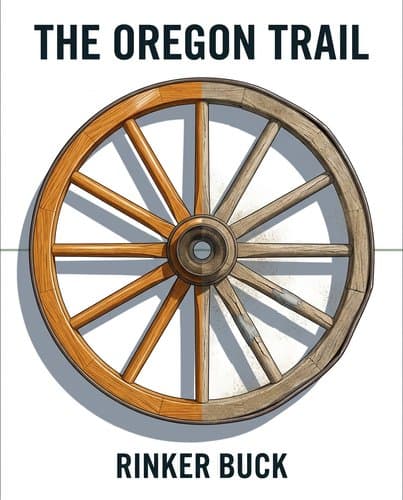
23492799_the-oregon-trail
by Rinker Buck
A broke, divorced dreamer hitches a covered wagon to mules and drags his difficult brother across 2,000 miles of modern America—discovering that his worst…
In Brief
A broke, divorced dreamer hitches a covered wagon to mules and drags his difficult brother across 2,000 miles of modern America—discovering that his worst qualities were survival assets, and that the frontier's legend of rugged individualism was always a lie held together by strangers and luck.
Key Ideas
Genuine uncertainty creates superior quality of attention
Choosing the hardest, most impractical version of a goal — the one that forces genuine uncertainty — produces a quality of attention and aliveness that optimized approaches cannot replicate. The inefficiency is the point.
Incompatible friction becomes where real work happens
The person best suited to help you through something difficult is often the person you'd least choose to spend sustained time with. Structural necessity and temperamental incompatibility can coexist, and the friction between them is often where the real work happens.
Disasters constitute the journey, not interruptions
Disasters are not interruptions to a journey — they are the journey's actual content. The shattered wheels, the flipped cart, the thunderstorm runaways trained Buck and Nick without their knowing it. Competence arrived through repeated failure, not preparation.
Frontier mythology masks collective human effort
The American mythology of rugged individualism inverts the actual history: every major frontier achievement — Whitman's crossing, the trail's infrastructure, westward settlement itself — was built on communal effort, federal investment, and strangers offering help. Self-reliance was always embedded in a web of mutual dependence.
Grief accumulates; let the dead ride beside
Grief for a parent does not resolve; it accumulates and travels with you. The healthier relationship with it is not resolution but recognition — learning to let the dead man ride beside you without demanding that he explain himself or let you go.
Perceived stubbornness often reflects superior judgment
A mule's refusal to cross a creek until it judges the crossing safe is not stubbornness — it's superior data. The 'obstinate' label almost always reflects the observer's impatience rather than the observed animal's deficiency. This applies well beyond mules.
Who Should Read This
History readers interested in Memoir and Resilience who want a deeper understanding of how we got here.
The Oregon Trail
By Rinker Buck
13 min read
Why does it matter? Because the hardest, most impractical version of something is often the only one worth doing.
There's a version of this story where a broke, divorced, professionally obsolete journalist looks at his life and makes the sensible call — updates his résumé, refinances, finds a therapist, moves on. Rinker Buck did not make that call. Instead he bought three mules, a 19th-century covered wagon, and recruited his large, chaotic, one-footed brother to help him cross two thousand miles of American wilderness on the same route that 400,000 desperate pioneers used when they also had nothing left to lose. What follows is equal parts catastrophe and revelation — the disasters arriving fast enough that you stop being surprised anything works at all — and underneath it all, a mounting suspicion that the people who looked insane for attempting the hardest possible version of something were actually the only ones who made it somewhere real.
The Wrong Idea at the Right Moment: How a Granite Monument Changed Everything
Rinker Buck pulls off a Kansas highway on a work afternoon, follows a set of granite-marked wagon ruts across the Flint Hills on a whim, and ends up in a small interpretive center talking to a retired farmer named Duane Durst. Duane laminated his Oregon-California Trails Association membership card and keeps it in his wallet. He unfolds a National Park Service map nearly four feet long across the counter and explains that more than 600 miles of original wagon ruts still exist in Nebraska and Wyoming — the physical grooves worn by 400,000 people hauling everything they owned toward Oregon, still just sitting there. Buck asks the obvious question: could someone still do it? The whole thing, end to end? Duane looks at him the way you'd look at someone who just asked if they could fly by flapping their arms. 'It isn't going to happen,' he says. That's the moment the idea becomes irresistible.
The trip doesn't begin as a romantic impulse. It begins as an exit. By the time Buck stumbles onto those ruts, he's assembled the complete starter kit for a middle-aged collapse: divorce, a house mortgaged past its limits, college tuitions bleeding him dry, and a job at a newspaper now owned by a Tribune Company that a Chicago billionaire had borrowed into bankruptcy. His editors, once genuinely interested in journalism, had been ground down into demanding celebrity car wrecks. He describes himself with precise, unsparing comedy as 'that familiar subspecies of the North American male, the divorced boozehound with a bad driving record and emerging symptoms of low self-esteem.' The covered wagon isn't escapism. It's the only remaining direction.
A winter of reading reframes everything. The Oregon Trail migration moved 400,000 people overland in roughly two decades — the largest single land migration in human history, and most Americans have no idea it happened. The trail that the Union Pacific rails and Interstate 80 still shadow through Nebraska wasn't just a route west. It was the event that turned a fragmented young country into a continental one. Buck needed a reason to go. The trail turned out to need someone to go.
The Most Qualified Impossible Person: Why the Trip Needed Nick
Nick Buck's introductory email arrives in Rinker's inbox moments after Rinker mentions the trip to someone in the family. The spelling is spectacular: 'listen hear you ashol why didn't you tell me you were making the Oregin trip this year Im comin.' This is, it turns out, the most qualified applicant Rinker will receive.
Nick is the eighth of eleven children, raised in the productive neglect of a large Catholic family, suspended from high school for smoking and never went back. What followed was: Coast Guard marine engineer, sleigh-ride operator running thirty-passenger Percheron-drawn rigs at New Hampshire ski resorts, builder of trophy mansions along the Maine coast. The recession of 2008 vaporized that last career. A fall from a neighbor's roof shattered his foot into dozens of fragments. He was flat on his couch, financially desperate enough that friends were throwing fund-raisers for his mortgage, when he demanded to join a two-thousand-mile mule wagon journey across the plains.
He is the single person alive who can handle draft horses, fix anything mechanical that breaks, and endure sustained physical punishment without complaint. He is also, by Rinker's own accounting, nearly impossible to spend more than two days with. Rinker irons his Brooks Brothers shirts when depressed and double-wraps his gear in garbage bags to protect it from truck grime. Nick breaks in a new Carhartt shirt by using it as an oil rag. These are not superficial differences. They are a complete theory of how a human being should move through the world, held by two men who share the same parents and are each other's only option.
Mules Are Not Stubborn — They're the Smartest Animal in the Room
The American mule's reputation for stubbornness is a story we invented to avoid feeling stupid. The animal isn't being difficult. It's doing the math faster than you are.
A mule's eyes sit farther back on its head than a horse's and are shaped more like a D than an O, giving it peripheral vision that sweeps all the way around to its own hind feet. It can see where it's about to step. A horse can't. When a mule stops dead at the edge of a creek crossing and refuses every spur and shout, it isn't staging a protest — it's running a calculation that its driver, perched above and back on the wagon seat, is genuinely not equipped to run. Pioneer Dexter Tiffany, crossing Wyoming in 1849, wrote it plainly in his journal: his mules knew whether a situation was safe long before he did, and no amount of whipping could convince them otherwise. He stopped trying.
When a driver runs out of patience and starts beating a mule for hesitating at a threat the mule can smell from a mile away — a predator over the next rise, a plastic bag snapping on a fence wire ahead — the mule eventually makes a decision. It uses its hind legs to kick free of the harness and runs. For this, across two centuries of American usage, mules have been called ornery. It's a classic example of man ascribing stupidity to the beast instead of to himself.
What this meant on the actual Oregon Trail was the difference between a wagon arriving in Oregon and a boneyard of wreckage at the bottom of a Kansas ravine. The mule that wouldn't cross the creek until it was ready was the mule that got there.
The Disasters Are the Journey: What Kept Going Wrong (and Why It Didn't Matter)
The disasters aren't setbacks. They are the trip.
Four hundred fifty miles in, with the Rockies still ahead, Rinker discovers that Don Werner — the respected wheelwright who guaranteed his oak brake shoes would last all the way to Oregon — skimmed six-inch strips of auto-body Bondo over dry-rotted wheel spokes and painted them. Museum-quality cosmetics over structurally compromised wood. Nick had spotted something wrong back in Horton, Kansas, during the pre-launch inspection — grabbed the spokes above the hub, felt the play, grimaced, said nothing, never removed his NAPA cap. He knew mechanics; Rinker saw a beautiful wagon. That silence, born from two men looking at the same object and seeing different things, became five hundred miles of borrowed time.
Werner's world was museum restoration — vehicles that travel fifteen miles a year in parades, never loaded, never wet, never asked to hold together through the Flint Hills in a two-inch rainstorm. He wasn't lying, exactly. He just had no experience with what the trail actually demands, which turns out to be the most valuable thing Rinker learns before Wyoming: that the gap between period-accurate and functionally sound is exactly as wide as two thousand miles of bad road.
The Bondo wheels mean Rinker is doing his Oregon Trail crossing on the original terms. That's not a consolation. It's the whole point.
The Emotional Hinge: What One Cry in a Thunderstorm Revealed
East of Shickley, Nebraska, a wall of storm drops on the wagon and everything goes wrong at once. The mules need unhitching before lightning grounds them, but the only corral runs alongside a hog barn, and hundreds of pigs erupt in a roar of squeals and sloshing manure the moment Beck and Bute approach. The mules are getting it from both sides — hogs screaming on the left, lightning detonating on the right — and Nick is standing on the wagon seat in a horizontal rain, screaming back at them, refusing to quit. Rinker grabs the lead chains and leaps for Beck's bridle, then Bute's, and finds himself suspended between two rearing animals, yanked airborne when one goes up, slammed sideways when the other does, a man-shaped rag between two animals that weigh ten times what he does. A thunderclap lands directly overhead, both mules rear simultaneously, and for one clear moment he's looking down at black mule ears with a lightning bolt sparking off the plain below him.
Then he hears himself cry out into the wind: he cannot do this alone. He can't.
He's mortified the second the words leave him. His father spent decades drilling the opposite lesson into the older boys — you help people, you do not ask to be helped, and weakness was the one thing his upbringing refused to accommodate. Rinker spends two days at the Kempf farm in Shickley bracing for the fallout from that admission, reassuring himself that he'll find a way across Wyoming alone.
Nick spent those two days at the laundromat. He comes back, sets a neatly folded stack of Rinker's shirts beside the wagon, sits down quietly, and says he's staying for the whole trail. His reasoning has nothing to do with obligation: every horseman in New England will be jealous. He needed out of Maine. 'You seem to forget,' he says, 'that we have the same mother.' Rinker, for once, says the sentence his entire childhood made nearly impossible: I need you. I can't do this without you. It's the most expensive thing he's said on the trip, and the storm was what it cost to get there.
The Dead Man Riding Beside You
Who was riding with Rinker Buck across the Oregon Trail? The obvious answer is Nick, Olive Oyl the dachshund, and three mules named Jake, Beck, and Bute. The real answer has been there since Kansas.
The father accumulates slowly. He surfaces as a recovered memory mid-afternoon on the first day out, when the metronomic clopping of hooves drags up an image Buck had entirely suppressed: two boys on Saturday mornings, climbing down to a New Jersey barn to harness their father's mare so Tom Buck — associate publisher of Look magazine, AA co-founder, part-time political operative, Irish cardigan and corncob pipe — could take a solitary sulky ride. He never wanted company. Nick and Rinker would stand in the drive watching him trot away until the hoofbeats faded out, quarter mile, half mile, gone.
The reckoning arrives in full outside a small museum in Gering, Nebraska. Buck has driven ahead to park Nick's pickup and accepted a ride back from Don Exner, a 73-year-old former Woolworth manager who nearly died in a 30-foot roof fall in his fifties — doctors certain he'd never walk again — now hauling himself around on crutches with a grimace and a jaw like compressed concrete. When Buck lingers too long inside the museum, Exner starts up the pinecone-strewn walkway alone. Every crutch tip lands on a cone and throws him sideways. Then: the same oval face, the same olive skin and bald pate, the same expression his father wore crossing a bridge into New Hope, Pennsylvania, in 1958. Buck simply stops being in Nebraska. What pours out is thirty-six years of compressed guilt delivered to a dead man through a stranger's body: the missed deathbed visit, the college abandonment, and one specific debt he'd never been able to pay. His father had told him at 25 that he'd amount to nothing until he got an opinion piece into the Sunday New York Times. The piece appeared — on prison reform, decent enough work — nine days after his father died. Buck walked in the rain to the bottom of State Street in Albany, bought the paper, stood reading it while tugboat lights moved on the Hudson, couldn't cry, couldn't leave. He'd been standing there ever since. The interior monologue ends: Dad, let me go.
Nick's response, when Buck confesses it all from the wagon seat, is the most useful thing anyone says in two thousand miles: nobody recovers from anything, I'm fucked up, you're fucked up, fucked up is the universal condition. He's right, and Buck knows it. Fathers don't let go. Memories of them thicken with age. The Oregon Trail hadn't caused this haunting — it had just given it somewhere to go.
The Myth the West Tells About Itself — And Why It's Backwards
The myth of the rugged western individualist collapses the moment you look at the actual numbers. Wyoming, ground zero for Tea Party anti-government fervor, receives roughly eleven thousand dollars per person in federal funds every year while its residents pay about sixty-eight hundred in federal taxes. The gap isn't close.
But the numbers land differently once you've stood at a specific corral. Somewhere along the trail there's a water trough with a small CCC plaque bolted to the post — the kind of thing you walk past without reading. Buck stopped at those troughs. Jake and Beck and Bute drank from them. The camp preceding the corral, the corral preceding the rodeo ground, the rodeo ground where the mules got water on a hundred and twelve consecutive nights — none of it was waiting there naturally. The Civilian Conservation Corps built it, federal dollars maintained it, and Buck crossed two thousand miles of trail without once sleeping on ground that rugged individualism had prepared for him.
The camp town preceded the corral. The corral preceded the rodeo ground. None of this happened by accident. None of it happened alone.
'Rugged individualism' is what you call communal investment once it's old enough to seem inevitable.
California Hill and South Pass: What 'We're Going to Make Oregon' Actually Cost
Nick is too hoarse to do more than whisper by the time the mules are seventy feet from the top of California Hill. He's been screaming at them since the bottom of the eroded sand track — eight feet below the surrounding terrain, two feet of dried tumbleweed piled across it like a barricade — and his voice gave out somewhere in the dust cloud raised by twelve hooves threshing for purchase. The trace chains crack against the wood. Bute, the little mule, pumps her legs in deep sand with nothing under her. Only Jake, on the center pole, has hard ground to push against, and he's pulling like he's settling a personal debt. The wagon is nearly motionless. Nick can't see ahead for the dust. He's leaning out over the footboard, slapping the lines on their rumps and mouthing words that aren't making sound.
Rinker grabs the lines for the last hundred feet and calls the mules to the flats — just keeps calling it, flats, to the flats, you're gorgeous, flats — until the Schuttler and the Trail Pup grunt over the crest and the brake goes on and everything stops. Both men sit without speaking. Then, without having consulted each other, they arrive at the same sentence at the same moment: they are going to make Oregon this summer.
Five hundred miles of accumulated disaster had built that sentence. The Bondo over the rotted spokes. The brake pads billowing smoke down the highway into Ash Hollow. The hog barn lightning storm. The disasters hadn't interrupted the competence — they'd installed it, quietly, the way callus forms, the way a man stops flinching at something because he's already survived it twice.
Which is why, when the Trail Pup's wheel shatters on the west side of South Pass — dry rot through the hub, both water spigots snapping on impact, eighty pounds of water puddling in the dust forty miles from the nearest town — Nick's response isn't panic. He looks at the wreckage, looks at the storm rolling black over the Wind Rivers, and grins. All summer, he says, you told me to wait till I see South Pass. Now we're here, it's the biggest disaster of my life, and I love it. We're still making Oregon. The disasters weren't the obstacles to the journey. Nick had known that since Kansas. It just took South Pass to say it out loud.
Twelve Shoes in Oregon: What You Find at the End of an Impossible Thing
Nick steps back from the fairground gate in Homedale, Idaho, toeing the dust with one boot, and tells Rinker to drive the last stretch into Oregon alone. 'This is your trip,' he says. 'You decided to do it.' And so Buck does: harness jingling, iron rims singing on the pavement, the Owyhee Mountains folding gold ahead. When the green WELCOME TO OREGON sign appears at Deer Flat he starts singing to the mules. He taps it as they pass and calls out their names — Jake, Beck, Bute — announcing that all twelve shoes are now in Oregon. He thinks of his father: thank you for raising us so crazyass, because that's why I could not only imagine this trip but do it. Not triumph. Gratitude. It arrives quietly, a man alone on a wagon seat with wet blue jeans and the smell of mowed alfalfa in the air, finally at peace with being exactly the loopy, anachronistic dreaming jackass he is.
The ending belongs to Nick. In Baker City, with winter closing on the Elkhorns and the trail ahead paved over or fenced off, Buck sells the mules to a couple whose Idaho ranch sits on the Oregon Trail — people who will keep the team together, build barns, let Jake pull a carriage into town for breakfast. Then he buys Nick a set of American-forged fence pliers the man had been eyeing since Fort Fetterman, five hundred miles back. They sit in Nick's pickup cab at the Oregon Trail monument and try to say goodbye. Nick says he would be dead in Maine if Rinker hadn't let him come. Rinker says Nick stayed at Shickley, and he couldn't have crossed without him. They hug shoulder to shoulder and that's it. Nick's white pickup disappears south toward the interstate with Olive Oyl's ears flattened by wind out the window.
What the Wagon Kept Teaching After the Journey Ended
Buck drives home with a welded barbecue in the truck bed and says flat out that he didn't come back changed. Take him at his word — and then notice what he lists anyway: he can read vanished trail on modern ground, he drives team better, he made some peace with a dead man who never quite released him. That's not nothing. That's not unchanged. The real kind of transformation looks, from the outside, like a man who simply did a strange and impractical thing and then came home. You don't recognize it because it doesn't perform. It just sits there quietly, the way twelve mule shoes somewhere in Oregon sit there.
Notable Quotes
“Boss, I'm headin into town for hardware parts, and then I think I'm goin to do some clothes at the Laundromat. Okay?”
“Rinker, I think you should drive this last stretch into Oregon by yourself. This is your trip. You decided to do it. I really like the idea of getting back to Maine and telling everyone that you drove the mules into Oregon alone.”
“You think I should do that?”
Frequently Asked Questions
- What is The Oregon Trail by Rinker Buck about?
- The Oregon Trail chronicles Rinker Buck's journey across America's historic emigrant route in a mule-drawn covered wagon. Using this adventure as a lens, Buck examines resilience, failure, and self-reinvention through challenges including breakdowns, disasters, and an unlikely partnership with his brother. The narrative reveals how embracing difficulty, communal dependence, and impractical ambition can restore a sense of purpose and aliveness. Buck interweaves personal experiences with broader historical reflections on frontier achievement and the hidden mutual dependence that enabled westward settlement, challenging popular myths about individual accomplishment.
- What are the main takeaways from The Oregon Trail?
- The Oregon Trail emphasizes that choosing the hardest, most impractical version of a goal produces a quality of attention and aliveness that optimized approaches cannot replicate. The book reveals that disasters are not interruptions to a journey—they are the journey's actual content, as repeated failure builds competence without formal preparation. Buck challenges American mythology of rugged individualism, demonstrating that every major frontier achievement was built on communal effort, federal investment, and strangers offering help. The narrative also explores grief as something that accumulates and travels with you rather than resolving completely.
- What does The Oregon Trail reveal about rugged individualism?
- The Oregon Trail reveals that American mythology of rugged individualism inverts the actual history of frontier achievement. According to Buck, every major frontier achievement—Whitman's crossing, the trail's infrastructure, westward settlement itself—was built on communal effort, federal investment, and strangers offering help. This directly challenges the popular narrative celebrating individual achievement while overlooking the vast infrastructure of mutual dependence underlying westward expansion. Buck's journey demonstrates how difficulties requiring partnership and vulnerability reshape understanding of what enables human achievement, showing that self-reliance was always embedded in a web of mutual dependence.
- How does disaster shape the journey in The Oregon Trail?
- In The Oregon Trail, disaster is not an interruption but the journey's actual content. Buck describes how the shattered wheels, the flipped cart, and thunderstorm runaways trained him and his brother without their knowing it, with competence arriving through repeated failure rather than preparation. This perspective reframes setbacks from obstacles into essential learning opportunities. By embracing difficulty and allowing disasters to reshape approach and understanding, Buck demonstrates that this produces a quality of resilience and wisdom that no amount of planning could provide.
Related Book Summaries
Read the full summary of 23492799_the-oregon-trail on InShort