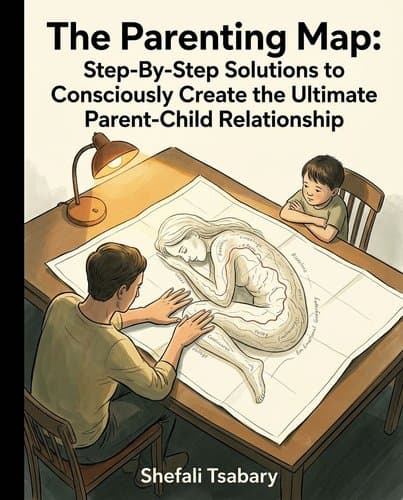
62364592_the-parenting-map
by Shefali Tsabary
Your child isn't the problem—your unhealed childhood wounds are. Map every parenting breakdown back to its real source and learn the inner excavation work that…
In Brief
The Parenting Map: Step-By-Step Solutions to Consciously Create the Ultimate Parent-Child Relationship (2023) argues that every parenting struggle is rooted in the parent's own unhealed childhood wounds, not the child's behavior.
Key Ideas
Past wounds fuel parental explosions
When you lose it at your child, pause and ask: 'What old wound is this triggering in me?' The reaction is almost never about the present moment — the child is the flame, but your past is the fuel.
Blame the child means work inward
Complete the sentence 'I feel stressed with my child because...' — if the word after 'because' is your child's name, you're focused on the wrong problem. The work is inward.
Your scripted ending hides unmet needs
Write your 'fantasy movie' for your child: title, their role, the ending you've scripted. The gap between that film and who your child actually is reveals where your unmet needs are hiding.
Name your pattern to interrupt reactions
Identify your primary ego mask under stress — Fighter, Fixer, Feigner, Freezer, or Fleer. Naming the pattern as it arises creates a gap between trigger and explosion. You can't interrupt what you can't see.
Behavior signals unmet needs, not malfunction
Treat your child's difficult behavior as a SIGN — Something Inside Gone Negative. Ask 'what is this behavior hiding?' before asking 'how do I stop this?' The behavior is a message, not a malfunction.
Connect before you correct always
Connect before you correct. Before addressing the behavior, say something that acknowledges the child's emotional state. Connection is the precondition for any correction to actually reach them.
Validate desire without fulfilling requests
Validate desire without fulfilling it. 'I love that you love that' keeps a child's dream alive and eliminates the forbidden-fruit dynamic — you become an ally instead of an obstacle.
One conscious parent changes everything
One conscious parent is enough. You do not need a unified front with an unconscious co-parent to change the dynamic. Your consistent inner work shifts the entire relational field.
Who Should Read This
People working on personal growth in Child Development and Family, especially those tired of generic motivational advice.
The Parenting Map: Step-By-Step Solutions to Consciously Create the Ultimate Parent-Child Relationship
By Shefali Tsabary
9 min read
Why does it matter? Because the child acting out in front of you isn't the one who needs to change.
Every parenting book starts with the same quiet assumption: something is wrong with your child, and your job is to correct it. The tantrums, the defiance, the withdrawal — problem to be diagnosed, fixed, managed.
This book makes the opposite bet.
When you genuinely lose it at your kid — the kind of moment you replay with embarrassment later — you are almost never reacting to your child. You are reacting to something inside yourself that your child just stepped on. Something old. Something unresolved. The child lit the match, but the fuel was already there, long before they arrived.
That shift in diagnosis — from "what's wrong with my kid" to "what in me just surfaced" — changes the job description entirely. You're no longer trying to fix your child. You're trying to understand yourself.
You Have Been Trying to Fix the Wrong Person
Shefali Tsabary had given herself extra time before leaving the park. She thought she was prepared. What followed was twenty minutes of her three-year-old screaming down a public street, heads turning, strangers glaring. She tried everything in sequence: distraction, singing, bribing, the gentle voice, the firm voice, logic, silence. Nothing moved the child. By the time she reached her front door, she was the one who had broken. She dropped to her knees and howled. Her husband told her to get a grip. She walked out of the house.
On that walk, something shifted. Her daughter had wanted to keep playing. That was the whole story. A child being a child. But Tsabary had cycled through rage, shame, and the impulse to flee as if her life were under threat. She turned the question inward. What surfaced was an image of herself as a small girl, desperate to be heard, craving control in a world that wouldn't give it to her. Her daughter's defiance hadn't provoked a parenting failure. It had detonated a wound from thirty years earlier.
Your child is almost never the problem. They are the trigger. The problem — the one that actually responds to intervention — is inside you.
Most parenting advice hands you techniques for managing the child, which works roughly as well as rearranging furniture to fix a structural crack. Tsabary's framework starts one level deeper: whatever your child's behavior pulls out of you — the rage, the shame, whatever got loose — that reaction belongs to your history, not their actions. It arrives from somewhere old. You cannot change your child, but you can change yourself. The only person in the room who can actually be worked on is you. That is the most direct path available.
Your Biggest Reactions Aren't About What's Happening Now
Picture the same traffic jam twice. First time: a slow Saturday, nowhere to be — you sit in it almost peacefully, window down, radio on. Second time: you're already late, the morning went badly, and those same brake lights produce something close to rage. The road was identical. You weren't.
Tsabary applies this to parenting. When a child ignores you, refuses to move, embarrasses you in public — that behavior is the traffic jam. A neutral event. What turns it into an explosion is what you were already carrying. The more unresolved pain inside you, the larger the detonation. The child provides the spark; the parent's past is the fuel.
For years, Jake fought daily battles with his eight-year-old son Max, a sensitive, soft-spoken boy with learning delays and no interest in the athletic identity Jake had built his adult life around. The conflict kept escalating until Jake threw a glass of water on Max and slammed him into a wall. That's when he sought help.
At a workshop, Jake uncovered a memory buried for decades. At ten years old, he had been cornered in a school bathroom by older boys who called him a sissy and laughed when he cried. When he got home, his father shamed him for not fighting back. Jake's response, in the years that followed, was to build the opposite — gym body, tough exterior, hypermasculinity as armor. But the original wound had never been touched. Max was the boy Jake had been before the bathroom: sensitive, soft, the kind his father had rejected. Jake's reaction had nothing to do with Max. Jake's own verdict: "I was my own trigger. He wasn't the trigger. It was me, all me."
The intensity of a parental reaction, Tsabary argues, is almost never proportionate to the present event. It's proportionate to how old the wound is, and how long it's been buried.
The Movie You're Demanding Your Child Star In
Imagine you spent years writing a screenplay you began in childhood, kept revising through your teens, and never quite finished. Now imagine hiring an actor to play the lead, except the actor keeps going off-script, improvising, refusing their lines. Your frustration doesn't come from caring about the film. It comes from caring about your film — the one that was always yours, never theirs.
Tsabary calls this the parenting movie. Every parent has one. They cast the child before birth: a genius, an athlete, a person who becomes all the things the parent never got to be. The menu for this ideal child, assembled fantasy by fantasy, includes generous portions of the world's most accomplished people. What makes this a trap isn't the aspiration. It's the wound underneath.
Lauren called her therapist in a rage. Her teenage son Brian hadn't made the varsity basketball team after a summer of ignoring her pleas to practice. She was furious. At him. Tsabary kept pressing: why was the anger so intense? Lauren defended herself for weeks. He had thrown away a real future. He had wasted his talent. She only cared because she loved him.
Finally, it broke loose. As a girl, Lauren had wanted to act. She was always cast in the forgettable roles, watching from the back row while someone else stood in the light. When she went home for support, her father told her she'd never succeed. She buried it and became a pharmacist.
Brian's basketball career had been carrying all of that for years, without her knowing it, and certainly without him agreeing to. When he quit, it wasn't his future that collapsed. It was her proxy ambition, her thirty-year-old rejection, the argument with her father that never got finished.
It wasn't about basketball. It was about a father who told her she'd never make it, and a pharmacist's career that had always felt like proof he was right.
The Part of You That Loses It Was Formed Before You Could Drive
Monica was six years old, outgoing, cake-loving, the kind of child who filled every room she walked into. Then her mother began announcing to neighbors, teachers, anyone within earshot: "Monica has a weight problem." She enrolled her in nutritionist sessions. She warned her she wouldn't be invited to birthday parties unless she controlled her weight. By the time Monica was seven, the gregarious girl had gone quiet. She stopped eating freely, stopped playing freely — her own words, recalled decades later in therapy: she hated herself.
That transformation shows exactly how the psychological architecture forms.
Tsabary calls the first structure the inner child: the residue left when a child's authentic self gets treated as conditional on parental approval. Every child needs one thing above all: to be seen as they actually are. Monica needed to be seen as a joyful, chubby six-year-old. Instead, she was seen as a problem. That gap between what the child needed and what arrived becomes a wound. The inner child lives there, carrying the original verdict: I am not enough as I am.
Built on top of that wound sits the impostor ego — a mask the child constructs to avoid further rejection, and to purchase the approval that never came freely. Monica's mask was withdrawal: go quiet before you can be publicly humiliated again. Other people build the opposite: the comedian, the overachiever, the person who never lets anyone close enough to hurt them. The mask fits the wound.
When you lose it with your child, both structures are running. The inner child is activated (something in the present moment echoes the original hurt) and the impostor ego fires its default response. It is the output of machinery built before you were old enough to drive. Understanding the mechanism is the right response: once you can see it running, you can choose something else.
You Run a Predictable Pattern With Your Child — And It Has a Name
Your reactions to your child feel personal and situational. They are not. You run one of five recognizable patterns — and once you can name which one is active, you've already put a small gap between the trigger and the explosion.
Tsabary calls these the Five F's: Fighters, Fixers, Feigners, Freezers, and Fleers. Each is driven by a different fear from the inner child, expressed through a different ego mask. Fighters use anger to regain control. Fixers scramble to win back affection. Feigners manage the scene for an audience only they can see. Freezers go silent behind walls. Fleers disconnect entirely — the child is simply not their problem.
Take one phrase almost every parent will hear. "I hate you." Watch what each pattern does with it. The Fighter hears a personal attack and responds with shame or punishment to restore dominance; the child feels silenced. The Fixer panics about losing love and pivots to pleasing; the child's actual upset goes unaddressed. The Feigner's first thought is who might be watching; the child's feelings are dismissed as an image problem. The Freezer retreats behind an emotionless wall; the child's distress lands on ice. The Fleer sees no personal stake at all; the child simply doesn't register. Every loop ends the same way: the child's real feelings go untouched.
What the taxonomy gives you is not a diagnosis to carry around — it's a pause mechanism. The moment you recognize "this is my Fixer pattern firing," something shifts. You're no longer inside the reaction. You're watching it.
Your Child's Worst Behavior Is a Distress Signal, Not a Character Flaw
Eli sat across from his college-age son Noah in a therapist's office, voice shaking with what he'd rehearsed on the drive over: "I raised you to be honest, and here you are — the biggest liar in the world." Noah's head dropped. He had spent the semester telling his father his grades were fine while barely passing his exams.
Tsabary interrupted before the verdict could settle. She asked Eli one question: why would Noah lie? Eli had the usual answer: disrespect, laziness, moral failure. Tsabary pushed back. Noah lied because he was terrified of exactly this reaction. The lie, surface-ugly as it was, was evidence he cared deeply about his father's opinion. Lying to someone you don't care about takes no effort. Lying to someone whose disappointment you can't bear is the opposite of indifference.
Eli went quiet. Then something loosened. He remembered his own father dropping him off at violin lessons he hated — week after week, he'd sit in a park instead and cover his tracks. Until the instructor called. His father didn't speak to him for months. "I wanted to tell him I wasn't a liar, I was just afraid of his anger. But the words never came out." He paused. "And now look. I'm doing the exact same thing."
Tsabary calls these SIGN moments: signals that something has broken down inside and the child has no words for it. The lying, the fighting, the withdrawal — none of it is the message. It's the only language for a feeling the child can't name. Asking "how do I stop this?" treats the symptom and teaches the child their inner world is dangerous. Asking "what is this hiding?" is the first move toward repair. In practice it sounds like this: "What are you scared of?" instead of "How could you do this?"
Connection Is the Precondition for Any Correction to Actually Land
Punishment teaches children one thing reliably: what you think of them. It communicates something about their worth, not about how to handle the situation that triggered you. A child yelled at for spilling something doesn't learn not to spill. They learn that mistakes make them shameful. This is why Tsabary builds her entire discipline framework around a single principle: connect before you correct.
The NBC framework — Negotiation, Boundaries, Consequences — replaces punishment, and its governing idea is that consequences belong to life, not to parents. Melissa's story is the proof. At twenty-two, trying to switch from engineering to culinary school, she developed an eating disorder during the six months her parents refused to let go. Once they released their grip, she became a successful chef. The eating disorder wasn't a product of her choices. It was a product of having no choices.
What the whole framework builds toward is a shift in purpose. The old goal of discipline was compliance. These tools aim at something different: a child who knows their feelings are real, their desires worth naming, their mistakes not evidence of being defective. That child doesn't need to be managed into behavior. They already have what they need to grow.
The hardest moment is when your child blames you directly: "It's your fault I never did better at math." Most parents defend themselves, which produces a second conflict on top of the first. The alternative: "I see you're hurting. I understand your anger. I own my part in this." Tsabary calls this sequence VENT: Validate, Empathize, Normalize and Neutralize, Transform. But the real test is the grammar of the apology that follows. "I am sorry for how I acted" is accountability. "I am sorry that you feel this way" is blame dressed as an apology. Children sense the difference even when they can't name it; one closes the loop, the other reopens it. Tsabary calls noticing which version you're reaching for "extinguishing your ego." It's a small thing to watch for. It's also the whole game.
You Are Where the Inherited Damage Stops
The wounds you carry weren't born in you. Someone handed them down — probably while trying their best with what they'd been given, probably without knowing what they were passing along. And someone handed those wounds to them. The inheritance runs further back than anyone can trace.
What Tsabary is really offering isn't a technique for raising better children. It's something stranger: the chance to be the person in your family line where it stops. Not because you became perfect, but because you started paying attention. Every time you catch the old pattern before it fires at your child — every time you stop and ask what this is actually about — that wound travels no further. Your child doesn't carry it forward. Neither does whoever they love someday. That's what this work is actually for.
Notable Quotes
“I am the worst mother alive,”
“I should be taken to a torture chamber and burned as a witch.”
“child and tells the parent,”
Frequently Asked Questions
- What is The Parenting Map about?
- The Parenting Map argues that parenting struggles stem from the parent's unhealed childhood wounds rather than the child's behavior. Shefali Tsabary provides a step-by-step framework helping parents identify their ego patterns and emotional triggers to respond consciously instead of reacting automatically. The book draws on psychology and inner work practices to help parents understand that when they lose patience with their child, it reflects their own past trauma. Through exercises like writing your "fantasy movie" for your child and identifying your ego mask under stress, parents learn to interrupt automatic reactions. The core message is that "the child is the flame, but your past is the fuel"—meaningful change happens through parental inner work.
- What are the key takeaways from The Parenting Map?
- Key takeaways include: pause during conflicts to ask "What old wound is this triggering in me?" rather than blaming the child; complete the sentence "I feel stressed because..." to recognize when focus is misdirected; identify your primary ego mask (Fighter, Fixer, Feigner, Freezer, or Fleer) to interrupt patterns; treat difficult behavior as SIGN (Something Inside Gone Negative) to uncover hidden messages; "connect before you correct" by acknowledging emotional states first; validate desire without fulfilling it using "I love that you love that"; and understand that "One conscious parent is enough" to shift the entire family dynamic without requiring unified co-parenting.
- How does The Parenting Map help with parenting struggles?
- The Parenting Map addresses struggles by redirecting focus from the child to the parent's inner work. Writing your "fantasy movie" for your child reveals the gap between your scripted expectations and their reality, exposing unmet needs within you. By naming your ego pattern as stress arises, you create "a gap between trigger and explosion." Rather than stopping difficult behavior immediately, ask "what is this behavior hiding?" to understand it as a message. Connection precedes correction: acknowledge the child's emotional state first. The framework emphasizes that "One conscious parent is enough"—your consistent inner work shifts relational dynamics regardless of co-parent participation, enabling systemic change.
- Is The Parenting Map worth reading?
- The Parenting Map is worth reading if you're frustrated by reactive parenting patterns and want lasting change. Rather than offering quick behavioral tips, it provides deep psychological frameworks addressing root causes of conflict. The book appeals to parents seeking self-awareness and willing to examine their own triggers and childhood wounds. Its step-by-step methodology—from identifying ego masks to reframing behavior as hidden messages—makes abstract concepts practical. The validation that "one conscious parent is enough" empowers solo change-makers. However, it requires introspection and inner work, not just external strategies. If you seek permission to stop blaming your child and start examining yourself, this book delivers both framework and permission.
Related Book Summaries
Read the full summary of 62364592_the-parenting-map on InShort