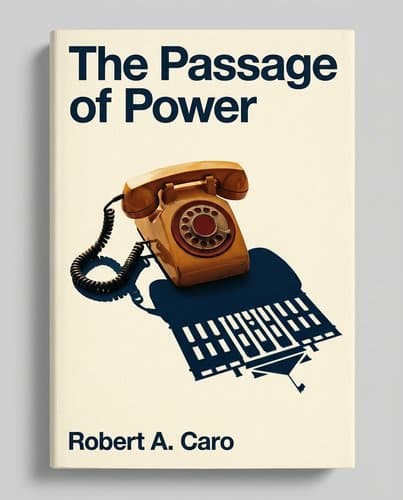
13049569_the-passage-of-power
by Robert A. Caro
Power doesn't corrupt—it reveals. Caro's masterwork dissects how Lyndon Johnson transformed from humiliated Vice President to legislative titan in seven weeks…
In Brief
The Passage of Power (2012) examines Lyndon Johnson's dramatic transition from marginalized Vice President to President in the seven weeks following Kennedy's assassination. Drawing on Caro's decades of research, it reveals how power exposes rather than creates character, and shows how Johnson's mastery of political leverage, legislative timing, and human psychology transformed a stalled agenda into landmark legislation.
Key Ideas
Character revealed, not created, by pressure
Power reveals character rather than creating it — the traits that define a leader under pressure are visible earlier, often in how they behave when they have nothing: Johnson's genius for reading men, his terror of defeat, his volcanic need for dominance were all visible decades before Dallas.
Give dignity stories, not just transactions
The most important skill in high-stakes negotiation is identifying what the other person needs to feel about themselves, not what they say they want — Johnson's manipulation of Byrd, Warren, and Russell worked because he gave each man a story about his own dignity, not just a transaction.
Catch institutional waves at their crest
Momentum in institutional change is not mysterious — it is a controllable fact, and the time to move stalled legislation is at the exact crest of the emotional wave, not after it has peaked. Johnson's genius was recognizing that the Kennedy tide had a crest, catching it at that precise moment, and knowing he had days, not weeks.
Virtue and vice from same well
A leader's worst instincts and best instincts often come from the same psychological source — Johnson's terror of failure, rooted in his father's public ruin, drove both his extraordinary discipline during the transition and the 'secrecy and deceit' about Vietnam that destroyed his presidency.
Find hidden procedural mechanisms others miss
When an institution's power feels fixed, look for the procedural lever others have overlooked — Johnson did this repeatedly, from the Senate Majority Leader position everyone else found powerless to the specific mechanism of the discharge petition to the budget number that was Harry Byrd's actual price.
Who Should Read This
Readers interested in Political Figures and World History, looking for practical insights they can apply to their own lives.
The Passage of Power
By Robert A. Caro
14 min read
Why does it matter? Because the man history mocked as 'Uncle Cornpone' turned out to be the most consequential seven weeks of American domestic policy in a generation.
Most people assume power transforms a man. That it takes something ordinary and makes it monstrous, or magnificent. Lyndon Johnson's story on November 22, 1963 destroys that assumption completely. Here was a man already complicated and magnificent in equal measure — a legislative genius reduced to a punchline, days away from a corruption scandal that would have ended him, sitting in a motorcade behind the one person whose death he both dreaded and needed. And then the shots fired. What Robert Caro documents in the seven weeks that followed isn't a transformation. It's a revelation — of everything Johnson had always been, finally given room to breathe. The question this book forces you to reckon with isn't whether Johnson was ready for the presidency. It's what readiness looks like when your greatest gift and your deepest wound are the same thing.
The Man Who Believed His Future Was Behind Him
Picture Lyndon Johnson on the campaign trail for John Kennedy in the fall of 1960, standing on the rear platform of a train somewhere in the South, bellowing 'The Yellow Rose of Texas' into a crowd while the man he'd spent his entire adult life trying to become President was somewhere ahead on another train. Johnson had devoted four decades to a single goal, mapped out with unusual specificity since he was a seventeen-year-old in harness with four mules on a Texas road gang: first the House, then the Senate, then the presidency. No detours. When Franklin Roosevelt offered him a plum administrative post at thirty, he turned it down — afraid of being 'sidetracked.' When a wealthy patron offered him three-quarters of a million dollars in an oil partnership, he refused that too, because being known as an oilman 'would kill me politically' on a national stage. The man knew exactly where he was going and refused every tempting exit off that road.
And then he lost. Outmaneuvered at the 1960 convention by a younger senator he'd privately dismissed as a sickly playboy who'd 'never said a word of importance,' Johnson accepted the vice presidency as his only remaining shot — and discovered that the vice presidency was, constitutionally, almost nothing. No legislative powers. No executive powers. Kennedy's aides mocked him behind his back as 'Uncle Cornpone.' He was excluded from the final meeting where Kennedy decided how to respond to Soviet missiles in Cuba. He also lied to the face of every man he needed, humiliated staff in front of rooms full of people, and ran money through Texas like a man who understood that politics and clean hands were incompatible. By the autumn of 1963, he was telling aides to find other jobs. 'My future is behind me,' he said to one. 'Go. I'm finished,' he told another.
He said this weeks before Dallas put him on Air Force One.
What makes the story that follows so strange is that it isn't a story of destiny. Here is what Lyndon Johnson does when given real power. The answer comes fast.
Power Doesn't Corrupt — It Reveals What Was Already There
The cliché says power corrupts. What Caro shows, watching Johnson in the vice presidency, is something more precise: power reveals. When a man is climbing, he conceals whatever might cost him the next rung. Once he has what he wanted, the concealment becomes unnecessary. The curtain rises. You see what was actually there.
What the vice presidency revealed in Johnson was not one thing but two, inseparable and contradictory. The first was a capacity for self-discipline that stunned people who'd known him for decades. The Johnson who'd been famous for volcanic rages, for kicking senators in the shins on the Senate floor and expecting gratitude for the bruise, spent three years keeping his hands folded in his lap during Cabinet meetings — and you could tell it was costing him something. His knuckles went white from the effort of not speaking. He'd stare down the length of the Cabinet table with a faraway look while Kennedy ran meetings across seven feet of polished mahogany with an ease that must have been its own form of cruelty. Johnson had managed that Senate for eight years. He knew every procedural lever, every pressure point, every senator's price. Now the only contribution expected of him was silence, and he produced it — for three years, with barely a crack.
But the second thing the vice presidency revealed was the compulsion that made the discipline necessary in the first place: an appetite for dominance so fundamental to his identity that going without it was a kind of slow psychological dismemberment. The moment he was sworn in, before Kennedy had even delivered the inaugural address, Johnson moved to grab power on two fronts simultaneously. He tried to keep chairing the Senate Democratic Caucus — a member of the executive branch presiding over legislative party meetings — and was publicly destroyed by the same Senate allies he'd commanded for years, including Richard Russell, the man who'd been something like a father to him. Then he drafted an executive order for Kennedy to sign that would have given the Vice President 'general supervision' over the CIA and the State Department, effectively making him a shadow prime minister. Kennedy returned a letter that stripped out every operative phrase and granted nothing. He did it graciously, almost casually, which may have been the sharpest part.
These weren't miscalculations by a desperate man. They were the automatic response of someone for whom the absence of power was genuinely intolerable. That's the psychological engine underneath everything that follows. The same man who could hold his tongue for three years in a Cabinet room could not stop himself from lunging at every available lever of power the instant he thought one was within reach.
The Blood Feud That Turned a National Tragedy Into a War
In July 1960, Bobby Kennedy made four separate trips down the back stairs of the Los Angeles Biltmore Hotel — from the ninth floor Kennedy suite to the seventh floor Johnson suite — trying to get Lyndon Johnson to give back the vice presidential nomination his brother had just offered. On the last trip, Bobby sat across from Johnson on the suite's couch and told him, in so many words, that Jack didn't want him. Johnson, a man who had made senators twice his age weep in Senate corridors, reportedly trembled. His eyes filled. He sat there shaking while Bobby Kennedy described the floor fight that would humiliate him if he stayed on the ticket, then offered him the chairmanship of the Democratic National Committee as a consolation prize — a job Bobby himself would have regarded as roughly equivalent to being asked to go park cars. When Bobby left, Johnson paced through the suite's connecting rooms in his shirtsleeves, arms flailing, asking 'What am I going to do?' In the years that followed, he told people later, he didn't call what Bobby had done a miscommunication or a negotiating tactic. He described it with a slow gesture, the edge of his hand drawn across his throat.
This is the context that makes every decision of November 22, 1963 legible. When Bobby shoved onto Air Force One at Andrews without looking at Johnson, pushing through the crowd with tears streaming down his face, saying only 'Excuse me, excuse me' and 'I want to be with Jackie' — leaving the new President of the United States literally jammed against a corridor wall while agents and Kennedy aides streamed past him — Johnson experienced it not as a grieving man's distraction but as another installment in a three-year war. Jack Valenti, watching from nearby, thought Bobby was too shattered to register that Johnson was standing there. Johnson knew better. He stood impassive while the man he hated flowed past him toward the coffin and the widow, and said nothing. The following morning, Bobby found Evelyn Lincoln crying in the hallway and learned that Johnson had asked to have his secretaries moved into the Oval Office by 9:30 a.m. 'Do you know he asked me to be out by 9:30?' Bobby forced a three-day retreat. Johnson operated out of a fluorescent-lit room in the Executive Office Building while the office that was now legally his sat across the street, used by no one.
The feud's timing is what made it dangerous. A transfer of presidential power in the nuclear age required continuity — visible, legible continuity, the kind that could be read correctly in Moscow and read correctly in the morning papers. Johnson needed the Kennedy people to stay, needed cameras to show the old team surrounding the new President, needed the first calls to allied heads of state to go out within hours, not days. All of that depended on cooperation from the same man who had descended those Biltmore stairs four times to destroy him.
Three Dramas Unfolding Behind One White Muslin Curtain
Don Reynolds was pushing documents across a table in Room 312 of the Old Senate Office Building — Magnavox invoices, KTBC broadcast checks, a paper trail linking Lyndon Johnson personally to a kickback scheme — when the shots were fired in Dallas. He kept going for another hour, not knowing. By the time a secretary burst through the door in tears, Reynolds had laid out the entire case: a cut-rate stereo set and twelve hundred dollars in useless television advertising, both extracted from an insurance broker in exchange for writing Johnson's life insurance policy. Small amounts. Devastating specifics. Canceled checks made out to the LBJ Company, stamped and deposited. When Reynolds finally heard the news and reached for his documents to take them back, the Senate investigator's hand came down: these belong to the committee now.
At that same hour, the nine-person Life investigative team was in their managing editor's office in New York, working through a story one editor had summarized bluntly: 'This guy looks like a bandit to me.' They had found that Johnson — a man who had never held any job outside government, whose salary had never exceeded $35,000 a year — was a millionaire many times over, and the trail ran straight through a television monopoly that seemed to have earned its favorable regulatory treatment. When word came from Dallas, the meeting broke up. Within days, the lead investigator told his editor they should give the new President a chance. The editor said he'd been about to say the same thing.
Johnson didn't know about the Life story. He may or may not have known how close Reynolds was to testifying under oath. What he knew was that he was finished: the humiliation of Yarborough's public refusals to ride in his motorcade was on every front page, a Life cover had already shown him grinning beside 'Lyndon's Boy' Baker, and Kennedy's own secretary had written in her diary that the president was planning to replace him on the 1964 ticket. The net was closing from three directions at once.
Then it wasn't. The same afternoon that made Johnson president closed every threat against him — not because of anything he did, but because the story had to be killed. You can't run a corruption exposé on a man the country is watching bury his predecessor.
Caro doesn't settle this into a clean moral. Johnson's composure in that cubicle was real — the same man who complained so theatrically about indigestion that people thought he was dying stood silent and still for thirty-five minutes while the presidency came toward him, and the agents who were there used the same word: calm. That steadiness mattered. What Caro forces you to sit with is the collision of the two facts: that Johnson rose to the moment, and that the moment also saved him. The discomfort of holding both is, for Caro, precisely the point.
What a Great Leader Looks Like When No One Is Watching
Johnson kept his hands flat on the lectern.
For thirty years, formal speeches had been his consistent failure: he talked too fast, hammered too hard, turned audiences of hundreds into restless spectators of a one-man storm. He knew this. So before the November 27 address to Congress, he had the speech retyped in single-sentence paragraphs — a device he'd tried before without success — and went further, writing 'Pause' between paragraphs by hand, and when he was afraid even that wouldn't hold him back, 'Pause — Pause,' sometimes on both sides of a single line. The man who had run the United States Senate like a private instrument was writing himself stage directions to keep from wrecking his own speech. Then he stood at the rostrum and delivered it in a voice that dropped almost to a whisper at its emotional peaks, his only gesture a forward thrust of the jaw — the expression his Senate colleagues recognized from the floor, from the cloakroom, from fifteen years of watching him decide to win something. Reporters who had covered him for a decade reached for words they hadn't used about him before: 'grave,' 'restrained,' 'commanding.' One said simply that he sounded like a president.
The same discipline showed in what he suppressed that week. He suppressed his ego to keep the Kennedy men in their posts. He suppressed his lifelong territorial instinct and stayed out of the Oval Office. He suppressed the bellowing, arm-flailing physical theater that had defined his public career. The discipline was the achievement.
But the moment that crystallizes everything is smaller and happened the night before. Around a dining room table at his house, with advisers urging him to keep civil rights out of the speech — too politically costly, too likely to wreck the tax cut, a lost cause no president should spend limited capital on — Johnson sat and listened. Then he asked one question: 'Well, what the hell's the presidency for?' The line didn't come from speechwriters or political calculation. Civil rights went into the speech as the first priority, framed as a memorial to Kennedy, and produced the longest and loudest applause of the night.
You Can Move Immovable Men If You Know What They Actually Want
Harry Byrd, the eighty-year-old chairman of the Senate Finance Committee, was sitting on the Kennedy tax cut like a boulder. His price was a federal budget under one hundred billion dollars — not suggested, demanded, and demanded in writing, with his own staff allowed to check for accounting tricks. Johnson slashed payrolls across the executive branch personally, terrorized his Postmaster General on the phone about five thousand excess jobs, and got there. But getting there was only half the work.
The other half was what he said when Byrd arrived at the White House to see the numbers. Johnson could have presented the budget the way a subordinate presents a concession — here, I've done what you asked, now move the bill. Instead he looked the old senator in the face and said: 'Now you can tell your friends that you forced the President of the United States to reduce the budget before you let him have his tax cut.' A man who had built his entire public identity around fiscal discipline, who had spent decades watching presidents ignore him, was being told — by the president, face to face — that he had won. That his principles had prevailed. That this was his victory.
Caro notes the sacrifice this required of Johnson, who hated losing with a physical intensity. He was standing there admitting defeat to the man who'd beaten him. But he'd read Byrd's psychology over twenty years, and he knew that Byrd didn't want a favor, didn't want gratitude, didn't even particularly want the tax bill to pass. What Byrd wanted was to feel that his life's work had mattered — that some president had finally bent to the logic he'd been arguing since the New Deal. Johnson gave him that feeling, and Byrd stopped obstructing. Within weeks, he was treating the tax bill as his own legislation, personally casting the deciding vote on a 9-to-8 committee motion, then calling the White House switchboard to report the news and laughing with the operator like a man who'd waited a long time to win something.
That's what Johnson's mastery looked like: not force, not charm, but surgical precision about what a particular person, at this point in their life, needed to believe about themselves. It's so intimate it almost looks like empathy. It isn't empathy. But it requires the same quality of attention — and Johnson had been paying it, to Byrd and a hundred men like him, for two decades. Find the need, meet it genuinely enough to be convincing, and you could move men everyone else had written off as immovable. The tax cut passed. The economic expansion it helped trigger lasted years. The immovable man cast the deciding vote and called in to make sure you knew it was him.
The Civil Rights Bill Was a Memorial, a Moral Commitment, and a Political Masterstroke Simultaneously
Caro is careful not to let you settle into either the cynical reading or the sentimental one. Johnson had spent thirty years subordinating his genuine sympathy for the poor and the excluded to the demands of ambition — whenever the two pulled against each other, compassion lost. But in the weeks after the assassination, they stopped pulling against each other. Passing civil rights had become not just the right thing to do but the only thing that would define his presidency as something other than a caretaker's. A purely moral man would have given a fine speech and watched the bill die in committee. A purely cynical one would have traded away the public accommodations section the moment the first southern senator offered him a deal. Johnson was neither, which is why he could do what neither could.
The scene Caro returns to is Johnson in the Oval Office rocking chair — positioned slightly higher than the sofa, so he was already towering before he leaned forward — pulling himself within inches of Roy Wilkins's knees, his eyes never leaving the NAACP chairman's face, telling him quietly, 'I want that bill passed.' Wilkins had spent years ambivalent about Johnson, never sure whether the man was after your heart or your wallet. What moved him wasn't the words. It was the recognition that Johnson understood the indignity the bill was designed to end — not as an abstraction but as something that had happened in his own house, to his own cook, Zephyr Wright, a college graduate who couldn't find a bathroom on a main highway driving through the South because she was Black.
But conviction alone couldn't move Judge Howard Smith, the Rules Committee chairman using procedural delay as a murder weapon. For that, Johnson called NASA administrator James Webb while House Republican Leader Charles Halleck sat watching, and arranged a $750,000 research building at Purdue — structured as an installment plan that stopped the moment Halleck 'kicked over the traces.' The moral case and the installation of a lever were, for Johnson, the same act. He'd spent 1957 weakening a civil rights bill to get something through; now he told his aides there would be 'no wheels and no deals.' The distance between those two stances is the distance between a man climbing and a man who has finally arrived.
Greatness and Catastrophe Run in the Same Man at the Same Time
While reporters were filing dispatches about a folksy rancher at ease in his native soil, Johnson was in a back room with a phone pressed to his ear, threatening the president of the Houston Chronicle with a federal investigation unless the newspaper delivered a written promise of unconditional editorial support for as long as Johnson remained in public life. The newspaper's president also ran a bank trying to complete a merger that required federal approval. Johnson's intermediary delivered the price: a signed letter guaranteeing support, or no merger. When the man offered something vaguer — 'call on us whenever you need anything' — Johnson told George Brown that wasn't close to enough. He dictated the exact language he wanted. The letter arrived. Johnson signed off on the merger the same morning he was finalizing his State of the Union address declaring an unconditional war on poverty.
Caro doesn't present this as hypocrisy exactly. He presents it as simultaneity — the man capable of genuine moral passion and the man capable of this were not different men operating at different times. They coexisted in the same week, the same day, sometimes the same hour. The seven weeks of the transition were this presidency's finest moment, Caro argues, because Johnson managed to keep those instincts suppressed just long enough for something large and lasting to get through. But the suppression was always temporary. The 'Hey! Hey! LBJ!' chants were coming. The secrecy visible in those back-room phone calls from the ranch was the same instinct Johnson would bring to Vietnam — hiding troop escalations, falsifying withdrawal figures, approving covert operations he never disclosed to Congress. The discipline held long enough to pass the Civil Rights Act. Then the other thing took over.
The Tide That Didn't Last
He suppressed himself long enough for history to move — long enough for a bill that had been suffocating in committee for twenty-six years to finally breathe. Then the pressure of holding back what he actually was became greater than any presidency could contain. The question that follows you out of this book isn't really about Johnson. It's about the cost of that suppression — and whether any of us, given the same stakes and the same demons, could hold the line even that long.
Notable Quotes
“Well, what the hell’s the presidency for?”
“Look here, I’m not leaving this man to phone anyone.”
“We didn’t know what was happening,”
Frequently Asked Questions
- What is The Passage of Power about?
- The Passage of Power (2012) is Robert Caro's examination of Lyndon Johnson's transformation from a marginalized Vice President to President in the seven weeks following Kennedy's assassination. Drawing on decades of research, Caro reveals how Johnson capitalized on this moment of crisis to pass landmark legislation that had stalled under Kennedy. The book examines how power exposes rather than creates character, and how Johnson's mastery of political leverage, legislative timing, and human psychology transformed a stalled agenda into transformational change. Rather than a traditional biography, it functions as a case study in institutional power, demonstrating how extraordinary leaders identify procedural mechanisms others overlook.
- What does Caro reveal about the relationship between power and character in The Passage of Power?
- Caro argues that "power reveals character rather than creating it." The traits defining a leader under pressure were visible decades earlier: "Johnson's genius for reading men, his terror of defeat, his volcanic need for dominance were all visible decades before Dallas." These psychological patterns were not created by high office but present when Johnson had little power, visible in his years as a struggling congressman and Senate Majority Leader. By examining how leaders behave when powerless, you can predict their behavior with extraordinary power. The book demonstrates that Johnson's early psychological patterns—his shame at his father's public ruin, his desperate need for dominance—explained both his legislative mastery and the paranoia that destroyed his presidency.
- How did Johnson leverage negotiation and timing to pass Kennedy's stalled legislation?
- Johnson understood that "the most important skill in high-stakes negotiation is identifying what the other person needs to feel about themselves, not what they say they want." Rather than offering transactions, he gave each key player—Russell, Byrd, Warren—a narrative about their dignity. "Johnson's manipulation of Byrd, Warren, and Russell worked because he gave each man a story about his own dignity, not just a transaction." Equally critical was timing. Caro emphasizes that "momentum in institutional change is not mysterious—it is a controllable fact, and the time to move stalled legislation is at the exact crest of the emotional wave, not after it has peaked." Johnson recognized Kennedy's assassination created that crest and moved within days, not weeks.
- What are the key psychological insights about leadership in The Passage of Power?
- Caro reveals that "a leader's worst instincts and best instincts often come from the same psychological source." Johnson's terror of failure, rooted in his father's public ruin, generated both "his extraordinary discipline during the transition and the 'secrecy and deceit' about Vietnam that destroyed his presidency." This paradox complicates simplistic leadership narratives: the same emotional source enabled legislative mastery yet contained seeds of later tragedy. Understanding leadership psychology requires examining relationships with powerlessness and defeat, not merely achievements. Caro demonstrates that beneath every major leadership decision lies a psychological current running back decades. When Johnson's psychological need for dominance encountered actual power's constraints, the same traits enabling greatest successes ultimately led to his presidency's destruction.
Related Book Summaries
Read the full summary of 13049569_the-passage-of-power on InShort