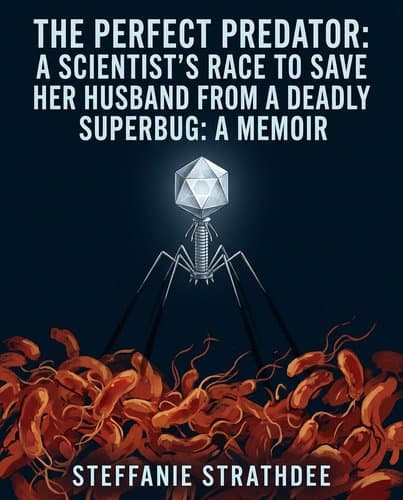
36589701_the-perfect-predator
by Steffanie Strathdee
When her husband was dying from a superbug no antibiotic could kill, an epidemiologist resurrected a century-old viral weapon Western medicine had buried for…
In Brief
When her husband was dying from a superbug no antibiotic could kill, an epidemiologist resurrected a century-old viral weapon Western medicine had buried for profit — proving that the cure for the coming post-antibiotic apocalypse was hiding in plain sight all along.
Key Ideas
Economic barriers paralyze antibiotic innovation
No new antibiotic class targeting Gram-negative bacteria (including the deadliest superbugs like Acinetobacter baumannii) has been discovered since 1962. The development pipeline isn't slow — it's been effectively closed for decades because the economics of antibiotic development are structurally broken: brief use, mandatory stewardship, and eventual resistance make them poor investments for pharma.
Cold War politics abandoned viable phage therapy
Phage therapy wasn't abandoned because it failed. It was abandoned in the West due to Cold War politics, AMA reports based on fraudulent commercial preparations, and the overwhelming success of penicillin making alternatives seem unnecessary. The science continued working in Eastern Europe the entire time.
Phages co-evolve with resistant bacteria
Unlike antibiotics, phages can co-evolve with resistant bacteria. When bacteria mutate to escape a phage, researchers can find or engineer phages that exploit the new vulnerability — including the genetic weakness bacteria develop in the act of resisting. This makes phage therapy self-renewing in a way antibiotics are structurally unable to be.
Phage cocktails require diverse multi-phage approach
A phage cocktail needs at least 3-4 different phages targeting different bacterial receptors. A single phage will be defeated by resistance within days — the same reason HIV is never treated with a single antiretroviral. Diversity of attack is non-negotiable.
Proactive phage libraries prepare for future outbreaks
Tom's treatment succeeded partly because the U.S. Navy had been collecting Acinetobacter baumannii phages for over a decade, specifically because returning Iraq and Afghanistan veterans were bringing home Iraqibacter infections. Phage libraries built for one crisis became the resource for another. Building these libraries proactively — before the next outbreak — is the systemic lesson.
Post-ICU syndrome requires separate psychological treatment
Post-intensive care syndrome (PICS) affects up to 75% of ICU survivors cognitively and up to 60% with PTSD — and extends to family members as well. Physical recovery from a superbug infection and psychological recovery are separate battles requiring separate treatment, a dimension of the AMR crisis that remains largely overlooked.
Who Should Read This
Science-curious readers interested in Memoir and Scientists who want to go beyond the headlines.
The Perfect Predator: A Scientist's Race to Save Her Husband from a Deadly Superbug: A Memoir
By Steffanie Strathdee & Thomas Patterson
11 min read
Why does it matter? Because the last antibiotic may already be failing — and the only thing that can replace it has been buried for fifty years.
Here's the assumption: if your wife is one of the world's leading infectious disease epidemiologists, you're probably fine. She has spent three decades tracking HIV through some of the most dangerous settings on the planet. She knows where microbes hide. She knows what it costs to underestimate them. So when a bacterium she once cultured without gloves in an undergraduate lab begins destroying her husband from the inside — first in an Egyptian clinic, then a German ICU, then a San Diego hospital — defeating every antibiotic in the arsenal without slowing, the horror isn't just personal. It's civilizational. The best-equipped mind in the room has nothing left. What follows is a quiet indictment of a medical establishment that let a working treatment gather dust for fifty years — not because it failed, but because no one could figure out how to charge for it.
The World's Top Superbug Expert Ran Out of Options Before She Could Save Her Own Husband
Dr. Chip Schooley, Steffanie Strathdee's colleague and one of the most respected infectious disease physicians at UC San Diego, arrives at Tom's bedside to deliver the sensitivity results. He pulls on gloves and gown, takes the stool beside the bed, and speaks in a clipped, unfamiliar voice. Tom's bacteria has now defeated every antibiotic they have. Steffanie gestures at the IV pole: four antibiotics, an antifungal, a bag hanging from every prong. What are all of those doing? Chip's answer, as he stands to leave: "Those are to make us doctors feel better."
Tom's infection is Acinetobacter baumannii — ranked, a few months after his diagnosis, as the single most dangerous drug-resistant pathogen on earth by the WHO. Of fifteen antibiotics tested against his strain, twelve came back marked "R" for resistant. Three remained: colistin, a last-resort drug developed in World War II with kidney-destroying side effects; meropenem; and tigecycline. Within weeks, they too were losing their grip. The last new antibiotic class had been discovered in 1984. The pipeline was empty. The person most qualified in the world to understand what was happening was also the first capable of seeing, without flinching, that they had run out of road.
Her expertise doesn't protect Tom. It gives her the precision to understand, earlier than anyone around her is willing to acknowledge, that they've run out of options. The IV pole is theater. The antibiotics are comfort measures. Steffanie is the first person in the room capable of saying so, which makes her the first to face the question her career left unanswered: what do you reach for when medicine's last option is already on that pole?
Medicine Didn't Run Out of Luck. It Ran Out of Investment Sixty Years Ago.
The antibiotic era didn't end because bacteria outran science. It ended because the pharmaceutical industry did the math and stopped trying.
Here's what that math looked like in 2015, the year Tom Patterson lay in a San Diego hospital losing ground: no new antibiotic class targeting Gram-negative bacteria (the category that includes Acinetobacter) had been discovered since 1962. Not one. Worldwide, exactly one novel drug in that category was in clinical development. Meanwhile, bacteria were evolving in real time, sharing resistance genes across species through loops of mobile DNA, acquiring new defenses faster than any drug regimen could stay current.
The science didn't stall. The investment did. Antibiotics are a terrible business: patients take them for a week or two, public health officials beg doctors to prescribe them sparingly to slow resistance, and the bacteria eventually defeat them anyway. One health economist put it this way: it's like asking a company to invest heavily in fire extinguishers when consumers won't buy them and stewardship programs demand they stay on the shelf. Pharma's calculation was rational. They closed the antibiotic research labs and shifted capital toward drugs people take for decades: cholesterol, blood pressure, depression.
The warning came at the very beginning. That's what makes this feel almost malicious. Alexander Fleming, accepting the Nobel Prize in 1945 for discovering penicillin, told the world plainly that misuse would breed resistant bacteria. Within two years, resistant Staph strains were already appearing in hospitals. The industry kept releasing new classes through the 1950s and into the early 1960s (more than twenty new classes between 1940 and 1962) and then, more or less, stopped. The assumption was that the pipeline would always replenish itself. It didn't.
By the time Acinetobacter baumannii had worked its way through every option on Tom's IV pole, Steffanie understood that it was never a matter of when the new drug would arrive. The last one targeting bacteria like his had already arrived — in 1962.
Western Medicine Didn't Abandon Phage Therapy Because It Failed — It Abandoned It Because Penicillin Was More Profitable
If phage therapy worked against bacterial infections, why hasn't your doctor ever mentioned it?
She almost certainly would have, if you'd been born before 1940.
Félix d'Hérelle, a self-taught Canadian microbiologist at the Pasteur Institute in Paris, cracked the problem during a WWI dysentery outbreak in 1917. He filtered stool samples from recovering soldiers, added the filtrate to a cloudy flask of live Shigella bacteria (the pathogen killing the troops), and left it overnight. The next morning, the flask was clear. Something invisible had consumed every bacterium. D'Hérelle understood the implication at once: if it happened in the flask, it happened in the soldier. He named the agents bacteriophages, from the Greek for "devour," tested the preparation on himself first, then gave it to a twelve-year-old boy dying of dysentery. Symptoms cleared after a single dose.
Within a decade, phage therapy was mainstream enough to anchor a Pulitzer Prize–winning American novel: Sinclair Lewis's 1925 Arrowsmith borrowed d'Hérelle as its inspiration. Eli Lilly was selling phage preparations. This wasn't fringe science.
Then it vanished from Western medicine — not because it failed, but because it was commercially undermined and politically quarantined.
The commercial problem came first. Companies rushed phage products to market without purifying them, marketed them fraudulently for viral infections (phages kill bacteria, not other viruses), and some accidentally destroyed their phages with the same stabilizing agents meant to preserve them. The science took the blame for its worst commercial practitioners.
Penicillin finished the job. When antibiotics arrived in the 1940s, the pharmaceutical industry had every incentive to back the simpler product: antibiotics were patentable, scalable, and didn't require matching each preparation to a specific patient's bacterial strain. Phage therapy required exactly that — plus sourcing the phages from sewage. The economics weren't close.
Then came what medical historian William Summers called the "Russian taint." While America abandoned phage therapy, the Soviet Union built an entire infrastructure around it. The Eliava Phage Therapy Center in Tbilisi, Georgia (co-founded by d'Hérelle's Georgian protégé before Stalin's secret police executed him in 1937) employed 800 people at its 1980s peak and produced tons of phage products daily, mostly for the Soviet military. Once the Cold War hardened, supporting phage research in America meant being associated with Soviet science. The AMA's damning reports and the geopolitical hostility combined to transform what had once inspired a Pulitzer Prize–winning novel into, as Ryland Young, a Texas A&M phage biologist, described the prevailing view of his own graduate school days, "a bizarre chapter in medical history that should remain closed."
What Steffanie found in her late-night PubMed search was that the chapter hadn't closed. The science was intact. The biology was unchanged. The phages were still in the sewage, waiting for someone desperate enough to go looking.
The Treatment That Took a Century to Revive Was Found in a Sewage Pond in Ten Days
Biswajit Biswas, the Navy's lead phage scientist, stood at a sewage treatment plant in Laurel County, Maryland, and flung a half-gallon milk jug loaded with rocks into the brown water. What came up in that jug (filtered, cultured, screened against a frozen sample of Tom Patterson's specific bacterial strain) eventually got named Super Killer. It would become the decisive weapon.
The cure for the world's most dangerous superbug came from a pond full of shit.
What makes the timeline so disorienting is its speed. Steffanie sent cold emails to about a dozen phage researchers on a Sunday night in February 2016. By the following morning she had her first collaborator: Ryland Young at Texas A&M. He spent two hours on the phone explaining the problem — the phages would need to match Tom's exact bacterial isolate, not just the species; they'd need three or four minimum to stay ahead of resistance mutations; and the primary source was sewage. Within the week, researchers from Belgium, India, and Switzerland had committed phages. The Belgian military was offering to ship theirs via diplomatic pouch.
The Navy required a different kind of unlocking. Their phage library had been built specifically because so many Iraq and Afghanistan veterans came home carrying Acinetobacter baumannii, and the military had already done the work Steffanie needed, against exactly the strain that was killing Tom. What was missing was permission to use it on a civilian. A Navy lieutenant commander escalated to the director of the Biological Defense Research Directorate, Alfred Mateczun, a physician who had managed the federal anthrax response in 2001. His decision took fewer words than a text message: they had the bacteria, they had phage that killed it, nothing to lose, send it. Fifty years of institutional hostility toward phage therapy dissolved in the time it takes to ask two questions.
By March 15, less than three weeks after that Sunday cold email, the phage cocktail had been assembled, purified to FDA specifications by a team at San Diego State working through the night, and delivered to the investigational pharmacy at UCSD's Thornton Hospital. Chip handed Steffanie a consent form to sign on Tom's behalf. She read it first as a scientist, parsing endotoxin risks and dosing unknowns. Then she read it as a wife. The key sentence acknowledged that the treatment itself could accelerate his death. If Tom died of septic shock now, it would be because of a treatment she had found and proposed. She signed, then told Chip she thought it was going to work — without a single data point to support saying so.
When the Bacteria Learned to Dodge the Phages, It Accidentally Made Itself Weaker
Think of bacteria as a city-state that responds to siege by dismantling its own walls. The attackers needed the walls to scale — no walls, no foothold. But a city without walls is also a city without defenses.
That city-state was A. baumannii, the bacteria colonizing Tom Patterson in late March 2016. It had evolved complete resistance to the first phage cocktail by shedding its capsule — the protective outer sheath over the cell wall. The capsule kept the bacteria hydrated, helped it acquire new resistance genes, and housed the surface receptors the phages used to dock and inject. Dropping it stripped away the bacteria's own virulence. Chip called it the perpetual Darwinian dance: the escape move was also a surrender.
Shedding the capsule exposed a new surface. Super Killer, a second-generation phage harvested weeks later from a Maryland sewage pond, was built for exactly that surface. The resistance mechanism the bacteria evolved became the opening for the next round of treatment.
A century of pharmaceutical economics had buried the distinction: when bacteria evolve resistance to a drug, the drug stays fixed and the pipeline has to start over. When they evolve resistance to a phage, the arms race continues with both sides in motion. The mutation the bacteria used to escape becomes the next target. Phage therapy is a platform that inherits the bacteria's own evolutionary logic.
Tom's Survival Was a Miracle. The Next Patient Deserves a System.
Knowing how phage therapy works and having a system ready to deploy it are different problems.
Mark Smith had a simple idea. His daughter Mallory — twenty-five years old, a cystic fibrosis patient whose lungs were being consumed by a drug-resistant Burkholderia cepacia infection — was scheduled for a double lung transplant. Before surgery, he asked her doctors: could they clear the infection with phage therapy first and give her new lungs a fighting chance? The doctors hadn't heard of it. Too risky, they said. Mallory received her transplant, the infection returned in her new lungs, and by the time a global team had scrambled to find matching phages and race vials to Pittsburgh, she had hours left. She died before the preparation could be properly purified. Mark told Steffanie the story at the reception after the funeral.
Less than two years later, a UC San Diego team applied Mark's exact idea to another cystic fibrosis patient the same age Mallory would have been. Phage therapy before transplant. The infection cleared. The woman went home to wait for her new lungs.
The distance between "too risky" and "textbook success" wasn't measured in decades of clinical trials. It was months, and one set of physicians who had watched what happened in Bed 11 at UCSD's Thornton Hospital.
Tom's survival required things that can't be assembled on demand. It needed a wife who happened to be one of the world's leading infectious disease epidemiologists, connected enough to reach phage researchers on three continents via cold emails on a Sunday night. It needed the Navy's fifteen-year Iraq-war phage stockpile. It needed an FDA official who answered her phone from her son's hockey game. These weren't workarounds — they were the system, improvised at the last possible moment around one patient with extraordinary luck.
Steffanie understood this because she recognized her own place in the problem. She had packed Cipro for Egypt and administered it to Tom without a prescription (the sensible preparation of a scientist who knew her antibiotics). By the epilogue, she names it plainly: if an infectious disease epidemiologist can be a vector for antibiotic resistance, how far does the ignorance run?
The book's answer is IPATH, the Center for Innovative Phage Applications and Therapeutics, the first phage therapy center in North America, opened at UC San Diego in 2018 with $1.2 million in seed funding. Clinical trials are now underway. The biology was never the obstacle. Tom's case proved the system was worth building. One ember, after a hundred years of sparks going out, had finally held.
The Question Worth Asking Before the Next Phone Call
Tom Patterson is alive because his wife happened to be exactly the right person, the Navy happened to have spent fifteen years collecting exactly the right phages, and an FDA official answered her phone from a hockey rink. Remove any one of those and you're reading a different book.
The science isn't in question anymore. Phages work, and the biology was on our side the whole time we ignored it while the antibiotics we'd bet everything on quietly lost ground. What doesn't exist yet is a system that works without a globally connected epidemiologist sending cold emails on a Sunday night. The next patient almost certainly won't have those connections, that spouse, or that luck. That's what the book leaves you with: not a story about survival, but a question about whether we'll build the infrastructure before the next call comes — and whether this time we'll actually pick up.
Notable Quotes
“We need Martin to bless the phages!”
“We wait, and hope that the next twenty-four hours are the most boring we have ever had.”
“Emerging Therapies for Multidrug Resistant Acinetobacter baumannii.”
Frequently Asked Questions
- What is The Perfect Predator about?
- The Perfect Predator chronicles epidemiologist Steffanie Strathdee's effort to save her dying husband using phage therapy — a century-old treatment abandoned by Western medicine for political and economic reasons, not scientific ones. The memoir explores how Strathdee races against time to find an alternative when her husband becomes infected with a deadly superbug (Acinetobacter baumannii), ultimately demonstrating how phage therapy could revolutionize treatment of antibiotic-resistant bacteria. The book also examines the broken economics of antibiotic development and why phages represent the most credible path through the coming post-antibiotic crisis.
- Why was phage therapy abandoned in Western medicine?
- Phage therapy wasn't abandoned because it failed. It was abandoned in the West due to Cold War politics, AMA reports based on fraudulent commercial preparations, and the overwhelming success of penicillin making alternatives seem unnecessary. The science continued advancing in Eastern Europe during this entire period, demonstrating that the treatment's efficacy remained unaffected by Western rejection. With antibiotic-resistant bacteria now increasingly intractable and new antibiotic classes scarce, this historical decision appears less scientifically justified and more politically and economically motivated.
- How does phage therapy work differently from antibiotics?
- Phages co-evolve with resistant bacteria, unlike antibiotics. When bacteria mutate to escape a phage, researchers can find or engineer phages that exploit the new vulnerability — including the genetic weakness bacteria develop in the act of resisting. This makes phage therapy self-renewing in a way antibiotics are structurally unable to be. A phage cocktail needs at least 3-4 different phages targeting different bacterial receptors; otherwise a single phage will be defeated by resistance within days.
- What is the systemic lesson from Tom's successful treatment?
- Building phage libraries proactively—before the next outbreak—is the key systemic lesson. The U.S. Navy had been collecting Acinetobacter baumannii phages for over a decade, specifically because returning Iraq and Afghanistan veterans were bringing home Iraqibacter infections. Phage libraries built for one crisis became the resource for another. Post-intensive care syndrome (PICS) also affects up to 75% of ICU survivors cognitively and up to 60% with PTSD, a psychological dimension of AMR crises requiring equal treatment and support.
Related Book Summaries



Read the full summary of 36589701_the-perfect-predator on InShort