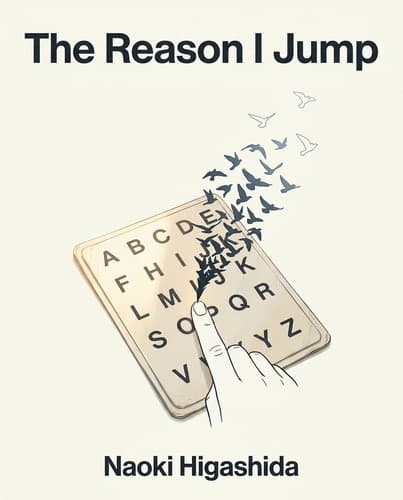
16113737_the-reason-i-jump
by Naoki Higashida, K.A. Yoshida, David Mitchell
A thirteen-year-old boy with severe autism uses a letter grid to reveal what neurotypical observers consistently get wrong: autistic people aren't emotionally…
In Brief
A thirteen-year-old boy with severe autism uses a letter grid to reveal what neurotypical observers consistently get wrong: autistic people aren't emotionally absent, they're emotionally trapped—and every misread behavior has a precise, logical explanation that caregivers and loved ones desperately need to hear.
Key Ideas
Audio and visual input cannot process simultaneously
When an autistic person doesn't respond to you, they are not ignoring you — their attention system cannot synthesize audio and visual input simultaneously. Use their name first as a dedicated 'wake word' before delivering your message.
Repetitive questions strengthen memory anchoring foundations
Repetitive questioning is a memory anchoring tool, not a comprehension failure. Answering the same question patiently reinforces a memory that has no chronological weight and would otherwise vanish.
Autistic speech reflects accessible language, not intent
Do not take every spoken word literally. Autistic speech often reflects what language was accessible in that moment, not what the person intended. A 'Yes' or 'No' can be wrong; an echoed phrase is usually a search, not a statement.
Meltdowns stem from cognitive shock, not defiance
Meltdowns over minor mistakes are not tantrums. A small error triggers a cognitive shutdown — the shock of the mistake, not the mistake itself, causes the reaction. The person in the meltdown is its primary victim.
Caregiver distress signals worthlessness to autistic person
Caregiver distress directly erodes the autistic person's will to persist. When a caregiver appears overwhelmed or hopeless, the autistic person experiences it as confirmation that their existence has no value — not as motivation to improve.
Verbal planning builds flexibility better than schedules
Visual schedules can backfire: because they create vivid memory imprints, any deviation from the schedule becomes catastrophic. Verbal planning, though slower, builds more flexible understanding.
Stimming provides neurological relief, not mere preference
Repetitive behaviors (stimming) are neurological compulsions, not preferences. Obeying the brain's command feels like relief; resisting feels like being pushed toward Hell. Intervention requires patience, not punishment — and should prioritize safety over suppression.
Refuges provide essential decompression from neurotypical demands
Nature, predictable media, and familiar routines are not signs of a limited inner life — they are the sensory refuges that allow an autistic person to decompress from the exhausting work of surviving a world calibrated for neurotypical processing.
Who Should Read This
Readers who connect with first-person stories about Mental Health and Social Issues and want to see the world through someone else's eyes.
The Reason I Jump
By Naoki Higashida & K.A. Yoshida & David Mitchell
12 min read
Why does it matter? Because every behavior you've been misreading as absence is actually a desperate, ingenious form of presence.
Most of us assume that when someone cannot speak, they have little to say. That when a child stares past you, flaps their hands, runs from the room without warning, they are somehow less present than the rest of us — less aware, less feeling, less there. Naoki Higashida was thirteen years old and could not produce a single reliable sentence when he began, one painstaking letter at a time, pointing to a laminated card to prove that assumption catastrophically wrong. What he spelled out — slowly, patiently, with a precision that embarrasses ordinary conversation — was not a simple message. It was a demolition. The silence, the repetition, the bolting, the meltdowns: none of it meant what you thought it meant. Behind every behavior you've ever misread as absence, there is a person in full — feeling everything, trapped by a body that has declared total war on his ability to show it.
The Body Declared War on the Soul Before Naoki Could Form His First Sentence
Picture a thirteen-year-old sitting in a room. He can hear you. He understands, at some level, that you're speaking to him. But when he tries to answer, the words dissolve before they reach his mouth — and on the days they do arrive, they come out backwards, saying the opposite of what he meant. His name is Naoki Higashida, and before he learned to point to letters on a laminated card, this was the whole of his conversational life.
Most of us carry a quiet assumption about autism: that the silence means absence, that the person who can't respond isn't quite tracking what's happening around them. David Mitchell, whose son has severe autism, held this assumption until a book from Japan dismantled it. To show you what was actually happening inside his son's head — inside Naoki's head — Mitchell runs a thought experiment. Imagine your internal mental filter, the one that quietly demotes ten thousand thoughts a second so only the useful ones reach consciousness, suddenly walks off the job. Then imagine the same thing happens to your sensory gating. Now you're flooded: every smell, every texture, every sound arriving at maximum volume with no priority queue. Your father, standing right in front of you, sounds like someone speaking an unfamiliar language through a phone breaking up on a train. The floor tilts. You can feel the bones of your own skull. This isn't a metaphor for being overwhelmed. For Naoki, it describes Tuesday.
The person inside that sensory catastrophe is fully intact. Naoki describes the experience of non-verbal autism as living like a doll — sealed off, without hopes, without the ability to share a single thought with another human being. What changed everything was small: his mother took a piece of card, wrote out the Japanese alphabet on it, and laminated it. Instead of fighting to produce spoken words that vanished the moment he reached for them, Naoki could point to letters. One at a time. Building words. The grid gave his thoughts somewhere to land.
He Already Knows He Is Making You Miserable — and Cannot Say Sorry
Here is the assumption most of us carry into a room with a non-verbal autistic child: the silence is mutual. They can't express distress, so they must not register ours. Naoki Higashida wants you to know how completely, devastatingly wrong this is.
When Naoki asks what the worst thing about autism is, he doesn't mention the sensory overload, the body that won't follow instructions, or the words that dissolve before they arrive. He goes straight for something else: the knowledge that he is ruining your day, and the total inability to say he's sorry. The cycle he describes is its own kind of trap. He does something he cannot control. He watches the person caring for him — exhausted, frustrated, sometimes laughing at him — register it as a problem. And then, because the apology will not come, because the explanation cannot form, he turns the whole weight of that moment inward. The despair accumulates, visit after visit, until the question that surfaces is not 'why did I do that?' but something far more vertiginous. Why was he born at all.
What stops him is not the sensory chaos or the physical helplessness. He says those personal hardships are manageable — he can bear them. What he cannot bear is the thought that his existence is the engine of someone else's unhappiness. When a caregiver lets their exhaustion show, Naoki experiences it as a verdict on his life's worth. It doesn't comfort him; it extinguishes the very resolve he needs to get through the day.
So his plea to caregivers lands in an unexpected place. He isn't asking for patience or accommodation. He's asking them to protect their own visible equanimity — because their distress becomes his unbearable burden, and his burden becomes their greater exhaustion, and the loop feeds itself. The empathy was never absent. It was always there, acute and wordless, with nowhere to go.
Repetitive Questions Are Not a Failure of Memory — They Are How Memory Works
Why does a child keep asking whether tomorrow is a school day, thirty seconds after you told them it isn't? The question sounds like evidence of a short circuit — the words going in but nothing sticking.
Naoki offers a different anatomy entirely. He describes his memory not as a timeline where recent events sit close and old ones recede into distance, but as a pool of scattered dots. There is no near and far in this pool. Something said to him ten seconds ago and something said three years ago carry exactly the same weight, floating at the same depth. When a caregiver answers his question, that answer doesn't arrive in the slot marked 'just now' and stay fresh. It enters the pool and immediately drifts. Asking the question again isn't confusion — it's the act of reaching into the pool and pulling the relevant dot back to the surface. The question is a retrieval mechanism, not a symptom of failing to understand.
Then there's this: fluid conversation is, for Naoki, something close to agony — words failing under pressure, responses arriving wrong, the whole machinery seizing up in real time. Familiar questions are the rare exception. A question he has asked a hundred times, with an answer he already knows, works like a game of catch with a ball: something looping and predictable and, crucially, something he can do without failing. For someone whose relationship with spoken language is mostly a record of defeat, that loop is a small, genuine pleasure — playing with the rhythm and sound of words that, for once, don't betray him.
So the same behavior carries two entirely different purposes at once: a practical strategy for anchoring memory, and a rare moment of mastery over a medium that usually refuses to cooperate. What looks like the repeated question is doing real work on both counts.
The Words Coming Out of His Mouth Are Not the Words in His Head
Think of a ventriloquist's dummy. Its mouth moves, sounds come out, a sentence forms — but nobody in the room believes the dummy is speaking its own mind. Now imagine the dummy believes it too, watches its own mouth producing the wrong words, and cannot stop it.
Naoki Higashida describes exactly this gap between what he means and what he says. The machinery of speech is not under reliable command. Words pour out with no relationship to the thought behind them — he describes it as remote-controlling a robot that keeps misfiring. The operator is in there. The signals just don't land.
The most devastating version of this happens with the simplest exchanges. A yes-or-no question — the floor of human communication, the thing we offer to make things easier — turns out to be just as treacherous as anything else. Naoki gets it wrong. The listener hears an answer and acts on it as though it were true. And now Naoki faces something worse than the original misfire: a misunderstanding in motion, with no conversational tools to chase it down and correct it. Because doing that requires the very fluency that failed him the first time. Each uncorrected error closes another door. He describes what follows as self-loathing, and then silence.
Taking verbal output as a faithful transcript of intent is precisely the mechanism by which autistic people become more trapped, not less. His feelings, he insists, are the same as yours. The body just refuses, often catastrophically, to be a reliable messenger for them. The words coming out of his mouth are evidence of what language was available in that moment — not of what he wanted to say.
He Is Not Ignoring You — He Is Looking at Your Voice
The eye contact thing has it exactly backwards. When adults instruct Naoki to look at whoever is speaking to him, they are operating on the assumption that the eyes prove the mind is present. Naoki's account dismantles this completely: when he is not looking at your face, he is looking at your voice. That phrase sounds paradoxical until you follow the logic. Decoding speech demands everything his nervous system has. Under that load, his visual field simply goes quiet — not as a choice, but as a trade-off, the way a camera blurs the background when it's focused on something close. If he were to force his eyes onto yours, the visual input wouldn't confirm comprehension; it would shatter it. The very behavior taken as proof of listening makes listening impossible.
The same inversion applies to social withdrawal. When people observe Naoki drifting to the edge of a group and say, with well-meaning resignation, that he clearly prefers to be alone, they are reading the outside of something they can't see the inside of. He doesn't want isolation. What drives him away is a crushing awareness that he is causing trouble — that every failed exchange, every misread signal, every moment where things go wrong is a burden he is placing on someone else. And then, quietly, over time, he gets used to being alone without ever deciding to be a loner. When someone voices the assumption aloud — he'd rather be by himself — it lands on him like a door being locked from the outside. What began as a protective move becomes a permanent sentence, enforced by the very people who thought they were being kind.
The Reason He Jumps Is That His Body Has Seized Up and He Needs to Shake Loose the Ropes
Imagine watching a child jump. Hands clapping, legs springing, face alight with something that looks, from the outside, like pure animal glee — the kind of unselfconscious joy that adults have mostly lost. Your instinct is to smile, maybe to feel a little envious. What you are almost certainly not thinking is: that person is trying to shake loose the ropes.
Naoki explains what actually happens inside the jump. When something moves him — happiness, sadness, it doesn't matter which — the feeling hits his body the way lightning hits a tree. The result isn't tears or laughter; it's a physical lockdown, a seizing up that leaves him unable to move the way he needs to. Jumping is how he breaks that grip. The upward motion isn't symbolic. It's mechanical — a specific physical act that loosens whatever the emotion has bound. And there's a second thing the jumping does, quieter but just as real: it lets him feel his own body parts with a clarity that is otherwise missing. His legs as they push off. His hands as they meet. For someone whose sense of where his body is in space is unreliable at the best of times, that clarity is not nothing. It's proof of existence.
The image Naoki reaches for at the end of this explanation is the one that stays with you. He describes the whole situation — the stimming, the flapping, the hopping — as the behavior of a bird in a cage. Constrained by his own body and by the world watching it, all he can do is flutter and hop. The jumping that looks like mania is, from inside, the desperate wing-beats of someone trying to get airborne. He knows he can't. The cage is real. But the longing to fly — to shed the body that seizes up, that produces the wrong words, that causes so much grief to people he loves — is just as real as the bars.
That image reframes everything the prior sections have been circling. The meltdown, the verbal misfires, the retreat from company — none of it is random dysfunction. It is a person, mind running clear, repeatedly slamming against the limits of the body he inhabits. He knows, while the tsunami is still raging, that it will recede and leave wreckage behind. What he cannot do is stop it. And then he has to stand in the wreckage, looking at what happened, and figure out how to go on.
The Brain Keeps Sending the Same Command Whether the Person Wants It To or Not
What does it look like when a child does the forbidden thing for the hundredth time, after a hundred scoldings? From the outside, it looks like defiance — or worse, contempt. As though the rules simply don't apply, or the people enforcing them have no real authority. Naoki Higashida wants you to feel the full weight of how wrong that reading is.
He describes a specific loop, and once you see its shape, the behavior stops looking like a choice. Something happens — an action, a consequence, a scolding. That sequence gets imprinted. And then the brain produces what Naoki calls an electrical buzz, a sensation with no close equivalent except perhaps watching your single favorite moment from a film on endless repeat. The brain isn't chasing the action. It's chasing that specific discharge — the feeling that arrives when the loop completes. The rule is known. The guilt is real. And then the loop fires anyway, and the knowledge of the rule is simply not fast enough to intercept it.
What makes this devastating is the layer underneath: the person inside the loop is often the one suffering most. Naoki describes resisting the brain's repetitive commands as fighting at the edge of a cliff — not a metaphorical discomfort, but something that feels like annihilation. Obedience to the loop brings relief. Resistance brings horror. And then, when the loop wins — when the forbidden thing happens again — comes the guilt of watching someone who loves you absorb the damage, again, without being able to explain yourself or stop what is coming next time.
He doesn't ask for rules to be abandoned. He asks to be stopped — and he asks only that the stopping come with one thing: the understanding that he is not the author of what just happened. The body carried him there. He was watching from inside.
What Looks Like Strangeness Is Almost Always a Survival Strategy
Take hand-flapping. Watch a child waving their fingers rapidly in front of their eyes and the easy interpretation is self-stimulation — meaningless, a tic to be extinguished. Here is what is actually happening: ordinary light, the same light you're reading by right now, arrives in the visual system of someone with autism like a series of needles fired in straight lines directly into the eyeballs. Not dimly uncomfortable. Acutely painful. There is no neurological filter softening the input to something manageable. Flapping fingers across the face works like a shutter, breaking the light into intervals, transforming those needles into something closer to moonlight through leaves. The hand is not performing a symptom. It is operating a coping tool the person invented for themselves because the world ships too much light with no way to turn the intensity down.
The same logic runs through every behavior in this family. Cupping ears isn't a response to volume — it's a defense against a specific horror: that certain sounds can dissolve the sense of where your own body sits in space. Spinning a top and watching it isn't pointless repetition — it's the relief of something that follows a perfectly predictable arc in a visual environment that otherwise refuses to hold still.
The person isn't broken. They have diagnosed their own sensory environment and engineered a workaround. The workaround just happens to look, from the outside, like strangeness.
Understanding Is the Only Bridge the Autistic Person Cannot Build Alone
Understanding is not a kindness you extend to an autistic person. It is the structural material their hope is made of — and they cannot manufacture it themselves.
Naoki makes this explicit in the book's final pages. As a child, the question that haunted him wasn't about sensory overload or the body's refusals. It was something more vertiginous: whether being autistic meant he could never fully exist as a human being. Every day brought new failures and new apologies, and the accumulated weight of that cycle slowly drained him of the will to keep going. What kept him writing — kept him pointing to letters on a laminated card, building words one at a time — was a specific theory about survival. If the people around him could grasp that his behavior wasn't selfishness or contempt or ego, but something physiological and mostly involuntary, that recognition would hand him something he couldn't generate alone: a reason to endure. With understanding, he said, we are handed a ray of hope. Without it, the hardness of an autistic life has no counterweight.
The book exists for that reason. Not as a catalog of symptoms or a manual for caregivers, but as a bridge Naoki could only build from one side. The other end requires you. When a reader feels the reality of what it's like to watch your own mouth produce the wrong words, or to retreat from company not out of indifference but out of guilt too large to carry in public, something shifts. The behavior stops being a problem to manage and becomes a person to meet. That shift, Naoki argues, is what connects his future to yours. He isn't asking to be cured or pitied or accommodated. He is asking to be understood.
The Wall Has a Brick Missing — Naoki Already Knocked It Out
David Mitchell describes what happens when an autistic person manages to write about their interior life: a brick comes out of the wall. Naoki Higashida, at thirteen, pointing one finger at one laminated letter at a time, knocked out enough of them that we can finally see through. What's on the other side is not the emptiness we assumed. It's someone who has been watching us, feeling every flicker of our impatience and exhaustion and love, unable to send a single word back. You don't need to fix anything to meet him. You only need to understand what is actually happening. That understanding is the bridge he cannot build from his side — and, it turns out, the only thing that makes hope load-bearing. He has been waiting there, with a patience that should humble anyone who has ever walked out of a hard room, for us to stop talking about him and actually look.
Frequently Asked Questions
- What does it mean when an autistic person doesn't respond?
- When an autistic person doesn't respond, they are not ignoring you — their attention system cannot synthesize audio and visual input simultaneously. Use their name first as a dedicated 'wake word' before delivering your message. This sequential processing requirement explains what may appear as disinterest or defiance. By understanding this neurological difference and adjusting your communication approach, you can significantly improve connection. The shift from interpreting non-response as intentional rejection to recognizing it as a processing limitation transforms caregiving and opens meaningful avenues for interaction.
- Why do autistic people ask the same question repeatedly?
- Repetitive questioning is a memory anchoring tool, not a comprehension failure. Answering the same question patiently reinforces a memory that has no chronological weight and would otherwise vanish. The autistic person is not choosing to ask repeatedly; their memory system requires this reinforcement. What feels tedious to neurotypical listeners is genuinely necessary support for memory retention. This understanding shifts frustration into compassion. Each repeated question is an opportunity to strengthen essential internal references. Patience in answering becomes meaningful neurological support, helping stabilize the person's sense of continuity and understanding.
- Are autism meltdowns tantrums?
- Meltdowns are not tantrums — this distinction is critical for harm prevention. A small error triggers a cognitive shutdown, and the shock of the mistake, not the mistake itself, causes the reaction. The person in the meltdown is its primary victim, suffering from neurological collapse. Treating meltdowns as behavioral problems requiring discipline causes additional trauma. Understanding that meltdowns are involuntary neurological events fundamentally changes caregiver response. The appropriate intervention involves calming support and reduced demands, not punishment. This reframing protects both the autistic person's wellbeing and the caregiver-child relationship.
- Why do autistic people engage in repetitive behaviors or stim?
- Repetitive behaviors (stimming) are neurological compulsions, not preferences. Obeying the brain's command feels like relief; resisting feels like being pushed toward Hell. These behaviors serve essential regulatory functions for the nervous system. Intervention should prioritize safety while respecting this neurological need, using patience rather than punishment. Suppressing stimming without understanding its regulatory role creates distress and damages trust. Understanding stimming as a necessary neurological response, not a deficit or choice, allows caregivers to provide genuine support. The goal should be harm reduction and regulation support, not elimination of the behavior itself.
Related Book Summaries

Read the full summary of 16113737_the-reason-i-jump on InShort