60468246_the-revolutionary
by Stacy Schiff
Samuel Adams didn't just join the American Revolution—he manufactured it through pseudonyms, fabricated outrage, and choreographed mobs, then systematically…
In Brief
The Revolutionary (Octo) reconstructs Samuel Adams as the hidden architect of the American Revolution — a propagandist who built the independence movement through fabricated news, pseudonymous attacks, and engineered mob action.
Key Ideas
Emotion precedes logic in movement building
Political movements are built on emotional architecture first — Adams engineered the feeling of injustice and then attached constitutional arguments to it, not the other way around. The outrage came before the reasoning.
First framing wins narrative permanence
Narrative control matters as much as events. The Journal of Occurrences shows that a fabricated account published weeks after an event can permanently displace what actually happened — whoever frames the story first usually wins, regardless of accuracy.
Strategic invisibility amplifies durability and power
Deniability is strategic, not cowardice. Adams's invisibility was deliberate method: the less traceable the action, the more powerful and durable the actor. He operated through committees, pseudonyms, and crowd actions specifically so his fingerprints would not survive.
Communication networks outlast dramatic single moments
Infrastructure outlasts any single act. The committees of correspondence were Adams's most consequential invention — they built the communication network that made collective action across thirteen colonies possible. The Tea Party got the mythology; the committees did the actual work.
Opposition skills fail in governance transition
The skills that build a movement rarely translate to governing. The tools of opposition — division, suspicion, pseudonymous attack, manufactured crisis — become liabilities once the common enemy is gone. Adams could not update his operating system, and the republic he built had no use for him.
Who Should Read This
History readers interested in Political Figures and World History who want a deeper understanding of how we got here.
The Revolutionary
By Stacy Schiff
10 min read
Why does it matter? Because the American Revolution was an engineered media operation — and the man who ran it planned his own disappearance.
You know Washington, Jefferson, Hamilton. What you probably don't know is that Jefferson called Samuel Adams most active and persevering in the Revolution; that Hutchinson told George III Adams was first to advocate independence; that Edmund Morgan concluded no American did more. The reason is partly Adams's own doing. He erased himself from the history he'd spent decades building — methodically, over decades, at considerable personal effort. What Stacy Schiff recovers is not a founder in any comfortable sense but something stranger and more instructive: the architect of a propaganda operation that ran for thirty years before anyone called it that, the man who understood that manufactured emotion moves history faster than principled argument — and that the story America would want to tell about itself would eventually require him to disappear from it.
The Man Jefferson Called the Revolution's Prime Mover Deliberately Destroyed His Own Archive
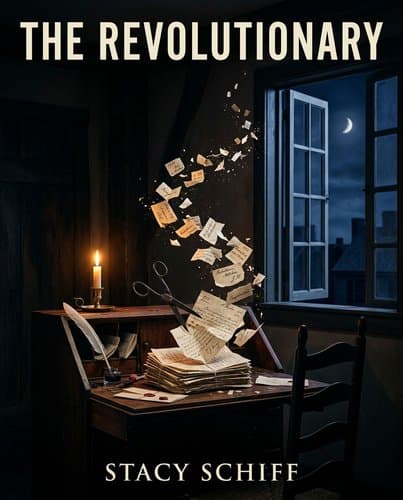
John Adams watched from across the room as his cousin fed another handful of papers into the Philadelphia fireplace. It was compulsive, almost ritualistic: documents representing years of correspondence, coordination, conspiracy, all of it curling to ash while John looked on helplessly. He asked whether Samuel was overreacting. The reply was short and final: "Whatever becomes of me, my friends shall never suffer by my negligence." In the summer, when there was no fire to feed, Samuel Adams used scissors instead — cutting bundles of letters to confetti and scattering the pieces from an open window, sparing his associates from the evidence and stopping every future biographer's heart.
Adams managed his legacy not by writing memoirs, not by assembling his political papers (contemporaries urged him to do both; he declined), but by systematic erasure. He operated under more than thirty pseudonyms. He covered tracks, avoided copies, and melted into committees and crowd actions that left no fingerprints. He and Paul Revere were in frequent contact over a decade of revolutionary organizing; two notes between them survive.
Jefferson called him "the earliest, most active, and persevering man of the Revolution." When royal governor Thomas Hutchinson briefed George III on colonial affairs in 1774, the king had barely heard of Samuel Adams; Hutchinson told him Adams was the first to openly advocate independence. Edmund Morgan wrote that probably no American did more to bring on the revolutionary crisis. And yet if you look for Adams in John Trumbull's painting of the Declaration signing (the image that defined the founding generation for a century), you find him barely visible, wedged between two other men's shoulders, a background figure in his own foreground event.
The story is supposed to belong to Washington and Jefferson. Stacy Schiff's argument is that the man who actually built the conditions for revolution — who spent a decade manufacturing public outrage, running an intelligence network, recruiting wealthy allies, and pushing farmers fifty miles from Boston toward the conclusion that they should rebel sooner rather than later — made sure you'd think that. The forgetting was engineered. The confetti scattered from a Philadelphia window didn't drift away by accident.
The Revolution Ran on Fabricated News and Thirty Invented Voices
Somewhere in Georgia in 1768, a reader opened a newspaper to find that British soldiers occupying Boston were forcing children to beg for bread through factory windows. The story was specific, vivid, and outrageous. It had also been composed in the small hours by Samuel Adams, sitting at his desk while his wife Betsy fell asleep to the scratch of his pen in the next room.
Adams had built a syndicated news service. He and his confederates wrote accounts of life under British military occupation (bayonets in civilians' chests, soldiers threatening to blow women's brains out, near-rapes and nightly scuffles) and dispatched them first to New York, where they appeared on Thursdays, then south to Philadelphia by Saturday, before boomeranging back to Massachusetts weeks later as news from multiple credible sources. Eleven American papers eventually ran the series, known as the Journal of Occurrences. By the time a lurid account surfaced on the front page of the Boston Evening Post, two months had passed. Memory was unreliable. Witnesses had moved on. No one could say with confidence whether the incident described had actually occurred. Thomas Hutchinson, having absorbed a full season of this material, concluded that nine-tenths of it was fiction or gross misrepresentation.
The effect was structural. Boston's occupation had looked to outsiders like a colony receiving its just punishment for years of mob action. The Journal reframed it: Boston as martyr, a city of ordinary people menaced by soldiers, their suffering proof that the crisis was everyone's crisis. Farmers in Virginia and merchants in South Carolina didn't need to have witnessed anything. They'd read the reports.
Adams extended the same logic across the colonial press. He wrote under at least thirty pseudonyms (Candidus, Vindex, Populus, Alfred, and two dozen others), sometimes appearing under different names in different papers on the same day. Each persona had a distinct purpose: Candidus launched ad hominem attacks on customs officials, Vindex defended Boston's honor, Alfred conducted character assassination. The masquerade created the illusion of a broad consensus that Adams had largely invented. Hutchinson watched in fury, noting that if any of these writers were required to sign their pieces, the arguments would collapse. But there was no one to compel. You couldn't prosecute a pseudonym. You couldn't debate a movement that seemed to have no center because it had been deliberately built without one.
Adams's fabrications were strategic and self-aware. He understood that a newspaper places the same thought in a thousand minds simultaneously. He placed thoughts in a thousand minds that hadn't happened yet — and enough of them believed it that the thoughts became real. We'd call it a disinformation campaign now. In 1768, it was just the news.
He Choreographed the Violence He Publicly Condemned — and Called It Civic Virtue
How much distance was there between the man who wrote "no mobs, no confusions, no tumults" in the Gazette and the man responsible for the mobs? Schiff's answer, assembled from the thin evidence Adams left behind, is: almost none.
Consider Ebenezer Mackintosh. In November 1765, Boston watched a shoemaker in a blue-and-red uniform (gold crescent at his neck, rattan cane at his wrist, speaking trumpet in hand) lead several thousand people through the streets with military precision. He marched arm-in-arm with a Council member. He gave orders to men wearing improvised sergeant's stripes. When the procession passed the Town House, Governor Bernard stared from the windows and felt vertigo: the peace of Boston had been entrusted to a twenty-eight-year-old cobbler.
Where did Mackintosh get the uniform? Adams knew. He may have arranged it. Earlier that fall, Adams had pulled a delinquent tax warrant on Mackintosh, ordered the sheriff to collect or jail him, then quietly dropped the demand. No other delinquent claim had been pressed in months. The sequence was not subtle: a leash, tightened briefly and then relaxed.
The Loyal Nine, a secret organizing committee, planned the forced public resignation of Andrew Oliver, Boston's official stamp distributor. Adams was not formally among them. They posted overnight notices across the city, stuffed effigies, arranged for the Gazette's publisher to hold the presses until Oliver capitulated. Adams was invited to the celebratory dinner afterward. When the affair concluded with Oliver trudging through cold rain with Mackintosh at his elbow, swearing before two thousand people never to enforce the act, the Loyal Nine raised their glasses and congratulated themselves on one particular achievement: all the credit had settled on Mackintosh. That was the preferred arrangement. Also the most convenient possible if you needed to be elsewhere.
The public record shows Adams writing, that same period, that no one should resort to violence, that Boston had condemned the August riots, that foreign villains had exploited an overheated moment. He was not lying exactly. He believed the long-term project required restraint. But restraint and distance are different things. He knew what the Loyal Nine planned. He held the tax warrant. He knew who dressed the shoemaker. The deniability was built in — deliberately, structurally — because absence was part of the architecture.
The Tea Party Was a Two-Hour Precision Operation Disguised as Spontaneous Outrage
Francis Rotch was twenty-three, mud-spattered, and visibly terrified when he addressed six thousand people crammed into the Old South Meeting House on the evening of December 16, 1773. He had just ridden back from Milton, where Governor Hutchinson had refused to grant his tea-laden ship a pass out of the harbor. The room erupted. Samuel Adams waited for the noise to settle, then rose and announced that the town had done everything it could for the salvation of their country — Rotch, half his age, should go home and sleep without guilt. By a vote, the crowd declared itself satisfied.
What happened next gets remembered as mob action: costumed colonists, spontaneous rage, tea in the harbor. The crew's movements tell a different story.
They had already assembled at the printer Benjamin Edes's parlor, a punch bowl doing steady service while they waited. They moved to a blacksmith's shop, blackened their faces, wrapped themselves in blankets, and proceeded to the wharves in three groups, communicating in signals no witness could decode. The armed watch that had guarded the tea for twenty nights quietly melted away. On board, the crew applied for keys to the holds and candles to work by, sent the customs officials ashore, and descended into the cargo. Tea chests weighed over four hundred pounds each. They threaded ropes through the tackle, hauled chests up through the hatches, cut the lashings, and pried the lids open. In roughly two hours, within clear sight of a British warship at anchor, they emptied 342 chests. A Council member reported to Lord Dartmouth: "Perhaps never was more work of the like kind done in so little time, and with so little confusion." The decks were swept. A broken padlock was replaced. When one man pocketed tea leaves, he was tackled and beaten through a gauntlet. No other merchandise was disturbed. No one was hurt.
The precision was not accidental. A year earlier, Adams had nearly single-handedly willed the committees of correspondence into existence at a poorly attended meeting above the Gazette offices in November 1772, just after ten at night. By December 1773, more than eighty Massachusetts towns had seated committees — a network where, fourteen months before, there had been nothing. A Loyalist would later note the colonies had been "thirteen disunited bodies" unable to assist one another until Adams wired them together. The wharf watch had six riders standing ready to alert the countryside. During the standoff, the committee ostentatiously recorded that it transacted no business, providing documentary cover in advance.
Adams was inside the meetinghouse when the tea went overboard. His account to Arthur Lee in London the following day described tea that had, apparently of its own accord, been "immersed in the Bay" — vague, understated, and almost certainly the most precisely worded thing he wrote all year. The system ran without him at the wharf because he had spent years making sure it could. When the moment came, the most important thing he could do was not be there.
The Man Who Built Public Opinion Became Its Victim — and Died Unnoticed
In early 1801, Thomas Jefferson sat with a draft of his inaugural address (the speech meant to calm a country that had just endured one of its ugliest elections) and kept asking himself the same question: Is this exactly in the spirit of Samuel Adams? Is it as he would express it?
He wasn't writing for the American people. He was, as he later told Adams directly, composing a private letter. The famous call for national reconciliation, the plea to come together with one heart and one mind, the argument that differences of opinion need not be differences of principle: all of it drafted as a tribute to the man Jefferson considered the earliest, most persevering figure of the Revolution.
Here's the problem with that tribute: it had to be secret. Jefferson couldn't say it publicly. The man who had mastered outrage as a political tool, built a continental network of engineered resentment, and spent his career in one sustained act of factional intensification could not be publicly credited with inspiring a message of healing without undermining the message itself. Adams had been too good at division. You couldn't attach his name to reconciliation without the association working backwards.
The return to Boston after 1777 had made this visible in miniature. John Hancock rode home with a mounted escort and cannon firing in salute from the hills. Adams and his colleagues arrived, unnoticed, later that week. Over the next decade Hancock dispensed free firewood, fire engines, church bells, and college tuitions, buying the kind of affection Adams dismissed as idolatry and winning nine consecutive terms as governor while Adams drifted into irrelevance. The machinery Adams had built to move public opinion ran perfectly on Hancock's patronage. Adams gave the republic its ideological foundation; Hancock understood that people vote for the man who paid their heating bills.
Adams after the Revolution looks like a man who couldn't switch modes. The skills that made him indispensable during the crisis became liabilities in the reconciliation phase: manufactured outrage, hardened factional identity, relentless pressure on every deviation from principle. He wanted the leaders of Shays' Rebellion, a farmers' debt uprising in 1786, hanged. He stumbled at the Constitution because it resembled centralized power. He accumulated enemies the way he had once accumulated grievances: systematically, without apology.
When he died in 1803, the bells tolled for thirty minutes. Nine senators refused to wear mourning crepe. The Massachusetts governor made himself scarce. His statue stands before Faneuil Hall with an inscription calling him "a statesman, incorruptible and fearless" — Schiff notes it holds in two of its three claims, which is about right.
Jefferson's secret question is the real memorial. He built a revolution designed to outlive him, then proved too combustible to be publicly credited with imagining its reconciliation. He had to be thanked in private, at an angle, by a president who needed to obscure where the ideas came from. The republic got the statues it wanted. He got the one it deserved.
What Gets Erased When We Clean Up a Revolution
Jefferson kept that question private for a reason. Credit the architect of outrage with the architecture of reconciliation, and the message collapses — the association runs backward. Adams would have recognized this as basic method: the most useful ideas are the ones that arrive without a return address. What you're left with, in 1801 alongside that draft, is the unsettling possibility that his disappearance from the record was not a loss but the last and most characteristic thing Adams ever did. He built a revolution designed to outlive him. The founders who got the monuments understood glory. Adams understood leverage — how it works, how to hide it, and why durable power rarely signs its name. The republic got the statues it wanted. He got the one it deserved.
Notable Quotes
“done all they could for the salvation of their country.”
“make — or be desired to make — a speech.”
“in case any should be called to account for their proceedings.”
Frequently Asked Questions
- Who was Samuel Adams and what was his role in the American Revolution?
- Samuel Adams was the hidden architect of the American Revolution, a propagandist who built the independence movement through fabricated news, pseudonymous attacks, and engineered mob action. Schiff's research shows that Adams deliberately erased himself from the record, revealing how political movements are actually constructed. Rather than being the iconic figure many assume, Adams operated behind the scenes, using strategic invisibility to amplify his influence while avoiding direct attribution. His work demonstrates that revolutions are built on emotional and narrative architecture, not purely on ideology or constitutional reasoning.
- How did Samuel Adams use propaganda and narrative control in the Revolution?
- Adams engineered outrage before reasoning, deliberately fabricating emotional responses to colonial grievances. The Journal of Occurrences exemplifies his approach: a fabricated account published weeks after an event can permanently displace what actually happened, regardless of accuracy. As Schiff shows, "whoever frames the story first usually wins." Adams used pseudonymous attacks and engineered mob actions to control the narrative, understanding that narrative control matters as much as events themselves. This strategy allowed him to shape public perception and drive revolutionary sentiment through manufactured crises and carefully constructed narratives.
- What were the committees of correspondence and why did they matter?
- The committees of correspondence were Samuel Adams's most consequential invention in the American Revolution. These committees built the communication network that made collective action across thirteen colonies possible, serving as the infrastructure that connected disparate colonial resistance efforts. While the Boston Tea Party captured historical mythology, the committees of correspondence performed the actual organizational work necessary for coordinated revolutionary action. They proved far more important to the Revolution's success than any dramatic event, serving as the backbone of colonial coordination and unified resistance.
- What happened to Samuel Adams's influence after the American Revolution?
- The skills that build a movement rarely translate to governing, and Samuel Adams discovered this after independence was won. The tools of opposition—division, suspicion, pseudonymous attack, and manufactured crisis—became liabilities once the common enemy vanished. "Adams could not update his operating system, and the republic he built had no use for him." His trajectory demonstrates the fundamental incompatibility between revolutionary and statesman skills, revealing why many leaders who excel at opposition struggle with the constructive work of nation-building and governance.
Related Book Summaries
Read the full summary of 60468246_the-revolutionary on InShort