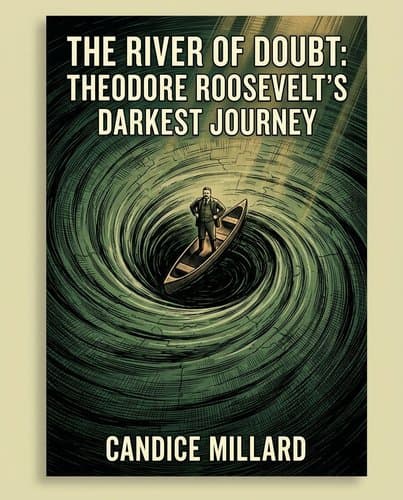
78508_the-river-of-doubt
by Candice Millard
Roosevelt survived grief and political defeat by manufacturing physical danger — a pattern that worked until it drove him into an unmapped Amazon tributary…
In Brief
Roosevelt survived grief and political defeat by manufacturing physical danger — a pattern that worked until it drove him into an unmapped Amazon tributary where every strength he possessed became a liability. The same iron will that built a legend nearly killed him, and everyone who followed him in.
Key Ideas
Survival mechanisms harden into new adversity
The patterns you develop to survive adversity can calcify into compulsions that manufacture new adversity — Roosevelt's flight into physical danger after loss was adaptive until it wasn't. Watch for the pattern repeating at escalating scale.
Resilience and recklessness share hidden roots
Resilience and recklessness share the same roots. The difference is often invisible until the environment changes enough to reveal it — and by then you may already be on the river.
Strengths are determined by environment
Every strength is a strength relative to an environment. Roosevelt's physical bulk, commanding presence, and relentless drive were genuine assets in every context he had ever occupied. The Amazon reversed all three in less than three weeks.
Instilled qualities outlast parental protection
What you deliberately build into another person can outlast your ability to protect them from it. Roosevelt engineered fearlessness in Kermit across decades of deliberate conditioning. By the time he was afraid for his son on the River of Doubt, the engineering was already done.
Competing virtues unified through survival
When two virtues conflict — Rondon's methodical caution and the speed required to not starve — survival does not wait for a resolution. Sometimes the only move left is the dangerous one, and the measure of a team is whether they can make it together.
Who Should Read This
History readers interested in Political Figures and World History who want a deeper understanding of how we got here.
The River of Doubt: Theodore Roosevelt's Darkest Journey
By Candice Millard
10 min read
Why does it matter? Because the qualities that save you can become the qualities that kill you.
The strenuous life worked. That's what people miss. Theodore Roosevelt wasn't born a warrior-statesman. He was a sickly, asthmatic child who decided to manufacture himself into something harder. Every loss, every defeat, every political humiliation became raw material: push further, endure more, convert grief into forward motion. It worked so well that by his fifties he had been a war hero, a conservationist president, and a Nobel laureate.
Then, after losing a third-term bid in 1912, he took the philosophy to its logical extreme. He chose an uncharted Amazonian river — genuinely unmapped, genuinely fatal — because anything less wouldn't register as real. The Amazon didn't defeat it. His own will did — and nearly took his son with it.
Theodore Roosevelt Treated Danger Like Medicine — and the Amazon Was the Largest Dose He'd Ever Taken
On Halloween Eve 1912, more than one hundred thousand people swamped the streets around Madison Square Garden to see Theodore Roosevelt's final campaign rally. His own sister had to climb a fire escape to get in. Dollar seats scalped for seven dollars. Inside, the crowd roared for forty-one unbroken minutes. Roosevelt stepped to the podium with a bullet still lodged near his ribcage, shot two weeks earlier by a Milwaukee bartender who feared a third presidential term would establish a monarchy. He had delivered that speech anyway, coat open to show the bloodstained shirt, manuscript held high to display the bullet holes. That night he did it again, voice filling the arena without a microphone, pounding the flag-draped desk. The man was fifty-four years old and he was magnificent.
He lost anyway. Woodrow Wilson took the White House by 2.2 million votes. The Republican establishment, which he'd abandoned to run as a third-party candidate, called him a spoiler and a megalomaniac. Friends who had competed for his attention stopped calling. The telephone at Sagamore Hill, his Long Island estate, went silent. Roosevelt had been born into New York's highest society. He'd been president. He'd been beloved. For the first time in his life, he was a pariah.
If you stopped there, you'd have a story about a great man absorbing a hard loss with some grace. But you'd be missing the pattern.
Twenty-eight years earlier, on Valentine's Day 1884, Roosevelt had received a telegram calling him home from the New York statehouse. He arrived to find both his mother and his wife dying in the same house. His mother, forty-six years old, still vivid and dark-haired, died of typhoid at three in the morning. His wife Alice Lee, who had given birth to their first child two days before, died of kidney failure eleven hours later. Roosevelt was twenty-five. He marked that diary page with a large black X and wrote seven words: The light has gone out of my life.
Then he handed his infant daughter to his sister, boarded a train, and disappeared into the Dakota Badlands for two years.
He came back changed, filled, as he put it, with vigor and perspective. He had one explanation: "Black care rarely sits behind a rider whose pace is fast enough."
That sentence is the mechanism. Not philosophy, not inspiration — a prescription. He'd been doing this since boyhood, when asthma left him gasping in the nursery and his father told him he'd have to make his own body if he wanted to survive. And every major loss after that triggered the same response: find something hard enough, remote enough, dangerous enough, and ride until the darkness can't keep up.
Now it was 1912, and his wife Edith, who had known him her entire life, watched him retreat to Sagamore Hill and waited. She knew exactly what came next. He would not rest until he found something that could keep pace with him. She feared what it would mean this time.
The Rain Forest Is Not a Garden of Abundance. It Is a Hundred-Million-Year-Old Killing Machine.
The Amazon rainforest looks like abundance. That's the trap.
The soil beneath the canopy is nearly depleted, leached for millennia by the same rainfall that makes everything look so impossibly lush. Trees cannot sink deep roots into that thin substrate, so they grow enormous buttresses instead, flared wooden flanges splaying outward to stay upright. Vines hang in loose coils rather than pulling taut, because host trees sway in storms and a rigid vine would snap. Every visible feature of the forest is a weapon or a defense developed over hundreds of millions of years of unbroken warfare. What looks like shelter is an arms race. When Roosevelt and his men paddled into it, they entered a battlefield dressed as a garden, and you would not know the difference until something started taking things from you.
George Cherrie, the expedition's ornithologist, had spent twenty-five years in jungles across South America — longer than most of the camaradas had been alive. At night on the River of Doubt, he lay awake with every sense strained toward the darkness. What unnerved him wasn't the howler monkeys or the crashing of fallen trees. It was the sounds no one could explain: a clang like iron striking a hollow log, a single piercing cry that came once and didn't repeat. Even the Brazilian guides, men who had grown up on these rivers, couldn't account for them. And then something worse: when an inexplicable sound rang out, every nocturnal creature in the forest went silent simultaneously. Insects, frogs, birds: thousands of them stopping at once. The men lay motionless in their hammocks, waiting in total darkness for whatever came next. The jungle didn't need to attack directly. It only needed to keep them sleepless and anxious long enough for something else to fail.
On March 10, after twelve days on the river covering only seventy-five miles, the men made camp below a rapids and hauled their food up the bank before sleeping — what Roosevelt later called a mild precaution. One of the smaller dugouts had a slow leak. It spent the night tied to their largest canoe, quietly filling. The rope held as it sank, dragging the big canoe with it. Both rolled over the boulders until the moorings finally snapped. By morning, only fragments remained in the eddies.
Two canoes gone. Five left. Not enough to carry the men, food, and equipment forward. They couldn't turn back. They couldn't move forward. They were stranded on an unmapped river, with no idea whether they had covered a fifth of the distance or a tenth.
The jungle hadn't ambushed them. It had simply waited.
Everything Roosevelt Built Over a Lifetime Became a Specific Liability in the Jungle
Imagine a weapon custom-built for one kind of warfare. Forged, tested, proven. Then carried into a conflict where the enemy plays by different rules entirely. The weapon still works. The problem is that the enemy is now aiming at it.
Roosevelt had spent thirty years building a body. After the Dakota Badlands hardened him in his twenties, after a lifetime of boxing, hunting, and treating physical suffering as a form of self-medication, he arrived at the River of Doubt at over 220 pounds, the heaviest man in the expedition by a wide margin. Every pound was earned. Each one marked him as a man who had gone through hard things and come out larger.
The Cinta Larga — the tribe that had been watching the expedition from the trees, invisible — had their own calculations. They were cannibals, but specific ones. Strict rules governed the practice: only after a war victory, only in early evening. The killer could not distribute the meat. The head and heart were discarded; arms, legs, and a round of stomach flesh were grilled. Lean kills were sometimes thrown back into the jungle.
Roosevelt was not a lean kill.
He was also a commander, giving orders, doing less physical work, receiving unmistakable deference from the men around him. Had the tribe attacked, the former president's weight alone would have made him the expedition's finest ceremonial target.
Roosevelt had hunted lions in Africa, bears in the Rockies, game on four continents. On the River of Doubt, he came back from solo hunting trips empty-handed, day after day. He had been nearsighted since childhood; in the Amazon's humidity, his glasses fogged constantly, and the rain, which arrived multiple times a day, made them useless. Rondon, the Brazilian colonel co-leading the expedition, was direct: Roosevelt did not always succeed in seeing the game from afar. Kermit put it more carefully, writing that his father had "skillfully discounted this handicap in advance" — the kind of compliment you offer a man you love and cannot help.
Rondon, meanwhile, woke at four in the morning, swam in whatever water was available, shaved without a mirror, and made every real decision the expedition required. Roosevelt talked. In the canoe, at meals, in the water, at night. He deferred to Rondon on everything that mattered.
Roosevelt Said He'd Rather a Child Die Than Grow Up a Weakling. The Amazon Was About to Find Out.
What exactly does a fearless man build when he sets out to raise fearless children?
Roosevelt found Kermit afraid of ordinary things — cold water, darkness, heights — and fixed every one of them. At Oyster Bay, he discovered a hollow tree with a wide opening twenty feet up, climbed into the branches, and lowered each of his children into it by rope. He stood at the end of docks shouting "Dive, Alice! Now, dive!" until his oldest daughter, trembling with fear, threw herself into the water. He invented the family "scrambles," cross-country walks with one absolute rule: through obstacles, over them, or under them, never around. Haystacks, ponds, fences, streams, all of it taken head-on. The point wasn't to clear the obstacle. The point was to train the nervous system out of the habit of hesitation.
He stated his principle plainly: he would rather one of his children die than grow up a weakling.
He meant it as an aspiration. A father's rejection of the coddled childhood he'd been given, and had to undo at great personal cost. The words read differently once you know where they end up.
On the Africa safari, Kermit disappeared alone into the bush for two months and came back, his father reported, a better hunter. Roosevelt wrote to his sister that Kermit's recklessness made him want to beat him. Proud. Frightened. Both in the same sentence.
On the River of Doubt, Kermit rode at the head of the expedition. First into every unknown bend, first past every submerged obstacle, first to plant the surveying rod in whatever waited around the next curve. Roosevelt admitted that the fear of some fatal accident befalling his son was a constant nightmare.
On March 15, 1914, Rondon ordered a portage around an impassable set of rapids and went ahead to scout the route. Kermit, waiting at the bank, decided to check whether the right channel offered a passable alternative. He ordered his camaradas, Joăo and Simplicio, into the current toward a small island splitting the river. The right channel was no better. As they tried to return, their canoe was caught by a whirlpool and driven over a low waterfall. The boat survived the drop but was immediately pulled into a second vortex, taking on water. Joăo jumped into the river and grabbed the bow rope to haul the canoe toward shore. The current tore it from his hands, flipped the hull, and hurled it downstream. The last thing Joăo saw before the boat vanished was Simplicio and Kermit clinging to the capsized bottom.
Roosevelt and Cherrie ran the bank. They found the canoe crushed to splinters in the boulders below.
Kermit survived. Simplicio was never found.
Roosevelt had feared some version of this moment since Africa. His son alive, someone else dead, the margin between the two outcomes a few feet of current. He had spent decades engineering a man who responded to hesitation by eliminating it. The training held — it always held. The Amazon was simply the first place where that cost was paid by someone who hadn't asked for the lesson.
The Only Move Left Was the Dangerous One
At some point on the River of Doubt, the careful choice and the suicidal choice became the same choice.
The expedition's officers did the math during the four days they spent cutting a new dugout from a rubber tree. They had roughly 35 days of food for the camaradas, 50 for the officers — packed with what now looked, against the arithmetic, like heartbreaking thoroughness. They'd covered 75 miles in twelve days. Under seven miles a day. They didn't know whether they had 100 kilometers remaining or 800.
Do the math yourself: at seven miles a day with 35 days of food, they could cover 245 miles. If the river ran longer than that — and they had no way of knowing — the last stretch would be traveled starving.
Rondon had been running a fixed-station survey, a disciplined, accurate method that required Kermit to land, clear the bank, and plant a sighting rod while Rondon took measurements. It was careful. It was right. It was killing them.
They decided to run every rapid. Not the safe ones, not the manageable ones. Every rapid, regardless. Starvation outweighed drowning as a risk calculation; they could agree on the math even if the math was terrifying. Rondon abandoned his survey method for a faster, less accurate technique that required Kermit, riding ahead in the lead canoe, to simultaneously track Rondon's sighting line and watch the river for whatever came next. Six rapids in four hours. Roosevelt's canoe caught a vortex, filled so fast that Cherrie and the expedition's doctor threw themselves overboard to lighten it. But they made ten miles. In a half-day.
That night, Cherrie wrote in his diary that the following day was to be one of tragedy. The men celebrating their first real progress couldn't read it yet. You can.
The Strenuous Life, at Its Limit
Picture Roosevelt at 105 degrees on a black river in the rain, reciting Kubla Khan in an endless loop — a poem about a palace built from pure will, recited by a man who spent fifty years building exactly that. Cherrie has his diary open. Twenty-five years in the Amazon, not given to drama. He writes that Roosevelt will not survive the night.
What the book asks you to hold: he built toward here. Not the fever — the man. The one who answered every loss with something harder, who engineered fearlessness into his son through decades of deliberate conditioning, who followed his own philosophy to its logical end. The strenuous life delivered him precisely here. Whether that makes it tragic or admirable — whether you can separate those two things at all by the end — is the question the book refuses to answer. So do we.
Notable Quotes
“and hissed; but Roosevelt turned towards us and cried out”
“a chivalrous act which made him immediately popular. During his sophomore year at Harvard, his father—”
“—died from stomach cancer at the age of forty-six. Blindsided, Roosevelt reeled from the greatest loss of his young life.”
Frequently Asked Questions
- What is 'The River of Doubt' about?
- The River of Doubt chronicles Theodore Roosevelt's near-fatal 1914 expedition down an uncharted Amazon tributary following his presidential defeat. The book reveals how Roosevelt's exceptional traits—relentless drive, fearlessness, and refusal to yield—that made him an effective leader became the very forces that led him toward catastrophe in an unfamiliar and hostile environment. Candace Millard's narrative examines the intersection of personal ambition, physical endurance, and survival against the backdrop of the Amazon's unforgiving landscape.
- What are the main lessons about leadership from Roosevelt's Amazon expedition?
- Roosevelt's story illustrates that the patterns you develop to survive adversity can calcify into compulsions that manufacture new adversity. His flight into physical danger after losing the presidency was adaptive until the environment changed. Resilience and recklessness share the same roots; the difference becomes visible only when circumstances shift. Every strength is contextual—Roosevelt's physical bulk, commanding presence, and relentless drive were genuine assets in every environment he had occupied until the Amazon reversed all three in less than three weeks.
- What does the book reveal about how Roosevelt's strengths became weaknesses?
- Roosevelt's strengths were entirely contextual. His physical bulk, commanding presence, and relentless drive were genuine assets in every environment he had previously occupied. However, the Amazon's conditions reversed all three advantages within three weeks. His bulk made him slower to recover from illness in extreme heat; his commanding presence had no currency with disease and starvation; his relentless drive pushed him to continue despite warning signs his body couldn't endure. The environment stripped away the conditions that made these traits advantageous.
- What does 'The River of Doubt' reveal about the relationship between resilience and recklessness?
- Resilience and recklessness share the same roots, and the difference between them is often invisible until circumstances shift. Roosevelt's adaptive response to loss—seeking physical challenge and danger—was sustainable in contexts where he maintained control. But the Amazon stripped away that control. The book also explores how leaders shape others through deliberate conditioning: Roosevelt engineered fearlessness in his son Kermit across decades. By the time Roosevelt feared for Kermit's safety on the River of Doubt, that fearlessness had become an ingrained vulnerability.
Related Book Summaries
Read the full summary of 78508_the-river-of-doubt on InShort