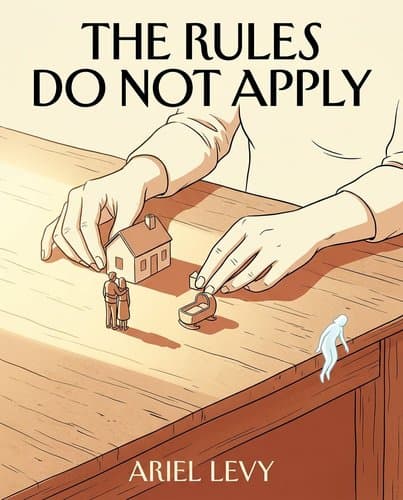
32572166_the-rules-do-not-apply
by Ariel Levy
Fearlessness and willpower can feel indistinguishable from a life plan—until catastrophic loss proves otherwise. Ariel Levy's memoir excavates what survives…
In Brief
The Rules Do Not Apply (Marc) traces Ariel Levy's collision with the limits of radical self-determination — the feminist promise that will and ambition can design any life. Through devastating personal losses, it examines self-deception, grief, and the reckoning that follows when ambition fails, offering readers a sharper framework for distinguishing genuine courage from the refusal to see clearly.
Key Ideas
Courage requires brutal honesty about yourself
Fearlessness and the refusal to see clearly can feel identical from the inside. The diagnostic question is whether your boldness ever gets turned on your own choices — not just on the world.
Failed relationships reveal your listening gaps
In any relationship that fails, the more productive question is not what the other person chose not to hear, but what you chose not to hear from them at the very founding moment.
Self-blame masks grandiose illusions of control
Intense self-blame after a loss can be its own form of grandiosity — the belief that you are powerful enough to have caused what chance or biology delivered regardless of your behavior.
Loss opens vision into others' suffering
Grief, unlike ambition, forces you to see other people's interior lives. Catastrophic loss opens vision sideways into other people's suffering in ways that drive and success rarely do.
Limitations reveal what truly survives
'Everybody doesn't get everything' is not resignation — it is the prerequisite for finding out what actually survives when the plan falls away completely.
Who Should Read This
Readers who connect with first-person stories about Memoir and Resilience and want to see the world through someone else's eyes.
The Rules Do Not Apply
By Ariel Levy
10 min read
Why does it matter? Because the kind of person who refuses to accept limits is exactly the kind of person who can miss what's right in front of them.
Ariel Levy was nineteen weeks pregnant, alone in a hotel bathroom in Ulaanbaatar, when she delivered a son who lived for a few minutes. She photographed him before she called for help.
Levy wasn't the kind of person who believed she could get away with anything. She was the kind of person who believed she had already done the work — had earned, through ambition and fearlessness and deliberate construction, a life large enough to hold everything she wanted. That is a different and more dangerous belief. It leaves no room for bad luck. It has no vocabulary for the kind of loss that doesn't arrive as punishment for a mistake but simply arrives, impartial, biological, contemptuous of how carefully you planned. This memoir is what happens when a woman who has spent her entire adult life treating her own story as something she authors discovers, in the cruelest possible sequence of events, that authorship was always the wrong word for what she was doing, and that learning to grieve the illusion of it might be the only work that actually matters.
Fearlessness Can Look Exactly Like the Refusal to See Clearly
In 1996, at 22, Ariel Levy was a typing assistant at New York magazine. Her actual job was inputting the crossword puzzle, squinting between a paper printout and her screen to get the black and white squares in order. She seethed. Instead of waiting for someone to decide she was ready, she took the subway far into Queens with her friend Mayita and a reporter's notepad. They found an enormous, dim bar in Rego Park where very large women danced, held lingerie pageants at four in the morning, and flirted with their admirers. The air smelled stagnant. The drinks were strong. The women wore jewel-toned sequined gowns with elaborate false lashes, and Levy walked straight up to them and asked them to tell her their lives.
They did. They talked about fat little girlhoods, about men who might love them for their bodies rather than themselves: the complicated mathematics of desire and shame. When Levy walked back to the subway at 5 AM, what she felt was not relief but amazement at what she'd found: another world, just one hour from her apartment. The piece ran under the magazine's "Women's LB" column and paid her more than a month's salary. It confirmed a conviction she'd carried since childhood: she could walk into any room, ask anyone anything, and the story would come.
Levy's courage is real, and the bar shows it. She writes about the part of her that was always competent talking the frightened part into the room, and in that Queens bar at four in the morning, that voice simply said: what we're writing matters more than your fear. Most people at the edge of that bar would have turned around. Levy walks in with her notepad. You feel the appeal of that before you start to wonder what else it might be doing.
Because Levy names the other thing it is. Right after the nightclub story, she writes that the belief you're exempt from the rules everyone else follows is what makes a visionary, and also what makes a narcissist. She states this plainly and moves on, which is itself a performance of what she's describing. The insight is real. The speed at which she passes through it is also revealing.
A decade later, the same certainty is operating, only the canvas is domestic. Levy and her partner Lucy are sitting on the living room floor of a house they've just bought, mapping a future on butcher paper: Lucy's solar company, Levy's career as a foreign correspondent, a child penciled in between 2011 and 2012. The baby Levy draws comes out looking like a cartoon tooth. Lucy fixes it and adds a speech bubble — Do I even exist? — and they eat popcorn and keep planning. That caption is the memoir's cruelest detail, and its cruelty lies in Levy's certainty: she is so persuaded of her own authorship that the child she keeps deferring barely registers as a question.
Both People in a Marriage Can Choose Not to Hear What Would Save It
In the summer before their wedding, with Lucy's only bathroom gutted for renovation and both of them showering with the garden hose, Levy and Lucy sit on the back deck with Meyer lemon vodka sodas they'd given some breezy California name, drafting their vows. The vows are warm and irreverent — promises to care for each other through illness and diminishing looks, not to micromanage the garden, to keep things festive. Then Lucy asks about fidelity.
Levy says she can't honestly commit to that for an entire lifetime. She has a philosophy ready: same-sex marriage isn't even legal yet. They're inventing this entirely. Why replicate rules inherited from an era more concerned with bloodlines and property than with love, when they could build something better suited to who they actually were?
The conversation moves on. The evening moves on.
Two sentences near the end of that chapter carry the weight of the whole marriage. For years afterward, Levy writes, she resented Lucy for choosing not to hear the warning she'd given plainly on that deck. Then it occurred to her that she had also chosen not to hear how much monogamy mattered to Lucy.
The first lets you read Levy as someone who at least tried to be honest. The second closes that reading. What happened on the back deck wasn't one person failing to deliver a warning — it was two people in the same California dusk, each listening selectively for what cost them nothing. Levy heard her own courage. Lucy heard what she needed to say yes.
The affair that erupts years later — obsessive, consuming, eventually confessed — can read as Levy's failure alone. She names it that way, and she's not wrong. But the foundation was laid crooked on that deck, and both women helped lay it. What neither could manage, at the moment they were making this agreement, was to hear the other person clearly enough to either fix it or walk away. That mutual, chosen silence is where the marriage actually ends — years before either of them knows it.
Blaming Yourself for a Random Disaster Is Just Another Form of Believing You're Exceptional
On the bathroom floor of the Blue Sky Hotel in Ulaanbaatar, at nineteen weeks pregnant and alone, Levy gives birth. The baby is translucent and pink and very small, and he is alive — his lips opening and closing, every finger and toenail present, his eyebrows just visible, almost not there yet. She holds him up to her face and kisses his forehead, feels his skin against her mouth. No scissors: she pulls the cord free herself. She watches his skin turn purple. Before calling for an ambulance she takes a photograph — because she fears that otherwise she will never believe he existed.
The doctor the next morning tells her she had a placental abruption, a condition that usually affects heavy cocaine users or women with high blood pressure. Sometimes it happens because you're old. He repeats what he said the night before: there is no causal connection between air travel and miscarriage. She could have been anywhere.
Levy concludes that she is responsible.
She writes it plainly: she had flown to Mongolia for vanity and selfishness, and Mongolia had punished her for it. She had wanted to be the kind of woman who'd go to the Gobi Desert pregnant. She had scorned the optimal-pregnancy culture — the wipe warmers, the $600 strollers, the friend who treated coffee like crack — and had meant to raise her child on fearlessness. When the catastrophe arrives, the logic writes itself: her fearlessness killed him.
Every doctor she consults confirms there is no causal link. She performs sanity in each consultation — no crying, rational questions — and believes none of the answers. She keeps taking folic acid. Just in case. What she actually wants to ask the specialist at Weill Cornell, seated behind his long wooden desk with no baby photographs on the wall, is the one thing she can't say out loud: How do I get him back?
The self-blame feels like reckoning. But Levy catches herself doing to others the exact thing others do to her. The moment she hears someone has lung cancer, the words Did he smoke? arrive before she can stop them. She knows why: she wants to believe that if her people don't smoke, they are ineligible. She names the mechanism without flinching. Hunting for the victim's error isn't compassion — it's self-insurance. If they did something wrong and I haven't done that thing, I'm safe.
I flew to Mongolia pregnant is her version of Did he smoke? It is the answer that makes the disaster her fault, which makes her powerful enough to have prevented it, which makes the world the kind of place where sufficient care and right behavior protect you. But the doctors have already answered this. Her body was 38. Placental abruption sometimes just happens to older women. That's the whole story.
The self-blame is not confession. It is the old grandiosity wearing grief's face — the same conviction that she is exceptional, now running in reverse: not I can do anything but I caused everything. Both directions carry the same premise. She is powerful enough that what happens to her happens because of her. Accepting that the catastrophe came from nowhere — that it was just a body, just time, just bad luck — means accepting she was never in control to begin with.
The Losses That Break You Are Also What Let You Finally See Other People
Her mother comes to stay after Mongolia, sleeps beside her in a green flowered nightgown chosen because the seams don't catch on scar tissue. Levy, for the first time, really looks. The scars divide her mother's torso into territories: the ridged, collapsed skin where her breasts had been, the seamed stomach where surgeons had taken tissue to rebuild one breast after the first cancer, then a second mastectomy when the second came and her mother decided she was done with hospitals for good. No reconstruction. Since puberty her mother had been aware of men's eyes on her breasts; now she noticed those same eyes registering what was no longer there.
Levy had been scared during both cancers, late twenties for the first and early thirties for the second. But she had never thought about what it felt like to be inside her mother's life: a single woman fighting death as she turned sixty, then living in a body remade by amputation, chronic pain threaded through every ordinary day. Her mother had her own suffering, her own private reasons. She writes she could never see this before losing her baby, before motherhood briefly sharpened some things and distorted others. Nothing looked entirely the same afterward.
That gap, between watching and actually seeing, is what ambition couldn't close. Levy had been walking into rooms and persuading strangers to tell her their lives since she was twenty-two, reading people for a living. But the woman sleeping next to her in the green nightgown had been carrying that remade body for years without Levy ever really looking. It took losing a child to finally make her see a parent.
The Al-Anon meeting comes months later. The room is fluorescent-lit, folding chairs, strangers who have agreed to listen. A young Eastern European woman describes coming home to find her boyfriend drunk, the fury of it, calling him pathetic. Levy sits there and hears her own voice. "You're the worst," she had told Lucy. She had looked Lucy in the face and said it. All those years of trying to decode Lucy's behavior, to understand her mother's old choices, to analyze her way toward some outcome: none of it had changed anything. Both situations were what they were, entirely outside her reach.
For twenty years she had entered strangers' lives and come out with a version of them she could argue for on the page. At that meeting she realizes the same drive had done nothing in her personal life except extend her suffering. The sharpest observers are sometimes the last to know, not despite their precision but because of it. You can spend years decoding a person instead of simply being with them.
Accepting That You Won't Get Everything Is the Harder Freedom
The sign of what that looks like had been in front of her for years. In her early thirties, Levy profiled Maureen Dowd — then 53, sole female columnist at the New York Times, Pulitzer winner, living alone in a Georgetown brownstone with blood-red walls, feathered fans, motion lamps, a dozen vintage martini shakers, toy tigers in every material you can name. The room was its own argument: a portrait of someone who had built exactly the life she wanted from exactly what she was, with no apology for what wasn't there. When Levy asked about children, Dowd said: "Everybody doesn't get everything."
What she arrives at isn't resignation. Something more durable than the freedom she started with.
At thirty-two, Levy heard defeat in it: a woman explaining what she'd settled for. Years later, after Mongolia, after her son, after her marriage, the same sentence sounds entirely different. Not defeat: the clearest description she'd encountered of what growing up requires. Limits aren't punishments. They're the basic condition of being alive, which doesn't arrange itself around anyone's particular story of herself.
The difference between those two readings is the whole book. You can spend years gripping the conviction that you'll outmaneuver the constraints. Eventually, if you're paying attention, you stop. What you lose is the illusion of total authorship. What remains is harder to name but more durable: after the son, the marriage, and the house have all gone, what she had before she tried to have everything — the impulse to ask questions, to follow them somewhere. Not a triumphant ending. An intact one.
What Survives When You Stop Being the Author
The suitcase goes back on the plane, refilled with notebooks where the maternity clothes had been. No plan this time — no butcher paper, no cartoon tooth, no year penciled between career milestones. Just the original impulse she carried into a Queens bar at 22: the need to ask, to follow the question wherever it goes. You can read the whole book as a story about what ambition costs — and it is that. But it's also something quieter: evidence that what survives the loss of everything you tried to build is older and steadier than any of it. Surrender doesn't feel like winning. What Levy finds, when she finally stops gripping, is not freedom from difficulty but an unexpected solidity underneath it. Not triumph. Just the person she always was, still here, still following the question.
Notable Quotes
“You just cry, cry, cry.”
“You want toast and tea?”
“No. I want that one.”
Frequently Asked Questions
- What is The Rules Do Not Apply about?
- The Rules Do Not Apply traces Ariel Levy's collision with the limits of radical self-determination—the feminist promise that will and ambition can design any life. Through devastating personal losses, the book examines self-deception and grief, offering a reckoning that follows when ambition fails. It provides readers with a sharper framework for distinguishing genuine courage from the refusal to see clearly. The narrative explores how catastrophic loss fundamentally changes one's perspective on life and relationships.
- What are the key lessons from The Rules Do Not Apply?
- The book offers several transformative insights. Fearlessness and the refusal to see clearly can feel identical from the inside—the diagnostic question is whether your boldness gets turned on your own choices. In failed relationships, the productive question isn't what the other person didn't hear, but what you chose not to hear from them. Intense self-blame after loss can be its own form of grandiosity. Grief forces you to see other people's interior lives in ways that success rarely does, opening vision sideways into others' suffering.
- How does The Rules Do Not Apply address the relationship between ambition and grief?
- The book reveals a profound contrast between ambition and grief. While ambition drives people forward with focused intensity, grief operates differently—it forces you to see other people's interior lives. Catastrophic loss opens vision sideways into other people's suffering in ways that drive and success rarely do. Levy suggests that intense focus required for ambition creates blind spots, whereas grief clarifies what matters. The key insight is that 'Everybody doesn't get everything' is not resignation — it is the prerequisite for finding out what actually survives when the plan falls away completely.
- What does The Rules Do Not Apply teach about self-blame and grief?
- Levy offers a counterintuitive insight: intense self-blame after loss can be its own form of grandiosity—the belief that you are powerful enough to have caused what chance or biology delivered regardless of your behavior. This reframing helps readers understand that excessive responsibility for catastrophic events can reflect narcissism rather than accountability. By recognizing this pattern, people move beyond unproductive guilt toward genuine understanding of loss. The book suggests grief's real gift is not self-condemnation but expanded ability to see other people's suffering and interior lives with clarity.
Related Book Summaries

Read the full summary of 32572166_the-rules-do-not-apply on InShort