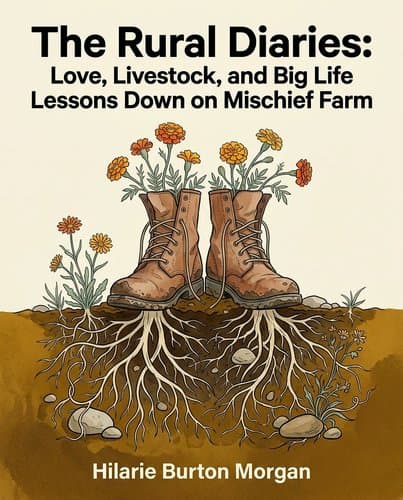
51082172_the-rural-diaries
by Hilarie Burton Morgan
Leaving Hollywood's approval machine behind, Hilarie Burton Morgan discovers that physical labor—laying stones, boarding alpacas, saving the town candy shop—is…
In Brief
Leaving Hollywood's approval machine behind, Hilarie Burton Morgan discovers that physical labor—laying stones, boarding alpacas, saving the town candy shop—is the only honest syntax for grief, marital repair, and the kind of moral courage that lets you finally tell the truth about your own life.
Key Ideas
Physical labor heals broken relationships
Physical labor is a legitimate syntax for grief and marital repair — when words fail a relationship, find something to build together. The garden stones Jeff lays without speaking accomplish what months of avoidance couldn't.
Active custodianship preserves community institutions
The institutions your community loves will die the moment everyone assumes someone else will save them. Active custodianship — buying the candy shop, showing up to scrub its floors on your hands and knees — is what separates a living community from a town people used to live in.
Independence enables honest moral courage
Economic and social independence is the infrastructure of moral courage. You can only afford to tell an uncomfortable truth once you've built something real enough that losing your old life doesn't mean losing everything.
Confidence builds competence through action
The want-to creates the how-to: faking competence to get into a situation where you'll develop real competence ('Of course I can board alpacas') is a legitimate strategy — not recklessness, but the only way to become someone capable of things that currently feel impossible.
Structure enforces authenticity in relationships
Find the place and the relationship that won't let you approximate. The farm's most important function wasn't scenic — it was structural: it made performing your way through a marriage structurally impossible, because the fields still had to be mowed whether or not you were being honest with each other.
Who Should Read This
Readers who connect with first-person stories about Memoir and Marriage and want to see the world through someone else's eyes.
The Rural Diaries: Love, Livestock, and Big Life Lessons Down on Mischief Farm
By Hilarie Burton Morgan
9 min read
Why does it matter? Because you cannot tell the truth about your life until you've built one you actually own.
The farm books never mentioned the mud. Not the kind that swallows a Suburban whole on moving day before a single box is inside, not the kind you navigate three-quarters of a mile along your brand-new property praying you don't clip a fence, not the kind that makes lying to your husband about where you parked feel like the only rational option. They also skipped the broken hand bones, the favorite chicken killed by a Cinderella pumpkin mid-swing, and that Googling "woman screaming in the woods" is a perfectly reasonable Tuesday evening activity. Hilarie Burton Morgan read those books anyway, bought that farm anyway, and found something none of them could advertise. The farm is the occasion. What it's actually about is what happens to a woman when she plants herself somewhere real and refuses to be moved.
Two People Whose Hometowns Were Erased Built a New One Worth Protecting
Jeff crouches under a catalpa tree on a horse farm outside Rhinebeck, New York, and touches two hand-carved stones he's found in the dirt: Mischief, 1936 to 1950. Mischief 2, 1951 to 1960. A cat lover built this place, probably a century ago, and cared enough to chisel his animals into the land before he was done with it. Hilarie runs her fingers along the same marks. On the drive home she asks Jeff whether they should call it Mischief Farm. There was never going to be any other name.
Both of them had already lost a hometown to a corporation. Hilarie grew up in Sterling Park, Virginia (population 9,000, rural enough that she could hear cows lowing from her high school) until Amazon opened a massive headquarters there and 200,000 people moved in and erased it. Jeff's version: Kirkland, Washington, once a small waterfront suburb of Seattle where he camped with Boy Scouts and rode a mean old pony at his grandmother's pig farm, until Boeing arrived and swallowed the whole thing. Neither of them could raise children where they'd been raised. The place didn't exist anymore.
So when they crossed the Kingston Bridge into Rhinebeck and found a town with century-old shops, a candy store with Cow Tales on the shelves, and strangers who actually said hello — they didn't feel charmed. For two people whose childhoods had been absorbed by corporations, finding a village like this felt less like discovery and more like recovery.
The book keeps returning to one obligation: when a community genuinely nurtures you, it isn't enough to live in it. You have to protect it back — the people, the rhythms, the small shops that could disappear. Mischief Farm becomes the physical shape of that commitment. Fields that have to be mowed, wood that has to be chopped, animals that have to be fed. No approximating. They wanted to be part of what made the place impossible to absorb.
The Farm Doesn't Let You Fake It — and Eventually, Neither Does the Relationship
Jeff hands Hilarie a box wrapped in creamy white paper on her birthday (someone else did the wrapping), inside a sweltering New York apartment that still smells faintly of cat despite days of vacuuming. She opens it to find a white gold watch with diamonds across the band. It's beautiful. It's completely wrong.
She chokes out a thank-you. He storms out at midnight and doesn't come back until four.
The watch is a failure of attention. Hilarie comes from a family where gifts are proof of looking closely: her father hand-planes cutting boards from wood he's chopped himself, her brother wrote their infant son a book of fairy tales with a handmade shield and sword tucked inside. A diamond watch from a store, wrapped by someone at the store, says: I didn't know what to get you, so I got you something expensive. Jeff was performing love at the exact moment she needed him to actually see her. She never tells him any of this — she stews while he storms out, and two weeks later he leaves for another film.
The farm holds to the same standard. Mischief Farm's first moving day arrives after a warm spell thaws the ice, which sounds like good fortune until Hilarie drives her Suburban down what she thinks is a loop road and discovers it's a seven-foot gap between fences and three-hundred-year-old trees, the ground now pure mud. By the time the groundskeeper pulls her out with a John Deere tractor, she'd carved knee-deep trenches across three-quarters of the carefully tended property. When Jeff asks why the Suburban is parked at the barn, she says she moved for the trucks. She never mentions the trenches.
The farm books she'd spent the whole winter poring over were full of orderly gardens and golden light. None of them covered broken bones from an antique deer head that snapped her hand during the cabin move (she kept unpacking for four days before urgent care confirmed two fractures), or a flu that took her and Gus down within the first week. Jeff's verdict on all of it: they'd earned three hundred points for being farmers, surely.
That's the shape of both things — the farm and the marriage. You show up performing the version you've imagined. The ground, or the other person, corrects you.
A Town's Best Institutions Die the Moment Everyone Assumes Someone Else Will Save Them
The town turned out to work the same way.
The text from Janice — Honey, call me — arrives on a Tuesday afternoon in April. Hilarie knows immediately something is wrong: Janice runs the antique shop next to Samuel's, and she knows Hilarie hates phone calls. Ira Gutner, the curly-haired owner who'd introduced the Morgans to their town one customer at a time, has collapsed. Heart failure. Hilarie drops to the floor of her bedroom.
The town goes loud. Gus's teacher texts. Shop owners text. School parents text. The bench in front of Samuel's fills overnight with flowers, cards, and stuffed animals. The funeral home draws a line that wraps around the block. Everyone had considered Ira something closer than a friend: an uncle, a brother, adopted son. That's what he had made himself: a man who memorized every customer's name, stayed open for strangers, built twenty years of gathering around coffee and chocolate bark and penny candy. The grief was public. Nobody pretended otherwise.
Jeff is in Durango filming a Western, unreachable for days, when he finally calls late that night. He doesn't want to talk. He wants to come home. But before they hang up, he says one thing: find John Traver and make sure he doesn't close the shop. A man a thousand miles away doing dangerous stunts on an unbroken horse, and his first concern is the candy store.
A few weeks later at a sushi restaurant, the moment they all sit down, Jeff floats the idea: they should buy Samuel's. No deliberation. Everyone on board. This is a preservation initiative. If you love a place like this, you don't get to be a passive beneficiary of it.
Everything hinges on one question Hilarie puts to John Traver, who's been working six unpaid days a week since Ira's death: did he want to be Rhinebeck's candy man for the rest of his working life, or was Samuel's just a chapter? His family's roots in Rhinebeck go back to the 1700s; streets carry his family's name. He doesn't hesitate. He wants to do this forever. That answer makes the purchase something other than charity: a town deciding its own institutions are worth fighting for before someone with a spreadsheet decides it's underperforming.
When Grief Can't Find Words, the Body Goes Looking for a Different Language
Jeff finds her in the vegetable garden one afternoon, blood dried into the creases of her knuckles from pulling stones out of a landscaping pile and setting them into paths between the raised beds. He asks her to talk to him. She says she's fine. You know she isn't, and so does he.
After losing a pregnancy she'd kept secret for a month, she and Jeff spend six months in near-parallel lives inside the same farmhouse. He vanishes to the garage to chop wood until dinnertime; she hides in the garden or disappears into town. He won't enter a room until she leaves it. She stops telling him where she's going. The things she needed him to say months earlier — hold me, I'm sorry, I feel it too — calcify into a running script of grievances she can't voice. Every time she tries to picture the conversation that fixes it, the words don't come.
What she doesn't expect is what he does next: he goes and gets rocks. No speech. No confession. He just starts laying paths beside hers, following her lines through the garden. Each path says what he hasn't been able to say in months. The repair doesn't begin with language. It begins with two people doing the same physical work in the same direction, close enough to touch if one of them reaches.
Eventually it becomes a conversation about failure, about loneliness, about whether the farm and the family are worth the fight. But the conversation only opens because the labor created the space for it. Six months of parallel grieving dissolved not through the right words but through stone placed next to stone.
You Can Only Afford to Tell the Truth Once You've Built Something Real Enough to Stand On
She's lying in bed live-tweeting episodes of her own show, heavily pregnant, when a stranger's tweet surfaces something from twenty years back. Someone has found the clip: Ben Affleck groping a nineteen-year-old Hilarie Morgan on camera during a live broadcast. She finds the footage. She watches herself laugh. "Well, he played that card, huh. Ha ha." She watches a teenager performing cheerfulness the way you perform it when the alternative is crying on camera and everyone discovers you can be broken.
She posts two words back — she remembered — then attaches the clip and adds what she couldn't say at nineteen.
October 2017, and Hilarie had been performing that cheerfulness — that good-sport toughness — for the better part of a decade. She'd believed the posture would protect her. It hadn't. Mark Schwahn, the showrunner of her biggest TV role, had spent years pitting female actors against each other, pressuring them into unwanted scenes, touching without consent. She'd left rather than report it. Stopped auditioning. Folded her childhood dream of being an actress because the game itself was rotten. What changed was what she'd built.
By the time eighteen women from her old show co-signed a joint letter about Schwahn, Hilarie was a co-owner of the local candy store, a board member at Astor (a residential treatment center for children who'd survived severe abuse), and a farmer with animals that needed her every morning. E! News refused to cover the letter because his current series aired on their network; they'd run multiple stories on the single-second Affleck grope but stayed silent when nearly two dozen women described years of sustained harm from someone they were actively paying. The machinery of suppression counted on the women having too much to lose.
Hilarie didn't. Not anymore.
When a reporter at Variety told her he needed specifics — that vague allegations would be dismissed as drama — she talked to him for five hours. Other women were warned off by their agents and publicists. Some called her in tears to apologize. She understood; she'd made the same calculation for years. But she looked at Mischief Farm in full autumn, at the candy store, the children's home, her son, her husband, her daughter kicking inside her, and landed somewhere different: If I never work on another show or film, I'll be okay.
The farm hadn't given her a backup plan. It had given her the thing that makes losing the plan survivable. By the end of that year, Schwahn was fired.
The Real Payoff Is What You Can Now Give Away
She sits down to write the announcement and realizes she can't write it the way anyone else would.
For five years she'd opened her laptop at the kitchen table and watched celebrity announcements roll past — magazine covers, corporate-sponsored baby showers, performances of uncomplicated joy from people who didn't seem to know that something could go wrong. She'd miscarried, more than once. She knew. And now her daughter George has arrived, and Hilarie is the one who has to say something.
So she starts somewhere else. She describes the first miscarriage, the names they'd already chosen. She describes the losses that followed. She writes: I don't want her birth to cause any other woman to weep at her kitchen table. Then she introduces George.
The response is a flood. Thousands of women send their own stories — miscarriages, failed treatments, years of quiet grief carried through other people's celebrations. Hilarie hadn't known how many people were holding this. She reads every message and cries.
The farm, the candy store, the children's home — they gave her a life concrete enough to survive the losses. But the Instagram post does something the farm alone couldn't: it refuses the performance. It says the thing she'd needed someone to say for five years: I had dark days too, and I see you having yours. And because she says it plainly, thousands of strangers feel less alone.
What the Marigold Seeds Were Always About
Every guest left that wedding carrying a packet of seeds Hilarie had grown herself, little paper envelopes of something she'd put her hands into. You know what it cost: two miscarriages, a marriage that went six months without real words, a career she nearly surrendered rather than keep pretending the game was fair, and a public reckoning with harms she'd laughed off at nineteen. Three things came out the other side: a daughter named George, born on the farm; a community that held her through every failure; and a brand. She and Jeff scrawled MF on a scrap of paper — Mischief Farm, Mama Farmer — and were well aware what else those initials stood for. She writes that anyone could have done what they did. It's a lie — not everyone gets this chance. But it's also the only true thing: she grew something that nearly broke her, then handed it to you.
Notable Quotes
“Oh, that's our retirement dream,”
“We wanna do that someday.”
“I think we should share the farm with people,”
Frequently Asked Questions
- What is The Rural Diaries by Hilarie Burton Morgan about?
- The Rural Diaries (2020) follows actress Hilarie Burton Morgan as she trades Hollywood for a working farm in upstate New York. The memoir explores how physical labor, community stewardship, and building something real from scratch become the foundation for honest relationships, personal courage, and a life that doesn't depend on performance. Burton Morgan chronicles her journey leaving entertainment to create authentic existence with her family, discovering that genuine accomplishment and self-worth emerge from tangible work rather than public recognition.
- What are the key life lessons in The Rural Diaries?
- The Rural Diaries emphasizes that physical labor addresses relationship struggles when words fail—building something together repairs connection. It stresses community institutions require active custodianship; passive hope isn't enough. Burton Morgan highlights economic independence enabling moral courage to speak uncomfortable truths. The book suggests strategic optimism—confidently tackling unfamiliar tasks—develops real competence. Ultimately, the farm's greatest value was structural: it made performing through marriage impossible, forcing authentic connection or confronting unavoidable realities. Independence becomes the infrastructure supporting honest living in all relationships.
- How does physical labor help heal relationships in The Rural Diaries?
- Physical labor plays a transformative role in Burton Morgan's marriage in The Rural Diaries. According to the memoir, "the garden stones Jeff lays without speaking accomplish what months of avoidance couldn't." This demonstrates that shared work and tangible creation address what conversation alone cannot resolve. The farm became a space where authentic effort replaced performance, enabling genuine connection through collaborative purpose. Physical labor transcends its practical function to become a language of repair and commitment, proving that sometimes doing replaces talking.
- What does The Rural Diaries reveal about community stewardship?
- The Rural Diaries presents critical insight about institutional survival: "The institutions your community loves will die the moment everyone assumes someone else will save them." Burton Morgan illustrates this through active participation—buying the candy shop and scrubbing its floors on hands and knees exemplifies the hands-on commitment required. The memoir argues thriving communities versus dying towns differ in whether residents choose active custodianship over passive hope. Real community health depends on individuals taking personal responsibility for institutions they want to preserve.
Related Book Summaries
Read the full summary of 51082172_the-rural-diaries on InShort