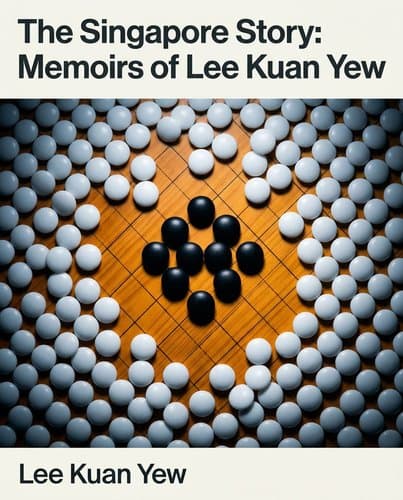
326981_the-singapore-story
by Lee Kuan Yew
From colonial outcast to economic miracle, Lee Kuan Yew's memoir reveals the ruthless clarity behind Singapore's rise: power isn't opposed to good…
In Brief
The Singapore Story: Memoirs of Lee Kuan Yew (1998) recounts how Lee Kuan Yew built a viable nation from a small, resource-less island expelled from Malaysia in 1965.
Key Ideas
Institutional Design Against Early Infiltration
Design your institutions before your enemies attempt to capture them — after the PAP nearly lost control of its own branches in 1957, LKY modeled a two-tier membership system on the College of Cardinals: only pre-approved cadres could vote for party leadership, closing the circuit against infiltration
Control Apparatus Precedes Policy Effectiveness
Power is the precondition of every other value — without controlling the police, the broadcasting system, and the party's internal structure, even correct policy is irrelevant, as LKY saw when he had to build all three simultaneously in his first months as prime minister
Organized Base Creates Capture Vulnerability
The mass base you need to build can create the most dangerous dependency you will ever face — LKY needed communist-organized Chinese-educated networks to reach the majority, and the same networks nearly captured his party, orchestrated riots, and forced him into detention politics
Strategic Utility Ensures Small State Survival
Small states survive by making themselves more useful to powerful allies than they are threatening — LKY leveraged Britain's military presence in Malaysia to prevent his own arrest, force constitutional concessions, and ultimately execute the separation itself before London could intervene
Communal Coalitions Trap Multiracial Progress
Racial arithmetic in multiethnic states tends to be self-reinforcing: leaders who build coalitions along communal lines cannot afford to stop without losing their base to someone who won't — which means appeals to multiracialism inside a communal system are structurally threatening, not just politically inconvenient
Who Should Read This
Readers interested in Memoir and Political Figures, looking for practical insights they can apply to their own lives.
The Singapore Story: Memoirs of Lee Kuan Yew
By Lee Kuan Yew
11 min read
Why does it matter? Because Singapore almost didn't happen — and the engineering behind its survival is nothing like what you've been told.
On August 9, 1965, Lee Kuan Yew stood before cameras and wept for twenty minutes, unable to speak. The outside world saw a nation born. He saw something closer to eviction — a 214-square-mile island, mostly Chinese, surrounded by a hundred million people in a federation whose government had just moved to cut it loose, dependent on a foreign country for its drinking water, with no army, no hinterland, and no reason, by any rational accounting, to survive.
What followed wasn't inspiration. It was engineering. The Singapore Story is the record of how one man learned (from Japanese bayonets, communist infiltration tactics, and deliberate racial expulsion) that every value he cared about required power as its precondition, and that power required structure built faster than your enemies could capture it. Back-of-envelope agreements signed at midnight. Party constitutions sealed against infiltration from below. Press conferences timed to the hour. This is what statecraft looks like from inside the machinery.
Singapore Didn't Choose Independence — It Was Expelled, and That Guilt Shaped Everything After
At a television studio on the morning of 9 August 1965, a journalist asked Lee Kuan Yew to describe the events that had produced Singapore's independence proclamation, broadcast two hours earlier. Lee began — the meetings in Kuala Lumpur with Malaysia's prime minister, the impossibility of remaining in the federation on any viable terms. Then he stopped, mid-sentence, and said he had believed his entire life in the unity of these two territories, their shared geography and kinship. He asked whether they could pause. It took twenty minutes before he could continue.
His adviser P.S. Raman, director of Radio and Television Singapore, urged him not to cut the footage. The press had already witnessed it; an edited version would only look worse when reporters described what was missing. Lee took the advice. The clip aired that evening across Malaysia and beyond. Lee considered weeping in public unmanly. He couldn't stop.
Elsewhere in the city, Chinatown merchants had fired firecrackers and covered the streets in red paper, celebrating the liberation from Kuala Lumpur's Malay-dominated rule that had just broken their prime minister on camera. The stock exchange recorded twice its previous peak volume.
Lee had spent years fighting against this outcome. He had personally persuaded 70 percent of Singapore's voters to support merger with Malaya. What the firecrackers called victory was, to him, the collapse of that project — and an abandonment of the non-Malay allies across Malaysia who had joined him because he had promised a multiracial alternative was achievable.
That guilt was not rhetorical. It became the engine.
Japanese Occupation Was Lee's Real University — and the Curriculum Was Brutal
Three days after Singapore's surrender, a nineteen-year-old Lee Kuan Yew joined a queue at a checkpoint near Jalan Besar stadium. The Japanese military police had ordered every Chinese man between 18 and 50 to register for inspection. They called it Sook Ching — wipe out. When Lee reached the soldier at the exit, the man waved him sideways, into a holding group of young Chinese men. Something in his stomach turned. He asked permission to go back and retrieve his belongings. The soldier let him go.
He didn't retrieve anything. He returned to his friend's bunk in the dormitory attached to the stadium and stayed there for a day and a half. Then he tried the exit again. This time, for no reason he could ever explain, the soldier stamped his arm and shirt with the character meaning "examined" and let him through. He walked home. Those he'd been grouped with were eventually loaded onto lorries, driven to a beach near Changi, tied together and machine-gunned into the water. The Japanese admitted killing 6,000 young Chinese men during that four-day operation. Post-war exhumations estimated the actual toll at 50,000 to 100,000.
Lee's comment on his own survival is characteristically unsentimental: he would never understand how decisions over life and death could be made so capriciously. What he took from the occupation wasn't philosophical. It was a set of observations he never stopped testing against everything that came after. He watched a society built around British prestige collapse in seventy days, because that prestige rested on force and the force was beaten. He watched the same population adjust its children's schooling, its daily language, its expressed loyalties, within months — not because people were spineless but because humans adapt to whoever holds the gun.
Throughout the occupation, he watched crime nearly vanish. Japanese punishment was immediate, public, and lethal: heads on poles, bodies left on bridges. People left their doors unlocked through the worst food shortages of the occupation. The lesson Lee drew was simple: severe punishment works. He would hear the liberal counter-argument many times afterward. Running Singapore for decades, he never found it convincing. The data he'd seen was too stark.
Lee Needed the Communists Before He Could Fight Them — and That Dependency Almost Destroyed Him
The moment Lee grasped what he was up against was specific. A London barrister named D.N. Pritt arrived at a student function in Singapore and found 5,000 Chinese middle school students seated in a hall in perfect rows — each holding a box of cakes and peanuts. When the event ended, ushers collected the leftover boxes; 15-year-olds at microphones issued crisp orders that were instantly obeyed; the crowd filed out leaving the hall immaculate. Lee had never seen anything like it among the English-educated students he'd been working with: diffident, psychologically constrained by operating in a language that wasn't their own.
His response was not fear. It was calculation. "If I could not harness some of these dynamic young people to our cause," he wrote, "we would never succeed." The Chinese-educated formed the largest voting bloc in Singapore; without access to their networks, no path to power existed. So Lee began embedding himself in that world: taking student cases, defending protesters in court, keeping his door open at odd hours.
The trap closed when he tried to do the same in reverse. He placed English-educated allies inside Chinese-speaking labor networks, hoping proximity would keep them from going communist. It worked in reverse: a Sikh recruit Lee had placed at the harbor workers' union watched the Chinese unions grow militant, decided his own clerks shouldn't lag behind, and called a strike. The inoculation strategy produced infection.
Those same networks eventually triggered the Hock Lee riots of May 1955 — a pitched battle between students and police that killed two officers and an American journalist. The new chief minister, five weeks into office, found himself publicly helpless; order was only restored with British support, and his government never recovered its footing. Lee could not fight them without first needing them.
Lee's Most Important Innovation Wasn't Policy — It Was a Party Constitution No Enemy Could Infiltrate
In London for the 1958 constitutional conference, Lee opened his morning Straits Times and found, on the front page, the resignation of Chang Yuen Tong — city councillor, union president, and vice-president in the party of David Marshall, Singapore's first chief minister — citing "demands of employment." Eight weeks earlier, in the Assembly House committee room, Lee had named Chang to an underground communist contact he'd agreed to meet secretly and issued a challenge: prove you represent the MCP by ordering this man to stand down. The contact, whom Lee and Goh Keng Swee would come to call "the Plen," short for plenipotentiary, had done exactly that, from hiding, through intermediaries, with no chain the police could follow. Lee's word for it: "unnerving."
What unsettled him wasn't the discipline itself. He'd anticipated that. It was the implication. Here was an organization that could move public figures like pieces on a board, invisibly, across thousands of miles. Better speeches, bigger rallies, a more convincing platform: none of it touched this.
The answer came from Rome. Traveling between conferences, Lee walked into St. Peter's Basilica and watched a papal procession: the pontiff on a palanquin, crowds pressing close, nuns almost faint with joy. What caught his eye were the choirboys, not in the procession itself but stationed on the circular balconies up the great pillars, leading the cheers from above. The crowd's fervor looked organic from the floor. From the balconies, it was managed. The Church had worked out mass mobilization long before the communists had a name for it. When Pope Pius XII died that October, Lee watched how succession worked: roughly a hundred cardinals, each appointed by earlier popes, electing the next pope, who would then appoint the next generation of cardinals. The mechanism validated only those already inside it.
On November 23, 1958, the PAP adopted the structure. Ordinary members could still join through branches. But a second class — cadres, vetted and approved by the Central Executive Committee — held the only votes that mattered for choosing the CEC. Only the CEC approved new cadres. You couldn't flood the branches and flip the party; the branches no longer controlled the party.
Lee understood the contest in wei qi terms (the Chinese game of territorial encirclement): not as a series of moves but as a question of board position. The cadre constitution didn't win a single election. It made the party something the other side couldn't take, no matter how many pieces they moved.
The Man Who Defended Democracy Used Some Deeply Undemocratic Weapons to Do It
Did Lee Kuan Yew defend democracy — or something harder to name, something closer to democratic outcomes, pursued by whatever tools the situation required?
Consider the 1957 London constitutional conference. Colonial Secretary Alan Lennox-Boyd introduced a non-negotiable provision: anyone charged with subversive activities would be barred from standing in Singapore's first election under the new constitution. Lee objected on the record — calling the clause "disturbing," a departure from democratic practice, a potential weapon against legitimate opponents as easily as communist ones.
Thirty-eight years later, declassified documents told a different story. Lee and Chief Minister Lim Yew Hock had already informed Singapore's governor that neither man planned to resist if the secretary of state imposed the condition. London knew this before the conference began. The objection was theatre.
The arrangement had been worked out weeks earlier, over tea at Lennox-Boyd's home in Eaton Square. Lennox-Boyd asked what would happen if Lim Chin Siong — the prominent left-wing organizer sitting in Changi Prison — stood for election. Lee's answer was honest: he'd win easily; his opponents would lose their deposits. Lennox-Boyd was surprised. He invoked Oswald Mosley, a British fascist whose wartime detention had ended his political career. Lee explained the gap: in Britain, a detained man is a traitor; in Singapore, jailed by a colonial government, he becomes a martyr. The logic was irreversible.
So when Lennox-Boyd proposed the ban, Lee said what was necessary: I'll denounce it publicly. You take the political heat. "My shoulders are broad enough," Lennox-Boyd replied. The arrangement held. Lee objected. The clause passed. The detained leaders stayed out of the election.
The book records the arrangement without apology or full reckoning. What you're left holding is the question Lee never quite answers: if the communists were wrong to exploit democratic forms for anti-democratic ends, what was he doing? The book doesn't answer.
Malaysia's Racial Math Was Never Designed to Add Up for Singapore
UMNO's opposition to the PAP was never about Lee Kuan Yew's personality or policy disagreements. It was arithmetic. Tunku Abdul Rahman, Malaysia's first prime minister, held his coalition together only so long as UMNO owned the Malay vote and the MCA (the Malayan Chinese Association, the coalition's Chinese-vote partner) owned the Chinese vote, each confined to its own lane. A party that appealed across that boundary dismantled the entire system those leaders depended on to govern.
The clearest demonstration came on 27 May 1965 in the Malaysian federal parliament. Lee began his address in English, then switched mid-speech to Malay. Fluent, unaccented, without a script, the language of his Singapore childhood. Rising to respond to a young UMNO backbencher (a man who would later become prime minister) in a chamber packed with hostile Malay MPs fed months of anti-Lee propaganda by Utusan Melayu (the Malay-language newspaper), he posed a series of questions nobody had put to them in those terms before: How does declaring Malay the national language raise a farmer's crop prices? How does turning a fraction of a percent of Malays into shareholders solve rural poverty? How does telling a Malay bus driver to back his UMNO director, while his Chinese colleague votes MCA, improve either man's wages? For half an hour, the chamber went silent. Cabinet ministers slid so far down in their seats that only their foreheads showed above the desks.
The silence wasn't agreement. Something structural was cracking: Lee was reaching Malay MPs in their own language with arguments they couldn't easily dismiss, and in the gallery, heads were nodding. Lee, for his part, read this as the project beginning to work. He had believed since the merger that Malaysian Malaysia could actually succeed — that once Malays heard these economic arguments clearly enough, communal arithmetic would give way to something better. The speech seemed to him like evidence. He was not wrong about the argument. He was wrong about what the Tunku needed.
Eddie Barker, Lee's old friend and minister, said afterward that he believed that was the moment the Tunku and his colleagues decided Singapore had to go. Not because Lee had been provocative. Because he had been effective. The Tunku later admitted as much: he feared Lee might someday lead Malaysia because Lee could make the argument to his own political base, in his own language. Lee's response was almost flat — he noted he didn't actually speak Malay better than the Tunku. But that wasn't the point. The Tunku had watched someone compete for his coalition, from inside it, and win the argument. That was enough.
Singapore's Founding Was a Constitutional Ambush — Signed While Everyone Was Drunk
Sometime after midnight on August 7, 1965, a small group of men in Kuala Lumpur had finished typing Singapore's founding documents. The typist was Singapore's own cabinet secretary, Wong Chooi Sen, brought in because Razak's stenographer couldn't handle legal text; Lee's staff had been called to Razak's home to do the work. The room had been drinking while they waited. When the papers finally emerged, Eddie Barker, Singapore's law minister and the documents' drafter, was the only one sober enough to want to read them before signing. Razak waved him off: they'd been friends since Raffles College hockey, it was Eddie's own draft, Eddie's own man had typed it. What exactly was he checking for? Barker signed anyway. Sign buta, he called it in Malay: signing blindly. Goh Keng Swee, Lee's finance minister and closest political ally, had already gone to bed. Lee Kuan Yew, waiting alone at Singapore House, looked at Barker when he returned and said: "Thanks, Eddie, we've pulled off a bloodless coup."
The documents would amend Malaysia's constitution, declare Singapore independent, and reach the British as an accomplished fact before anyone with the power to stop them could react. Lord Head, the high commissioner, had already wrecked a looser rearrangement in February; given time, he'd have found a way to unravel this one too. The plan was to notify him at 9:30am on August 9th, thirty minutes before the bill's first reading in parliament. When Lee described this timing to Razak and Ismail, both men found it hilarious.
That laugh is worth holding. Singapore's independence was a legal ambush — documents drafted in secret, typed by the losing side's guest in the winning side's house, signed by drunk men in a living room. Survival requires structural speed more than democratic legitimacy, institutional design more than vision, closing the door before your enemies can walk through it. August 9th is where that argument became a country.
What One Small Island Actually Proves
The framework Lee built — seal the party before they can flood it, treat ethnic politics as a structural problem that rhetoric cannot solve — is portable. You can take it to any small state navigating communal arithmetic, any institution trying to hold its shape against organized capture, any politician who has concluded that democratic procedures matter less than democratic outcomes. Lee deployed these tools against a genuine opponent who acknowledged no such procedures at all. The next leader who invokes the same logic may face no such opponent. The memoir is honest about the costs it describes. It is silent on who gets to decide which emergencies justify them.
Notable Quotes
“Yes, provided it is done quickly before Lee's commitment and involvement in the Solidarity Convention makes it impossible for him to get out.”
“Eddie, it's your draft, it's your chap who typed the final document, so what are you reading it for?”
“Today is the day of your victory, the day of my defeat; but in five to ten years, you will certainly feel sad about it.”
Frequently Asked Questions
- What is The Singapore Story about?
- The Singapore Story: Memoirs of Lee Kuan Yew recounts how Lee Kuan Yew built a viable nation from a small, resource-less island expelled from Malaysia in 1965. The memoir draws on his firsthand experience navigating communist infiltration, racial conflict, and Cold War geopolitics. Lee Kuan Yew demonstrates how power—over institutions, security forces, and political structures—is the precondition for every other value a leader wants to uphold. The narrative shows how effective leadership requires simultaneously controlling multiple levers of state power to implement policy successfully.
- What are the key takeaways from The Singapore Story?
- The Singapore Story presents several critical insights about leadership and state-building. Design your institutions before adversaries attempt to capture them—after the PAP nearly lost control in 1957, Lee Kuan Yew implemented a two-tier membership system modeled on the College of Cardinals, restricting voting to pre-approved cadres. Power is the precondition for implementing any other value; without controlling security forces, media, and party structures simultaneously, even correct policies fail. Additionally, the book demonstrates the paradox that building coalitions with communist-organized networks necessary for power can create dangerous dependencies that threaten that same power.
- How did Lee Kuan Yew prevent communist infiltration in Singapore?
- Lee Kuan Yew recognized that after the PAP nearly lost control of its own branches in 1957, institutional design became paramount. He modeled a two-tier membership system on the College of Cardinals, restricting party leadership votes to pre-approved cadres only. This closure prevented infiltration by communist and rival factions seeking to capture the party from within. The approach prioritized structural safeguards over ideological persuasion, ensuring that institutional rules—not just individual loyalty—protected party integrity against external and internal subversion.
- What does The Singapore Story reveal about power and leadership?
- The Singapore Story reveals that power is the precondition of every other value a leader wants to uphold. Without controlling the police, broadcasting system, and party structure, even correct policy remains irrelevant and unimplementable. Lee Kuan Yew had to build simultaneous control over all three during his first months as prime minister to establish effective governance. The memoir demonstrates that leadership effectiveness depends fundamentally on institutional control, not policy sophistication—a principle that shaped Singapore's development from a small, resource-depleted island into a viable nation.
Related Book Summaries

Read the full summary of 326981_the-singapore-story on InShort