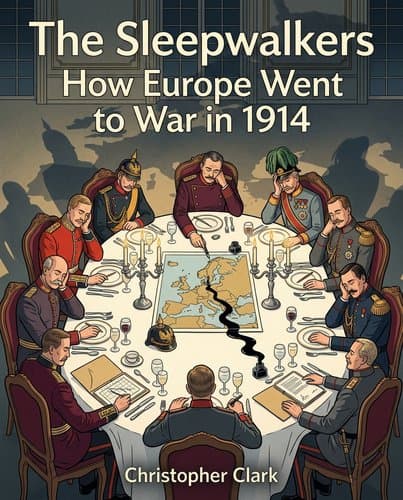
18669169_the-sleepwalkers
by Christopher Clark
Europe's leaders in 1914 weren't reckless warmongers—they were intelligent, informed men who read intelligence reports, exchanged telegrams, and still stumbled…
In Brief
Europe's leaders in 1914 weren't reckless warmongers—they were intelligent, informed men who read intelligence reports, exchanged telegrams, and still stumbled into history's deadliest catastrophe. Clark's forensic reconstruction reveals how fractured institutions, alliance logic, and self-serving narratives trap decision-makers into confident action toward disaster.
Key Ideas
Postwar histories constructed as advocacy narratives
The historical record of WWI was deliberately constructed by every major power after the fact to shift blame — any serious analysis has to read primary sources against themselves, not as evidence but as acts of advocacy
Fragmented authority prevents accountability and full sight
A fragmented decision-making structure — where military commanders, foreign ministers, ambassadors, and monarchs all had partial authority with no clear hierarchy — is not just inefficient; it is structurally dangerous, because no one is ever fully accountable and no one sees the whole picture
Economic alliances acquire unintended military logic
The Franco-Russian Alliance shows how alliances built for one purpose (colonial bartering, financial loans) can acquire completely different military logic once a crisis arrives — the mechanism and the intention diverge, with catastrophic results
Catastrophic confidence from faulty foundational assumptions
The 'blank cheque' and Russian partial mobilization both illustrate the same failure: decision-makers reasoning carefully within their own assumptions while those assumptions were false, a dynamic that produces confident action toward catastrophe
Knowing danger differs from feeling its weight
Knowing the facts about danger is not the same as feeling its reality — the pre-1914 leaders used phrases like 'extinction of civilisation' and still mobilized; the question Clark leaves open is what narratives in our own moment we are inside without feeling their weight
Who Should Read This
History readers interested in World History and Military History who want a deeper understanding of how we got here.
The Sleepwalkers: How Europe Went to War in 1914
By Christopher Clark
14 min read
Why does it matter? Because every country believed it was acting defensively — and that's exactly the problem.
Ask most people who started the First World War, and they'll say Germany. Ask the Germans of 1914, and they'd have said Russia. Ask the Russians, and they'd have said Austria. Ask the Austrians, and they'd have pointed at Serbia. Every government that mobilized in the summer of 1914 believed it was the victim defending itself against aggression. Christopher Clark finds that collective delusion more disturbing than any deliberate conspiracy — because it means the catastrophe that killed seventeen million people wasn't engineered by villains. It was stumbled into by watchful, intelligent men who were so trapped inside their own institutional fractures, self-serving narratives, and alliance logic that they couldn't see what they were actually doing. Clark calls them sleepwalkers. After reading this book, you'll recognize the type immediately — and you won't be thinking about 1914 when you do.
The Historical Record Is a Crime Scene Where Every Witness Is Also a Suspect
The primary sources for World War I were assembled, in large part, to win arguments — not to tell the truth. Start there, and the entire debate looks different.
After Versailles saddled Germany with sole war guilt, the German foreign ministry spent years compiling 'Die Grosse Politik,' nearly 16,000 diplomatic documents released to prove the verdict wrong. The French, Russians, and British followed with their own documentary arsenals. What historians have been treating as evidence is, in significant part, litigation. Every archive is also a brief for the defense.
And that's before you get to the memoirs. Russian Foreign Minister Sazonov, one of the key figures during the July Crisis, produced recollections that Clark characterizes as breezy and self-congratulatory — which, placed beside Sazonov's own private diaries, directly contradict themselves. The man who helped push Russia toward mobilization in 1914 later constructed a version of events that quietly absolved him of the consequences. He wasn't unusual. Poincaré did the same. The witnesses rewrote their testimony after the verdict was in.
Clark asks how rather than why as a methodological choice, not a semantic one. 'Why' invites you to sort sources by which ones support your theory of guilt. 'How' forces you to reconstruct the sequence of decisions as they actually unfolded, moment by moment, before anyone knew the outcome. It treats the archive not as a verdict but as a crime scene — one where the witnesses were also, in many cases, the suspects, and came back afterward to rearrange the furniture.
In Serbia, Political Murder and Statecraft Were the Same Profession
Shortly before 2 a.m. on a June night in 1903, a group of Serbian army officers broke into King Alexandar's palace in Belgrade. They blew apart his bedroom doors with dynamite, fusing the electrics and plunging the building into darkness. Working by candlelight, they searched the royal apartments and found them empty — though the queen's French novel lay face-down on the bedside table and the sheets were still warm. The royal couple had hidden behind a wall panel. When the king finally called out to ask whether he could trust the oath of his officers, the conspirators said yes. He emerged with his arms around Queen Draga. They were shot at point-blank range, their bodies hacked with swords and bayonets until they were unrecognizable, then hoisted to the bedroom window and thrown into the garden below. As the assassins lifted the king, one of his hands closed around the window railing. An officer severed it with a sabre.
Christopher Clark begins his account of the road to 1914 not in Sarajevo, and not with the policy documents of the great powers, but here, in a blood-soaked Belgrade bedroom. The choice is deliberate. The 1903 regicide didn't just change which dynasty sat on the Serbian throne. It installed a clique of officers who had demonstrated, in the most literal terms, that political murder was an acceptable tool of state. They were never seriously punished. Several rose to prominent positions. One of the ringleaders, a man called Dragutin Dimitrijević — known as Apis — went on to found the Black Hand, the secret society that would eventually arm and dispatch Gavrilo Princip to Sarajevo.
The Black Hand was not a rogue element operating against the grain of Serbian political culture. It was an expression of it — shaped by what Clark calls the Kosovo Myth, a cultural fixation on a medieval defeat by the Ottomans that elevated martyrdom and assassination to something close to sacred virtues. The peasantry absorbed this through epic folk songs performed on a one-stringed instrument called the gusla: songs celebrating martyrdom and revenge killing. Young men in Bosnia grew up hearing those songs. Gavrilo Princip was one of them.
Nikola Pašić, the dominant civilian statesman of the period, understood what this machinery was capable of. When he received word that armed men were crossing into Bosnia ahead of Franz Ferdinand's visit, he sent a warning to Vienna — through his minister, in terms so indirect that the Austrian officials who received it couldn't parse what was being said. Clark doesn't decide whether Pašić was paralyzed by fear of Apis or hedging his strategic bets. What's clear is that by 1914, the Serbian government no longer fully controlled the Serbian state. The border guards, the intelligence services, the officer networks — they were running a separate foreign policy, aimed at provoking exactly the kind of crisis that would force a war.
The Man Killed to Start the War Was the One Man Determined to Prevent It
The man killed to start the First World War was the man most actively working to prevent it. That's not a paradox — it's the point. The Black Hand didn't assassinate Franz Ferdinand because he threatened the South Slavs. They killed him because he was about to help them.
Ferdinand had a specific reform in mind: 'Trialism,' a restructuring of the Habsburg Empire that would elevate the South Slavic peoples to the same standing as the Austrians and Hungarians — a genuine third pillar of power, not a subject population. If that happened, the entire logic of Greater Serbia collapsed. Why join a foreign country when you already had autonomy, prosperity, and status inside the empire you lived in? Ferdinand understood this. So did the men in Belgrade. A satisfied Slav population within Austria-Hungary was a mortal threat to Pan-Serbian ambitions. They needed the Slavs to be unhappy.
There's another layer. When Franz Conrad von Hötzendorf, the Habsburg military chief — a man who spent much of 1913 writing love letters to another man's wife while urging the empire toward war — pushed for a preventive strike against Serbia, he pushed around 25 times that year alone. Ferdinand killed every proposal. His reasoning was strategic: war with Russia would destroy the Habsburgs. 'Should the Emperor of Austria and the Tsar of Russia oust each other from their thrones,' he asked, 'and open the way to revolution?' He wasn't a pacifist. He was a man who understood that the war being proposed was one his empire couldn't survive.
So here is what Princip's bullet actually accomplished: it removed the one consistent voice for restraint in Vienna, and gave the faction pushing for war the emotional justification they'd been looking for. The assassination didn't just eliminate a reformer. It cleared the path for Conrad and handed the hawks a cause. The nationalists in Belgrade weren't blind to this. Ferdinand's good intentions were precisely what made him dangerous to them, and precisely why the road to Sarajevo ran through his archive of vetoed war proposals.
Europe's Alliance System Didn't Cause the War — But It Made a Local Murder into a Continental Catastrophe
When the French fleet sailed into Kronstadt harbor in 1894, Tsar Alexander III — a man who despised everything the French Revolution represented — had to stand at attention while a Russian band played the Marseillaise, anthem of the regicides. He held his hat and waited. Ideology was irrelevant. Russia needed French capital to modernize its railways and its army; France needed a military partner after two decades of isolation following its defeat by Prussia in 1870. The loan sequences came first — French banks had been financing Russian strategic infrastructure since the late 1880s — and the formal military convention followed the money. If Germany attacked either partner, the other would immediately commit all available forces: for Russia, somewhere between 700,000 and 800,000 soldiers; for France, over a million. The convention required this automatically, before diplomacy had a chance.
The Germans saw the ring closing. Their answer was the Schlieffen Plan, and that's where the logic becomes catastrophic. Because Russia mobilized slowly, German war planners concluded that in any two-front war, France had to be knocked out first — quickly, before the Russian steamroller could build momentum. The fastest route into France ran through Belgium. So a war triggered by an Austro-Russian quarrel in the Balkans would, by the internal logic of German military planning, automatically require invading a neutral country. The local became continental not through any decision made in July 1914, but through decisions locked into place years earlier.
None of this was designed as an aggression machine. The alliances were assembled from colonial disputes settled between rivals, from financial dependencies, from the paranoia of isolated states looking for partners. Think of it as a circuit breaker wired backward — built to distribute the shock of conflict, but actually configured to amplify it. The danger wasn't in the intent; it was in the architecture. Once the trigger was pulled in Sarajevo, the wiring did exactly what wiring does.
Foreign Policy Was Never Made by One Person — It Was Fought Over by Dozens
Who actually made foreign policy in 1914? The instinct is to name someone — Grey, Bethmann Hollweg, Sazonov — and imagine a statesman sitting alone with maps and cables, deciding the fate of nations. What Clark shows instead is that in every capital, foreign policy was the residue of a permanent internal war between monarchs, foreign ministers, military commanders, permanent officials, and the press. And because every power was like this, no power could accurately read what any other power actually intended. The structural result was a diplomatic system functioning like a game of telephone played between people who didn't know they were playing.
Take the Kaiser. Wilhelm II controlled, in theory, the most powerful monarchy in Europe. In practice, the most consequential foreign policy decision of his reign — the choice not to renew the Reinsurance Treaty with Russia in 1890, which accelerated Russia's drift toward France — was made entirely without his knowledge or participation. He complained constantly of being kept from important documents. His ministers, who found him erratic and embarrassing, managed him like a hazardous material. When he sat next to King Leopold of Belgium at a gala dinner and promised the Belgian king the ancient crown of Burgundy if he'd side with Germany in a future war — and then threatened invasion when Leopold demurred — Leopold was so unsettled he put his helmet on backwards when he stood up. The diplomats around Wilhelm weren't horrified by the threat; they were exhausted by the pattern. The man nominally steering German foreign policy was routinely steered around. Sir Edward Grey managed something even neater: he privately committed Britain to landing 150,000 men in France while publicly assuring his own Cabinet that no binding military commitments had been made.
The trap this built was structural and nearly invisible to the people inside it. When Vienna tried to read Berlin's intentions, it was reading the outputs of a system Wilhelm didn't fully control. When Paris tried to gauge Russian resolve, it was measuring the position of whoever had most recently gotten to the Tsar. Miscalculation wasn't a failure of intelligence — it was the only possible output of systems that were themselves incoherent.
The Assassination Almost Didn't Happen — and That's the Most Disturbing Part
Gavrilo Princip had already given up. After the first bomb arced through the summer air and bounced off Franz Ferdinand's car, exploding under the vehicle behind it and wounding several bystanders, the assassination plot collapsed into confusion. The other conspirators stationed along the Appel Quay did nothing. Princip drifted away from the embankment in a daze, wandered through the bazaar district, and stopped outside a delicatessen. The Archduke had survived. The plot was over.
Then a driver made a wrong turn.
The motorcade, rerouted after the bomb attack to avoid the bazaar, set off down the main road — but no one had told the drivers. The lead car swung into Franz Joseph Street and the vehicle carrying the Archduke followed. When the governor Potiorek realized the mistake and ordered the driver to reverse, the car didn't have a reverse gear. It had to be pushed back by hand, slowly, to a stop. The car came to rest directly in front of the delicatessen where Princip was standing.
He had seconds to think. Princip said later he paused when he saw the Duchess Sophie beside her husband. 'I reflected for a moment whether to shoot or not,' he said. 'At the same time, I was filled with a peculiar feeling.' He fired twice. Then the strangest detail: both the Archduke and the Duchess remained perfectly upright and motionless in their seats as the car roared away. Potiorek assumed they were fine. They were already dying. The first bullet had torn Sophie's stomach artery; the second had ripped through Ferdinand's jugular. As the car sped toward the governor's residence, Sophie toppled sideways until her face rested between her husband's knees. His last audible words were a plea to his wife to stay alive for their children. He was dead by eleven o'clock.
The world that ended that morning was ended by a broken plan, a miscommunicated route, a gearbox with no reverse, and a moment of hesitation that resolved the wrong way. The proportionality is almost impossible to hold in your mind. Hundreds of thousands of people would be dead within months; millions within years. And the hinge on which it all turned was a car being pushed backward by hand to a stop in front of a young man who'd already walked away.
The 'Blank Cheque' Was a Gamble, Not a War Plan — and That Makes It Worse
The conventional wisdom treats the blank cheque as evidence that Germany wanted the war. Clark's more unsettling argument is that German leadership reasoned its way into catastrophe through logic that was, given their assumptions, almost coherent — which means the disaster didn't require malice, just people who had thought themselves into a corner.
When Kaiser Wilhelm assured the Austrians on July 5 that they had Germany's full support, even if punishing Serbia brought Russia in, he was running a calculation. Russia's massive 'Great Programme' of military expansion — railways, troop concentrations, artillery — was scheduled for completion around 1916 or 1917. Once that finished, the Schlieffen Plan's entire premise collapsed: you can't knock out France in six weeks if Russia can mobilize as fast as Germany. The question facing Berlin wasn't 'war or peace' in the abstract. It was whether, if war was coming anyway, it was better to have it now or later. The Tsar's military wasn't ready yet. The gamble was that Austria could crush Serbia quickly enough that Russia would back down rather than fight — and if Russia didn't back down, at least the war came before the strategic window closed forever.
The horror is that this logic is followable. You can see exactly how a group of men, staring at the military projections, arrived there step by step. No one in Berlin was cackling over a map. They were doing risk management on a system none of them understood. Chancellor Bethmann Hollweg reportedly said in those days that it was 'a leap in the dark' — but they leaped anyway, because standing still felt worse.
What the calculation required, and didn't get, was speed. The Austrians needed to move before the other powers could coordinate. Instead, soldiers were on harvest leave — a mundane agricultural rhythm that would, within weeks, become a factor in a continental war. The dualist machinery ground on. Hungarian Premier Tisza had to be talked around. The ultimatum to Serbia was deliberately held until the French president finished his state visit to St. Petersburg, a window designed for decisiveness consumed by bureaucracy. By the time the machinery lurched into motion, every other power had weeks to mobilize its own response. The gamble required a sprint. What it got was a slow-motion cascade.
Russia's Mobilization Was Militarily Incoherent — and No One in the Room Knew Enough to Notice
The most consequential military decision of the July Crisis was made by two men who had almost no idea what they were deciding. That's not a harsh retrospective judgment — it's what the record shows.
On July 24, 1914, Russian Foreign Minister Sergei Sazonov pushed for what he called 'partial mobilization' against Austria-Hungary. The idea had an obvious appeal: it threatened Vienna without provoking Berlin, kept the pressure on without triggering a continental war. The problem was that the Russian military had no plan for it. The document governing Russian mobilization — Schedule No. 19 — was a single indivisible machine. Army corps in border districts drew their reservists from other zones entirely; troops earmarked for the Austrian frontier were also slated, under full mobilization, to cover parts of the Polish salient facing Germany. Trying to mobilize only in the south wouldn't produce a southern army — it would produce gridlock on every rail line feeding the concentration zones, while leaving the German frontier bare. If Germany responded with its own measures, the one region Russia hadn't mobilized would be precisely the one now under threat. The room for maneuver that 'partial' suggested was entirely theoretical. The option Sazonov was pressing for didn't exist.
Chief of the General Staff Yanushkevich, who should have explained this, had been in his post for five months, had never served in the field, and owed his promotion largely to the Tsar's personal affection for him. Sazonov's ignorance of military realities was, by most accounts, notorious, and the man advising him was out of his depth. Between them, they were doing what sleepwalkers do — moving with confidence through a space they couldn't see clearly, toward a door that opened onto something irreversible.
What makes this more than a story about two ill-equipped officials is that no one else in the room stopped it. The system around them was pushing in the same direction: Paléologue, the French ambassador, had spent lunch that same day goading Sazonov toward firmness, and the emotional momentum of Slavic solidarity and Franco-Russian alliance politics did the rest. There was no friction. Nobody said: wait, does this plan actually exist? The mobilization machinery, once set in motion, would make the next decision harder to reverse than the last. And the men pulling the levers didn't know how the levers worked.
At 9:30 p.m. on July 29, the War Almost Stopped — Then Didn't
At 9:30 p.m. on July 29, General Sergei Dobrorolsky was standing in the main hall of the St. Petersburg Central Telegraph Office, watching operators prepare to transmit the order for general Russian mobilization simultaneously to every corner of the empire. The hall had been cleared of all other traffic. Multiple copies of the text were typed and ready. Then the phone rang. The Tsar had changed his mind. A telegram from his cousin Wilhelm had arrived, and Nicholas II — who had already signed the order — was rescinding it. Dobrorolsky stood down. The operators waited.
By the following morning, the order had gone through anyway.
What happened in those intervening hours is the July Crisis in miniature. Nicholas II was genuinely tormented. He wavered between the mobilization his generals demanded and the personal appeal from 'Willy' not to let the machinery run away with both of them. The machinery won — not because anyone overpowered the Tsar, but because Sazonov spent the next morning persuading him that restraint would only be read in Berlin as weakness, that 'exaggeratedly prudent' behavior was itself a provocation. Nicholas re-signed. The telegram from his cousin turned out to be the thing that needed overcoming.
This is what makes the July Crisis slow-motion horror rather than tragedy with clean lines. It wasn't leaders marching confidently toward war. It was men second-guessing themselves at every threshold, with the system catching them each time and assembling the next step before the hesitation could hold. The Tsar rescinded a mobilization order and then signed it again. Wilhelm II read the Serbian reply on July 28, concluded that 'every cause for war has vanished,' and proposed a ceasefire — a genuine impulse, written in the margins of the document in his own hand. His Foreign Office ignored the instruction. The moments of doubt were real. They just didn't stop anything.
The nearly-moments keep multiplying the further you look. A Tsar reverses himself twice in twelve hours. An emperor's genuine second thoughts disappear into his own bureaucracy. Each time the machinery should have stopped, something — a persuasive argument, the logic of not being the one who blinked — kept it moving. Not because anyone decided the war must happen, but because no single person had enough purchase on the whole machine to stop it once it was moving. By the time Dobrorolsky's transmission finally went out, the question of whether Europe was going to war had been answered by an accumulation of smaller questions, each of which had seemed, in the moment, reversible.
They Knew What the Weapons Did to Human Bodies — They Just Didn't Feel It
Imagine you could prove, in advance, that a building would collapse and kill everyone inside it — and then congratulate yourself on the quality of the mortuary. That is roughly what happened in Paris in March 1913, when French military doctors returned from the Balkan front and described what French-made artillery had done to human bodies: crushed bones, torn tissue, chests and skulls shattered beyond recognition. The suffering was so acute that one prominent military surgeon proposed banning such weapons from future use. The journalist covering the lectures understood the generosity of the impulse and dismissed it. France, he concluded, should feel pride in the 'horrific force' of its arms and the excellence of its medical services for treating what those arms had done.
The men of 1914 were not uninformed about what modern weapons did to human bodies. They were insulated from feeling it. Moltke himself acknowledged that the coming war might drag on for years and leave 'immeasurable ruin.' Asquith wrote privately of approaching 'Armageddon.' French and Russian generals reached for phrases like 'extinction of civilisation.' The words were available. The visceral understanding was not.
After Hiroshima, something changed. Leaders and ordinary citizens alike had images burned into their minds — actual photographs of what the technology did — and the greatest arms race in history never produced nuclear war, because the people controlling the weapons could not fully separate the weapon from its consequence. The men of 1914 had no such anchor. The hope for a short war and the fear of a long one sat side by side in their minds and cancelled each other out.
The sleepwalker metaphor, then, is not an exculpation. It is the sharpest indictment Clark can construct: these leaders were watchful, active, often brilliant — and they walked straight into the abyss because they had never learned to feel the ground beneath their feet.
The Question the Sleepwalkers Leave Behind
The sleepwalkers weren't sleepwalking because they lacked information. They had the phrases. They wrote them down. 'Extinction of civilisation.' 'War of extermination.' The words existed in their letters and their margins and their private diaries — and then they signed the mobilization orders anyway, because knowing a thing and feeling its full weight are two entirely different cognitive events. That gap, between the words you can produce and the reality those words are supposed to represent, is not a pathology unique to 1914. It's a permanent feature of being inside a story. The question is which present-day phrases you use fluently, confidently, perhaps even with great sophistication, that some future historian will hold up as evidence that you also knew — and also didn't feel it.
Frequently Asked Questions
- What is Clark's main argument about responsibility for World War I?
- Clark challenges the conventional narrative that assigns clear blame for WWI, arguing instead that Europe's leaders stumbled into catastrophe through fractured institutions, alliance logic, and self-reinforcing assumptions. Rather than identifying singular villains, he demonstrates through primary sources that shared political dysfunction produced the disaster no one intended. Europe's interconnected decision-making systems created a cascade where no individual leader could fully control or predict outcomes. This institutional failure, not deliberate aggression, explains how the continent's major powers collectively sleepwalked into war.
- How does The Sleepwalkers explain the relationship between institutional fragmentation and war?
- Clark argues that fragmented decision-making structures—where military commanders, foreign ministers, ambassadors, and monarchs all possessed partial authority with no clear hierarchy—are not merely inefficient but structurally dangerous. When no one is fully accountable and no one sees the complete picture, catastrophe becomes likely. This institutional dysfunction enabled leaders to act confidently within their limited assumptions while remaining ignorant of the broader strategic reality. Because authority was dispersed across multiple decision-makers with conflicting interests and incomplete information, Europe's descent into war proceeded without any single leader bearing full responsibility or possessing complete control.
- What does The Sleepwalkers reveal about how alliances contributed to the outbreak of war?
- Clark illustrates how alliances demonstrate a critical divergence between original purpose and crisis-driven logic. The Franco-Russian Alliance, initially constructed for colonial competition and financial coordination, acquired completely different military significance once the 1914 crisis arrived. Leaders reasoned carefully within their own strategic assumptions, unaware those assumptions were fundamentally false. This produced confident mobilization toward catastrophe. Alliance structures created an interlocking system where actions intended to deter war accelerated it instead. Each nation responded according to its limited understanding of the broader situation, yet none could step outside the mechanism they had collectively created.
- What does Clark suggest about why leaders pursued war despite understanding its dangers?
- Clark argues that possessing factual knowledge about danger differs fundamentally from emotionally grasping its reality. Pre-1914 leaders used language about catastrophic consequences, yet mobilized regardless. This gap between intellectual awareness and emotional conviction permitted confident action toward catastrophe. Clark poses a troubling question: what narratives in our own moment do we inhabit without fully feeling their weight? The book suggests that when institutional structures are fragmented and underlying assumptions are false, nations can march toward disaster with confidence even as explicit warnings exist. Understanding risk abstractly does not prevent catastrophic choices.
Related Book Summaries


Read the full summary of 18669169_the-sleepwalkers on InShort