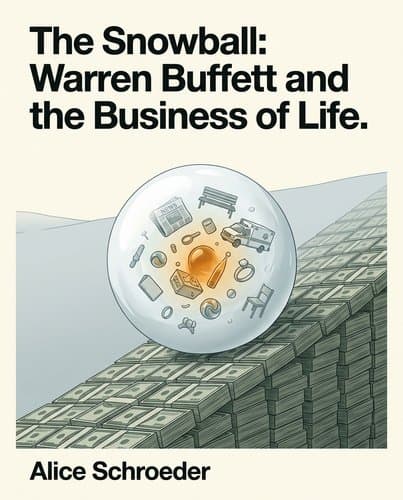
2054761_the-snowball
by Alice Schroeder
Warren Buffett built the world's greatest fortune by treating every dollar, relationship, and hour as a compounding asset—then discovered too late that neglect…
In Brief
Warren Buffett built the world's greatest fortune by treating every dollar, relationship, and hour as a compounding asset—then discovered too late that neglect compounds just as ruthlessly. Schroeder's biography reveals the hidden cost of total obsession: the exact habits that create extraordinary wealth quietly destroy everything money cannot replace.
Key Ideas
Internal Philosophy Masks Validation Hunger
The Inner Scorecard — measuring yourself by your own standards rather than public opinion — is genuinely useful for making better decisions, but it does not protect you from needing validation; watch for the gap between your stated philosophy and your actual hunger for applause
Inattention Compounds Into Family Absence
Compounding works in every domain, including neglect: the habits of inattention you build in your thirties compound into absences your family feels in their forties, and the math runs in the same direction as the interest
Integrity Assessment Beats Technical Analysis
Buffett's greatest investments were character assessments first and financial analyses second — identifying people whose obsessive integrity was itself the competitive moat is a skill more transferable than any specific valuation technique
Daily Prevention Beats Crisis Management
The 'front-page test' (would you be comfortable if your family read about this action tomorrow in a critical article?) is more useful as a daily decision filter than as crisis management — it only works if applied before the crisis, not during
Accountability Makes Delegation Actually Work
Delegation without accountability is not a management philosophy, it is a postponed problem — the same trust that works with people of exceptional integrity fails catastrophically with people who merely seem that way
Self-Knowledge is Professional Risk Tool
Your emotional responses to loss, humiliation, and spite are not separate from your professional decisions — Buffett's most consequential acquisition was made in anger, which means self-knowledge is not a soft skill, it is a risk management tool
Invisible Trade-Offs of Extreme Focus
The trade-offs of radical focus are invisible while you're making them and obvious in retrospect — the question worth asking is whether you would make the same choices if you could see the rearview mirror from the beginning
Who Should Read This
Readers interested in Business Leaders and Investing, looking for practical insights they can apply to their own lives.
The Snowball: Warren Buffett and the Business of Life
By Alice Schroeder
14 min read
Why does it matter? Because the man who built the greatest fortune in history also built the perfect trap — and he knew it.
Here's what they don't tell you about Warren Buffett: the rumpled suit and the Cherry Coke and the folksy Nebraska modesty aren't humility. They're load-bearing walls. Every habit, every ritual, every relationship in his life was engineered — consciously or not — to protect one thing: the compounding machine. The folksy billionaire is real, but so is the man who couldn't feed himself when his wife left. He sobbed for two hours in his office chair when she got sick. He built a fortune so vast it required a partner to help him give it away. And at nearly eighty, he still felt like a snowball at the bottom of a new hill. This book is about what it actually costs to optimize a life around a single obsession. The genius and the damage turn out to be the same story.
The Boy Who Timed Marbles Was Building a Defense System, Not a Fortune
Picture a six-year-old alone in the bathroom, hour after hour, naming his marbles and timing their roll down into the tub with a stopwatch his aunt gave him. Not once. Not until the pattern revealed itself. Endlessly, repetitively, with the focused absorption most children reserve for nothing. His family found it charming and strange. They called it a love of numbers. They were only half right.
Warren Buffett grew up in a house where catastrophe arrived without warning. His mother Leila could be fine one moment and then, triggered by nothing visible, she would turn on whoever was in reach — most often his older sister Doris — and pour an hour of scorching blame onto her. Everything wrong in Leila's life, every sacrifice and indignity, became the child's fault, listed and relitigated until the target collapsed in tears. Howard knew it happened. He sometimes warned the kids that Leila was 'on the warpath.' He did not intervene. So Warren learned early that the emotional weather of his home was unforeseeable and the best strategy was to stay out of it — to find a room, a system, a set of numbers that obeyed rules his mother did not.
The marble timing wasn't proto-entrepreneurship. It was architecture. He was building a private world governed entirely by cause and effect, where the same action produced the same result, where data could be gathered and patterns confirmed. He applied the same logic to the church hymnal, calculating whether composers who wrote pious music lived longer than secular ones. When the numbers said no, he filed that conclusion away and became a religious skeptic at six.
What followed — bottle caps sorted by brand to determine soda market share, every city's population memorized from the almanac — looks like curiosity from the outside. But the engine underneath wasn't curiosity in the abstract. It was a need for a world that could be understood and therefore, just slightly, controlled. Whether that need ever stops driving him is a harder question than it looks.
The Inner Scorecard Is Real — and It Doesn't Protect You From Needing Applause
The legend of the Inner Scorecard goes like this: Warren Buffett decided early that external approval was irrelevant, built his philosophy around that conviction, and spent six decades making decisions based entirely on what he knew to be true. The legend is accurate. It's just incomplete in the most interesting possible way.
At Sun Valley in the summer of 1999, Buffett took the stage before a room full of tech billionaires who had been quietly laughing at him for two years. Berkshire's stock had slid from $80,900 to roughly $65,000 while the NASDAQ climbed 86% in a single year. The people in those chairs weren't just richer than they'd ever been — they thought they were watching his entire worldview become obsolete. Buffett stood up and told them, using a single slide showing the Dow frozen at 875 for seventeen years despite a fivefold growth in the underlying economy, that innovation and investor profit are not the same thing. He worked through the math on airlines: every dollar ever put into the industry had, in aggregate, returned nothing. He said, with the specific pleasure of a man who has been waiting to deliver this line, that if he'd been at Kitty Hawk he would have done future investors a favor and shot Orville Wright down. The room went quiet in a particular way. Within two years, the NASDAQ would lose 75% of its value.
Buffett's Inner Scorecard philosophy — he framed it as a question about whether you'd rather be the world's greatest lover thought of as the worst, or the worst thought of as the greatest — genuinely guided his investment decisions. He refused to buy technology stocks he didn't understand regardless of the mockery, and he was correct. But he also tracked his Forbes wealth ranking closely, and he described his ability to preach as standing on a platform built entirely out of his stock price. He knew that if Berkshire kept falling and he turned out to be wrong, the platform would collapse. The Inner Scorecard protected him from making bad investments. It did precisely nothing to protect him from needing the audience.
His Most Consequential Investment Was Made in Anger, Not Arithmetic
The most important investment decision Warren Buffett ever made wasn't driven by a spreadsheet. It was driven by spite.
In the early 1960s, Buffett had been quietly buying shares in Berkshire Hathaway, a failing New England textile mill, at around $7.50 a share against a book value of nearly $20. Classic cigar-butt investing — one last puff before you walk away. He eventually reached a handshake understanding with Berkshire's owner, Seabury Stanton: when the tender offer came, Buffett would sell his shares at $11.50. Then the letter arrived from Stanton's bank offering $11.375. Twelve and a half cents less per share than agreed.
Buffett didn't shrug and take it. He didn't do the math on whether the difference was material. He went cold. He sent an intermediary to New Bedford to confront Stanton, who denied the agreement had ever existed and said he'd run his company however he pleased. That was the wrong thing to say. Instead of selling, Buffett bought. He bought and bought until he owned the whole company, then forced the Stantons out entirely — refusing, in the process, to let even a family member keep two shares for sentimental reasons.
He acquired a dying textile business because someone tried to chisel him out of an eighth of a point. He knew it was irrational while he was doing it. Years later he described it plainly: he'd bought his own soggy cigar butt and tried to smoke it, but Berkshire had no puffs left. Trapped in a declining industry by his own promise not to close the mills and devastate the town, he spent years watching capital dissolve into machinery that couldn't compete. He eventually concluded he would have been better off if he'd never heard of Berkshire Hathaway.
Buffett mastered the market's irrationality completely. His own was another matter. The margin of safety, it turns out, was never just about price. It was always also about ego.
The Compounding Machine Was Also a Compounding Absence
What does it actually cost to be the world's greatest capital allocator? Not in abstract terms — lost dinners, missed recitals, the generic toll of ambition — but in the specific, granular texture of real omission?
The answer arrives in a single image. Disneyland, sometime in the early 1960s. Three Buffett children are riding the rides, burning through the happiest afternoon childhood offers, and Warren is on a park bench reading. Not supervising. Not watching. Reading. His daughter later recalled it matter-of-factly, the way kids describe things that have simply become the weather: Dad was on a bench with a book. Susie didn't say much about it. She'd learned not to. He was also known to sit at the breakfast table so buried in the Wall Street Journal that he failed to register which children were actually in the room. Susie handled everything else: the emotional weather of the household, the au pairs, the after-school chaos, three distinct personalities who needed three distinct kinds of attention. Warren ran the numbers.
The traits doing this damage were identical to the traits making him extraordinary. His ability to go completely inward — to block the external world and sit alone with a problem until it yielded — was precisely what produced the discipline to hold when markets panicked and buy when everyone else fled. The concentration that made him miss his children at breakfast was the same concentration that made him rich. He wasn't choosing work over family in any conscious sense. The machine had one setting.
When Susie left for San Francisco in 1977, the full weight of what had been transferred became visible. A man worth $72 million turned out to be functionally incapable of feeding or clothing himself. He called her daily, in tears. She recruited Astrid Menks, a quiet waitress she trusted, to move in and provide the scaffolding Warren required to function. He later described it plainly: ninety-five percent his fault. He'd been so absorbed in the work, so energized by its expanding complexity, that Susie's needs had simply failed to register as inputs requiring response.
What's strange is that no single moment broke it. There was no rupture, no fight that ended things. It was more like a house where one room goes unheated for years — you don't notice until one winter when you realize no one goes in there anymore. Small omissions became large absences. Large absences became a wife who stopped waiting and children he'd spend decades trying to actually know.
Character Was the Moat — But Only When It Was Tested Under Oath
The phone call that saved Salomon Brothers lasted about ninety seconds. It was a Sunday afternoon in August 1991, and Warren Buffett had just learned that the Treasury Department was going to ban Salomon from bidding at government auctions — effectively a death sentence for a firm carrying $146 billion in debt on $4 billion of equity. He got Treasury Secretary Nicholas Brady on the line and said, his voice breaking apart, 'Nick, this is the most important day of my life.' Brady later admitted the argument Buffett was making wasn't particularly good. What moved him was the feeling behind the words — the sound of a man who believed he was about to go over Niagara Falls in a barrel he hadn't built.
Not negotiating — begging, on the basis of a reputation he'd spent fifty years accumulating and now needed to spend in a single afternoon. The billionaire who had spent decades preaching that the Inner Scorecard was all that mattered was on his knees.
The business school version of Salomon cleans this up. What you get in classrooms is the front-page test — Buffett's instruction to employees that they should ask whether they'd be comfortable seeing any contemplated action reported the next morning by a critical journalist, read by their families over breakfast. Elegant, transferable, quotable. What gets left out is the terror producing it.
The strange thing is that the fear produced something real. Ron Olson, the lawyer Buffett brought in, stood in front of the U.S. Attorney and voluntarily waived attorney-client privilege — offered to make Salomon an arm of the government's own investigation. The prosecutor was incredulous. Nobody did that. You do that when you believe the integrity itself is the only asset left worth protecting.
Buffett understood that his entire platform — his ability to preach, to attract capital, to be listened to at all — rested on his reputation, and that reputation and stock price were not as separate as his philosophy implied. He didn't implement radical transparency at Salomon because it was the right thing to do in some abstract ethical sense. He did it because the alternative was watching everything he'd built dissolve, and because he was frightened in a way he almost never allowed himself to be.
Character isn't a separate thing from strategy. It is the strategy, because it's the only asset that compounds without limit and collapses completely the moment it's spent. Buffett wasn't more virtuous than other men. He was more afraid of what losing it would cost.
The Best Businesses He Ever Bought, He Bought on Character, Not Spreadsheets
An eighty-nine-year-old woman is roaring around a furniture store on a three-wheeled golf cart, screaming at her employees that they're all good for nothing, when Warren Buffett walks in to buy her company. He has brought no accountants, no inventory checkers, no due diligence team. He looks at Rose Blumkin and says he'll take her word for what she's got. She says she doesn't change her mind. He hands over $55 million.
The business press version treats this as charming eccentricity — the folksy billionaire and the immigrant grandmother, a handshake deal in Omaha. What it actually represents is the most sophisticated move in Buffett's investing evolution, and it took him thirty years to get there.
He started where Graham taught him: find dying companies trading below their liquidating value, extract one last puff, move on. It worked until he owned too many cigar butts with nothing left in them and a textile mill he couldn't unload. Munger's correction was simple — a mediocre business at a bargain price is still a mediocre business — and Buffett understood it fully only when he met Ben Rosner.
Rosner was a fourth-grade dropout who ran a chain of women's clothing stores and kept duplicate store records in his bathroom so he could study them while sitting on the toilet. At a black-tie gala at the Waldorf, he spent twenty minutes interrogating a competitor about toilet paper costs, became suspicious the numbers were wrong, excused himself, drove to his warehouse in Long Island, and started tearing open cartons to count sheets. He was right — his vendor was shorting him. Buffett's reaction to this story was not amusement. It was recognition. Intensity is the price of excellence, he said. He wanted to own more businesses run by people who would leave a formal dinner to count toilet paper.
Rose Blumkin was that person, scaled up. She had undersold every competitor in Omaha for decades by running on a ten percent margin when others demanded thirty. Her word was the business — there was no separating them. When Buffett waived the audit, he wasn't being reckless. He had learned that the balance sheet is a photograph of the past, and what he was actually buying was the character producing the future.
He Called Derivatives 'Weapons of Mass Destruction' — Then Wrote $37 Billion Worth
Buffett's public philosophy said: don't sit down. In his 2002 shareholder letter he called derivatives 'time bombs' and 'financial weapons of mass destruction,' arguing that their complexity made losses invisible until they were catastrophic. He'd watched Long-Term Capital Management detonate in 1998 — a team of Nobel laureates running leverage of 100-to-1 on the idea that history predicted the future — and wrote the whole episode into his annual letters as a cautionary text. The lesson he drew for shareholders was clear: instruments you can't fully value, held at leverage you can't survive, will eventually find the one scenario the model didn't imagine.
Then, when the price was right, he wrote $37.1 billion in equity-index puts.
The logic was characteristically precise. Think of it like a seat at a blackjack table where you've done the math on every card in the shoe — you know the odds, you know how bad the worst run could get, and the only question is how many chips to push forward. Buffett had structured the contracts so Berkshire collected premiums upfront, years of float to compound before any claims could arrive. The puts only paid if major stock indices were lower in fifteen to twenty years than when the contracts were written, meaning the counterparties needed a multigenerational market failure to collect. By his calculation the odds were strongly in Berkshire's favor, and the structure prevented the one catastrophe he actually feared: having to come up with cash tomorrow morning. The same logic surfaced in the Goldman Sachs preferred stock deal in 2008, where he extracted roughly fifteen percent annual returns from a desperate firm he knew would survive. When you hold the float and control the timing, 'risky' instruments stop looking risky.
But the $37 billion put book contributed to Berkshire losing its AAA credit rating in 2009. The weapons were his now.
The more honest version of Buffett's investing philosophy isn't that he avoided risk. He understood risk better than almost anyone alive, priced it ruthlessly, and then took more of it than his public warnings implied — when he held the float, when the odds were sufficiently asymmetric, when the structure protected him from a forced loss. That's a more interesting story than consistency. It's also, unmistakably, more human.
Giving Away $37 Billion to Someone Else's Foundation Was His Most Logical — and Most Human — Decision
Buffett's decision to give away $37 billion was the most logical thing he ever did — and the most emotionally honest. In June 2006, he announced that 85% of his Berkshire Hathaway stock would go to the Gates Foundation. No Warren Buffett wing, no Warren Buffett Foundation, no stone with his name on it. He required the money be spent as it was given, so the foundation couldn't stockpile it into a monument. He was the second-richest person on earth, and he was handing the whole pile to someone else to disburse.
The argument he made was indistinguishable from an investment thesis. Gates had the infrastructure already built. The last dollar given to him would be as useful as the first — no diminishing returns, no bureaucratic drag of a new institution learning how to exist. It was like doubling your position in a stock you've already done the work on. He found any objection to that sentimental rather than strategic, and he ignored it.
But there's something underneath the logic. Buffett spent decades arguing against dynastic wealth with the pointed fury of a man who'd noticed something about country club conversations — how the same people lamenting welfare dependency were quietly arranging trust funds that amounted to a lifetime supply of food stamps with a better-dressed administrator. His children received meaningful but not life-distorting sums. He refused to let the snowball simply transfer into the next generation's hands unchanged. The money had to go back.
What that cost is visible if you look at when the announcement came. His children were adults by then, shaped by decades of a father who was mostly elsewhere — reading, calculating, compounding. He'd started calling them more. He'd started showing up in ways he hadn't before. One of his daughters once said she used to schedule time with him like a meeting. That was changing, slowly, in the way things change when someone finally starts paying the bill for sixty years of staying in his lane. Giving the snowball away wasn't just logical. It was the act of a man who had finally started to reckon with what the machine had cost.
The Ambulance Ride He Couldn't Escape
Wyoming, late July 2004. Susie Buffett is in the middle of dinner at Herbert Allen's ranch in Cody when she blinks and says something funny is happening inside her head. For a split second Allen thinks she's doing a dance step. Then she folds. They carry her to a couch, wrap her in blankets, wait for the ambulance. When it arrives and the paramedics load her in, Warren climbs into the front seat. The hospital is thirty-four miles away through winding mountain roads. He sits there the whole drive — separated from her by a wall, unable to see her, unable to do anything — while she slips away. She dies a few hours later. He cannot bring himself to attend her funeral.
He calls it unfinished business. He means he never finished the conversation he'd been having with himself for fifty years about what she actually meant to him.
The ambulance ride is the whole book in a single image. Warren Buffett had spent six decades building a machine that could optimize almost anything quantifiable — risk, float, competitive moats, the gap between price and value. He sat in the front seat because that's where they put passengers. There was no position to take, no calculation to run, no action that would improve the outcome. The one variable that mattered most had always been outside his system, and he had let the distance accumulate because the machine required his full attention and the machine was extraordinary.
He'd always assumed she'd outlive him. She would run the foundation, manage his funeral, hold his hand at the end. When her cancer was diagnosed a year earlier, he collapsed in his office chair in two hours of soundless, heaving sobs — not because the assumption was wrong, but because he was only then, at seventy-three, genuinely confronting that he'd built the whole structure on top of it without ever examining whether it would hold.
The trade-off is visible only in retrospect, and the book's quiet argument is that this is always how it works. You don't notice the compounding absence until the math runs out. A person can go so completely inward — can block the world and sit with a problem until it yields — that the people nearest them experience it as a kind of permanent weather. What looks like focus from the inside looks like absence from the other seat. Buffett eventually understood this. He married Astrid, called his children more, gave the snowball away. But the reckoning came in a front seat on a mountain road in Wyoming, which is not when you want it.
What the Snowball Actually Costs
The snowball metaphor is about patience, but the book is about cost. Buffett chose the image himself — a small, wet ball at the top of a very long hill — and it's perfect for what it describes: the mathematics of compounding, the discipline of starting early, the rewards of staying on the hill long enough. What the metaphor leaves out is everyone the snowball rolls past. The real question the book presses on you isn't whether you could build something like this. It's whether the trade-off is visible while you're making it, or only later, when you're sitting in the front seat of an ambulance on a mountain road with no formula for what comes next. Buffett eventually got there — the calls, the marriage, the snowball given away. But eventually is doing a lot of work in that sentence.
Notable Quotes
“I looked about sixteen and emotionally was about nine. I spent ten minutes with the Harvard alumnus who was doing the interview, and he assessed my capabilities and turned me down.”
“What am I going to tell my dad?”
“These were big names to me. I’d just read Graham’s book, but I had no idea he was teaching at Columbia.”
Frequently Asked Questions
- What is The Snowball by Alice Schroeder about?
- The Snowball: Warren Buffett and the Business of Life traces Warren Buffett's life from childhood to becoming the world's wealthiest man, revealing how psychology, obsession, and compounding shaped both his fortune and his character. Drawing on unprecedented access, Alice Schroeder shows how the same relentless focus that built his empire also defined its costs. The biography goes beyond standard business writing by examining the psychological foundations of Buffett's success while honestly addressing the personal trade-offs his focus created. Rather than presenting wealth-building as unambiguously positive, Schroeder offers readers a framework for understanding wealth, decision-making, and trade-offs.
- What does The Snowball teach about the inner scorecard and decision-making?
- The inner scorecard—measuring yourself by your own standards rather than public opinion—is genuinely useful for making better decisions. However, it does not protect you from needing validation. Watch for the gap between your stated philosophy and your actual hunger for applause, as Schroeder illustrates through Buffett's life. The book demonstrates that understanding this contradiction is essential for effective decision-making. Many people adopt an inner scorecard philosophy while remaining blind to their actual psychological need for recognition. Schroeder shows that self-awareness about this tension determines whether your decision-making framework actually works.
- How does The Snowball explain Buffett's approach to identifying great investments?
- Buffett's greatest investments were character assessments first and financial analyses second. Schroeder shows that identifying people whose obsessive integrity was itself the competitive moat is a skill more transferable than any specific valuation technique. This approach reveals why Buffett succeeded where technical analysts often fail. Rather than reducing investments to spreadsheet calculations, he excelled at recognizing psychological qualities that sustain competitive advantages. The book demonstrates that partnering with people of exceptional integrity determined his long-term success more than any single market insight. For readers seeking to replicate his approach, developing character-reading skills alongside financial analysis may prove more valuable than mastering traditional valuation methods.
- What does The Snowball reveal about the hidden costs of Buffett's success?
- Compounding works in every domain, including neglect: the habits of inattention you build in your thirties compound into absences your family feels in their forties, and the math runs in the same direction as the interest. The book documents how Buffett's focus on wealth-building created measurable costs in relationships and personal life. The trade-offs of radical focus are invisible while you're making them and obvious in retrospect. Schroeder poses a crucial question: would you make the same choices if you could see the rearview mirror from the beginning? The Snowball suggests understanding long-term compounding effects—both financial and personal—is essential before such choices accumulate.
Related Book Summaries
Read the full summary of 2054761_the-snowball on InShort