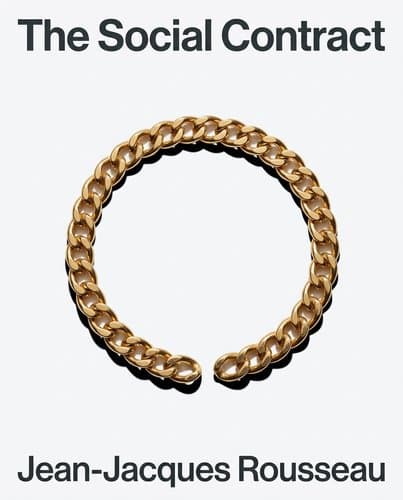
12651_the-social-contract
by Jean-Jacques Rousseau
True political freedom isn't granted by constitutions or elections—it's an act of collective self-creation that most societies quietly surrender the moment…
In Brief
True political freedom isn't granted by constitutions or elections—it's an act of collective self-creation that most societies quietly surrender the moment they hand sovereignty to representatives. Rousseau's radical argument forces you to ask whether your government has any legitimate authority at all.
Key Ideas
General Will Exceeds Majority Opinion
'The General Will' is not majority opinion — it is what the entire community would choose if each person set aside private interest and considered only the common good. Most political systems never produce it.
Sovereignty Cannot Be Delegated
Sovereignty cannot be delegated. The moment a people hands its legislative authority to representatives, it ceases to be self-governing, regardless of how those representatives were chosen.
Consent Alone Legitimizes Political Authority
Force creates no moral obligation — only prudence. The only legitimate basis for political authority is the consent of the governed expressed through a genuine founding act of association, not through historical conquest or inherited tradition.
Periodic Renewal Prevents Institutional Decay
Political institutions inevitably decay toward concentrated power. The corrective Rousseau proposes is not trust in good rulers but mandatory periodic assemblies where citizens vote on whether to keep the current form of government at all.
Equality Requires Active Legal Protection
Equality is not a natural state — it must be actively maintained by law. If the force of legislation does not counteract the natural tendency toward wealth concentration, civil society merely protects the usurpations of the rich and keeps the poor in misery.
Population Growth Defines Government Legitimacy
The measure of a good government is not its ideology or its institutions but a single demographic fact: whether the population is growing or shrinking. Everything else is rationalization.
Who Should Read This
Thoughtful readers interested in Democracy and Geopolitics willing to slow down and wrestle with ideas.
The Social Contract
By Jean-Jacques Rousseau
12 min read
Why does it matter? Because the assumptions you have about freedom and authority are almost certainly backwards.
Man is born free, and everywhere he is in chains. Sit with that for a moment — not as a bumper sticker, but as an accusation directed at you, right now, about the authority you obey without questioning. Rousseau isn't describing history. He's demanding you justify the present. And the justifications most people reach for — tradition, consent, the greater good, the fact that someone stronger said so — collapse under his scrutiny one by one, Rousseau driving the blade with a wit that draws blood. He will show you that the peace of a well-governed state and the peace of a dungeon are not so easily distinguished. That the English, so proud of their liberty, are free for precisely as long as it takes to cast a vote. His answer to what makes authority genuinely legitimate will unsettle every comfortable assumption you've inherited — because it sets a standard almost nothing in the real world actually meets.
Every Justification for Obeying Power Collapses Under Scrutiny
Every justification you've ever accepted for why people must obey their rulers dissolves the moment you press on it. Rousseau presses, and what's left is a genuinely open question.
Start with the most intuitive case: raw power. If the strongest gets to rule, then the moment someone stronger comes along, they inherit the right — and the moment you can safely resist, you should. Rousseau makes this vivid with a single image: a robber steps out of a forest and puts a pistol to your chest. You hand over your wallet. Did you have a moral obligation to do so? Obviously not — you acted out of prudence, not duty. The pistol is a fact, not a principle. Calling that transaction a 'right' adds nothing to it; the word is just decorating a threat. And if force is all it takes to create obligation, then sickness also comes from God — but nobody concludes we're forbidden to call a doctor.
Natural hierarchy doesn't hold up either. Aristotle argued that some people are born for slavery. Rousseau concedes Aristotle was observing something real, then identifies the sleight of hand: he mistook the effect for the cause. The condition creates the person, not the other way around.
The last refuge is consent: perhaps a people can voluntarily surrender itself to a ruler, just as an individual might sell themselves into bondage. Rousseau's answer is the sharpest of all. He distills the logic into a single sentence: a contract where one party gives everything and receives nothing, kept in force for exactly as long as the stronger party finds it convenient, is not a contract at all. It's a formula with two equal sides that don't balance. You can't have mutual obligation when one party holds all the power and the other holds none. The words 'slave' and 'right' cancel each other out.
Strip away force, natural hierarchy, and coerced consent, and the question of what actually makes authority legitimate is left standing without an easy answer. That's where Rousseau wants you — because once you can't answer it, you have to start thinking seriously about it.
The One Moment That Makes Everything Else Possible — or Impossible
Here's a question you've probably never thought to ask: before a people can choose a king, how did they become a people in the first place?
Rousseau catches Hugo Grotius — a Dutch legal theorist whose arguments were the standard defense of royal power in his era — in a logical trap with exactly this. Grotius argued that just as individuals can sell themselves into bondage, a people can give itself to a king. Rousseau accepts the premise and watches it collapse: the moment Grotius says a people gives itself, he's already admitted that a people exists before the giving. That act of becoming a community — that founding agreement — is necessarily prior to any submission to a ruler. Which means the true foundation of society has nothing to do with kings at all.
So what does that founding moment look like? Human beings reach a point where the dangers of living alone outmatch what any individual can handle. They can't conjure new strength from nowhere — they can only pool what already exists. The problem, as Rousseau frames it: how do you combine everyone's force to protect each person without destroying the very freedom that makes protection worth having? How do you join with everyone and still answer only to yourself?
His answer is the social contract, and its core logic is a paradox that actually holds. When a person surrenders everything to the whole community, they surrender to nobody in particular. Every member gives on identical terms, so nobody gains an advantage over anyone else. The person who might otherwise lord power over you has given up everything too. What you lose in isolated self-reliance, you get back amplified — the protection of a collective force that now belongs to you as much as to anyone. Total surrender that produces genuine equality.
This only works if the founding act is unanimous. That's not a procedural nicety — it's load-bearing. Majority rule is itself a convention somebody invented. A minority has no natural obligation to obey a majority unless they already agreed, at some prior moment, to accept that arrangement. Every vote, every election, every law traces its legitimacy back to that original unanimous compact. Without it, you don't have a society making collective decisions. You have the stronger faction imposing its will on the weaker one — which, as the previous section established, is just force with a flag on it.
And that compact doesn't only create a society. It creates a new kind of person: someone who is, at the same moment, both subject and sovereign.
You Are Simultaneously the Ruler and the Ruled — and That's Not a Contradiction
Think of a group of people forming a band. Everyone agrees on the setlist, the rehearsal schedule, the split of any money earned. You helped write those rules. You're also bound by them. When the drummer wants to cancel practice, the rest of the band can hold him to the agreement — and that coercion isn't tyranny, it's the thing that makes the band exist at all. Remove the obligation and you don't have a band; you have four people who happen to own instruments.
Rousseau's social contract works on this logic, but with a twist that trips most readers. Every person who enters civil society carries a dual identity: they are simultaneously a member of the Sovereign — the collective body that makes the law — and a subject of the State, bound to obey it. The law that compels you is a law you helped create. This is why Rousseau can say, without contradiction, that whoever refuses to obey the general will shall be compelled to do so by the community — and that this compulsion makes you more free, not less.
The phrase 'forced to be free' sounds Orwellian until you see what the alternative actually is. In the state of nature, your freedom runs exactly as far as your muscles. A stronger person can take your food, your shelter, your life — and there's no principle in the universe that stops them, only physics. That's not freedom; it's subjection to the arbitrary power of whoever is bigger. Civil society replaces that subjection with something you actually helped design. The constraint is real, but it's your constraint, agreed upon under identical terms by everyone else. The drummer who resents being held to the rehearsal schedule he signed is not a free man being oppressed — he's someone trying to enjoy membership while dodging the obligations membership requires.
Rousseau goes further still. He distinguishes three layers of liberty, each more demanding than the last. Natural liberty is raw: do whatever your strength allows. Civil liberty is bounded by the general will, which replaces the law of the fist with a law everyone shares. But moral liberty is the highest form — it's what you have when you obey a rule you genuinely authored. Here's what makes it concrete: the person who blows their savings the moment they feel the urge isn't free, they're owned by the urge. Governing yourself by a law you've rationally prescribed is the only way to be master of yourself rather than servant to your own impulses. That, for Rousseau, is where freedom actually lives.
The General Will Is Always Right — But the People Are Often Wrong
The will of the people is always right — but the people are frequently mistaken. Rousseau means this literally, and the distinction is the hinge on which his entire theory of law turns.
Here's the sleight of hand most readers miss. When a thousand citizens vote on a proposal, what you get is the Will of All: a sum of private interests that happen to align on this particular question, today, for their own particular reasons. The General Will is something different in kind. Every citizen brings a vote shaped partly by genuine concern for the community and partly by personal advantage. Add all those votes together. The personal-advantage portions, because they point in a thousand different directions, cancel each other out. What remains — the residue, not the consensus — is the common interest. That residue is the General Will, and it is always right almost by definition: you've already subtracted everything that wasn't aimed at the good of all.
This only works under one demanding condition: citizens must deliberate without coordinating with each other. The moment they start organizing into factions — a merchants' guild here, a religious bloc there — the arithmetic breaks down. Each faction develops its own internal will, which is general to its members but purely particular to the state as a whole. Instead of a thousand independent voices producing a fine-grained cancellation of biases, you have a handful of blocs whose much larger competing interests dominate the sum. Push it to the limit: if one faction grows powerful enough to overwhelm all the others, the General Will vanishes entirely — the way Senate factions eventually made Rome ungovernable. What prevails is just that faction's private interest wearing the costume of public law.
Rousseau's solution is almost shockingly blunt. The Spartan lawgiver Lycurgus, he notes with evident admiration, simply banned partial associations outright — no guilds, no parties, no clubs. Each citizen was to think only his own thoughts. When total prohibition is impossible, the next best option is what Solon and others practiced: multiply factions until they're too numerous and too small to dominate anything. The goal is a large pool of small differences, not a small pool of large ones.
The Founder Must Lie — and Rousseau Admits It
Lycurgus of Sparta had a problem. He wanted to give his city laws that would last centuries — laws demanding sacrifice, discipline, and equality of property. But the people who needed to accept those laws were the very people the laws were designed to reshape. You can't convince someone to become the kind of person who would understand why these laws are good. They aren't that person yet. The effect would have to precede the cause. The cure would have to precede the disease.
Rousseau sees this clearly and doesn't flinch from what it implies. A genuine Legislator — the founding genius who designs the institutions of a new people — cannot use force, because forced laws aren't legitimate. Cannot use reason, because ordinary people can't yet perceive the long-term benefits of rules that impose immediate hardship. The only tool left is one Rousseau names with complete candor: divine authority. The great founders packaged their own political genius as divine revelation. They didn't receive tablets from heaven; they invented the tablets and attributed them to heaven.
This is where Rousseau — the philosopher who insisted that all legitimate power flows from the people — admits that the people cannot actually found themselves. Someone has to come first, someone who stands outside the system they're creating, who holds no official power and must hold none (the moment the author of the laws also commands the army, their private ambitions corrupt the whole project). And that person must persuade through a mechanism that bypasses rational consent entirely.
Rousseau isn't embarrassed by this. He notes that only a truly great soul produces lasting political work — anyone can dress up as a prophet, but the laws of Moses and the reach of Islam testify to genuine genius behind the performance. The deception, in his view, is legitimized by its results. Which means the legitimacy of your entire political inheritance may rest on a founding fiction you were never meant to examine.
He never resolves this. The whole system quietly rests on a founding moment when consent wasn't given — it was manufactured. Rousseau surfaces the tension and moves on. You're left holding it.
Representative Democracy Is Not Freedom — It's Elected Slavery
Voting for representatives is not a smaller, more practical version of freedom. For Rousseau, it is freedom's replacement — a ritual that produces the sensation of self-governance while delivering the opposite.
The argument cuts clean. Sovereignty, as Rousseau has built it, consists of the General Will — and will is internal. It lives inside the person who holds it. It cannot be handed to a deputy any more than you can outsource your conscience. A deputy is a steward, someone who carries out instructions on your behalf. The moment they exercise independent judgment, they've stopped representing you and started substituting their will for yours. Any law that the people haven't ratified in person, Rousseau says flatly, is no law at all.
His example of England is the sharpest blade in the argument. The English of his era prided themselves on their parliamentary system as the model of civilized self-rule. Rousseau's verdict: they are free for roughly the duration of a trip to the polling booth. The moment the election ends and they return home, they become nothing. What they've done is elect their masters and given them a clean conscience about it. The English mistake is one of category — they've confused the mechanism for choosing rulers with the act of ruling themselves. These are not the same thing.
Rousseau knows exactly what genuine self-rule would cost. The Greeks managed it, he acknowledges — citizens gathered constantly, debated in the open air, handled public business directly. But the Greeks had slaves doing everything else. The haunting question he poses without blinking: is liberty only possible when someone else is carrying the labor that would otherwise consume the citizen's time? He doesn't resolve it. He points out instead that modern peoples, having rid themselves of legal slavery, have simply become slaves by another arrangement — they've handed their political existence to representatives and told themselves it counts as freedom.
The discomfort Rousseau forces on you here is genuine. Direct democracy at scale seems logistically impossible. What he insists is that papering over it with elections is not a solution. It's a surrender dressed up as a civic ritual.
Governments Inevitably Devour the Freedom That Created Them
Think of the body politic as an organism that sickens slowly. The disease is constitutional. You can manage the symptoms, but you cannot cure the patient — that's not failure, that's Rousseau's diagnosis.
His claim is starker than most readers expect. Political decay isn't caused by bad rulers or unlucky circumstances. It's structural, written into the government from the day it's assembled. Every government has what he calls a natural propensity for contraction — the drift from many hands holding power toward fewer and fewer, from democracy to aristocracy to royalty. The direction is one-way. Governments only reverse course when they've exhausted themselves and must reform just to survive — never because wisdom prevails, never by design.
The mechanism is the tension we've tracked throughout the book: the particular will of those who govern versus the general will of those they govern. Officials are human beings with their own interests, and those interests press constantly against the sovereignty of the people. Eventually, the executive swallows the legislative — a smaller, tighter state forms inside the larger one, composed only of those in power, and everyone else becomes subjects of masters rather than members of a body politic. The social compact, at that moment, is simply void.
Rousseau doesn't pretend this can be stopped. What he proposes instead is a mechanism for slowing it that's almost shockingly procedural: mandatory assemblies, convened by law on a fixed schedule, requiring no summons from the prince. That last detail is load-bearing. A prince who can call or cancel assemblies already controls the people's ability to check him. Remove that power, and blocking the assembly means announcing yourself an enemy of the state. At each opening, citizens vote on two questions separately — whether to keep the current form of government, and whether to keep the current people running it. Revolution becomes routine procedure rather than last resort.
Rome shows you where this ends. The Senate that once checked the consuls became the instrument of whoever was strong enough to intimidate it; by the time Caesar crossed the Rubicon, the assemblies were theater. France in 1789 hadn't held an Estates-General in a hundred and seventy-five years — the king had simply stopped calling one. That is what unchecked contraction looks like at full speed.
The quiet tragedy of the book lands here. Rousseau has spent every preceding chapter building toward a system of genuine freedom — consent, equality, the general will — and then he tells you, at the end, that the system is designed to fail slowly. The best you can do is design the failure to take longer.
The Standard That Will Make You Uncomfortable
Rousseau finishes by handing you something you can't put down. Not a blueprint. A question you'll carry into every civic ritual for the rest of your life. He knew his ideal was unreachable: sovereignty can't survive delegation, the founding moment can't be repeated, governments are wound to unwind. He built the standard anyway. Which means the book's real argument isn't about 18th-century France or ancient Sparta — it's about what you're actually doing when you pull a lever or sign a petition or decide an authority has the right to compel you. Is this legitimate, or is it just power that's been here long enough to feel like something more? Rousseau spent two hundred pages teaching you to hear the difference. The uncomfortable gift he leaves is that you can no longer claim you don't know how to ask.
Notable Quotes
“I now will actually what this man wills, or at least what he says he wills”
“What he wills tomorrow, I too shall will”
“The problem is to find a form of association which will defend and protect with the whole common force the person and goods of each associate, and in which each, while uniting himself with all, may still obey himself alone, and remain as free as before.”
Frequently Asked Questions
- What is Rousseau's concept of the general will in The Social Contract?
- The general will is not majority opinion—it is what the entire community would choose if each person set aside private interest and considered only the common good. In Rousseau's framework, most political systems never produce this collective reasoning because citizens rarely transcend self-interest entirely. The general will represents the ideal outcome of collective self-governance where individual preferences align with communal benefit. It forms the legitimate foundation for laws and governance, distinguishing between what people actually want and what would genuinely serve the common good. This distinction is central to Rousseau's argument that legitimate authority requires more than voting; it demands a transformation of perspective toward collective welfare.
- Is legitimate political authority based on force or tradition according to The Social Contract?
- Force creates no moral obligation—only prudence. The only legitimate basis for political authority is the consent of the governed expressed through a genuine founding act of association, not through historical conquest or inherited tradition. Rousseau rejects the idea that might makes right or that long-standing governance justifies itself. Instead, he establishes consent as the sole moral foundation for legitimate authority. This founding act of association, freely undertaken by a community, becomes the only defensible source of political power. Conquest and inheritance perpetuate power without consent, making them inherently illegitimate regardless of their historical durability or practical effectiveness.
- Can sovereignty be delegated to representatives according to Rousseau?
- Sovereignty cannot be delegated. The moment a people hands its legislative authority to representatives, it ceases to be self-governing, regardless of how those representatives were chosen. This principle undermines representative democracy as a fully legitimate system in Rousseau's theory. True sovereignty—the power to create and amend laws reflecting the general will—must remain with the people themselves. Delegation of this authority to legislators, whether elected democratically or appointed otherwise, fundamentally violates the essence of self-governance. For Rousseau, legitimate government requires citizens to actively participate in lawmaking rather than merely selecting those who will govern on their behalf.
- How does Rousseau measure the success of a government in The Social Contract?
- The measure of a good government is not its ideology or its institutions but a single demographic fact: whether the population is growing or shrinking. Everything else is rationalization. This criterion reflects Rousseau's belief that genuine legitimacy and effective governance ultimately manifest in population growth, indicating that people choose to remain in and reproduce within that society. Declining population signals fundamental failure, regardless of institutional structure or theoretical justification. This metric bypasses claims about ideological purity or institutional elegance to focus on the most basic indicator of societal health and citizen satisfaction, providing an objective standard for evaluating governance.
Related Book Summaries
Read the full summary of 12651_the-social-contract on InShort