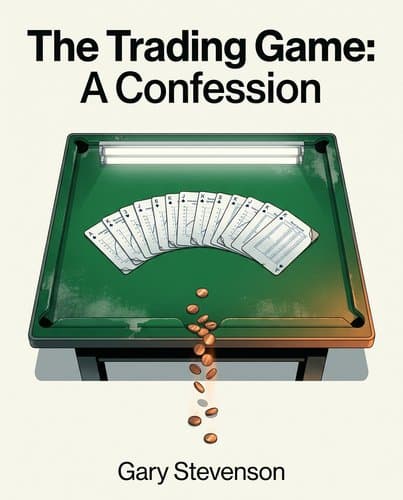
188543465_the-trading-game
by Gary Stevenson
A working-class East London kid becomes Citibank's most profitable trader by betting on permanent inequality—then realizes his winnings are proof the system is…
In Brief
A working-class East London kid becomes Citibank's most profitable trader by betting on permanent inequality—then realizes his winnings are proof the system is irreparably broken. Gary Stevenson's confession exposes how the financial crisis never ended; it just shifted who bears the cost.
Key Ideas
Inequality permanently removes aggregate spending power
The standard explanation for why the economy hasn't recovered — 'crisis of confidence,' 'temporary shock' — is wrong. Gary's evidence from inside the system is that high inequality permanently removes spending power from the economy, meaning zero interest rates aren't an emergency measure, they're the new permanent condition.
Correct predictions matter only when contrarian
Markets don't reward being right. They reward being right when everyone else is wrong. The traders who lost money in 2008-2011 weren't dumber than Gary — they were using the same textbooks. Gary's edge was looking at real people (his friends, his parents, the homeless under bridges) rather than models.
Deferred compensation weaponized as talent trap
Deferred compensation isn't just a reward structure — it's a trap. The bank pays a fraction upfront and holds the rest for years specifically to prevent its best earners from leaving. Understanding this mechanism is the first step to seeing it.
Bailouts socialized losses, privatized recovery gains
The financial crisis transferred wealth rather than destroying it. When banks collapsed, the losses were socialized (taxpayer bailouts, quantitative easing) while the gains from the recovery in asset prices flowed to those who already owned assets. The crisis didn't end — it just changed who was visibly suffering.
Cover your tracks as survival strategy
'Cover Your Arse' is the real operating philosophy of finance. Billy's lesson isn't cynicism for its own sake — it's a survival principle in a system where institutional memory is used selectively against individuals when it's convenient. Document everything, leave no trace of anything questionable.
Markets reward betting against ordinary people
Winning at the highest level of the game often means being willing to bet on outcomes that are bad for most people. Gary's greatest trades profited from correctly predicting that ordinary families would get poorer. Acknowledging this is not a personal confession — it's a structural description of how financial markets work.
Who Should Read This
Readers interested in Memoir and Macroeconomics, looking for practical insights they can apply to their own lives.
The Trading Game: A Confession
By Gary Stevenson
14 min read
Why does it matter? Because the economy you think is broken is working exactly as designed — for someone else.
You probably think the 2008 crash was a disaster that got cleaned up. Markets tanked, banks got bailed out, things slowly went back to normal. Maybe you lost something — a job, a house, a bit of faith — but the system held, right? It recovered. That's the story.
Gary Stevenson grew up delivering newspapers for £12 a week in Ilford, East London, staring up at the Canary Wharf towers the way a kid stares at a locked door. Then he cracked it open — became Citibank's most profitable trader on the entire planet — and from that vantage point, right at the top of the machine, he ended up with a front-row view of exactly how the lie worked. Not recovering. Not rebalancing. Just moving money, steadily and permanently, from the people who needed it to the people who already had too much. The crash didn't break the system. The system was working perfectly.
The Trading Game Was Rigged Before You Sat Down
The game was rigged. Gary Stevenson knew it the moment the last card turned over.
He was twenty years old, standing at the final table of Citibank's national Trading Game competition, holding a -10 card — the lowest in the deck — and he'd spent three weeks memorising every angle of this game while everyone else had been attending finance society mixers. His strategy was working. He'd been bluffing loud prices, reading the Oxford and Cambridge graduates around him like a poker shark reads nervous tourists, racking up hundreds of 'sell' bets because his -10 card made a low total almost certain. Then the three community cards turned face-up: 13, 14, 20. The four other players flipped their hands: 10, 11, 12, 15. Every single one of the seven highest cards in the deck, clustered against him — a roughly one-in-twelve-thousand shot. His scorecard hit negative one thousand. He'd been obliterated.
Except he hadn't. A recruiter named Caleb Zucman stepped forward and told the room the game had been deliberately fixed — not to find the sharpest calculator, but to find someone who'd keep swinging when the numbers turned impossible. Gary had screamed his bluffs louder as the catastrophe unfolded, doubling and tripling down, refusing to fold. That was the quality Citi wanted. He got the internship.
This is where the myth wants to end: scrappy East London kid outsmarts the elite, earns his seat on the floor. But look at what the test actually measured: not cleverness, not strategy, but whether Gary would keep playing a game he couldn't win, on faith that the people running it would reward him in the end. The trading floor wasn't looking for the kid who'd question the rigged table. It was selecting for someone who'd accept it — and call it a test of character.
The Trading Floor Is a Pirate Ship — and the Pirates Eat Their Own
The trading floor selects for predators — and then turns them on each other. That's not a flaw in the system. That's the system.
Gary's first week on the STIRT desk reads like a documentary about a dominance hierarchy. Rupert Hobhouse, senior Euro rates trader, barely acknowledges Gary's existence for four days — then drops into the empty chair beside him and interrogates him about where he bought lunch. When Gary returns change from Rupert's fifty-pound note, Rupert stares at the coins with the intensity of a man who's been personally insulted, then sweeps them into his drawer and informs Gary: on this desk, we keep the change. No further explanation. Just a stare engineered to communicate that the normal rules of human exchange have been suspended, and Gary needs to decide right now whether he's in or out.
He is, obviously, in. And once you see what 'in' requires, the meritocracy story collapses completely.
Billy silently cutting a sales team's speaker wire with scissors mid-data-release because they wouldn't turn the music down — not angry, not even particularly interested, just clipping the wire like deadheading a plant. Rupert, months later, on an ordinary afternoon, detecting that a colleague had covered his book too well, erupting into something Gary can only describe as animal — leaning forward over the gap between their chairs, gnashing his teeth, growling like something cornered, kicking his computer tower doors until they crack — for a full twenty seconds, in a room full of people, while nobody looks up from their screens. The non-intervention is the point. Everyone already knows the rules of this ecosystem. You don't look. You don't intervene. You survive.
Billy states the moral philosophy plainly, in an Italian café, after a colleague is fired for stealing from Rupert's book: 'I don't care who you steal from in this game, as long as it's not me or my mates. Cover. Your. Arse.' No mention of honesty. No mention of the institution. Just the tribe — and the imperative to leave no trace.
Gary files all of this away. He is learning what kind of person this place needs him to become — and that education will cost him more than he currently knows how to calculate.
You Don't Understand Money Until You Watch It Break Someone Who Loves You
It's a January morning in Canary Wharf and Gary Stevenson, twenty-three years old, is sitting cross-legged on a small rectangle of grass between three skyscrapers, no jacket, no scarf, no gloves, his hands pressed flat against the frozen ground. Twenty minutes ago a man named Big Chuck handed him a piece of paper with the number £395,000 on it. One year's bonus. His colleague Billy spotted the face he was making and physically stood between him and the rest of the trading desk so nobody would see, then told him to go outside and sit in the park.
The first thing Gary thinks about, alone in the cold sun, is his father. Not champagne, not a car, not a flat — his father, waving from the lit window of the Seven Kings commuter train in the pitch-black winter dark, thirty-five years at the Post Office, maybe twenty thousand pounds a year. Gary runs the comparison and the mathematics of it are obscene. He earned, in a single year, nearly twenty times what his father made in a decade — and not because he built something, healed someone, or taught anyone anything. Because he read interest rate spreads slightly better than the person next to him.
That's when something changes. Not guilt exactly — something colder. He decides, sitting there on that frozen grass with the towers looking at each other above his head, that the whole thing is bank robbery. If the system is willing to hand twenty-three-year-olds £395,000 for reasons that bear no relationship to any human value he grew up understanding, then the only rational response is to take everything you can and get out. Winning stops being a career and becomes a heist.
But the money doesn't liberate him. It quarantines him. Back in his friends' living room — working-class lads he'd known since childhood, some of them also in finance — someone asks about his bonus. He says the number. The silence is total. A PlayStation controller drops to the floor and bounces twice. That sound is the relationship changing in real time, and everyone in the room knows it. His girlfriend, waking at 3am months later, stops crying the instant he tells her the figure — her eyes going wide and still, the face of someone receiving news too large to process — and Gary's immediate instinct is that he should never have said it. They break up a few months after that.
The money was supposed to be the reward for everything: for the newspaper rounds at thirteen, for the hunger, for outlasting every Oxbridge graduate in the building. He won the game. The game took everyone he started with. And once you can see the machine clearly enough to beat it, you can't stop seeing it — which is where Gary's head is when he starts looking at the numbers that will consume the next decade of his life.
The Real Edge Wasn't a Formula — It Was Looking at Homeless People Under a Bridge
The pivot happens when Billy, Gary's Scouse mentor, snatches an LSE textbook out of Gary's hands and drops it in the bin. Not metaphorically. Physically. Gary is twenty-three, has just dug himself out of a four-million-dollar loss, and he's trying to solve the Swiss franc problem through interest-rate parity equations. Billy bends at the waist, gets his red face about a foot from Gary's, and delivers the most important lesson in the book: if you want to know what's happening in the economy, go look at the high street. Count the shuttered shops. Look under the bridge. Read the ads on the tube — debt relief, home equity release, people selling their houses to keep the lights on. The time for books, Billy says, is over.
Billy isn't being anti-intellectual. He's saying the academy trained an entire generation of traders to treat the economy as an abstraction — a system of equations that, properly tuned, would always self-correct. But the economy is people. It's Asad's mum selling the family home. It's Aidan paying his unemployed mother's mortgage. It's Gary's friends in Ilford choosing between the bus fare and lunch. Billy, who never went to university, who started out as a cashier handing wads of cash across a counter in Yorkshire, had always seen this. The Oxbridge graduates around him had not. That's why Billy beat them, year after year.
Gary absorbs this and looks around the room with new eyes. He's at a Timothy Prince presentation, surrounded by millionaires, and a thought assembles itself with horrible clarity: the growing debts of his friends' parents, of struggling governments, of ordinary people — those debts must be balanced somewhere. Every liability has a corresponding asset. He glances at the initials stitched into a trader's collar. Looks left, looks right. White shirts, pink shirts, the quiet hum of money compounding. It's them. It's this room. The wealth isn't disappearing — it's arriving here, in perpetuity, drawn upward by the same gravity every time. Not a crisis of confidence, not a temporary shock. Cancer. Permanent, structural, and getting worse.
Which means interest rates will never rise. The economy is too hollowed out to sustain a recovery. And if that's true, then every consensus forecast predicting normalisation is wrong — which means every price built on that forecast is wrong. Gary recruits Titzy, a fresh Bocconi graduate who still believes the textbooks, and sits him right next to him. Titzy is the instrument: a live readout of what the consensus thinks, updated in real time. Gary's edge is that he can see what Titzy cannot yet — that the working-class economy his family lives in has already arrived at the destination the models keep insisting is still years away. Every time Titzy is surprised, Gary knows he's still ahead.
The Machine Doesn't Break Down — It Transfers
Gary cross-checked his model against the people he actually knew. Asad's mum selling the family home to stay afloat. Aidan covering his unemployed mother's mortgage. Harry jumping tube barriers to save fifty pence. Then he looked left and right along the trading floor — white shirts, pink shirts, initialled collars, millionaires every one — and the accounting identity snapped into place. Every pound of debt his friends were drowning in had a corresponding entry somewhere. He was staring at the corresponding entry. 'It wasn't a crisis of confidence,' he concluded. 'It was cancer.'
Cancer doesn't recover. It grows. Which meant the entire consensus forecast — every economist predicting that rates would soon normalise as the economy healed — was wrong. And if the consensus was wrong, every price built on it was mispriced. Gary placed the green Eurodollar trade (a bet, using financial instruments tied to US interest rates, that rates would stay near zero for years) — that American interest rates would stay near zero not for a year or two but for the foreseeable future, because the middle class was too gutted to generate the demand that would justify raising them. He was right for over a decade.
The full moral weight of this lands during the 2011 Tōhoku earthquake. Twenty thousand people die. The disaster forces rates even lower — Gary's position pays out eleven million dollars. He sits at his desk snapping pens, unable to quite locate the line between his cleverness and his complicity. He didn't cause the earthquake. He didn't cause inequality. He just got very good at reading a system that converts human suffering, whether structural or catastrophic, into a number with a plus sign in front of it. The people on the wrong side of the ledger weren't bouncing back. They were selling the house.
Winning the Game Means Betting on Everyone Else Losing
What does it actually mean to win? Not in theory — in practice, once the number has been calculated and the bonus is in your account and you are, by any measure, the person you were trying to become.
By the time Gary finishes 2011, his profit-and-loss line reads thirty-five million dollars. His bonus is computed at exactly seven percent of that — a figure he describes as a 'dead number,' not a triumph. On his way home through Chrisp Street Market in East London, a few miles from where he grew up, he passes a homeless man in an alley beside a halal chicken shop, carefully wrapping himself in a mattress cover that is, somehow, gleaming white. Gary breathes in the winter air and feels it burn his lungs like something has finally broken. The distance between the number in his account and the man in that alley is not a coincidence or a contrast — it is, precisely, the mechanism he has spent three years understanding. He got rich by correctly predicting that ordinary people's living standards would not recover. Every year that he was right was a year their situation got worse. The trade and the suffering are the same event, viewed from two different windows.
Harry, his childhood friend and flatmate, sees this more clearly than Gary can. Standing nose to nose with him at one in the morning, Harry asks the only question that matters: what is the money actually for? Gary has no answer — just the gym, then home to find Harry passed out on the sofa. He has built the intellectual framework to explain why the whole system is broken, executed the trades that proved it, and arrived at the other end with nothing: no joy, no rest, no one to share it with. The people he started with can't follow him across that line, and the people on his side of it are the ones his framework indicts.
So he buys a luxury marina apartment for five percent over asking, because his own thesis says assets will keep inflating while wages stagnate, and tells Harry he can't move in. The trade is logically consistent. It is also the moment the heist consumes the thief. The smarter you are about what is happening to the economy, the more precisely you understand that your wealth is not a reward for genius — it is a receipt for someone else's loss. You can see it clearly. You cannot stop it. You can only decide how much of it to take.
The Bank Doesn't Let You Leave — It Just Changes What Cage You're In
Caleb Zucman is sitting in a Japanese restaurant by the Thames, describing his California mansion — the columns out front, the garden rolling into alien trees, his blonde children playing until dusk. Gary pushes him to go further, and eventually Caleb does. There was a problem with the heating, he admits. No matter where the builders moved the thermostat, it kept tripping when the fire was lit, leaving the upstairs cold. He's still talking when Gary stops listening. What he's just heard isn't a construction complaint. It's a confession. A wolf who needs to watch the market to feel alive cannot sit in a beautiful house waiting for the temperature to be right. Caleb came back to the trading floor because the trading floor is the only thermostat he understands. He came back — and he came back specifically to take Gary with him.
That's when Gary grasps the actual architecture of the trap. The money was never the cage. The cage is that the skills which made you valuable — reading pressure, holding nerve, knowing when the system is lying — only work inside the machine. Take them outside and you're Caleb in California, watching a thermostat, waiting for something to happen. The bank doesn't need to threaten you. It just has to wait for you to realise there's nowhere else the wiring fits.
Except Gary tries to leave anyway, and then the bank does threaten him. In a Tokyo ramen restaurant, Caleb recounts the story of a Deutsche Bank trader destroyed by litigation — slowly, quietly, as if it's just interesting gossip — and tells Gary the bank can make life very difficult. Gary feels fire running up his legs and something copper in his mouth, the same sensation he once felt facing a knife in an Ilford alley. The message is clear: the system will activate every mechanism it has before releasing what it considers its property.
What follows is six months of intimidation dressed as concern, deferred compensation held hostage, a voice recorder in his pocket, and a 47-second silence in which an HR official sits perfectly motionless after being caught in a lie.
The reckoning underneath all of it is this: the same clarity that let Gary see the economy was broken — reading systems, holding contradictions, spotting the lie inside the consensus — is what makes him irreplaceable to the machine and therefore impossible to release cleanly. He is the only person in the room who understands what collapse actually means, because he grew up inside it. That knowledge made him rich. It also means he knows, with perfect precision, that his wealth is not a reward. The bank doesn't let you walk away from that. Neither does your own mind.
The Drug Dealers and the Traders Are the Same People — Just Born in Different Hospitals
Caleb has just delivered his threat — courtrooms, poverty, the full weight of one of the largest corporations on earth brought down on a twenty-six-year-old from Barking — and in the silence that follows, Gary's mind doesn't go to lawyers or exit clauses. It goes to his old street. Specifically, to the drug dealers on it. They were there because there were no dealers on the streets where his grammar school classmates lived. Those classmates came to Gary when they wanted drugs, not because Gary was dealing, but because Gary was a bridge: the kid from the wrong postcode, in contact with people who had no reliable route out and so had built their own. That's why Gary got expelled and they didn't. Same transaction. Different consequences. Determined entirely by which hospital your mother went into labour in.
The epiphany goes further. Those street corner kids, born behind the gates of Eton or St Paul's, would be on the trading floor — sharp, hungry, willing to play a system rigged against everyone below them. And if the men in pink shirts had been born in Barking General, they'd be exactly where those dealers are now: locked out of every formal path, improvising. The ambition is identical. The ruthlessness required to survive is identical. What differs is the game they were handed at birth, and whether that game ends in a Bloomberg terminal or a court summons.
This is the thing the financial system cannot afford for you to see. Because if the traders and the dealers are the same people, just sorted by postcode, then the wealth isn't a reward for merit. It's a prize for randomisation. The entire ideological architecture justifying who gets the bonus and who gets the cell collapses the moment you hold those two images side by side: Gary's old neighbours on the corner, and Gary's old colleagues buying Eurodollars.
By the end, Gary walks his bicycle through a Tokyo park in a convenience-store vest, counting trees, and arrives at something that sounds like defeat but is the only honest position available: the economy will keep collapsing, ordinary lives will keep getting harder, and winning alone changes nothing. So — now that you can see the machine — who benefits from you looking away?
The Question Gary Couldn't Stop Carrying Home
Here's the thing the book won't let you escape: Gary almost hopes he was just lucky. Because if he wasn't — if the maths was always pointing toward permanent inequality and hollowed-out living standards and a machine that redistributes rather than creates — then the people running the economy already know exactly what he knows. They have the same data. They've seen the same homeless man carefully unfolding his mattress cover in that alley off Chrisp Street. They just don't live three miles from it. And they're not losing sleep. So here's the question Gary leaves on the table, still warm: you've now heard someone from inside the system explain, precisely, how the machine works and who it's working against. He counted the trees. He did the sums. He left. Picture that man in the alley — still there, same spot, same mattress cover — and the machine still running, and everyone who could fix it already knowing what you now know. What are you going to do with that?
Notable Quotes
“That’s a lot of money.”
“Go outside. Go sit down in the park for a bit. Take a moment. You’ll feel better. It’s OK.”
“Sometimes bad things happen to good people. We can make life very difficult for you.”
Frequently Asked Questions
- What is The Trading Game: A Confession about?
- The book follows Gary Stevenson's journey from a working-class East London background to becoming Citibank's most profitable trader, exposing how financial markets systematically concentrate wealth upward. Stevenson argues that the standard explanation for post-2008 economic stagnation—'crisis of confidence,' 'temporary shock'—is fundamentally wrong. Rather, high inequality permanently removes spending power from the economy, making zero interest rates not an emergency measure but the new permanent condition. Drawing on his insider experience, Stevenson reveals how record inequality, not policy failure, explains the permanent low-growth economy.
- What is Gary Stevenson's main insight about how markets reward traders?
- "Markets don't reward being right. They reward being right when everyone else is wrong." The traders who lost money in 2008-2011 weren't dumber than Gary—they were using the same textbooks. "Gary's edge was looking at real people (his friends, his parents, the homeless under bridges) rather than models." This insight demonstrates that observing actual human behavior and real economic conditions beats reliance solely on mathematical models, revealing the practical advantage of ground-level insight over abstract theory.
- How does The Trading Game explain deferred compensation in finance?
- "Deferred compensation isn't just a reward structure — it's a trap." The bank pays a fraction upfront and holds the rest for years specifically to prevent its best earners from leaving. Understanding this mechanism is the first step to seeing how financial institutions systematically control top talent. Stevenson reveals this compensation structure not as isolated corporate practice but as a deliberate institutional strategy to lock in employees and maintain control over their workforce development and career trajectories.
- What does The Trading Game reveal about who benefited from the 2008 financial crisis?
- "The financial crisis transferred wealth rather than destroying it." When banks collapsed, losses were socialized through taxpayer bailouts and quantitative easing, while gains from asset price recoveries flowed exclusively to those who already owned assets. "The crisis didn't end — it just changed who was visibly suffering." Stevenson demonstrates how institutional mechanisms systematically protected the wealthy while ordinary families bore the burden, revealing how financial crises redistribute resources upward rather than resolving economic imbalances.
Related Book Summaries
Read the full summary of 188543465_the-trading-game on InShort