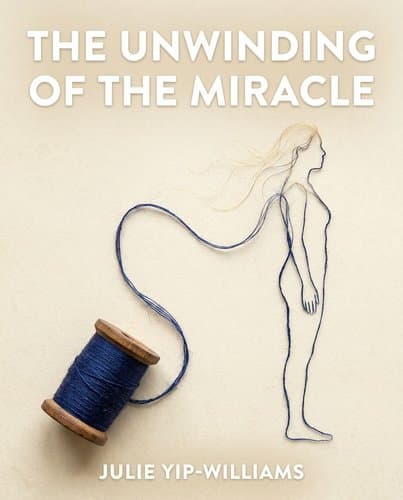
39216478_the-unwinding-of-the-miracle
by Julie Yip-Williams
Sentenced to death by her own grandmother at two months old, Julie Yip-Williams survived blindness and poverty only to face Stage IV colon cancer at forty—and…
In Brief
Sentenced to death by her own grandmother at two months old, Julie Yip-Williams survived blindness and poverty only to face Stage IV colon cancer at forty—and discovered that every obstacle meant to erase her was, in fact, the precise material from which an extraordinary life is made.
Key Ideas
Honesty, not bravery, guides us
When impossible news arrives, the most useful question isn't 'how do I stay positive?' — it's 'how do I stay honest?' Performed bravery distances you from truth and misleads the people around you. Julie's explicit refusal to perform is what makes this book useful to anyone navigating mortality, their own or someone else's.
Statistics don't dictate personal outcomes
Statistics describe populations. They carry no authority over an individual future. Julie had a 99.92% chance of never developing colon cancer and got it anyway — which means the odds were never the point, and treating them as such is a category error whether they reassure you or terrify you.
Name dreams to break paralysis
The paralysis that any crisis creates usually comes from mentally grouping 'dreams that are truly gone' with 'dreams that can be reshaped.' Naming which is which — explicitly, out loud — breaks the paralysis. Julie renovated an apartment and planned a Galápagos trip while dying of incurable cancer, not because she was in denial, but because she had done this specific work.
Genuine connection requires no pretense
Love deepens fastest when performance becomes impossible. The strangers in a hospital, the old doctor who took an afternoon to really talk, the husband who made a deal with a Pac-Man machine — these connections reached an intimacy most relationships never find because dying made pretense impossible. You don't have to be dying to ask: what am I still performing, and for whom?
Acceptance frees you from fear
Accepting that you might not survive is not giving up — it may be the only thing that frees you from what Julie called 'a paralyzed mind succumbing to fear,' which is what actually robs you of remaining life, not the illness itself. The terms of your surrender are yours to set.
Anger and peace can coexist
Rage and peace are not opposites. Julie could write 'I would kill them in cold blood' about cancer survivors in one chapter and describe arriving at genuine peace in another — both were honest, both were real, and one did not cancel the other. The expectation that peace means the absence of anger is itself a lie the self-help genre tells about dying.
Who Should Read This
Readers who connect with first-person stories about Memoir and Resilience and want to see the world through someone else's eyes.
The Unwinding of the Miracle
By Julie Yip-Williams
9 min read
Why does it matter? Because a woman who was nearly killed at two months old has more to teach about dying — and living — than almost anyone who made it to ninety.
The cancer memoir has a formula: diagnosis, fear, courage, gratitude, maybe death, definitely growth. Julie Yip-Williams knew the formula and hated it. She called performed positivity disingenuous, an insult to readers, and actively harmful to anyone newly diagnosed who couldn't locate themselves in that performance. So she wrote something else — something true. Which means this: a woman nearly killed as an infant by her own grandmother, who spent forty-two years defying every limit imposed by blindness and poverty and war, was eventually told her colon cancer had spread to her lungs, her ovaries, her liver — and discovered, in the process of dying, that accepting death was the thing that finally let her live without flinching. What she found, knowing she would not see her daughters grow up, is that borrowed time sharpens rather than softens: acceptance fiercer than hope, love that doesn't require a future to be real.
The Cancer Bloggers Who Performed Courage Were Doing Harm. She Wrote Something True Instead.
Julie Yip-Williams knew exactly what she was rejecting.
She had read those blogs — where the author greets every scan with a pumped fist, where fear never appears on the page, where the writer seems almost grateful for the opportunity cancer presented. She didn't just find them unconvincing. She found them harmful: disorienting and dangerous for newly diagnosed people who felt far more darkness than light and couldn't understand why they weren't holding up the way the bloggers were. Performed positivity made newly sick people feel broken for a completely reasonable response to a terminal diagnosis.
So she made a promise: she would write honestly about who she actually was during this fight. She wanted her daughters, if they read this after her death, to know their real mother — not a curated version, but someone who felt fear, rage, despair, darkness.
What that looks like: the day after Christmas, after learning her cancer had spread to her lungs, Julie broke completely. She screamed, hurled objects, and begged her husband Josh to let her board a plane to somewhere unknown and die alone. She made a cold, logical argument to him — he was young, handsome, successful; another woman would love their daughters; the girls were small enough to transfer their affections easily. She didn't want to fight. She wanted to flee into death. Josh grabbed her by the arms and screamed back that he would not let her give up.
That scene is the point of the book. For Julie, bravery is what you do after the collapse, not what you look like during it. The book is built on that distinction, and it makes nearly every other cancer story you've read feel like a press release.
Before She Was a Cancer Patient, She Was a Baby Her Grandmother Sent to Be Killed
In March 1976, when Julie Yip-Williams was two months old, her mother dressed her for a trip. Not in fresh clothes — in old baby garments stained with a sibling's feces that no amount of scrubbing had removed. Her grandmother stood in the doorway supervising the dressing. When it was done, she looked at the soiled garments and said they would do. These were the clothes in which the baby was supposed to die.
Julie had been born blind with cataracts in a Vietnam that had just fallen to the Communists. Doctors had fled or been imprisoned in reeducation camps. The family store was shuttered. In her grandmother's accounting, a blind girl was unmarriageable, therefore worthless, therefore a burden a struggling family couldn't sustain — and killing her was mercy. Over three weeks, the grandmother wore both parents down until they agreed to carry the baby two hours north to Da Nang, to an herbalist they paid in gold bars, to get a concoction that would make her sleep forever.
The herbalist looked at the infant's clouded eyes, heard what the parents were actually asking for, and refused. His voice was low but firm: he helped people afraid of dying, not people trying to cause it. With those words, Julie's mother burst into tears of relief she'd been suppressing the entire bus ride. She embraced the baby and thanked the herbalist over and over. Her father held his daughter for the first time in her short life. They rushed out before the man could change his mind. What ultimately saved Julie wasn't her parents' will. It was a stranger's conscience, and then a great-grandmother's pronouncement that the girl had come into the world blind and would leave it the same way, and there was nothing more to discuss.
Julie Yip-Williams didn't encounter death for the first time when she was diagnosed with Stage IV colon cancer at thirty-eight. She entered the world already sentenced, already dressed in the clothes she was supposed to be buried in. She had been living on borrowed time since infancy, and she never expected to be saved a third time. Cancer isn't a tragedy interrupting a normal life. It's the latest chapter in a life that was never supposed to exist at all.
Her Husband Spent the Night Googling Survival Odds. She Told Him He Was Missing the Point.
What do you do with a 6% survival rate?
The night after Julie's surgery, Josh sat in the recliner beside her hospital bed with his iPad, running numbers in the dark. Stage IV colon cancer carried a 6 to 15% chance of surviving five years. But Josh — the kind of man who memorizes every Super Bowl score and calculates odds for sport — kept stacking favorable variables: single metastatic spread rather than multiple, her age, her fitness, her access to the best medical care available. He worked himself up to 60% and wanted her to understand why that should matter.
She told him to go back further. Back to 1976, to Communist Vietnam, and set the odds of a blind girl escaping that country, surviving the South China Sea, gaining sight after years of optic nerve damage, graduating from Harvard Law School, marrying a lawyer from South Carolina. He couldn't do it. That was the point. Statistics describe populations. They say nothing about any individual who has already spent a lifetime defying them.
Here's the irony Julie lays out: per Mayo Clinic data, a woman under forty has a 0.08% chance of developing colon cancer. Her internist had never seen a nongenetic case in someone her age in thirty-seven years of practice. She got it anyway. When you hit the 0.08%, the probability retroactively becomes 100%. The same framework Josh used to console himself had already failed once, spectacularly, in the wrong direction. Statistics couldn't tell Julie whether she would live. Her biography already had — and it told a different story than the numbers did.
The Moment She Accepted She Was Probably Going to Die Was the Moment She Started Living
About two years into living with incurable cancer, Julie Yip-Williams had stopped making long-range plans. Every dream with a horizon came loaded with what-ifs: what if the cancer progresses mid-project? What if she dies before it's finished? What if they need the money for treatment?
The dream in question was absurdly ambitious: combining her Brooklyn apartment with the neighboring unit to create a 2,500-square-foot family home. A mortgage. A renovation. Years of work. The kind of commitment people make when they're planning decades out.
When the neighbors announced they were selling, Julie's first thought was about her daughters losing a playmate — she didn't mention it to her husband Josh for an entire week. When she finally did, he understood immediately what she hadn't: this was their chance. Then the what-ifs flooded in. What if she got too sick to oversee construction? What if she died before it was done?
She worked through every objection methodically — architects, lawyers, financial advisers — and finally asked her oncologist for his blessing. Two words: "Do it." Two years of cancer-shaped deliberation, dissolved in a breath.
Here is what she found out: it wasn't cancer blocking her dreams. It was a mind made rigid by resisting what was already true, paralyzed by fear of something she'd spent years refusing to accept. Once she accepted her death as the ground she stood on rather than a threat to dodge, the paralysis lifted. She signed the contract. She put a down payment on a future she might not see, and discovered that was exactly the point.
She Had Three Completely Contradictory Positions on Hope — and Was Right Every Time
Hope is not a philosophy you adopt. It's a weather system you live inside, and it changes without asking your permission.
Julie holds three positions on hope simultaneously and abandons none of them. After bad CEA results, she deliberately contracts her future to eight achievable years — "fuck hope," she calls it — because imagining grandchildren and then losing that image is a kind of violence she won't absorb again. This is the same move her mother made on the refugee boat from Vietnam: when asked what she hoped for during eleven days at sea with three hundred people and dwindling water, her mother said the future had gone blank. Survival required banning hope entirely. Julie maps this onto herself. She recognized her mother's survival mechanism from the inside: hope as exposure, a liability to be cut before it costs you anything more.
Then there's Josh, who never stopped believing. Not once. At the 2017 Australian Open, he pockets Julie's phone so she can't check live scores, and they watch Roger Federer, thirty-five and widely considered finished, come back from a fifth-set deficit against Nadal to win. Julie had told Josh it was "game over" for Federer (she'd made the same argument about herself) and yet she's jumping and dancing and high-fiving when it happens. Her conclusion, with characteristic dark humor: apparently she was going to have to start listening to her husband after all.
Julie refuses to resolve this. She says she will always oscillate between embracing and rejecting hope. What she won't do is pretend the oscillation doesn't happen, which is the one demand every other cancer story makes. The contradiction isn't a failure of nerve. It's what hope looks like when the audience disappears.
The Strangers Who Loved Her in Ways Her Old Life Never Would Have Allowed
One night at UCLA, a man whose name Julie never learned came into her room. Young, slicked-back hair, thick forearms — she admitted she'd have read him differently anywhere else, the kind of person she'd have quietly avoided. She'd had a humiliating accident. He cleaned her without a word. No hurry, no disgust. Just a steadiness she found almost impossible to process. She wrote afterward that she doubted she could do for a stranger what he'd done for her — and that being in his presence made her want to try.
What cancer took, she came to understand, wasn't only time and health and the ordinary future. It also took the distance that keeps most human encounters polite but shallow. Strip that away, and what remains is something Julie had almost no experience receiving: love with nothing performed in it.
The ward became its own proof. A nurse named Karen told her that her own mother had died of colon cancer at thirty-eight, leaving behind a two-year-old. A nurse named Costa clutched her hands and prayed in a language she didn't understand. Her surgeon cried at their goodbye and told her she was going to be fine. A whole ward of strangers became the ones to whom she could show what she concealed from everyone who loved her.
She called it a love that surfaces only when life is threatened, when everyone briefly agrees on what actually matters. She knew it was transient. She knew most of these people would recede. But she also understood something that takes the entire book to earn: love felt at that intensity becomes part of you. It doesn't require the other person to stay.
What Julie Yip-Williams left behind isn't a lesson about how to face death. It's evidence. Evidence in two daughters who will someday read a book their mother wrote so they would know who she really was. Evidence in a marriage that held through screaming and grief and Pac-Man deals struck on Santa Monica piers. Evidence that a life the world once tried to end before it began — dressed in soiled hand-me-downs, carried to an herbalist who refused — turned out to be, by any measure that matters, a miracle.
What Isabelle Knew That No Adult Could Say
Julie comes home from a doctor's appointment with bad news. She lies on the couch, calls Isabelle over, and tells her she's getting sicker. Isabelle studies her mother, asks how old she is, hears forty, stares at the television for a long beat, then turns back and tells her: she isn't gone yet.
Four words. They do what pages of adult consolation couldn't: they locate Julie in the present tense. Alive. Still here. A four-year-old observing the obvious, which turns out to be the one thing no adult had thought to say.
Throughout the memoir, Mia and Isabelle appear as the people Julie is fighting for: the daughters who will someday read this book and know who their mother really was. But Isabelle kept reversing the direction. When Julie hit her lowest point — physical agony from mouth sores, gutted by the deaths of two friends, having just screamed at Isabelle for not going to bed and been told by Josh she'd crossed a line — she collapsed on the living room rug and wept. Isabelle found her there. The same child she'd raged at sat down beside her, put a hand on her mother's head, and said nothing. When Julie finally told her to go back to bed, Isabelle offered her the floor of her room instead. An invitation from a child who had nothing to explain and knew it.
Julie wrote this book so her daughters would know who she really was. Isabelle, in return, kept offering something Julie couldn't have anticipated: the plain, insistent fact of her mother's presence. You are here. Not a philosophy. Just a fact she kept insisting on, in words once and then in the offer of her bedroom floor. And that, not the eloquence or the fight, was the whole miracle.
The Terms of Her Surrender
She was supposed to die in soiled clothes before she could speak. Instead she made it to seven continents, to Harvard Law, to Josh, to two daughters who will someday read a book their mother wrote so they could know her — not the performance, the person. What she left behind isn't a guide to dying well or a way to make peace with the inevitable. It's evidence. Evidence that a life can be completely inhabited in whatever window you're given, that refusing to look away from anything, including the worst of yourself, is its own form of courage, and that love at that intensity outlasts the person. Isabelle understood this without being taught. The girl in soiled clothes made it everywhere. Look what she left.
Notable Quotes
“I have to go back to school tomorrow, Grandma,”
“I love you, Grandma. I'm going to miss you so much. And I'm going to make you so proud of me, I promise.”
“In unison, my parents sucked in air so they would not faint from the horror of my grandmother's words, gaping up at her, searching for signs of insanity. But her dark eyes were steady and her jaw set. In her most reasonable tone, she said,”
Frequently Asked Questions
- What does The Unwinding of the Miracle teach about facing terminal illness?
- The Unwinding of the Miracle teaches that when facing terminal illness, the most useful question isn't "how do I stay positive?" — it's "how do I stay honest?" Julie Yip-Williams argues that performed bravery distances you from truth and misleads others. Her explicit refusal to perform is what makes this memoir powerful. The book reframes terminal illness not as a story of survival or defeat, but as a clarifying force. It shows how honesty about mortality, not optimism, enables people to keep living fully.
- Why does Julie Yip-Williams argue statistics are misleading about individual medical outcomes?
- Statistics describe populations and carry no authority over an individual future, according to Julie Yip-Williams. She had a 99.92% chance of never developing colon cancer and got it anyway—which means the odds were never the point. Treating statistics as meaningful guides, whether they reassure or terrify you, is a category error. This isn't about ignoring medical information, but rather refusing to be paralyzed or falsely reassured by percentages that cannot predict your personal trajectory. Individual outcomes defy population-level probabilities.
- What does The Unwinding of the Miracle reveal about planning while facing mortality?
- The paralysis that any crisis creates usually comes from mentally grouping "dreams that are truly gone" with "dreams that can be reshaped." Julie demonstrates that naming which is which—explicitly, out loud—breaks the paralysis. She renovated an apartment and planned a Galápagos trip while dying of incurable cancer, not from denial, but because she had done this specific work. Her example proves that accepting mortality doesn't mean abandoning all aspirations; rather, it clarifies which dreams remain possible and which require reimagining.
- How does The Unwinding of the Miracle explore relationships in the face of death?
- Love deepens fastest when performance becomes impossible, according to Yip-Williams. The strangers in a hospital, the old doctor who took an afternoon to really talk, the husband who made a deal with a Pac-Man machine—these connections reached an intimacy most relationships never find because dying made pretense impossible. The broader lesson extends far beyond terminal illness: you don't have to be dying to ask what you're still performing and for whom. Approaching life with such honesty deepens all human connection.
Related Book Summaries
Read the full summary of 39216478_the-unwinding-of-the-miracle on InShort