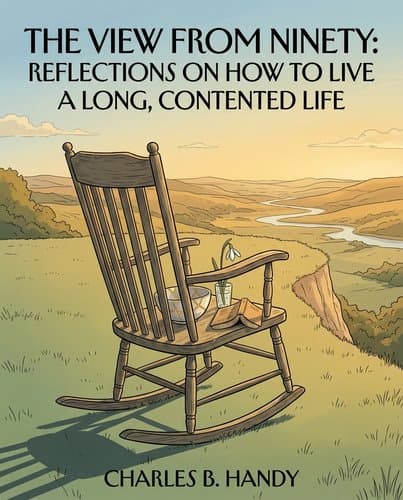
219097412_the-view-from-ninety
by Charles B. Handy
A 90-year-old philosopher hands you the rearview mirror he wishes he'd had at 30—revealing why freedom-to matters more than freedom-from, why reckless…
In Brief
A 90-year-old philosopher hands you the rearview mirror he wishes he'd had at 30—revealing why freedom-to matters more than freedom-from, why reckless experimentation in your twenties is mandatory, and why the relationships you neglect today are the only thing you'll regret at the end.
Key Ideas
Experiment boldly while failure costs least
Experiment recklessly in your twenties — the cost of failure is at its lowest and the failures themselves are the material you'll spend the rest of your life using
Balance security with creation and agency
Diagnose your life using Berlin's two freedoms: freedom-from (security, no worries) and freedom-to (agency, creation). Most people have too much of the former and not enough of the latter — and the trade-off is real
Name your blind spots with friends
Ask a trusted friend to name your blind spots. Your most dangerous flaw is almost certainly one you've never tested for, like a colour-blind man refuelling aircraft by colour code
Nurture relationships that compound through life
Build your 'snowdrops' now: the relationships you water and fertilise today are the only success metric that compounds into old age
Design deals that benefit both sides
When you can't trust someone, give them more — not more legal protection. If the deal doesn't please both sides, it won't hold
Debrief failures privately, celebrate publicly
'Make your mistakes in private; boast about your successes in public.' Create the equivalent of the Marines' confidential debrief — an environment where failure is safe to name
Plan your future while still able
Luck in old age is disaster planning that worked. Design your care arrangements, your finances, your relationships while you are fit and well enough to do it thoughtfully
Build legacy of trusted character
Judge your choices by what adjective you want on your tombstone. Wisest is less useful than reliable, kind, and trustworthy — the unsung virtues are what people actually remember
Embrace the gold in your breaks
Face your Kintsugi mirror: the breakages that have been mended with gold are more interesting than the flawless original. Stop flinching at the evidence of a life fully lived
Who Should Read This
Readers who connect with first-person stories about Memoir and Self-Improvement and want to see the world through someone else's eyes.
The View from Ninety: Reflections on How to Live a Long, Contented Life
By Charles B. Handy
13 min read
Why does it matter? Because the view from ninety reveals what you've been optimizing for the wrong things all along.
He woke up one morning expecting to be dead. The doctors had given him two years after his stroke, and he'd outlived the estimate. So there he was — statistically a corpse, functionally still curious — and the gap between those two facts turned out to be the most honest vantage point he'd ever had. At ninety, with nothing left to protect, Charles Handy looked back at a life of wrong trains, expensive silences, deliberate blindnesses, and one excellent marriage, and found he could finally see which parts actually mattered. This summary hands you his view early, before you've earned it the hard way.
The Wrong Train Gets You There Faster Than the Right One
A friend of Charles Handy's in Mumbai once passed along a local saying: sometimes the wrong train takes you exactly where you need to go. Handy knew it was true before he even finished reading the message.
When he graduated, the plan was straightforward: land a serious corporate job, earn serious money, build a serious life. He joined Shell International and shipped out to Sarawak, a remote corner of Borneo ringed by jungle and rivers, to run a marketing company. He was, by his own frank assessment, a poor manager. So he did what struggling managers do — he bought a stack of American business books and sat down to fix himself.
The books were terrible. Dry, clunky, badly argued. Handy, who'd been quietly modelling his prose on Hemingway, found himself thinking he could do this better. He pulled out the theories worth keeping, rewrote them in clean, short sentences, and illustrated every point with stories from his own Borneo disasters. The disasters, it turned out, were the whole point. Readers didn't want a guide written by someone who'd always got it right. They wanted someone who'd made a mess of it and could tell them what he'd learned.
The book sold ten thousand copies in its first month. By the end of the year it had reached a million readers worldwide. Publishers came calling. Speaking invitations followed. Handy had boarded a train marked Shell International and stepped off at Penguin Books and the BBC, into a life of writing and storytelling — which, as it turns out, is what he'd been born to do.
Your twenties are when you should experiment, precisely because the cost of failure is lowest then. No mortgage, no dependants, no accumulated identity to protect. Get on whatever train looks interesting. If it's the wrong one, you'll find out cheaply — and you'll learn things you couldn't have planned your way into knowing.
Comfortable Prisons Are the Most Dangerous Kind
The most dangerous prison is the one with a good salary and a view. Charles Handy figured this out mid-hand at a bridge table in South Malaya, playing cards with Army friends in his plantation-style house near Malacca. By any reasonable measure, he had won. Shell International had guaranteed him employment for life, a generous pension, a beautiful home, and a career that consisted largely of hosting lunch parties on the beach and keeping the heads of rubber plantations well-supplied with wine. The sun was warm. The arrangement was permanent. He suddenly thought: this is not what I want to be doing with my life.
He reached for a framework from Isaiah Berlin, an Oxford philosopher who rarely published but, when he did, produced essays that rearranged how you thought about things. Handy felt it at the card table, and Berlin had a name for the gap — the difference between freedom from (which Shell delivered in abundance) and freedom to (which it didn't). He had protection against every conceivable misfortune. What he lacked was any meaningful say in his own days. The rules were set. His team was competent without him. His real function was keeping the wine flowing for people whose goodwill Shell needed. He was, as he put it to himself, a voluntary prisoner.
He resigned. His wife greeted his return to England with champagne. They didn't need much, she said — just enough to feed the dog. It was the kind of conversation that sounds romantic in retrospect and terrifying in the moment.
Here is Berlin's sting in the tail, the part Handy doesn't soften when he passes this framework to his grandchildren: you usually cannot have both. Choosing freedom to — pursuing work you actually believe in — frequently means accepting less money than you'd like, schools for your children that aren't what you'd planned, a house your partner didn't picture. The tension doesn't resolve into a tidy lesson. It stays uncomfortable. What Handy offers instead of a solution is a warning: the cost of staying in the comfortable prison is real too, it just arrives slowly, as a low-grade frustration you learn to stop naming.
The Stain on the Ceiling Is Never Just a Stain
One morning Charles Handy noticed a brown stain spreading across the corner of his bedroom ceiling. His neighbor above must have a leak, he thought. What a nuisance. Then he shut his eyes, got dressed, and went to work, telling himself that maybe the hot weather would dry it out. Weeks passed. The stain, he suspected, was still there. He still hadn't looked.
That is wilful blindness — a term Handy borrows from Margaret Heffernan — and the unsettling thing about it is how reasonable it feels from the inside. The ceiling story isn't a confession of unusual weakness. It's a mirror. Handy's friend received a surveyor's report on a property he badly wanted to buy and simply refused to open it, reasoning that surveyors always exaggerate problems to cover themselves legally. The insurance will handle it. The surveyor is just being cautious. The hot weather will dry it out. The rationalizations arrive before you've consciously decided to avoid anything.
That's the trap. Wilful blindness doesn't feel like avoidance. It feels like pragmatism, or patience, or just not catastrophizing. You notice the uncomfortable fact, you register it, and then your mind quietly escorts you to something else. The stain is still there. You just stop looking at the corner.
Naming it matters. Once you have the term, you start catching the behavior in real time — in governments that keep spending past the point where the numbers add up, in men who dismiss serious symptoms as minor inconveniences, in yourself, telling yourself you'll deal with it tomorrow. The first move isn't willpower. It's recognition: the thing you've been most carefully not looking at is exactly the thing that needs you.
The stain you refuse to look at is bad enough. The one you genuinely cannot see is worse.
You Don't Know Your Own Flaws Until They're Catastrophic
Singapore, sometime in the 1960s. A young Handy is hauling fuel hoses around the tarmac at the international airport, sweating through a long day of aircraft refueling for Shell. The job was designed to be impossible to get wrong — every hose and valve wore a color code, red to red, green to green. Then the supervisor's voice cut across the noise: you damned fool, are you color blind? Handy's first instinct was outrage. Of course not. Except — he was. He had gone his entire life without knowing he couldn't distinguish red from green, and Shell had never thought to test him before assigning him a role where that specific gap could cause engines to stall mid-flight.
The insight isn't about organizational failure, though Shell should have screened him. It's about the category of flaw that lives entirely in your blind spot. He wasn't hiding his color blindness. He genuinely didn't know it was there. That's what makes it dangerous — not the flaw itself, but the unawareness. He'd been walking around with a deficiency that, in the wrong context, could have brought planes out of the sky, with no idea it existed.
Handy's practical suggestion is simple: ask someone who knows you and will actually tell you the truth. Not a performance review, not a self-assessment — a person who will say the uncomfortable thing out loud. The flaws that cost you most are never the ones you're already managing. They're the ones nobody has ever mentioned because they assumed you knew, or because the moment never arrived that made them matter. Until it does.
The Snowdrops on the Grave Know What Success Means
A teenage boy asked his grandfather what success looked like. Without hesitation he described yachts and motorbikes and a future loaded with things to buy. His sister was already sketching the dream house in her head — sea-view terrace, spectacular bathroom, the whole picture. The grandfather, Charles Handy, said nothing and took them to a churchyard instead.
A friend had planted snowdrops on his late wife Elizabeth's grave shortly after she died. What Handy found when he arrived was that the flowers had migrated — spread themselves across the graveyard, rooting on the tombs of neighbors, friends, people Elizabeth had loved and kept close over a lifetime. She hadn't asked them to do anything. The snowdrops had just gone where the warmth was.
Elizabeth's social practice looked, from the outside, almost embarrassingly ordinary. An hour on the phone with a friend, discussing nothing in particular. A Sunday lunch conjured from thin air because the weekend felt too empty. Good wine poured generously for whoever came through the door. She called it "just stuff" — keeping in touch — but Handy recognized it for what it was: the disciplined, patient work of maintaining a living ecosystem of people who cared about each other. Tend the roots, and the flowers spread.
Standing in that churchyard, Handy told his grandchildren that their grandmother's grave was surrounded by friends. Not metaphorically — the snowdrops had literally traveled to the people she'd loved. That was the record of her life: not what she'd accumulated, but how widely her care had reached.
He saved the quietest detail for himself. Elizabeth once called him her best friend — her highest compliment, he said. That made him, in his own reckoning, the chief snowdrop.
The move Handy is making here isn't sentimental. It's precise. Success leaves a visible trace — you can see it in whether your care has spread, or stayed contained. The grandchildren's yachts and dream houses stop accumulating the moment you stop earning. Friendships, tended properly, keep growing after you're gone. Elizabeth's gift for making people feel genuinely seen — what it looked like in practice, and how it worked — is worth examining more closely.
The Listening Trick That Makes You Seem Wiser Than You Are
Think of a radiator. You almost never notice one — same colour as the walls, no drama, no demands on your attention. But walk into a cold room where one is running and you feel it immediately: the whole atmosphere changes. That's the image Handy reaches for when describing Tom, a friend who 'hardly said a word' at social gatherings yet somehow elevated every room he entered. Meanwhile Bill, who had plenty to say and knew it, left people quietly exhausted.
The difference was a single habit: Tom paid attention. When Handy's wife talked about her photography — stories Tom had surely heard before — he looked at her as though she were the only person worth listening to in England. She glowed. She came alive. Tom hadn't said anything clever. He'd just made her feel that what she was saying mattered.
The strange thing is, the more someone talks, the higher they tend to rate the person listening. The speaker walks away convinced the listener is wise and perceptive — even if the listener has contributed almost nothing. Attention, it turns out, is indistinguishable from admiration when you're on the receiving end of it. You can deploy this at a dinner party, in a job interview, in a difficult meeting: ask a question, then stop talking. The other person fills the silence and leaves the room thinking well of you.
Becoming a radiator isn't about warmth of personality or natural charm. It's a practice, and Handy is honest that it's a tiring one — genuine attention costs something. But the return is outsized. You make the speaker feel seen; they attribute wisdom to you in exchange; and occasionally, if you're actually listening rather than just performing it, you learn something you wouldn't have found any other way. And when you know what someone actually needs — not what they say they need, but what slips out when they feel heard — you're already most of the way toward giving it to them. Which is where Ahong comes in.
If You Can't Trust Someone, Give Them More — Not More Lawyers
Malacca, sometime in the early 1970s. Handy has spent the afternoon in his oil agent's office, working through trading terms with a local businessman named Ahong. By the end of it they're both satisfied — Ahong got extended credit, Handy held his ground on discounts — and the deal is ratified with brandy, ginger ale, and a toast to future prosperity. Then Handy produces a three-page document blanketed in Shell corporate emblems and asks Ahong to sign. Ahong looks at it and says: this tells me you think you got the better of me, and you want the law on your side if you did. Why should I trust you now?
The question cuts through everything. The contract wasn't a safeguard — it was a signal. It announced that one party suspected the other might eventually feel shortchanged, and wanted enforcement ready. Ahong's counter-principle was simpler: any agreement that lasts must leave both people genuinely pleased. If someone can't be trusted, it's because they haven't received enough. The remedy isn't tighter contracts — it's more generosity.
This is a harder discipline than hiring a good lawyer. It requires you to keep asking whether the person across from you has enough — enough of the deal, enough trust, enough stake in the relationship continuing. If they don't, the contract won't save you. People with nothing to lose from walking away will walk. The legal document is always the last line of defense for someone who already lost the argument that mattered.
Ahong's logic doesn't stop at trading partners. It applies to the future self just as well. The person who builds nothing for later — no savings, no habits, no stored goodwill — has no one to negotiate with when age arrives. Which is where luck comes in, or rather where it doesn't.
Luck Is Just Disaster Planning That Worked
Most of what passes for luck in old age is just foresight that nobody witnessed. Handy is direct about this: he doesn't believe in luck as a mysterious dispensation. He believes in preparation so thorough that when things go right, observers assume fortune smiled on you.
The clearest proof is in his own living room. Decades ago, while he and his wife were still healthy, still employed, still capable of the sustained effort such things require, they converted an apartment inside their existing house into a purpose-built care home — a self-contained space designed for exactly the kind of dependency that age eventually brings. Unglamorous work: thinking hard about wheelchairs and carers and proximity to family while their peers were presumably planning retirement holidays. Now, following a stroke, Handy lives there comfortably with a full-time carer and his daughter one floor down. When visitors tell him how lucky he is to have such a perfect arrangement, he accepts the compliment. He knows what it actually was.
The cost is the part worth holding. They made that decision with time, money, and physical energy — three things that compound together and then quietly disappear. The people who most need a plan like that are often the least capable of executing one, because they waited. You cannot retrofit foresight. The window when you can design your own future is real, it is finite, and it tends to close before you notice it has gone.
The harvest only comes if you planted something.
Kindness Doesn't Always Win, and You Should Know That Going In
Kindness is not a strategy. It won't reliably produce better returns, more loyal teams, or longer careers. The book is honest enough to say so, which means if you choose kindness, you need to choose it for its own sake — not because the evidence promises it will pay off.
Handy learned this the direct way. His first management posting was running a Shell subsidiary in Borneo, and he went out of his way to be good to his team — patient, considerate, accommodating. His superiors in Singapore were unimpressed. They compared him to a mythical Chinese general who supposedly reassured his troops by announcing he'd be right behind them — safely at the rear while they faced whatever was coming. The message from Singapore was blunt: character, not intelligence or niceness, is what makes a leader, and character means being out front. Handy was recalled to London after two years. The kindness hadn't worked, at least not by the metrics his bosses were using.
So where does that leave you? Handy's answer isn't to pretend the trade-off doesn't exist. It's to accept that you are what you are, and then choose deliberately. His own nature is kind — his father's rectory, the open door, the person in need. That doesn't change because someone else was profitable. You pick it because it's who you are, and you run your organisation for others rather than yourself. Just don't expect the case studies to back you up.
The Face in the Mirror Is a Kintsugi Bowl, Not a Ruin
Imagine a ceramic bowl that cracked badly once and was repaired, but the restorer decided not to hide the damage. Instead, the mend was sealed with lacquer mixed with gold dust, leaving bright metallic seams running across the surface. The repaired bowl is stronger than the original, and the breakage lines are now the most interesting thing about it.
Kintsugi is the Japanese practice, and Handy received a book about it as a gift. He looked through photographs of repaired pottery and felt the force of the idea immediately: the mend made visible, the damaged object made more beautiful for having been broken.
The test came the next morning when he looked in the mirror before shaving. His first instinct was dismay — the forehead deeply lined, the hair gone except for tufts above each ear, the eyes wet. But he stayed with it. The lines across his forehead were like a ploughed field: the accumulated evidence of decades of reading and writing. The tears were grief for his wife, dead for several years, still missed every morning. The weakness in his legs was the aftermath of a stroke. Each of these things had once broken him. All of them showed. And all of them were, in the kintsugi logic, exactly what made his face worth looking at — a record, not a ruin.
The Stoics called something like this experience digested at leisure; Handy calls it experience understood in tranquillity. The stroke gave him the tranquillity he hadn't chosen; what he did with it was the wisdom. He stopped flinching at his reflection and started greeting it instead — something close to, well, old friend, you've been through it, haven't you?
That greeting is the whole move. Kintsugi isn't acceptance of decline; it's a reinterpretation of what decline means. The breakages aren't subtracted from you. They're added to you, visible in the gold seams if you choose to see them that way. Handy clearly does. He's developed a habit of bellowing Carroll's nonsense verse at the dawn from his Norfolk garden — 'O frabjous day! Callooh! Callay!' — disabled, housebound, waited on like royalty, and apparently delighted about it. His son watched this and said: if this is what old age is like, I can't wait.
'Never Mind' Is the Most Liberating Theology Available at Ninety
One morning Handy told his housekeeper he thought he was about to have a heart attack — that this was, in all likelihood, the day he would die. She looked at him brightly and said, 'Never mind!' He was furious. He had just made the most consequential announcement of his life, and she had waved it off like a spilled glass of wine. Then, slowly, he came around to thinking she might be right. His life was like the walnut tree he'd planted half a century earlier in his Norfolk garden — it had grown, fruited, dropped its harvest across the ground, and was now visibly fading. When it finally went, another tree would grow in its place. Probably not even a walnut. But it would still shade the courtyard entrance and welcome whoever came through.
What Handy reports next should unsettle every assumption you carry about dying. The days that followed — the days when he genuinely believed he was at the end — were, by his account, remarkably pleasant. He said goodbye to the people he loved. He looked at his favorite view one last time. He poured himself a glass of good wine. And he felt something he hadn't expected: relief. No more responsibilities. No more overdraft to worry about — someone else would have to deal with that. The dread he'd anticipated simply didn't show up.
This is what the Stoics had been pointing at for two thousand years, and what the Serenity Prayer crystallizes in a single sentence: accept what cannot be changed, act where you still can, and know which is which. Handy encountered it when a bishop used it to redirect his ambitions during a meeting at Windsor Castle — the details of which Handy declines to elaborate on, which somehow makes it more plausible. He carried that creed into his nineties not as a consolation prize for failing to live forever, but as the clearest description of what freedom actually looks like. The readiness isn't resignation. It turns out to feel less like surrender and more like setting down something heavy you'd forgotten you were carrying.
The Question Worth Asking Every Morning
Here is what the whole book is really asking: can you borrow the view without earning it the hard way? Handy shouts Carroll nonsense at the Norfolk dawn from a wheelchair not because senility freed him, but because clarity finally did. He stopped waiting for the credentials to live deliberately and started living deliberately. The stroke didn't teach him that — it just removed the last excuse not to. Every framework he offers — Berlin's two freedoms, the kintsugi mirror, the snowdrops, the housekeeper's cheerful 'never mind' — points at the same thing: the life worth having is assembled from what you paid attention to, not what you accumulated. You don't need ninety years and a near-death announcement to a disinterested housekeeper to see that. You just need the honesty to look at your ceiling stain directly, today, while you still have time to do something about it.
Notable Quotes
“Sometimes the wrong train leads you to the right destination.”
“Colin, the boiler’s gone again,”
“Oh, dear, I will get a plumber and if necessary we’ll put a new boiler in.”
Frequently Asked Questions
- What is 'The View from Ninety' about?
- The View from Ninety examines what determines a contented life, drawing from Charles Handy's nine decades of experience. Rather than offering wisdom solely in hindsight, the book provides practical frameworks for work, friendship, freedom, and failure that readers can apply early. It challenges assumptions about security and agency, emphasizing how relationship-building, failure management, and deliberate planning in youth compound into meaningful old age. The central message: a contented life depends on early decisions about risk-taking, authentic relationships, and how you define personal success beyond conventional metrics.
- What does Handy say about failure and mistakes?
- Handy advocates strategic failure early in life: "Experiment recklessly in your twenties — the cost of failure is at its lowest and the failures themselves are the material you'll spend the rest of your life using." He emphasizes creating psychological safety around failure through "Make your mistakes in private; boast about your successes in public." This principle, exemplified by the Marines' confidential debrief model, transforms failure from shameful to instructive. Handy suggests that normalized failure discussions in trusted environments enable learning without social punishment, turning mistakes into valuable experience for future decades.
- What are Berlin's two freedoms in this book?
- Handy diagnoses contentment using Isaiah Berlin's framework of two freedoms: freedom-from (security, no worries) and freedom-to (agency, creation). He argues that most people have excessive freedom-from while lacking freedom-to, and critically, "the trade-off is real." This imbalance leaves many feeling secure but constrained. Understanding this distinction helps readers evaluate their choices more clearly—whether they prioritize comfort over autonomy, and whether that alignment serves their contentment. The framework recontextualizes common life struggles as structural rather than purely psychological challenges.
- What does Handy mean by 'snowdrops' and legacy?
- "Snowdrops" represents relationships cultivated intentionally over time—"the relationships you water and fertilise today are the only success metric that compounds into old age." Unlike financial or career achievements, relationships gain value exponentially through decades of consistent tending. Handy advises judging your choices by what adjective you want on your tombstone: "Wisest is less useful than reliable, kind, and trustworthy — the unsung virtues are what people actually remember." This reframes success from accomplishment-focused metrics to relational and character-based legacies that genuinely endure.
Related Book Summaries

Read the full summary of 219097412_the-view-from-ninety on InShort