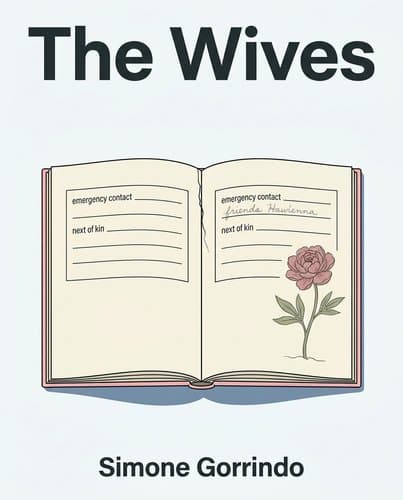
176443920_the-wives
by Simone Gorrindo
When her husband joined the Army, Simone Gorrindo discovered that military marriage doesn't just separate partners—it structurally designs their distance.
In Brief
When her husband joined the Army, Simone Gorrindo discovered that military marriage doesn't just separate partners—it structurally designs their distance. A memoir about how a group of wives, not a husband, taught her that love is less a feeling than a practice of showing up inside unbearable absence.
Key Ideas
Institution Designs Compartmentalization, Not Communication
The emotional distance inside a military marriage is often structural, not personal — the institution actively selects for and trains compartmentalization in soldiers, which means the unavailability a spouse suffers is a designed feature, not a fixable communication problem
Mutual Protections Create Unintended Barriers
Performed invulnerability by both partners builds walls that neither intended — Simone's 'protecting him from my reality' was as much a barrier as Andrew's OPSEC; naming this mutuality is the first move toward closing the distance
Specific Shared Trauma Sustains Survival
The community of people who share your specific unbearable thing — not family, not old friends, not a therapist — is often what makes survival possible; the wives' meal trains, late-night texts, and silent kitchen cleanings did what no amount of individual resilience could
Living Contradiction Without Final Answers
Belonging and critique can coexist without resolution: Simone both mocks the tribal rituals of military culture and is genuinely seduced by them, and the book insists both responses are honest — you don't have to choose a verdict about a life you're living inside
Individual Calling Morphs Into Capture
The 'calling' that looks like individual will from the outside often looks like a loop from the inside: Andrew says 'time is running out' four years after first saying it, suggesting that what begins as a philosophical choice can become institutional capture — and that spouses absorb the consequences of that shift whether or not they agreed to it
Who Should Read This
Readers who connect with first-person stories about Memoir and Marriage and want to see the world through someone else's eyes.
The Wives
By Simone Gorrindo
11 min read
Why does it matter? Because the most corrosive thing about military life isn't the danger — it's the demand that everyone perform invulnerability
Most books about military life are really about the soldier. This one isn't. Simone Gorrindo followed her husband into the insular world of Army Special Operations expecting to find herself on the margins of his story — a supporting character waiting at windows, filling out pink emergency handbooks, learning to say nothing because everything is classified. What she found instead was a parallel world, invisible to the outside and largely invisible to the soldiers themselves: a community of women who had quietly built the infrastructure for surviving what the Army's briefings don't cover. The Wives is the account of what it costs to perform invulnerability for years at a stretch — on behalf of a marriage, a unit, an identity you didn't choose — and what quietly breaks open when that performance finally fails. It turns out the most dangerous thing about loving someone at war isn't the war. It's the silence both of you agree to keep.
She Didn't Follow Her Husband Into the Army — She Followed Herself Into a Crisis She Already Knew How to Survive
The night before Andrew shipped out to Afghanistan, Simone stood in their half-empty living room in Columbus, Georgia, watching her husband move through a moat of combat gear, ticking off a packing list. She was a New York magazine editor who had spent years chasing literary bylines and 11 p.m. dinners in the city she loved. Now she was an Army wife in a brick house near a church marquee that read 'SIN ERS ARE WELCOME,' holding a pink booklet — pink, apparently, because she was a woman — that asked for her emergency contact. The question stopped her cold. Who, exactly, would she call?
The easy story is sacrifice: brilliant woman gives up her life for her husband's calling. But that framing misses something the book quietly insists on. When Andrew sat across from Simone in a Manhattan therapist's office and told her that if he had to choose between her and the Army, he'd choose the Army, she described the words landing like a physical blow. What she didn't say then, and only begins to understand in Georgia, is that some part of her had already chosen this too — not the Army, but the structure underneath it. The crisis. The listening.
She'd been training for exactly this since she was eight years old. One spring evening in Marin County, she stood at a living room window watching the sky go dark, waiting for her mother to come back from a walk that had gone wrong. She found her under a peony bush, a fifth of gin on the ground beside her. Her father carried her mother inside the way you'd carry a bride over a threshold — the image is almost tender, which makes it worse. After that night, Simone became the family watchman: monitoring her mother's speech for the slur that meant danger, listening for the temperature change in her father's voice, scanning the house each morning for signs of what the night had done. That childhood hyper-vigilance, exhausting and involuntary, is precisely what the military asks of its spouses. Wait. Watch. Say nothing on social media. Be ready.
She didn't follow Andrew into crisis. She followed herself back into a kind she already knew how to read.
The Pink Book, the Petunias, and the Arranged Marriage You Didn't Know You Were Entering
The system Simone mocks is also the system keeping her alive, and she knows it even as she's rolling her eyes at it. The clearest proof sits in the pink emergency handbook — pink, the Army explains, because spouses are women, the way regulations are blue because soldiers are men — that asks for an emergency contact in the event notification officers appear at her door. Simone avoids the form for weeks. Completing it means naming the person who will come hold her together if Andrew is killed, and she doesn't have one. She's new to Columbus, new to Georgia, new to this entire world. Her family is scattered across California. Her New York friends are a world away. The blank line in the booklet isn't a bureaucratic inconvenience. It's a precise map of her isolation.
Then Rachel texts from across the street: wine and TV?
The friendship that follows is, as Simone eventually recognizes, a kind of arranged marriage — engineered by proximity, by matching husband rank, by the simple fact that the Army has installed them in identical brick houses on the same street. Rachel's own marriage proposal came in a parked car in Lawton, Oklahoma, Dan informing her that they had to wed because the military doesn't let enlisted soldiers live off-base unless they're married.
Simone finds this absurd. Then she fills in Rachel's name as her emergency contact.
That simultaneity — the mocking and the depending — is what the section keeps pressing on. When a pastor's wife takes the stage at a spouse retreat in Birmingham and instructs fifty women to put on heels and lipstick so their husbands' faces don't fall in disappointment at the door, Simone wants to catch Rachel's eye and share a look of disbelief. Rachel won't give it to her. Simone scans the room for someone else who sees what she sees. She finds Maggie, a first sergeant's wife surviving her eleventh deployment, who meets Simone's gaze and holds it for a beat — then rolls her eyes, hard and slow, like she's been waiting years for someone to notice. They grin at each other like co-conspirators. The system produced this moment too.
The Seduction of Belonging Is Served in a Gritty, Sand-Filled Bowl
Jack slides the grog bowl across the table and fixes Simone with a look that says he already knows the answer. The bowl is cloudy brown, shot through with a dark smudge at the center — actual desert sand from Iraq, poured in by a soldier during the ceremony that just unfolded on stage, where each bottle represented a war: Cognac for Normandy, Soju for Korea, Budweiser for Vietnam, Rum for Panama. It's the Unit Ball, and Simone has spent the evening watching this ritual with the faint anthropological detachment she brought with her from New York. The whole thing is, she thinks, utterly bizarre.
Then Jack names her. "If there's any wife who's gonna go for it, it's you."
She picks up the bowl and drinks. It's gritty and acidic, and it burns. And the prize she feels she's won is real — not imagined, not ironic, real. Jack's arm around her shoulder, the warmth moving through her chest: she has passed some threshold she didn't know she was walking toward.
Simone arrived in Columbus as someone who would notice the absurdity of a silver bowl filled with sand and call it a cult. She still notices. But somewhere in the year of waiting alone, of filing away at her isolation, of learning when to eat dinner without Andrew and how to drive a stick shift through pitch-black Alabama roads, the tribe has gotten inside her. The grog ceremony works on her precisely because she finally understands what Andrew meant when he said he wanted to be part of history. Watching the battalion commander take a long pull from the bowl while liquor drips down his meticulously pinned uniform, she stops judging the male need to leave a mark and feels instead the weight of the lineage he's joining — all those men in the photographs behind the stage, the ones who didn't come back. The sand isn't theater. It's a relic.
This is what Simone didn't expect: belonging doesn't announce itself, it just shows up one night in a gritty silver bowl. That night, flushed and belonging, she leans close to Andrew on the dance floor and tells him she's ready to have a baby. The seduction and the clear-eyed critique are both completely honest, and they don't cancel each other out. You can see through a ceremony and still be changed by it. The bowl was gritty and it burned and she'd do it again.
The Unit Is Designed to Produce the Emotional Unavailability You Are Suffering From
The emotional distance in Simone's marriage is not a communication problem. It is a design specification.
At a Family Readiness Group meeting in a hotel conference room, a military psychologist named Doc Radley stands before a roomful of wives and describes the men they married with the calm precision of someone reading a product spec sheet. High IQ. Socially skilled but fundamentally introverted. Low anxiety. And, the one that stings: low empathy — not as a regrettable side effect, but as a primary screening criterion. The Unit actively selected for men who could watch a friend take a bullet, get him to a medic, and continue the gunfight without losing operational effectiveness. Radley calls this compartmentalization. The room laughs when someone from the back calls it 'healthy sociopathy.' Radley doesn't exactly disagree.
Simone sits with this. She has spent months trying to reach Andrew across a distance that feels personal — his deflections, his 'I don't talk like that' when she asks how a deployment felt, the way he stopped calling during one stretch because, he told her, going back and forth between that world and this one was simply too hard. She had been reading these as failures of intimacy, evidence of a marriage that needed work. What Doc Radley is telling her, in the language of clinical psychology, is that the man she married was chosen precisely because he could put her — her worry, her need, her voice on the phone — into a box and set it aside. The Army didn't create that capacity in Andrew. It found it, confirmed it, and then spent years rewarding him for using it.
The cost lands somewhere below argument. Simone isn't failing to reach Andrew. Andrew was built, before she ever met him, to be unreachable in exactly the ways she keeps trying to reach him. That's not a problem with a solution. It's a load-bearing feature of the structure she moved into.
Heartbreaking Relief: What It Costs to Feel Safe When Someone Else's Husband Dies
What does it feel like to wait for news of casualties when the casualties might include your husband? The honest answer is uglier than noble stoicism, and Simone doesn't flinch from it.
When Lisa, a key caller whose husband is on his ninth deployment, phones to report that two soldiers from B-company were killed in Kandahar and nine wounded, she's supposed to deliver the script and hang up. Instead she starts sobbing mid-sentence. What she calls a MASCAL — a mass casualty event — has broken through whatever professional composure the Army's communication protocol is designed to maintain. Simone listens to her cry, then tells her Andrew is at Ranger School. Not in Afghanistan. Not in any of the casualty numbers. Lisa's voice lifts with something that sounds almost like relief, and Simone feels it too — a rush of gratitude so immediate it almost knocks her over. Then comes the guilt, arriving just as fast. Ten more wives are waiting for Lisa's call. Some will spend the next hours learning their husbands are fine. Others won't. Simone gets to be the easy call, and she knows it.
By Andrew's second deployment she is twenty-four weeks pregnant, alone in Columbus at three in the morning, phone screen the only light in the room. American outlets have moved on to Trump. So she checks Pakistani and Indian news sites instead — a habit she hides from Rachel, from the other wives, from Andrew. She scrolls through the numbers: thirty-five civilians killed in a Kabul market bombing, a UN tally running toward four thousand. She reads every word. And then she notices what the reading reveals about her: a soldier killed by a roadside bomb keeps her awake in a way those thirty-five civilians simply don't. The screen goes dark and she doesn't move to wake it. She just stays there, one hand on her stomach, and writes it down afterward with what she calls a ruthless clarity — if it had to be someone else's husband or hers, it would be theirs. Every single time.
The system's actual cost isn't fear of loss in the abstract. It's the discovery of exactly how far your moral circle extends and exactly where it stops. The line isn't drawn by cruelty. It's drawn by love.
'Shut It Down NOW': Surviving 48 Hours in Bite-Sized Chunks at 31 Weeks Pregnant
The phone call lasts maybe three minutes. Simone is lying on her side at Rachel's, thirty-one weeks pregnant, trying to describe the feeling of the baby's movements — like tidal waves now, not the popcorn flutter of a few weeks earlier — when she hears the background shift. Not the usual murmur of other guys, but something urgent, tightly compressed. A voice cuts through, so close to the receiver it could be Andrew himself: Shut it down NOW. Andrew says he has to go. She starts to protest — already? — and he repeats it in a voice she'll think about for the next two days, rougher than the command she just overheard, almost harsh. Then the line goes dead.
What follows is one of the most honest accounts of deployment survival you'll read, precisely because it refuses to be heroic. Simone doesn't pray. She doesn't call the other wives. She doesn't cry, at least not in any sustained way. Instead, she breaks the next forty-eight hours into pieces small enough to survive: an eleven-minute walk along the outdoor mall, an eight-minute drive to Marshall's where she buys a pink dress the baby doesn't need yet, twenty-two minutes eating half a bagel at Panera while waiting for a movie she leaves before it ends because the theater is too cold and everyone inside is on a date and that easy, ordinary intimacy — did you let the dog out before we left? — is more than she can stand. The bite-sized chunks aren't a coping technique she chose. They're what's left when you cannot afford to feel the actual size of what you're waiting to find out.
The redeployment briefings cover sleep hygiene and ADHD and the five-day adjustment model for when the men come home. Nobody hands out a protocol for the forty-eight hours when your husband's voice went rough and a stranger barked a security command and you have no idea whether the next knock at the door will be routine or the thing you have been quietly rehearsing since you moved to Georgia. You make yourself drive to Marshall's. You make yourself count the minutes. You keep moving in pieces because the alternative is to feel the whole thing at once, and the whole thing is unsurvivable as a single unit.
Both Partners Built the Wall — But Only One of Them Called It Love
She mortared her half of the wall with something she was calling love.
The clearest evidence comes at five in the morning during the deployment's extension, when Simone is alone and unraveling and finally writes Andrew the raw, desperate message she's been suppressing for months. The moment she sends it, she panics. She fires off two follow-up emails instructing him not to read the first one. Her reasoning, which she states plainly and then sits with, is that shielding him from her reality was how she loved him best. She believed the wall she was building between his attention and her actual interior was an act of devotion. What she slowly recognizes is that it was also self-erasure with a noble story attached — and that the noble story made it invisible, even to her.
Andrew's half of the wall is well-documented by the time they reach Gary's office: the OPSEC that converts his work into a classified zone she cannot enter, the institutional reward for compartmentalizing her worry, the choice he named plainly in a Manhattan therapy room before any of this began. But Simone, in that same session, finally names her contribution. His life is designed to keep her from knowing him — and the version of herself the Unit expects, quiet and capable and unbreakable, is equally designed to keep him from knowing her. The wall runs both ways. They built it together, him through trained emotional inaccessibility, her through performed stoicism she had mistaken for strength.
Here's what they finally had to admit in Gary's office: you cannot demand to be known by someone you have spent four years carefully hiding from. The concealment was mutual, the institution enabled both sides of it, and what looks like Andrew's failure to show up is inseparable from Simone's years of telling him — through careful emails, through unsent feelings, through those two frantic follow-up messages — that she didn't need him to. The reckoning isn't about who built more of the wall. It's about both of them finally admitting the wall is there.
The Wives Were the Real Institution All Along
The wives were the real institution all along. The Army moved the men around like chess pieces and set the terms of everything — the deployments, the silences, the sudden phone calls that ended mid-sentence — but it was the women who taught Simone how to live inside conditions no institution bothered to prepare her for.
The proof lands in a single kitchen moment. Hailey shows up unannounced one morning to find Simone weeks deep into a Vicodin spiral: blinds down, dishes congealed, a line of ants marching across the counter beside a rotting banana. Simone has been managing the performance of the capable Army wife long enough that she starts apologizing, picking up magazines, narrating a recovery plan she has no intention of executing. Hailey doesn't argue. She doesn't offer sympathy. She picks up a dish rag and wipes down the counter in one long, confident motion. No pity, no commentary, no request that Simone explain herself. Just the quiet acknowledgment — I see what I'm seeing and it isn't good — made legible through the act of cleaning up. That silence is its own kind of fluency, and it is entirely untranslatable into the language the Army speaks.
The wives built a parallel institution inside the official one, and it ran on forms of labor and attention the military had no category for. Maggie wrote Mark's English papers between deployments so he could fulfill a promotion requirement the Army mandated but gave him no time to complete. None of this appears in any FRG memo. None of it is decorated or acknowledged. It is simply what you do, and you learn it from the woman across the street, who learned it from the woman before her.
What Georgia actually gave Simone was not a marriage made stronger by adversity, not a clearer relationship to the institution she resisted and joined all at once, but an education in a practice of love that only becomes possible when you share the unbearable with someone who knows exactly what it weighs. The wives were her real curriculum. The Army was just the building they met in.
What Fiona's Question Actually Asks
Seven years after Georgia, Simone is in Tacoma when Fiona asks the question in the dark — but, like, a real war — with the frank skepticism of a child who measures her father's absences in sizes but hasn't yet learned what the sizing costs. No answer Simone gives will be adequate. Not because the truth is too complicated for a six-year-old, but because the truth is too complicated, period. What the book finally hands you isn't resolution but inheritance: Fiona will grow up inside the same structure her mother walked into holding a pink handbook and an empty emergency contact line. She'll find her own Rachel across the street, her own grog bowl to drink from or refuse. Home was never a place Simone arrived at. It was something she built in the rubble of the life she actually chose.
Notable Quotes
“Are you planning on running away and joining the Army?”
“You haven’t stopped thinking about this,”
“It’s what I want to do.”
Frequently Asked Questions
- What is *The Wives* by Simone Gorrindo about?
- *The Wives* is a memoir by Simone Gorrindo examining what it means to build a life as an Army spouse. The book draws on her years following her husband through military deployments and duty stations, exploring the structural forces that shape military marriages. Gorrindo investigates the communities of wives who make survival possible and examines what it costs—and gives—to belong to an institution you never enlisted in. Rather than treating military marriage as a personal relationship problem, the memoir frames it within institutional contexts that actively shape behavior and emotional availability.
- What does *The Wives* reveal about emotional distance in military marriages?
- Emotional distance inside military marriages is often structural, not personal. Gorrindo argues that the institution actively selects for and trains compartmentalization in soldiers, meaning the unavailability a spouse suffers is a designed feature, not a fixable communication problem. Additionally, both partners perform invulnerability that builds walls neither intended. Her "protecting him from my reality" was as much a barrier as her husband's OPSEC, and naming this mutuality is the first move toward closing the distance. This reframing shifts responsibility from individual failings to systemic design.
- What is the role of community in *The Wives*?
- Community is essential to survival in military life, according to Gorrindo. The community of people who share your specific unbearable thing—not family, not old friends, not a therapist—is often what makes survival possible. The wives' meal trains, late-night texts, and silent kitchen cleanings do what no amount of individual resilience could achieve. Gorrindo emphasizes that these practical acts of solidarity among military spouses create a collective strength that transcends what individual coping mechanisms can provide. This network becomes the actual infrastructure supporting military families.
- How does Gorrindo balance critique and belonging in *The Wives*?
- Gorrindo presents military life as something that can be both critiqued and embraced simultaneously. She mocks the tribal rituals of military culture while remaining genuinely seduced by them, and she insists both responses are honest. The book demonstrates that you don't have to choose a verdict about a life you're living inside—belonging and critique can coexist without resolution. This nuanced approach avoids simple judgments about institutional life, recognizing that complexity and ambivalence are fundamental to the experience of being a military spouse embedded in a system.
Related Book Summaries

Read the full summary of 176443920_the-wives on InShort