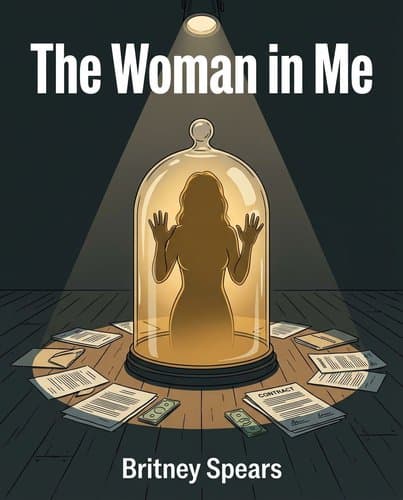
63133205_the-woman-in-me
by Britney Spears
Behind the world's most scrutinized "breakdown" was a woman more capable than everyone controlling her. Britney Spears dismantles the machinery of public…
In Brief
The Woman in Me (Octo) is Britney Spears' first-person account of living under a thirteen-year legal conservatorship that removed her financial and personal autonomy. It shows how family, legal, and media systems can be used to suppress a competent adult's agency, and what effective self-advocacy — through courts, public pressure, and legal representation — actually requires.
Key Ideas
Narrative Control Reveals Who Holds Power
The public narrative about a woman's 'breakdown' almost always tells you more about who controls the story than about what actually happened to her — the Britney case is an extreme version of a common dynamic.
Crisis Cannot Erase Artistic Competence
Artistic clarity and personal crisis are not mutually exclusive. Some of the most critically celebrated pop music of the 2000s was made by a person being held against her will. Don't use someone's pain as evidence against their competence.
Closeness Enables the Most Harm
The people closest to you can be the most effective agents of your harm — not despite knowing you, but because of it. They know which fears to exploit, which systems to use, and which silences to rely on.
External Pressure Breaks Internal Suppression
Self-advocacy in a system designed to suppress your voice requires using the system's own tools — courts, public testimony, legal representation — not just emotional authenticity. The #FreeBritney movement mattered because it created external pressure on an internal institution.
Apparent Passivity Is Coerced Survival
Compliance that looks like passivity is often a survival response to an environment where asserting yourself carries concrete costs. Before judging someone's 'choice' to go along, ask what they were told would happen if they didn't.
Who Should Read This
Readers who connect with first-person stories about Memoir and Social Issues and want to see the world through someone else's eyes.
The Woman in Me
By Britney Spears
9 min read
Why does it matter? Because the story you know about Britney Spears was told by the people who were harming her.
The public story of Britney Spears runs like a highlight reel of collapse: shaved head, umbrella, ambulance, psychiatric hold. You've seen the footage. What you haven't seen is who was standing just outside the frame — who called the paparazzi, who filed the legal papers, who took the salary while calling it protection. The Woman in Me is her account of how that footage got made and what it cost her. The woman who shows up in these pages was never the chaos the headlines promised. She tracked her own tax deductions while her father had her declared incompetent. She recorded the best-reviewed album of her career while legally barred from choosing her own lawyer. For thirteen years, the people controlling her story convinced the world she was the problem. She's here to tell you what actually happened — and who made sure you'd never know.
Before Anyone Knew Her Name, She Already Knew Exactly What She Was Doing
The night before recording "...Baby One More Time," Britney Spears stayed in her room listening to Soft Cell's "Tainted Love," deliberately not sleeping. She wanted to walk into the studio the next morning with a voice worn raw, gravelly, older-sounding. She got exactly that. The roughness on the track wasn't a fluke of mood. She'd engineered it.
The story she tells about herself is all cluelessness and luck: wandering into a New York office without knowing who Clive Calder was, picking up his teacup terrier, somehow walking out with a record deal at fifteen. She uses "clueless" constantly. But watch what she actually does. Before agreeing to meet a Swedish producer named Max Martin, she asks the label who he's worked with. Once in the studio, she pushes him toward more R&B and less straight pop, and he adjusts. She engineers her own vocal texture through calculated sleeplessness. These are the moves of someone who knows exactly what she's building.
The video makes it explicit. Jive brought her a concept: futuristic astronaut, Power Ranger aesthetic. She was sixteen, unknown, on her first album. She rejected it anyway and pitched something specific: a school hallway, bored students, a bell that triggers dancing, school uniforms that make the moment they're stripped off feel like release. The director accepted everything. The video made her famous. The label's concept ended up in no one's memory.
She keeps framing it as luck. The specific details she remembers — the Soft Cell record, the deliberate sleeplessness, the video pitch she turned down — tell a different story. Someone was in charge. It just wasn't the label.
She Didn't Learn to Please People. She Was Trained To.
Mid-gymnastics class, age nine, she had to stop whatever she was doing and look through the window. Confirm her mother was still standing there. Only then could she continue. One afternoon she looked and the space was empty. Britney dropped to her knees on the gymnasium floor in tears. Her teacher rushed over, guessed her mother had probably just gone to the store next door. The explanation did nothing. She couldn't be reached. When her mother finally came back from Walmart, Britney was still shaking.
Her mother never left that window again.
This is the schematic, not a childhood quirk. Her father talked to himself while he drove, drunk and unreachable. Her parents screamed at each other through the night while she lay staring at the ceiling. Safety wasn't something you could plan for in that house — it was something you watched for. That's what the gymnasium window was about. You checked because sometimes the window was empty. You stayed alert because relaxing was how you got caught off guard.
What she found — and this is the part the memoir keeps circling back to — was that performing was the one domain where none of that applied. When she was singing, she wasn't waiting for something to go wrong. She was the one making things happen. At five, winning dance competitions. By eight, shooting backyard music videos with a specific visual already in her head. On stage, she had stepped outside home entirely. Nothing from there could follow her. The stage wasn't an escape from reality. It was the only place reality behaved.
Trace that forward and here's what you get: an adult who is extraordinarily compliant in every domain except the one she built herself. The conservatorship, when it came, didn't encounter a stranger. It found a familiar architecture. Someone else now held the position her mother had held outside that gymnasium window. And she already knew how to live with that.
She Agreed Because She Didn't Feel She Had Much of a Choice
She was on the bathroom floor of their shared Orlando house, on her knees, holding the toilet. She had taken the pills hours earlier. There was no doctor, no hospital, no anesthesia. Secrecy required it, and she had agreed to secrecy because she had agreed to all of it. The pain was beyond description. At some point Justin came in and lay down beside her on the tile with his guitar and played.
That detail — the guitar — is the one that sticks. Not because it's cruel. He was trying to help. But there's something in it that crystallizes everything: she was on the floor screaming, and he was managing from a distance, doing something that made him feel useful. The same dynamic that put her there in the first place.
She had not wanted this. She says it plainly: if the choice had been hers alone, she never would have made it. She loved Justin, expected they'd eventually have a family together. The pregnancy was early, unplanned, but not a catastrophe in her mind. Justin was certain he didn't want to be a father. She writes that she didn't feel she had much of a choice, that she wouldn't want to push him into something he didn't want. One sentence. Her own clear preference dissolves the moment his certainty arrives.
The pattern turns up everywhere once you see it. She worked through stadium tours without complaint. She knew what she wanted. She just didn't think her wanting should outweigh everyone else's.
The conservatorship, years later, didn't create this quality in her. It found it there, already structural. The legal arrangement that stripped her of control over her finances, her medical decisions, her daily movements — it was familiar territory. She already knew how to yield her own certainty to someone who seemed more sure. She'd been doing it since she was nine, on her knees on a gymnasium floor, shaking because her mother had stepped away from the window.
The guitar on the bathroom floor was not the end of something. It was a rehearsal.
They Called It a Breakdown. She Was Making Her Best Album During It.
What do you already know about 2006 Britney Spears? The tabloid version runs like this: a woman spinning out, losing her children, shaving her head in a hair salon at 2 a.m. Proof of collapse, evidence in the custody case, justification for the legal arrangement that would strip her of control over her own life for thirteen years.
Here is what the tabloid version leaves out: Blackout is her most critically acclaimed record.
She made it in thirty-minute sessions, chased between studios by paparazzi who multiplied the moment she stayed still. The speed wasn't artistic philosophy — it was survival. Her method was to arrive, put down the vocal, and leave. What it accidentally produced was something she'd never made before: a record built on pure spontaneity. Working with producer Nate Hills, who came from dance and EDM rather than pop, she found sounds she hadn't explored. She describes it as play.
The session that crystallized it was recording "Hot as Ice." She walked into the studio to find six large men sitting quietly in the room. She sang the song twice through. Her voice reached higher than it ever had. She walked out. No effort, no retakes, no deliberation. She says it felt unlike anything she'd made before. Less like work, more like something that just moved through her.
Then the conservatorship began, justified partly by evidence from this same period, this same Britney, supposedly too incapacitated to manage her finances or make her own decisions.
In 2008, while legally deemed unfit to run her own affairs, she won more than twenty awards. Three VMAs. "Piece of Me" won Video of the Year in every category it was nominated in. From the stage, she thanked God, her sons, and her fans.
Her first instinct was to laugh at the absurdity of it. That passed. The album that proved her capable was made during the very months used to prove she wasn't.
The Conservatorship Wasn't a Rescue. It Was a Business Plan.
Two days before the SWAT team arrived, Britney's mother had been at a sleepover with her. Staying overnight. Acting normal. Then came the call: the police were after her, she should go to the beach house. Britney went. Her boyfriend arrived and immediately said something felt wrong. Helicopters appeared. Then what seemed like twenty officers filled the rooms. Britney kept shouting that she hadn't done anything, because she hadn't. She had been acting wild, grieving the loss of custody of her sons, but she hadn't broken any laws.
The conservatorship papers had already been filed.
That timing is the whole argument. Her mother didn't call because the police were coming. The police were coming because her father and Lou Taylor, a manager who at the time had almost no clients of her own, had already set the legal machinery in motion. Her father owed Taylor at least forty thousand dollars at the moment of the filing, a debt her later attorney described in court as a conflict of interest. Taylor's company would go on to be built, in Britney's telling, largely on her name.
Her father entered the arrangement in debt to Lou Taylor and left it a multimillionaire. Everyone around her was drawing salaries her earnings covered, and nobody in the structure had any reason for it to end. Her court-appointed lawyer cost her half a million dollars a year: she couldn't replace this person, and they'd never told her she could hire her own attorney.
Within weeks, this woman supposedly incapable of managing her own affairs was shooting a guest role on a network sitcom and preparing for a world tour. Her father moved into her home and turned her study into his office. He shoved aside a bowl of receipts she'd been manually totaling each week for tax purposes — her private proof, she writes, that her fundamental self was still intact — and told her he called the shots now. She would find out what that meant.
She Was Selling Out Vegas While Begging a Butler for a Hamburger
The conservatorship wasn't a set of legal restrictions. It was a daily occupation of her body.
For two years during the Las Vegas residency, Britney Spears ate almost nothing but chicken and canned vegetables. Not by choice. She had a butler, an acknowledged luxury, but he had instructions from her father and refused her when she asked for a hamburger, or ice cream, anything. She was begging household staff for basic food in the home her earnings paid for. Meanwhile her father drank Jack and Cokes freely, and her family spent weekends at the Florida beachfront condo she'd bought them, eating well every night. She was starving. They were fed.
She did 248 shows during that residency. Sold more than 900,000 tickets. Each show brought in hundreds of thousands of dollars. Her weekly allowance was two thousand dollars — not enough to cover a group dinner when she wanted to thank her dancers. The card was declined at the restaurant. Insufficient funds.
The food was the most visible layer. Beneath it ran something colder. Her father refused her request to remove her IUD, even though she was in her thirties and wanted children. In the recording studio, a team logged when she used the bathroom. Her calls and texts were monitored, including messages with her partner, her attorney, and her own children. A listening device was placed in her home.
The conservatorship didn't introduce those terms. It formalized them. Every structure she had spent her life adapting to — the watched window, the withdrawn affection, the body that belonged to whoever needed it most — was now backed by a court order. And it was run by the same man who had been drunk and unreachable while she lay awake as a little girl, staring at the ceiling.
That's what makes the Las Vegas years so difficult to sit with. She wasn't incapacitated. She was performing every night, dazzling full houses, earning the money that paid for everyone else's dinners. She just wasn't allowed a hamburger.
The First Thing She Said Freely, After Thirteen Years, Was That She Was Not Okay
The Vegas residency ended in 2018. It took three more years to get here.
Los Angeles, June 23, 2021. An ordinary afternoon. She was in her living room with Hesam beside her on the couch when the judge's voice came through the phone. She had been practicing for days. She had written the statement in too many versions to count, knowing millions would hear her the moment the call ended — she'd asked for the hearing to be public.
What she feared most was specific. Her voice had circled the globe for years, but almost always managed, shaped, deployed by others. She was terrified no one would recognize it if she spoke freely. They might call her crazy. They might say she was lying.
Hesam squeezed her hand. She began.
She told the judge she had been lying. For years she'd told everyone she was fine, kept saying it, hoping eventually it would become true. It never was. She hadn't slept right in years, she said. She was angry most mornings and cried every day. She didn't even drink, though maybe she should, after what the last thirteen years had cost her. She wished she could stay on the phone forever, because the moment the call ended, all she heard was no. She was done feeling surrounded, outnumbered, cut off from her own life. She deserved the same rights as anyone: a child, a family, a life.
The judge called it courageous. Britney says it was the first time in thirteen years she felt genuinely heard.
Everything before this moment — the practiced sleeplessness before her first studio session, the girl on her knees in the gymnasium, the hamburger she couldn't get in her own house — had been pointing here. Her lawyers hadn't produced this. The legal filings hadn't. She had. The conservatorship spent thirteen years teaching her she was too fragile to speak. What ended it was her speaking.
She says after it was over, she felt the woman in her was still strong enough to fight for what was right. That's the ending. It's also the argument: it always had been.
What 'I'm Here Now' Actually Costs
The book ends on warm rocks in Louisiana, sunlight on skin, something like peace. She's here. She made it. That's real.
But here's what stayed with me: she spent thirteen years being strong enough to survive, and what it cost — the migraines after, the faith she couldn't fully reassemble, the poems she deleted, the child she wanted but couldn't have — none of that resolves in a courtroom. Winning looks like freedom. It also looks like picking up pieces of a person who held everything together alone for so long she isn't entirely sure what was hers to begin with. She said "I'm here now." The question the book leaves with you isn't whether she made it. It's what here looks like, after everything it cost to arrive.
Notable Quotes
“Britney, we feel like something's going on. We hear that the cops are after you. Let's go to the beach house.”
“The cops are after me?”
“We want to talk to you.”
Frequently Asked Questions
- What is The Woman in Me about?
- The Woman in Me is Britney Spears' first-person account of living under a thirteen-year legal conservatorship that removed her financial and personal autonomy. It shows how family, legal, and media systems can be used to suppress a competent adult's agency, and what effective self-advocacy—through courts, public pressure, and legal representation—actually requires. Beyond Spears' personal experience, the memoir examines broader patterns in institutional control, exploring how legal systems, family dynamics, and media narratives can systematically strip agency from vulnerable individuals.
- What are the key takeaways from The Woman in Me?
- The Woman in Me conveys five interconnected lessons about power, agency, and survival. Public narratives about women's 'breakdowns' often reveal more about story control than what actually happened. Artistic excellence and personal crisis coexist—Britney created critically acclaimed pop music while under legal restraint, challenging assumptions that pain indicates incompetence. Close relationships can enable harm through intimate knowledge of vulnerabilities. Effective self-advocacy requires systemic tools—legal representation, court proceedings, and public pressure—not just emotional authenticity. Apparent compliance often reflects survival strategy in environments where resistance carries concrete costs.
- What does The Woman in Me reveal about conservatorships and personal autonomy?
- The Woman in Me reveals how conservatorships can strip competent adults of fundamental freedoms and decision-making power. Spears' account shows that conservatorships operate through normalized legal procedures that feel inevitable but are actually designed choices serving particular interests. The memoir demonstrates someone maintaining professional competence and creative excellence while losing autonomy over basic decisions—earning millions and creating acclaimed work while unable to choose her own residence, medical decisions, or finances. The book exposes critical gaps in legal protections when systems prioritize familial or financial interests over individual agency.
- Is The Woman in Me worth reading?
- Yes—The Woman in Me is both a compelling personal memoir and urgent institutional critique. Beyond Britney Spears' extraordinary story, the book provides crucial insight into how legal systems, family dynamics, and media narratives systematically suppress individual agency. It challenges assumptions about competence, compliance, and crisis. The memoir demonstrates how cultural figures' suffering becomes evidence used against them rather than grounds for support. For anyone interested in legal reform, media literacy, institutional accountability, disability justice, or understanding real human stakes of invisible legal systems, this book offers invaluable perspective and documentation.
Related Book Summaries

Read the full summary of 63133205_the-woman-in-me on InShort