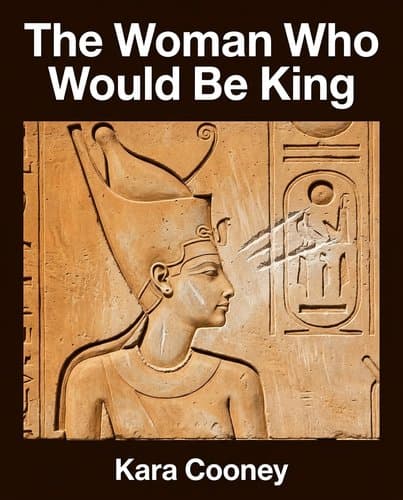
19500064_the-woman-who-would-be-king
by Kara Cooney
Ancient Egypt's most successful female pharaoh was erased not despite her achievements but because of them—Cooney reconstructs Hatshepsut's reign to expose how…
In Brief
The Woman Who Would Be King (Octo) reconstructs the life and reign of Hatshepsut, ancient Egypt's most successful female pharaoh, drawing on archaeological and historical evidence to show how she built, legitimized, and lost power.
Key Ideas
Female Power Expands in Crisis, Contracts After
Female power in patriarchal systems is most often permitted during crises and revoked once the crisis passes — Hatshepsut's reign followed this pattern with near-mathematical precision
Theology Replaced Patriarchy as Foundation of Authority
Hatshepsut's rise rested on theological engineering, not proximity to male power: she reframed her authority as divine mandate, making opposition to her rule equivalent to opposing the gods
Deliberate Erasure Requires Resources, Strategy, and Motive
The erasure of Hatshepsut's legacy began 25 years after her death, was expensive, slowed Thutmose III's own construction program, and was timed specifically to protect an heir with a politically weak mother — historical forgetting is often a deliberate, resource-intensive act, not passive neglect
Female Identity Fractured by the Demands of Kingship
Even Hatshepsut could not fully hold female and royal identity simultaneously: the hybrid bare-chested statues hidden in her innermost temple rooms suggest that the public self and the private self were forced apart by the demands of the office
Absence Reveals Who Destroyed the Historical Record
When studying whose stories survive, ask who had the resources and the motive to destroy the record — absence from history is data, not just a gap
Who Should Read This
History readers interested in Political Figures and World History who want a deeper understanding of how we got here.
The Woman Who Would Be King
By Kara Cooney
11 min read
Why does it matter? Because the most powerful woman in the ancient world was erased not by failure, but by success.
Say her name: Hat-shep-soot. Most people can't, and that's the point. She ruled the ancient world for twenty-two years — longer than most pharaohs, without a dynasty broken or a war lost — and history forgot to mention her. Not because she failed. Because she succeeded so completely, so quietly, so correctly, that the men who inherited everything she built found it easy, then necessary, to chisel her face off the walls and bury her statues in a pit. Kara Cooney's biography of Hatshepsut is a forensic examination of a mechanism — ancient but stubbornly recognizable — by which female power gets permitted in a crisis, tolerated during prosperity, and then unmade the moment it stops being convenient. The erasure wasn't personal. That's the part worth sitting with.
She Didn't Seduce Her Way to Power — She Out-Theologized Everyone
Here's what you need to understand about Hatshepsut before anything else: she didn't stumble into power. She engineered a theological argument so airtight that anyone who challenged her authority was, by extension, challenging the god of creation himself.
The mechanism was her role as God's Wife of Amen. Every morning before dawn, Hatshepsut entered the innermost sanctuary of Karnak temple — a low-ceilinged room with no windows, dense with incense smoke and lamplight — where a gold statue of Amen-Re stood in his shrine. The ritual she performed there was the cosmological equivalent of jumpstarting a dead engine. Egyptian theology held that Amen perpetually re-created the universe through his own sexual release, and the God's Wife was his instrument: she opened her linen robe before the statue, took the god's phallus into her palm, and facilitated what the priests understood as cosmic orgasm. Without this act, creation would stall. The Nile might stop flooding. The sun might fail to rise. This wasn't symbolic — or rather, to everyone present it was both symbol and literal truth simultaneously. The woman performing this ritual wasn't a wife serving her husband. She was the mechanism by which existence continued.
Kara Cooney is careful to flag where she's speculating — but the political logic here is almost mathematical. Hatshepsut held this religious office before, during, and after the brief reign of her sickly husband-brother Thutmose II. When he was dying and the only heir was an infant boy born to a palace concubine of no political standing, Hatshepsut was the single figure whose authority derived not from proximity to a man but from the god himself. To sideline her as regent would have meant dismantling the theological machinery that kept Egypt running. You couldn't remove her without pulling a load-bearing wall out of the universe.
The World She Was Born Into Treated Death as a Planning Assumption
Think of the Bronze Age royal court the way we imagine it: marble corridors, ceremonial pageantry, elaborately robed figures moving through rituals with practiced serenity. Now subtract the stability. What you actually have is a petri dish with a throne in the middle.
Cooney's reconstruction of Hatshepsut's Egypt is defined above all else by biological catastrophe as background noise. Half of all children died before their first birthday. Every bite of bread carried quartz dust ground in from the millstones, which wore teeth down to the nerve until abscesses tunneled into the jawbone — a death sentence at any social level. Cholera could empty a body of fluids so fast it turned the skin blue inside a day. The mummy of Thutmose II, the sickly half-brother Hatshepsut was married to at around age twelve, shows skin lesions, pustules, and an enlarged heart. He was almost certainly unwell for most of his short reign. He was also the most powerful man in the ancient world.
The Thutmoside dynasty had to function inside this. The two princes ahead of Thutmose II in the succession — Wadjmose and Amenmose — simply died before they could take the throne. The dynasty was one bad fever away from extinction at almost any given moment. No formal betrothal system existed partly because death arrived faster than any contract could account for.
Understanding this reframes everything about Hatshepsut's positioning. Her decades of theological groundwork — the priestess training, the God's Wife office, the careful cultivation of divine legitimacy — weren't ambition for its own sake. They were the only rational response to a world where any man in the succession could be gone by Tuesday. When every other support in the structure is made of something fragile, someone competent had better be holding the middle.
Becoming King While the King Was Still Alive
How do you take a throne that's already occupied? For most of history, the answer has been force — assassination, coup, civil war. Hatshepsut's answer was stranger and more durable: she out-argued everyone theologically, and then ruled for twenty-two years alongside the king she was supposedly serving — standing beside him as something the Egyptian theological vocabulary had no word for: a female expression of solar kingship, a woman whose authority derived not from marrying the right man but from being the right vessel for the god's power.
The moment that makes this visible is the coronation scene her craftsmen carved into stone: a figure wearing a queen's fitted linen gown and a king's atef crown. The atef was not subtle — ram's horns below, tall double plumes above, the whole assembly announcing 'this person commands the gods.' No woman had worn it in public before. The craftsmen cutting the relief had probably never received an instruction like this in their lives. Yet there it is, and beneath the image, text naming her 'King of Upper and Lower Egypt,' followed by a throne name she gave herself: Maatkare, meaning 'The Soul of Re Is Truth.' Throne names were received through secret revelation. They were for kings. They were, until Hatshepsut, inconceivable for a queen.
The oracular ceremony that put Thutmose III on the throne — and that Hatshepsut now claimed as precedent — is worth pausing on, because it's genuinely strange. A portable shrine carrying the god's statue was carried through Karnak by a team of priests. Wherever the god 'wanted' to go, the shrine would lurch and dip in that direction. The toddler the shrine stopped at became king. What looks like religious spectacle was also a political technology: it let the temple establishment ratify a choice while attributing it entirely to divine will. Hatshepsut had watched that ceremony work. She understood what it meant to frame authority as revelation.
The title she dropped a few years before the coronation scene matters more than it might look. She had been God's Wife of Amen — a powerful priestly role, but a priestly one. She replaced it with King's Eldest Daughter. That single swap moved her claim from the temple to the bloodline. She wasn't just the woman who served Amen; she was the daughter of Thutmose I, the greatest warrior-king Egypt had seen in generations, and the throne was her inheritance. Her supporters — including the High Priest Hapuseneb and her administrator Senenmut — helped build the theological scaffolding around this claim. But Hatshepsut had been laying the foundation since childhood: decades of ritual training, administrative experience, and public visibility that the young Thutmose III had never had time to accumulate.
The audacity isn't that she took power. It's that she did it openly, in stone, with the legitimate king still alive and seated beside her — and framed the whole maneuver as piety rather than ambition.
The monuments she built to justify this claim are the next part of the story.
To Hold Power, She Had to Erase Herself
Somewhere in the innermost chambers of her mortuary temple at Deir el-Bahri, a sculptor once carved a statue that almost certainly no ordinary person ever saw. It shows Hatshepsut bare-chested, wearing a masculine kilt and kingly headscarf — the full regalia of a ruling pharaoh — but the chest is unmistakably female. Small breasts, a slight frame, a woman's build under a king's costume. Whoever made it received an instruction with no precedent in Egyptian art history. And then the statue was placed deep inside the sanctuary, away from public festivals and daylight processions, visible only to the priests performing the innermost rites and to the gods who had supposedly ordained all of this.
That figure tries to hold both things at once: the kingly office and the female person inside it. It was made deliberately. And then it was sealed away where the world couldn't see it. If this were purely a political costume change — put on the masculine image, rule effectively, take it off in private — the private spaces would show nothing at all. They don't.
What came next was a decade-long experiment in erasure. First, Osiris statues with Hatshepsut's face but painted in the yellow traditionally reserved for elite women — the color that announced 'female.' Then a strange transitional phase: the same figures repainted a muddy orange, not the yellow of women, not the red ocher of men, but something that existed in neither category. Then broad-shouldered colossi with heavy pectoral muscles and no breasts at all. The experiment concluded with full masculinization, and the conclusion held for the rest of her reign.
Cooney reads this as pragmatism rather than psychological crisis, and she's probably right. The theological machinery of Egyptian kingship was built around a male body — one that impregnated the cosmos, that fused with solar gods coded as fathers and bulls and fertile creators. A female form in that role wasn't just unconventional; it created a structural contradiction in the belief system Hatshepsut relied on for her authority. You couldn't be the living Horus and have breasts. The office didn't accommodate the body.
What the evidence suggests, without quite proving, is that Hatshepsut understood exactly what she was giving up. She masculinized her image because the alternative was watching her authority erode as Thutmose III aged into a teenager who could, technically, outrank her in every sacred ritual. She made herself into what the office required. She was almost certainly right that it was the only way to hold power. And the statue in the dark says something about what that cost.
The Erasure Wasn't Revenge — It Was a Budget Decision
Here's the thing about Thutmose III's destruction of Hatshepsut's legacy: he waited twenty-five years to do it. She died around 1458 BCE. He didn't send the chisels until roughly 1433 BCE, when he was approaching fifty and his reign was already one of the most militarily successful in Egyptian history. That gap is the whole story.
By year 42 of his reign, Thutmose III had a problem with arithmetic. His older sons — the ones with pure royal blood, born to high-ranking wives — had apparently died before him. The heir he needed to protect was a boy of about eight named Amenhotep, and Amenhotep's mother, Merytre-Hatshepsut, was the daughter of a nurse. Not a princess. Not a God's Wife. A nurse's daughter.
What made him vulnerable, specifically, was precedent. Egypt had just spent twenty-two years watching a female regent accumulate enough theological authority to declare herself king. Any relative of Hatshepsut with genuine royal blood — anyone who could point to a purer lineage than Amenhotep's — could use that precedent as a lever. The solution wasn't to argue against it in writing. It was to erase the evidence that it had ever existed.
The scale of what followed was enormous. Across Egypt, craftsmen chiseled Hatshepsut's name from temple walls. Hundreds of her statues were smashed and dumped into a pit near Deir el-Bahri — so many fragments that modern archaeologists call it simply the Hatshepsut Hole. The work was expensive enough to slow Thutmose's own building program, which was itself one of the most ambitious in Egyptian history. He did it anyway, because the political calculation was clear: the cost of the erasure was lower than the cost of leaving the precedent intact.
But watch what his craftsmen actually destroyed, because the precision reveals the logic. Images of Hatshepsut as queen — standing beside her husband, performing rituals as a priestess — were frequently left alone. What the chisels targeted was her identity as king: the throne names, the royal titles, the images showing her wearing the double crown and carrying the crook and flail. This wasn't an attack on her soul or her memory. It was an attack on the political office she'd held. Thutmose III didn't need to erase Hatshepsut the woman. He needed to erase the fact that a woman could hold that office — specifically, that a woman could hold it peacefully, successfully, and for decades, without conquest or catastrophe.
The lesson that keeps surfacing in this history is that power doesn't fear enemies nearly as much as it fears templates. Hatshepsut was dead. She couldn't threaten anyone. What threatened Amenhotep's inheritance was the institutional memory that the arrangement had worked.
History Doesn't Lose Powerful Women by Accident
The pattern across the Eighteenth and Nineteenth Dynasties is too consistent to be accidental: Hatshepsut, Neferneferuaten, Tawosret — female rulers surface exactly when the system is failing, provide the stability it needs, then vanish once a male successor is secure. That's not coincidence. It's the operating logic of the institution.
The mechanism that made the vanishing permanent wasn't personal hatred — it was policy. After Hatshepsut's erasure, Amenhotep II and his successor Thutmose IV systematically gutted the office of God's Wife of Amen, the very position that had given Hatshepsut her initial claim to divine authority. The public roles of their wives were suppressed. Mothers were elevated instead — women whose power derived from the sons they'd produced, not from any office they held in their own right. Hatshepsut's reign became a negative blueprint: a detailed record of exactly which institutional levers a woman could pull, preserved so that those levers could be quietly disabled. Her erasure didn't just remove her from history. It reshaped the institution to make sure no one could replicate what she'd done.
Cooney is honest about what this means for recovering her at all. The gaps in the record aren't gaps — they were manufactured, block by block, by craftsmen paid to work methodically through every temple in Egypt. Imaginative reconstruction can fill some of the space, but it can't fully counter a politically engineered silence. What we're left with is a question that has no clean resolution: if the most competent female ruler the ancient world produced left almost no legacy — not because she failed, but because she succeeded — what does that tell us about whose stories the record was ever designed to hold?
The Chisel Marks Are Still There
Go to the eighth pylon at Karnak and look at the surface where her name once was. What you see isn't absence — it's the work order. Every chisel mark is a record of how many men, how much money, how many years it took to make one woman disappear from stone. The erasure is the evidence. Thutmose III's attempt to bury her is now among the loudest proofs that she existed, that she mattered enough to be worth the expense of forgetting.
Which leaves you with the harder question to carry out of here. Not whether powerful women get erased — we've settled that. But whether we have the patience to read the damage as data. The chisel marks are still there. They've been there for three thousand years. Whether you treat damage as data is the only question that matters.
Notable Quotes
“What is it that you desire to happen? I will do according to all that you have ordered.”
“still a baby bird in its nest.”
Frequently Asked Questions
- What is The Woman Who Would Be King about?
- The Woman Who Would Be King reconstructs the life and reign of Hatshepsut, ancient Egypt's most successful female pharaoh. The book draws on archaeological and historical evidence to show how Hatshepsut built, legitimized, and lost power. It reveals a broader pattern: "female authority has been systematically permitted in crisis and erased in stability." The work demonstrates that historical absence is often the result of deliberate suppression rather than passive forgetting, offering insights into how power, gender, and legacy intersect in ancient history.
- How did Hatshepsut legitimize her power in ancient Egypt?
- Hatshepsut's rise rested on theological engineering, not proximity to male power. She reframed her authority as divine mandate, making opposition to her rule equivalent to opposing the gods. This theological strategy allowed her to establish legitimacy independent of male support or inheritance claims. By positioning herself as divinely sanctioned, she created a framework that made her rule appear inevitable and sacred. This enabled her to maintain power for over two decades in a system fundamentally designed to exclude female rulers from the highest office.
- Why was Hatshepsut's legacy deliberately erased from history?
- The erasure of Hatshepsut's legacy "began 25 years after her death, was expensive, slowed Thutmose III's own construction program, and was timed specifically to protect an heir with a politically weak mother." Rather than passive forgetting, this was "a deliberate, resource-intensive act." Those in power invested significant resources in removing her from the historical record because she represented a threatening precedent for female authority. The book advises us to "ask who had the resources and the motive to destroy the record"—historical absence is data about intentional suppression rather than innocent gaps.
- What does The Woman Who Would Be King reveal about female power in patriarchal systems?
- The book reveals that "female power in patriarchal systems is most often permitted during crises and revoked once the crisis passes — Hatshepsut's reign followed this pattern with near-mathematical precision." Even when successfully consolidating authority, female rulers cannot fully integrate female and royal identities. "The hybrid bare-chested statues hidden in her innermost temple rooms suggest that the public self and the private self were forced apart by the demands of the office." This reveals the fundamental tension between female identity and institutional power in male-dominated systems.
Related Book Summaries



Read the full summary of 19500064_the-woman-who-would-be-king on InShort