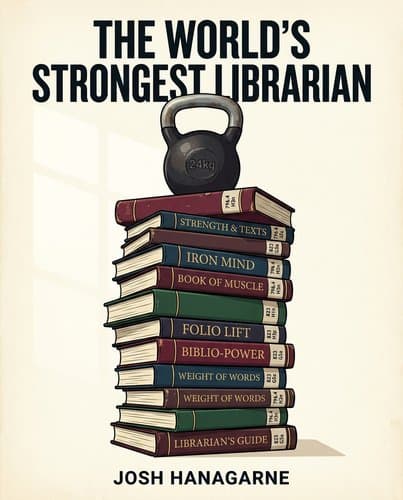
16101121_the-world-s-strongest-librarian
by Josh Hanagarne
A giant with Tourette's syndrome finds that mastering a 500-pound deadlift and memorizing library stacks are the same discipline—learning to inhabit an unruly…
In Brief
The World's Strongest Librarian (May ) is a memoir by Josh Hanagarne that traces his life with Tourette syndrome alongside his parallel pursuits of competitive strength training and librarianship. It shows how physical discipline, intellectual honesty, and incremental practice can help manage a condition medicine alone cannot fix — offering readers a framework for building control over the uncontrollable.
Key Ideas
Suppressing tics increases pressure release
The tic-impulse in Tourette's works like a sneeze you can't suppress: holding it in doesn't eliminate it, it stores pressure that releases harder later — which means the goal isn't suppression but finding conditions where the urge genuinely diminishes
Physical intensity displaces neurological bandwidth
Physical training offers a form of relief that medicine often can't: not because it cures the neurological condition, but because intense physical focus temporarily occupies the same cognitive bandwidth the disorder exploits
Body systems interconnect beyond symptom specificity
Neurological problems may respond to neurological inputs that look completely unrelated — Adam Glass's heel circles and jaw wiggles dissolved a year of shoulder pain instantly, suggesting the body's systems are more interconnected than symptom-specific treatments assume
Stillness becomes skill through biofeedback practice
Stillness is a trainable skill with measurable progress: Josh used motion-sensor bathroom lights as a biofeedback loop, starting with one perfect minute and building from there — treating calm as a practice, not a destination
Institutional norms aren't divine confirmation
When institutions use 'feeling' or divine confirmation to close a door on you, that is not God speaking — it is an organization protecting its own norms, and the two are not the same thing
Honesty bridges different knowledge systems
You can love someone with a completely different epistemology: Janette 'knows' through feeling; Josh needs testable evidence — they stayed married by being honest about the difference rather than pretending it didn't exist
Recovery is the next available motion
Getting up after your coping systems fail is itself a skill: not inspiring, not triumphant, just the next available motion — a kilt, a throwing stone, a backyard
Who Should Read This
Readers who connect with first-person stories about Memoir and Mental Health and want to see the world through someone else's eyes.
The World's Strongest Librarian
By Josh Hanagarne
11 min read
Why does it matter? Because the body you're fighting might also be the body that saves you.
Here's a man who should not work in a library. He's 6'7", weighs 260 pounds, and his nervous system fires off involuntary sounds and movements the way a car alarm goes off in a parking garage — constantly, unpredictably, and always at the worst possible moment. And yet. What looks like an endearing quirk from the outside — giant librarian has tics, cute — turns out to be the surface of something much stranger and harder: decades of watching every solution fail. The medication that silenced his voice. The religion that couldn't hold his questions. The prayer answered by nothing but his own pulse. What Josh Hanagarne eventually builds isn't a cure or a miracle or a redemption arc. It's something more useful and more honest than any of those — and harder to name than you'd expect. A practice. A way of inhabiting a body that never stops fighting back. This book traces how he got there, and why the method matters far beyond Tourette's.
The Disorder That Showed Up Without Asking and Never Left
The first sign arrived during a Thanksgiving school play. Six-year-old Josh Hanagarne had been cast as a tree — too tall for any of the animals, his teacher explained — and was doing his best impression of something arboreal when his face stopped cooperating entirely. Under the stage lights, his nose, lips, tongue, and eyes began contorting independently of each other, each feature running its own program. His parents watched from the dark auditorium in confused silence. They didn't say anything to him that night. Instead, they started a covert observation campaign at home, watching him read, watch television, wrestle with his dad — cataloguing the twitches, the blinks, the head-jerks he didn't know he was making.
That's the entry point into Josh Hanagarne's memoir about libraries, bodies, and the thing that came with his body without being invited. Most people carry the same image of Tourette Syndrome: the television version, where someone shouts obscenities at inappropriate moments and everyone is scandalized. That version exists, but it's a small and dramatic subset of something far more ordinary in its relentlessness. Hanagarne offers a better explanation — the best one in the book — through the most mundane physical experience available. Think about needing to sneeze. There's an itch first, a building pressure, and you can pinch your nose and fight it, but the pressure doesn't dissolve; it accumulates. What Hanagarne experiences with tics is that sensation, located anywhere in the body at any time: behind the eyes, in the shoulders, in the throat, spreading occasionally through every muscle at once. Sooner or later it has to be released. The relief lasts seconds before the pressure rebuilds.
The revelation doesn't arrive with a cure attached. A neurologist at the University of Utah eventually confirms the diagnosis in a fifteen-minute appointment — watch the patient, take notes, name the thing — and declines to prescribe medication. Having a name for it clarifies something without solving anything. Josh's father, characteristically, wants more than clarity. He finds a better story. Certain sharks, he tells his son, have to keep moving to breathe. They can't stop or they die. He frames this as an obvious parallel. Sharks get whatever they want. That's what Josh is going to be. It's a loving piece of nonsense — the kind of thing that carries a frightened kid through the next few months on sheer narrative momentum, right up until the moment the body makes its own argument and the story stops being enough.
Every System He Tried Told Him the Wrong Thing
Every system the world recommended had a turn, and every one of them came up short in a different way.
Consider what the medical system actually offered: when Josh's vocal tics became so loud and so socially catastrophic that life outside his apartment felt impossible, doctors injected botulinum toxin directly into his vocal cords. The logic was surgical in its simplicity — if the problem is noise, remove the noise. It worked, technically. He spent the next several years able to manage only short, effortful whispers. What the treatment couldn't account for was the daily intensity quota his body seemed to operate on. The tics didn't disappear; they just lost their exit route and converted into physical force instead. Silent screaming, done with enough full-body contraction to eventually give him a six-pack, until the abdominal strain caused a hernia. The hernia required surgery. The surgery interrupted the one thing that had been helping — obsessive gym sessions that produced something close to mental quiet — and by the time he was cleared to lift again, the habit was gone. One medical intervention, cascading into the next problem, which cascaded into the next.
Faith fared no better as a management system. During his Mormon mission in Washington DC, eight months in, Josh punched himself in the face on a sunny street. He looked at his bloody hand, then at the sky, which was still blue. The world offered no acknowledgment. He tried medication, achieved a few genuine conversions, prayed, and still found himself a year later sitting on his hands on a couch to stop hitting himself, having lost so much weight from tic-induced nausea that his mission president asked if he knew what he currently weighed. The church released him early and called it honorable service. What nobody could explain was why a God who supposedly had a plan would design one that involved a nineteen-year-old punching himself bloody in the August heat while carrying a Book of Mormon.
The pattern isn't bad luck. Every approved solution was load-bearing on the assumption that his body would eventually cooperate — that the arc would bend toward function, that meaning would accumulate, that the chain of consistency producing strength producing more consistency would hold. Break it once, with a hernia or a bad semester, and it's gone. His body never agreed to those terms. It still hasn't.
The One Thing That Worked Was the One Thing That Made No Sense
Think about how you'd try to fix a jammed drawer. The natural impulse is to understand why it's stuck — check the alignment, inspect the slides, reason your way to the cause. What you almost never do is wiggle your jaw, walk on the balls of your feet for thirty seconds, and then pull. But that's roughly the category of solution that worked for Josh Hanagarne.
Adam Glass was an Air Force veteran and competitive strongman living in North Dakota, with forearms the size of most people's biceps and a gaze that made inanimate objects nervous. When Josh arrived in Minot to train with him, he had been managing a shoulder injury for a year. Two doctors and a physical therapist had issued rubber resistance bands and told him to do gentle rotations. He'd topped out at thirty-five pounds on an overhead press. The shoulder just wouldn't go further.
Adam ignored all of this history. He had Josh stand sideways on a bottom stair, dangle one foot off the edge, and push the heel downward as if trying to draw a circle on the floor with an imaginary pencil. Then wiggle the jaw. Then walk briefly on the balls of the feet. None of it had any apparent relationship to a shoulder. Adam then pointed at a ninety-seven-pound kettlebell — four pounds heavier than Josh's all-time best, in a healthy shoulder — and told him to press it. Josh did. The weight went up with less effort than anything he'd lifted in months, then fell from his grip at the top because he hadn't expected it to actually work.
Adam's explanation was almost deliberately unsatisfying: the nervous system was applying brakes that weren't necessary, and the drills released them. He didn't elaborate much beyond that. His operating principle was that understanding kills progress — the moment you believe you've figured out how something works, you stop questioning it, and the questioning is the whole method.
That reframes everything that came before in Josh's story. Every previous attempt at managing his Tourette's had required understanding first — identify the mechanism, find the right drug, maintain the right faith — before applying the correct solution. Adam proposed something different: test the thing directly, observe what changes, and let the results be the argument. You don't need to know why the drawer opens. You need to know that it opened.
Stillness Is a Skill You Practice, Not a State You Achieve
What if the problem with every previous approach to managing Tourette's was that it was an approach to managing Tourette's? The goal of management is containment — hold the pressure down, delay the release, survive the interval. It doesn't ask whether the pressure itself can be retrained.
After Josh returned from Minot, Adam left him with a single instruction: pick one movement you perform constantly, and make it more efficient. Josh sat with a sheet of paper and listed candidates — deadlifts, kettlebell presses, walking — until his eyes kept returning to one item he'd written almost as an afterthought. Breathing. He noticed that his tics reliably quieted during a handful of activities: playing guitar, reading, sleeping. The obvious explanation was cognitive load — complex tasks consuming whatever mental bandwidth the tics ran on. But sleep didn't fit that theory. Sleep required nothing. What all those activities shared, he finally realized, was that his breathing in each was deep, uninterrupted, and completely automatic. Every tic he'd ever had was also an interruption of breath. He'd been slightly starving for twenty years and had adapted so thoroughly to the shortage that it felt like baseline.
He turned the library bathroom into a laboratory. The motion-sensor lights would shut off if he stood still for roughly fifteen seconds — a crude but immediate feedback system. He began practicing single breaths: a slow four-count inhalation, a full exhalation, complete stillness. Not forcing stillness. Not suppressing anything. Practicing it, the way you'd practice a piano scale — imperfectly at first, then with increasing reliability, then one day with something resembling fluency. A maxim from Russian kettlebell trainer Pavel Tsatsouline had been rattling around in Josh's head for years: strength is a skill, you don't work out, you practice. Adam had applied that framework to a shoulder injury. Josh applied it to his nervous system.
In December 2009, after two months of this, he achieved sixty uninterrupted seconds of stillness — no tics, no suppression, no distraction. The lights stayed off. It was, by his own account, the most perfect minute of his life after more than two decades of losing every one. He paid for it that night in a surge of tics. That made it a practice problem, not a life sentence.
The Faith That Carried Him and the Faith That Broke
At nineteen, Josh Hanagarne drove into a rainstorm outside Twin Falls, Idaho, and started talking to God like he genuinely expected an answer. He'd been avoiding the question of his mission for months, playing along with everyone's assumption that he would go while privately wondering whether he could. The car was too small for his six-foot-seven frame, the road had dead-ended in rural darkness, and he was crying with the particular desperation of someone who can't tell the difference between a legitimate spiritual crisis and ordinary teenage dread. Then the rain stopped. The tics didn't, but everything else quieted. A warmth moved through him that had no physical cause he could account for, and the crying — which had been nowhere near finished — simply ceased. He drove home and told his parents he was ready to put in his mission papers. He committed to two years on the basis of a feeling he couldn't prove and couldn't explain away.
That moment carries the weight of the rest of the book because it's the one Josh can neither reclaim nor disown. Fifteen years later, he's standing in his own kitchen telling his mother he no longer gets anything from attending church, braced for the rebuke he's convinced is coming. What he gets instead is a question about his son. She asks whether he knows he loves Max. Of course, he says. Can he prove it? Not in any way that would satisfy a skeptic who insisted on a single definition of love. His mother's point lands quietly: she doesn't say she believes the church is true; she says she knows it, with the same category of certainty. Josh can't argue with the logic while also no longer being able to share the premise. Feeling, for her, is a legitimate form of knowing. For him, it has become a variable too unstable to anchor anything to.
His wife Janette, whose belief is unshaken, tells him plainly that she won't stop believing for him. He doesn't ask her to. What they negotiate, carefully, is a kind of honest coexistence: both of them will tell their son Max exactly what they actually think, and let the kid eventually decide. Josh borrows a term from the mission field — investigator, the word for someone open to hearing the message — and reclaims it as a permanent identity. He won't be resolving this. He'll keep asking. After thirty-five years of a body that refused to be still, it turns out he can live with a faith that refuses to settle.
Watching Your Son Blink and Having No Words Left
One evening Josh Hanagarne looked over at his son Max — orange shirt, red-stained lips from a library ICEE, blond hair shaggy from the ongoing war of haircuts — and watched the boy blink. Not once. Not the way anyone blinks. Rapidly, repeatedly, with a subtle curl of the lip between each flutter. Josh had been doing that same thing his entire life. He recognized it the way you recognize your own handwriting on someone else's letter.
He kissed Max's forehead, went to his bedroom, closed the door, got on his knees, laced his fingers together, and tried to pray. Nothing came. He stayed there long enough to feel his own pulse in the silence. All the training, all the breathing work, all the careful nervous-system recalibration — none of it had prepared him for the specific horror of passing the thing he'd spent thirty years fighting to a four-year-old who still needed help with shoelaces. The next day, Misty — his name for the Tourette's — came back at full force, ambushing him at the library reference desk, in the weight room, in the parking garage at five o'clock. He survived it on spite. That night he flew a kite with Max in the park and watched his son blink again at lunch and said nothing.
Every system fails simultaneously here: faith produces only silence, training produces only pain, and control produces only the knowledge that you never really had any. Joe Simpson, the climber who survived being left for dead in a Peruvian crevasse — and wrote about it in his memoir Touching the Void — described the same moment, the one where you find out whether residual belief kicks in under maximum pressure. For Simpson, it never occurred to him to pray. For Josh, kneeling on his bedroom floor, it wasn't that prayer was unavailable. It was that he had nothing to say and no clear sense of who might be listening.
So he bought a seventy-dollar kilt and sent a twenty-five-dollar check to the Highland Games organizers in Payson, Utah. He spent two months throwing kettlebells, stones, and whatever else he could hurl across his backyard in the dark — once landing a kettlebell on his roof with a crash that did not delight his wife. Then he put on the kilt, drove sixty miles with Janette and Max, and competed. He won an event. Max watched from the bleachers wearing Josh's comically oversized shoes, holding a shoelace he'd tied around a rock so he could throw something too.
What One Perfect Minute Actually Costs
That December night in 2009 — the sixty seconds in the library bathroom — was the hinge point: the lights stayed off, and then Josh went home and paid for it in tics until morning. No clean ending. No symbolic completion. Just one minute of evidence that the body already contained the thing he'd been chasing, followed by proof that containing it wasn't the point. You don't read this book and walk away thinking Tourette's is solvable, or that faith is either. What you walk away with is something more transferable — the understanding that the work isn't toward stillness but toward the next available motion. Kneeling on a bedroom floor with nothing to say. Getting up. Buying a kilt. Throwing a stone badly in a backyard at night while your neighbor's lights come on.
Notable Quotes
“Josh, honey, are you okay?”
“Like that. Do you think you could stop?”
“Do I really look like that?”
Frequently Asked Questions
- What is The World's Strongest Librarian about?
- The World's Strongest Librarian is a memoir by Josh Hanagarne that traces his life with Tourette syndrome alongside competitive strength training and librarianship. The book demonstrates how physical discipline, intellectual honesty, and incremental practice can help manage a condition that medicine alone cannot fix. Through his experiences as both a competitive weightlifter and librarian, Hanagarne shows how these disciplines helped him cope with Tourette syndrome. Rather than offering a cure, the memoir provides a framework for building control over the uncontrollable, drawing on physical training, intellectual engagement, and institutional navigation.
- How does physical training help with Tourette syndrome in the book?
- Physical training offers a form of relief that medicine often can't: not because it cures the neurological condition, but because intense physical focus temporarily occupies the same cognitive bandwidth the disorder exploits. This differs fundamentally from trying to suppress tics, because holding it in doesn't eliminate it—it stores pressure that releases harder later. The book reveals that managing the condition requires finding circumstances where the tic-impulse genuinely diminishes rather than merely hiding it. Hanagarne's experience shows that intense physical focus provides genuine temporary relief, offering a practical tool beyond traditional medical treatment.
- What are the key takeaways about managing Tourette syndrome?
- The book reveals several interconnected insights about managing Tourette syndrome. First, the tic-impulse in Tourette's works like a sneeze you can't suppress: holding it in doesn't eliminate it, it stores pressure that releases harder later. Management therefore focuses on finding conditions where the urge genuinely diminishes. Second, stillness is a trainable skill with measurable progress—Hanagarne treated calm as a practice using biofeedback tools, building from one perfect minute upward. Additionally, the book shows that neurological problems may respond to seemingly unrelated inputs, suggesting deeper interconnections in the body's systems.
- What does the book teach about relationships and belief systems?
- The memoir teaches valuable lessons about relationships across fundamentally different worldviews. Hanagarne and his wife Janette demonstrate that you can love someone with a completely different epistemology—Janette knows through feeling while Josh requires testable evidence. They maintained their marriage by being honest about this difference. The book also addresses institutional authority: when institutions use 'feeling' or divine confirmation to close a door on you, that is not God speaking—it is an organization protecting its own norms. Finally, Hanagarne shows that getting up after your coping systems fail is itself a skill: not inspiring, not triumphant, just the next available motion.
Related Book Summaries

Read the full summary of 16101121_the-world-s-strongest-librarian on InShort