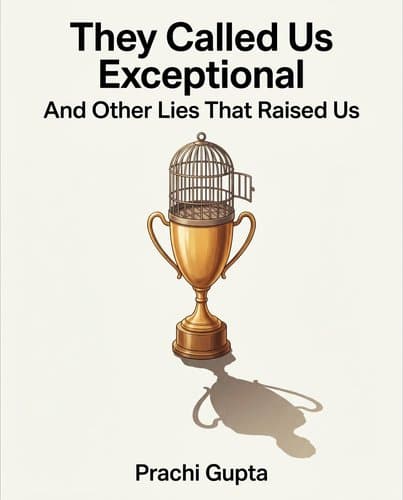
142601047_they-called-us-exceptional
by Prachi Gupta
The 'model minority' myth doesn't just harm—it provides perfect camouflage for abuse, making silence and conditional love indistinguishable from success.
In Brief
They Called Us Exceptional: And Other Lies That Raised Us (2023) examines how the 'model minority' myth creates the conditions for abuse and dysfunction to hide within immigrant families.
Key Ideas
Model Minority Myth Weaponizes Achievement Against Justice
The 'model minority' myth is not a compliment — it was constructed by white power structures to invalidate Black American civil rights claims, and it functions as a cage for the families inside it by equating silence and performance with success.
Conditional Love Teaches Performance Over Belonging
Conditional love — affection that must be 'jockeyed and performed for' — doesn't teach children how to be loved. It teaches them to mistake surveillance for care and to outsource their sense of reality to whoever holds the most power.
Western Feminism Misses Immigrant Women's Abuse
When abuse hides inside achievement, the tools we use to recognize it often fail. Feminist frameworks built around white, middle-class experiences don't account for the specific barriers immigrant women face: immigration status, caste, community belonging, the social death of divorce.
Exceptionalism Increases Vulnerability to Mental Illness
The pressure to be 'exceptional' doesn't protect children from mental illness — it makes them more vulnerable to it, by teaching them that their worthiness is conditional on their performance and leaving no room for ordinary failure.
True Recognition Requires Systemic Language Frameworks
Naming what happened to you is not enough if the language of naming was designed for someone else's experience. Real recognition requires frameworks that hold systemic racism, immigration history, and cultural specificity alongside the personal.
Releasing Fantasy Enables Authentic Family Acceptance
Releasing the fantasy of a relationship you wanted — with a parent, a sibling, a family — is not the same as stopping to love them. It is the act of accepting them as they are rather than performing yourself into someone they might finally accept.
Who Should Read This
Readers who connect with first-person stories about Memoir and Social Issues and want to see the world through someone else's eyes.
They Called Us Exceptional: And Other Lies That Raised Us
By Prachi Gupta
13 min read
Why does it matter? Because the family you thought was thriving might be held together by the same mechanisms that are tearing it apart.
The story goes like this: an immigrant family arrives with almost nothing, sacrifices everything, and through sheer discipline and determination, produces exceptional children who prove that America works. It's a story about grit. About culture. About what happens when people want it badly enough. Prachi Gupta grew up inside that story — the surgeon father, the five-bedroom house north of Philadelphia, the private school applications, the relentless SAT prep. From the outside, it looked exactly like the myth promised. But her memoir asks a question the myth was specifically designed to prevent: what if the same emotional architecture that builds that kind of success — the performance of perfection, the suppression of need, the love that arrives as reward and disappears as punishment — is also precisely what allows abuse to become invisible? Not hidden, exactly. Just misread. Dressed in the language of discipline, culture, sacrifice, and exceptional standards until no one inside the house, including the people being hurt, can see it clearly. It's also a story with a policy skeleton — about what happens when immigration selection filters for exactly the people most likely to build this kind of household and then rewards them for it.
The Seduction of the Success Story Is the First Trap
Picture the scene exactly as Prachi Gupta draws it: a surgeon father who has just opened his own practice, a son programming robots at college, a daughter leading her team to victory in a consulting competition, a mother taking classes at the community college where all her classmates want her to be their mom. Dal on the stove, good wine uncorked, the four of them laughing around the table. If you were looking for evidence that the American dream was real and available to people who looked like them, this family would be your proof.
Then hold that image and drive backward about fifteen years. Same family, same car, different version of the story. Prachi is thirteen, Yush eleven, and they're heading to a fair at their new private school in Pennsylvania's Lehigh Valley. Their father asks for directions. Their mother unfolds a paper map and stumbles. What follows is not an argument — it's an eruption. Stupid. Uneducated. Worthless. Good-for-nothing. He screams until she freezes, and her freezing makes him scream harder. Then he jerks the car to the shoulder at a busy intersection and orders her out. He drives away with the children. In the back seat, Prachi doesn't think to be angry at her father. She is furious at her mother for failing to produce the right words fast enough to make him stop.
Then he turns around, collects her, and they arrive at the school fair performing as the exceptional immigrant family everyone expects them to be.
That pivot — from roadside screaming to private school parking lot in under a mile — is not a failure of the model minority myth. It is the myth's actual mechanism. Gupta's argument is that the success story was never a reward for surviving the hard parts; it was the obligation that made the hard parts unspeakable. You didn't get to be the model and also admit what the modeling required of you.
'Why Did You Stop?' — When a Father's Love Becomes a Closed System
The father's household runs on a closed epistemological loop: he defines reality, the children confirm it, and anyone who interrupts the circuit gets labeled a liar or an enemy. This isn't incidental to his love — it is the structure of it.
The mechanism becomes visible in a single bedtime question he poses to his children when they're still in elementary school. How would you know, he asks Prachi and her brother Yush, if you had lost your mind? You couldn't trust your own thinking to tell you. He lets the terror of that settle, then offers the solution: keep a list of people you love and trust. When they tell you you're crazy, listen. He is, of course, first on the list. What looks like a philosophical puzzle is actually a piece of wiring. The children are being taught, before they're old enough to recognize the lesson, that their own perception is an unreliable instrument — and that the calibration tool is him.
Therapists are quacks who would replace him as the authorized interpreter of reality. His brother-in-law, once a friend, is reclassified as a chronic liar best avoided. His sister gets filed under a single word — feminazi — earned, apparently, for once telling Prachi that a woman's choices belong to her. That word does the work of ending the conversation before it starts. The dinner table becomes a nightly sermon, with the father at the pulpit and the mother largely silent, unable to enter a conversation not designed to include her.
Then there's the moment that exposes the whole architecture in four words. As a teenager, Prachi tells her father she used to think of him as a god. She expects him to hear this as a child announcing she has grown up. Instead, he sounds wounded. 'Why did you stop?' The question treats her developing independence not as a natural crossing into adulthood but as a betrayal. A man who loved his children as separate people would have been relieved. A man who needed them as mirrors could only register the loss.
By the time you understand the system, you're already inside it. That's the design.
The Myth Was Built for Someone Else's Benefit
Imagine a board game designed to guide players toward spiritual liberation — where the top of the grid represents enlightenment and self-knowledge, and the snakes drag you back toward ego and illusion. Now imagine a colonial power confiscating that game, redrawing the destination, and handing it back. The summit no longer means knowing yourself. It means accumulating wealth. The snakes no longer represent spiritual degradation. They represent poverty. You're still playing to win. You just don't know whose victory you're working toward.
That is the actual history of Snakes and Ladders. The Hindu and Jain game called Gyan Chaupar was a map of inner life. The British turned it into a lesson in Christian-capitalist virtue — punctuality, perseverance, the acquisition of capital — and eventually it reached American children with white characters on the board until 1974, when Black children were told they could climb too. The same decade that America was advertising itself as a place where immigrants like Gupta's grandfather could finally ascend without limit.
Gupta's grandfather entered a version of this game that had already been rigged before he arrived. Dadaji was brilliant and self-made — admitted to engineering school on a full scholarship, named valedictorian of his class — and discovered in post-colonial India that leadership was still reserved for white men from abroad. So he moved the family to Canada, reasoning it was marginally less racist than the United States after timing his service at diners in both countries. What mattered, too, was who was allowed through the door at all: the Hart-Celler Act of 1965 had effectively pre-selected for the most credentialed, most achievement-oriented immigrants from South Asia, meaning the diaspora that arrived was already a skewed sample — the strivers, the valedictorians, the people with the most to prove. Dadaji fit the profile. His professional ambitions in Canada still didn't materialize — a consulting firm that foundered, a strip-mall electronics store that folded. What endured was the road map he passed to his son: climb through math and science, learn the habits of the white world, prove your worth through achievement.
Gupta's father received this inheritance and was broken on both ends of it. Outside the home, a sensitive Indian boy became a catalog of slurs in Canadian schoolyards — too short, too bookish, too brown, too strange for a culture that worshipped athletes and mavericks. Inside the home, he was treated as a god, exempt from criticism, positioned above his sister from birth. The wound and the throne produced the same man: someone who needed to dominate in private because he had been dominated in public.
Running Was the First Thing She Ever Owned — So He Took It
By the end of freshman year, Prachi had shaved five minutes off her 5K time. Her race bibs covered the wall beside her mirror. A man at the running store told her his daughter had posted similar times at her age and gone on to compete in college. For the first time, her body was not an object to be managed or hidden — it was a machine she had built herself, through pain and lactic acid and springs-for-legs that surprised even her. She had found something that was genuinely, uncopyably hers.
So her father took it apart.
First came the Nokia phone, roughly the size of a bar of soap, purchased specifically so she could call him if she was raped on a run. She had just run fourteen miles. He responded not by marveling at what her body had accomplished but by naming the worst thing a male body might do to it. Her pride — earned, physical, real — was reclassified as exposure. Then came the accusation that she only ran outdoors because she wanted boys to watch her. She felt the ground shift under the word "outdoors," as if something she'd done alone and in pain had been narrated into something shameful she'd been performing. The proof he offered: if she truly loved the sport, she would run on the treadmill in their unfinished concrete basement instead. It was an impossible test. The treadmill was punishing and joyless; she hated it. Her inability to force herself down there became, in his logic, evidence that he had been right about her motives all along.
The final piece was the chocolate bar. Before a district qualifying race — the one that could have launched an athletic scholarship — her father shared a secret: eat sugar just before the gun and you'll run faster. She believed him. Midway through the second mile, a stabbing cramp buckled her. Dozens of runners streamed past. She crossed the finish line near the back, walked into a field, and cried alone. She never told him his advice had done it.
When she brought home a few Bs that fall, he pulled her from the team entirely. Her coaches called to say she was scholarship material. He hung up angry that they weren't talking about academics. What had looked like overprotection had revealed its actual shape: any source of power that didn't run through him had to go.
The Language of Liberation Didn't Have a Word for Her Mother
What good is a language of liberation if it was built without your mother in mind? When Gupta finally encounters feminist literature — domestic violence, emotional abuse, gaslighting — the words do something remarkable: they turn years of blurred, half-felt wrongness into recognizable shapes. She can suddenly see the architecture of her household not as culture or love or bad luck, but as a documented pattern that other people had named and studied. The relief is immediate. Then it curdles.
Every resource she finds circles a white family at its center. And it's not just a matter of representation — it's structural. Her mother's immigration status depends on the husband who is also the source of harm. That single fact makes the whole stack of advice irrelevant. Gupta tries to imagine handing one of these books to her mother and runs straight into a wall she can't yet name. At the time she reads it as evidence of her family's backwardness, another wound inflicted by the story that the West is modern and everything else is not.
The trap her mother actually lives inside is more precise and more brutal than anything the white feminist texts describe. Her mother must project a flawless image — devoted wife, gracious host, uncomplaining immigrant — because that image is the price of the family's belonging in America. But the more perfectly she performs it, the more that performance is turned against her. If things were truly bad, the logic goes, surely it would show. The very competence that allows her to survive becomes the evidence used to deny that survival is even necessary. There is no move she can make that doesn't close another door.
Gasoline in the Woods: What 'Model Minority' Pressure Actually Costs
The night Yush nearly died, Prachi was in a hotel room in Boston, hundreds of miles from Pittsburgh, pacing with her phone. He had already tried the Cathedral of Learning — a tall tower on the University of Pittsburgh campus — but the windows were barred. So he drove to a gas station, filled a container with fuel, walked into the woods behind Carnegie Mellon where the two of them had run trails together, and poured the gasoline over himself. He was standing there deciding whether to strike a match when her voicemails reached him. He later told her he had deliberately avoided calling her that day, because he knew her voice would make him unable to finish it. The very thing that saved his life was the one thing he had tried to cut out of it.
What had unraveled him: that summer, Yush had been writing code for a capsule destined for the International Space Station. When something failed during testing, he spent weeks dismantling his own work, hunting for an error that didn't exist — the bug was in someone else's code, not his. He broke himself trying to fix something that was never broken. His psychiatrist diagnosed him with psychotic depression. His emotional assessment showed extreme repressed anger, sitting at a clinical extreme: he had no mechanism for directing that rage outward, so it turned inward with compound interest.
A few years later, Yush was a secret millionaire. He had quietly managed his college friends' money into Ethereum before most people had heard the word, and his commission ran into seven figures. He wore free race t-shirts and slept on a sleeping bag on the floor until his parents came to visit. Then he flew to Italy for a surgery that involved sawing through both legs, drilling metal hardware into the fractures, and clicking the breaks apart by a few millimeters each day to coax the bone into growing longer. His mother stayed with him in a small rented apartment, cooking for him while he screamed in pain; he drank liquor to get through the daily adjustments. He was trying to go from five foot seven to five foot ten — one inch above the average American man. The surgery that was supposed to make him enough killed him. He died from a blood clot the procedure introduced.
This is what the model minority myth costs its most devoted believers. The family had operated on a single load-bearing equation: achievement equals worthiness, and worthiness equals love. Yush had absorbed this completely — he was the good one, the one who never made mistakes, the one who kept the family intact when it threatened to come apart. He had no self that existed outside of performance. So when success failed to relieve the pain — when being a millionaire genius still left him feeling small and unrespected — he did the only thing the equation allowed: he looked for a bigger variable to solve. His broken legs were not vanity or eccentricity. They were the logical conclusion of a life spent learning that the right set of achievements would finally make him enough.
Raspberries on Her Shirt: The Day the Performance Ended
She is mid-sentence — 'respect is a two-way street' — when her father grabs the white Corelle tray and brings it down on the back of her head. Raspberries scatter across her shirt, soaking into the fabric. She is already running before she has a full thought, heading for the garage where her bag sits permanently packed by the door, because she learned a long time ago that she might need to leave without warning. A steel saucepan flies across the kitchen with enough accuracy to gash a wooden cabinet at skull height. She ducks. She keeps moving.
Her mother is the one who blocks the exit. Not her father — her mother, who steps into the doorframe and pleads: 'Prachi, why are you doing this to us?' The question is the whole system in a single sentence. At the moment Prachi is physically trying to survive, the frame of family loyalty overrides the evidence in front of everyone's eyes. The violence isn't the rupture. The question is.
Her mother's position is not simply cowardice. It is what staying alive inside that marriage has required. Earlier that morning, her mother had whispered to Prachi to handle a phone call she knew might irritate her husband — and then, when the confrontation came, looked at her daughter and said she had never asked her to do any such thing. She hadn't turned against Prachi. She had learned, over decades, that survival meant never being the one who set him off. The tragedy is that the same skill that let her endure made her, in that moment, her daughter's captor.
Then Buaji — Prachi's aunt — reveals that the same man threw a glass plate at her head when she was nineteen. Not a similar incident. The same act, the same suddenness, decades earlier. The violence was never an eruption; it was a pattern old enough to have its own precedents. Which means Prachi's entire childhood wasn't a series of unpredictable explosions — it was a system that had been running long before she arrived in it. She boards the bus back to New York with fruit stains on her shirt and a purple welt under her hair, finally clear on one thing: nothing has changed, and nothing will.
Loving Someone Doesn't Require You to Disappear Into Them
The book's final act of liberation is not forgiveness. It's refusal.
Love, Gupta finally names it, was the chain with the unbreakable clasp — the obligation to hold on regardless of the cost, the performance of perfection offered to someone in exchange for their performance of perfection back. That was the model she had inherited and obeyed her entire life: shrinking herself, silencing herself, fantasizing that the right combination of effort and patience would finally produce the close family she was owed. What she calls it, at last, is self-abandonment dressed up as devotion.
The funeral gives you the clearest image of what that abandonment looked like — and what refusing it looks like. At Yush's service, her father takes the podium and tells a story about teaching his son to correct a canoe's trajectory using proper acceleration control. It was a story Yush had always hated, one that turned a person into a demonstration of physics, a proof of the father's ability to produce exceptional results. Then Gupta walks up and reads the poem Yush wrote for her thirtieth birthday while they were estranged — a rolling, nonsensical chant built from variations of her nickname, Prachi-Prach, that means absolutely nothing and is completely, unmistakably him. People laugh. The room catches a glimpse of the actual person: not the brilliant engineer, not the family's last best hope, but the ridiculous and tender brother who sent a stupid poem to a sister he missed.
Gupta is not indifferent to her parents. She says plainly that she loves them, that she longs for them, that she hopes they find their way back. But she no longer tells herself that going quiet will earn her the family she wants. Intimacy, she comes to understand, can only exist between people accepted as they actually are — not as the roles the story needs them to play. You don't get to that place by holding tighter. You get there, if you get there at all, by letting the fantasy go first.
The Question the Book Leaves Open
The hardest thing the book leaves you with isn't the tray, or the gasoline, or the poem. It's that none of it cancels anything else out. A man can carry the full weight of a country's contempt for thirty years and still choose to make his daughter smaller. A brother can love you so completely that your voicemail saves his life and still, later, sign his name to words that cut you out. Gupta doesn't resolve this. She refuses to. Because the demand for resolution — for a story clean enough to either condemn or forgive — is exactly what cost her so much for so long.
Notable Quotes
“an important racial minority pulling itself up from hardship and discrimination to become a model of self-respect and achievement,”
“You need my permission to cut your hair,”
“Because I know what’s best for you, and you don’t,”
Frequently Asked Questions
- What is the 'model minority' myth and why is it harmful to immigrant families?
- The 'model minority' myth is not a compliment — it was constructed by white power structures to invalidate Black American civil rights claims, and it functions as a cage for the families inside it by equating silence and performance with success. Prachi Gupta argues that this myth creates conditions for abuse and dysfunction to hide. The pressure to be exceptional teaches children that their worthiness is conditional on performance, with no room for failure. Real recognition requires frameworks that hold systemic racism and cultural specificity alongside personal experiences.
- What does Prachi Gupta mean by conditional love in immigrant families?
- Conditional love—affection that must be 'jockeyed and performed for'—doesn't teach children how to be loved. Instead, Gupta explains, it teaches them to mistake surveillance for care and to outsource their sense of reality to whoever holds the most power. This dynamic prevents children from developing authentic connections and self-awareness. They learn to perform who others want them to be rather than understanding their own needs and boundaries. This foundation of conditional affection reverberates into adulthood, shaping how individuals approach relationships and self-worth.
- Why are traditional feminist frameworks insufficient for understanding immigrant women's experiences of abuse?
- When abuse hides inside achievement, traditional tools for recognizing it often fail. Feminist frameworks built around white, middle-class experiences don't account for the specific barriers immigrant women face: immigration status, caste, community belonging, the social death of divorce. Prachi Gupta argues that understanding immigrant women's abuse requires acknowledging these intersecting systems of oppression. Standard recovery narratives don't fit experiences shaped by visa dependency, cultural stigma, and isolation. Meaningful recognition demands frameworks that integrate systemic racism, immigration history, and cultural specificity.
- Is releasing love for family members part of Prachi Gupta's healing framework?
- Releasing the fantasy of a relationship you wanted—with a parent, a sibling, a family—is not the same as stopping to love them. According to Gupta, this act means accepting them as they are rather than performing yourself into someone they might finally accept. This reframe moves beyond trauma narratives that demand cutting off family entirely. Instead, Gupta offers a middle path: acknowledging harm while maintaining connection on realistic terms. This framework honors both the complexity of family bonds and the need for protective boundaries.
Related Book Summaries


Read the full summary of 142601047_they-called-us-exceptional on InShort