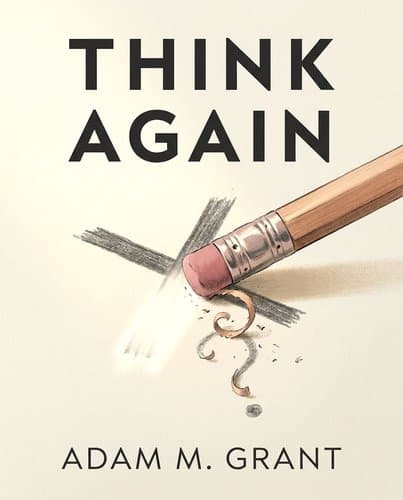
55539565_think-again
by Adam M. Grant
The smartest, most confident people are often the worst at changing their minds—and that blind spot is costing them. Adam Grant shows how treating your own…
In Brief
The smartest, most confident people are often the worst at changing their minds—and that blind spot is costing them. Adam Grant shows how treating your own beliefs as hypotheses to test, not identities to defend, unlocks better decisions, stronger relationships, and a rare competitive edge.
Key Ideas
Track belief revisions as quality metrics
Track how often you update your beliefs as a performance metric. Superforecasters revise their predictions more than four times per question; average thinkers revise twice. The goal is not to flip-flop — it is to stay curious enough to notice when evidence has shifted.
Identify evidence that changes your mind
When you catch yourself in preacher, prosecutor, or politician mode — defending a position, proving someone wrong, or seeking approval — ask one question: what evidence would change my mind? If you cannot answer it, you have left scientist mode.
Shift from defending to collaborative solving
In team disagreements, shift from arguing 'why I am right' to 'how would this actually work.' The first mode hardens positions; the second activates the kind of rethinking that let the Wright brothers discover both their answers were wrong.
Lead with strongest arguments then stop
When trying to persuade a resistant person, lead with your two or three strongest arguments and stop. Adding weaker arguments does not reinforce your case — it gives the other person ammunition to dismiss everything, and it signals that you are preaching rather than reasoning.
Build safety through judgment-free listening
To help someone change their mind, ask open-ended questions about how they reached their current position, reflect their answers back without judgment, and explicitly affirm their freedom to decide. The vaccine whisperer's single maternity-ward conversation moved vaccination rates by 15 percentage points and produced measurable behavior change two years later.
Model vulnerability before requesting team feedback
Build psychological safety on your team by sharing your own past experiences of being wrong and naming your current development goals — before asking others for feedback. This costs almost nothing and produces lasting safety gains.
Distinguish clarity from identity foreclosure settling
Schedule a twice-yearly career checkup: when did you form this aspiration, and have you hit a learning plateau? Identity foreclosure — settling prematurely on who you are and what you want — is not the same as clarity. It is the same cognitive trap that killed BlackBerry.
Who Should Read This
Curious readers interested in Cognitive Psychology and Behavioral Psychology and the science of how the mind actually works.
Think Again
By Adam M. Grant
10 min read
Why does it matter? Because the smarter you are, the harder you've probably made it to change your mind.
Most of us assume the problem is ignorance. Smarter people, we figure, update their beliefs more readily. It's a tidy theory. The evidence demolishes it.
High intelligence makes you better at defending whatever you already believe, not better at questioning it. Past success makes you less likely to rethink the decisions that produced it. And the more you've invested in a conviction, the more your brain treats contrary evidence as a threat rather than data.
The book isn't for the uninformed. It's for capable, confident people — people who are very good at being certain and very bad at noticing when certainty has become the liability. Which raises a better question than "how do I stay open-minded?" What's actually happening in your head the moment you stop?
The Smarter You Are, the Harder You're Working to Stay Wrong
In 2012, Mike Lazaridis sat in a BlackBerry board meeting and held up a touchscreen phone. "I don't get this," he said. He had built a record player out of Legos at age four, won both an Emmy and an Oscar before most people had heard of him, and grown BlackBerry into the fastest-expanding company on the planet. By the summer of 2009, his device held nearly half the U.S. smartphone market. By 2014, that share was under 1 percent.
Intelligence had built his empire. Certainty destroyed it. As far back as 1997, one of his top engineers pushed to add an internet browser. Lazaridis said no. Email only. Fifteen years later, as the iPhone was rewriting the market, he was still preaching the keyboard's superiority, still prosecuting the touchscreen as a gimmick, still surrounded by a fan base that echoed him back. He was too smart, in exactly the wrong way.
Psychologist Phil Tetlock identifies three modes most people slip into without noticing: preacher (defending sacred beliefs), prosecutor (proving others wrong), and politician (performing for approval). Each feels like reasoning. The fourth mode — scientist — treats a belief as a hypothesis: you actively look for evidence that could kill it, and you update when you find some. The difference sounds obvious. It almost never is, because the smarter you are, the better you get at constructing reasons your original view was right.
Quantitative skill improves analytical accuracy, but only when the data confirms what you already believe. When the numbers contradict your ideology, higher math skill actually worsens performance. You get sharper, but you're sharpening in the wrong direction. Researchers call this the "I'm not biased" bias: the higher your quantitative skill, the more confident you become that you're immune to it.
A mind capable of defending almost any position can do exactly that — even when the world has moved past it.
Confidence and Self-Doubt Are Not Opposites — The Best Performers Hold Both
Self-doubt and confidence feel like they belong on opposite ends of a scale. Turns out the most effective performers carry both — and the doubt is doing more work than we thought.
When Halla Tómasdóttir polled at 1 percent six weeks before Iceland's 2016 presidential election, she had already spent months trying to talk other women into running in her place. She had co-founded an investment firm and steered it through Iceland's banking collapse, but she was convinced she lacked the credentials to lead. Her opponent Davíð Oddsson had no economics training and presided over the central bank while the country's banks ballooned to ten times national GDP. Time magazine later named him one of the twenty-five people most responsible for the 2008 financial crisis. He announced his candidacy by describing his qualifications as "considerable." He finished fourth, with 14 percent. Halla finished second, with 28.
What separated them wasn't ability. It was what each did with uncertainty. Halla's doubt made her rethink everything: she answered social media messages personally into the night, held open Facebook Live sessions for voters, learned Snapchat to reach younger audiences, ran a positive campaign while her opponents were mostly attacking each other. Oddsson's certainty kept him doing what he had always done.
Basima Tewfik at Wharton asked medical students how much they felt like impostors, one week before their clinical rotations. The students with stronger impostor thoughts made no worse diagnoses than their confident peers — and scored significantly higher on bedside manner, rated as more empathetic and more effective at sharing information. Investment professionals who felt more like impostors received higher performance reviews four months later. The doubt wasn't getting in the way. It was making them listen harder and prepare more carefully.
What works is a specific split: high confidence in your ability to grow, genuine uncertainty about whether your current tools are good enough. Hold the first firmly. Feed the second.
How Often You Update Your Beliefs Predicts Good Judgment Better Than Intelligence Does
On November 18, 2015, a military historian named Jean-Pierre Beugoms submitted a forecast to an online prediction competition: Donald Trump had a 68 percent chance of winning the Republican nomination. Nate Silver had Trump at 6 percent. Beugoms reached the opposite conclusion by paying attention to what everyone else had filed under "obviously wrong": Trump's stranglehold on media coverage, his popularity across Republican demographic groups, his ownership of a single galvanizing issue.
He got it right. He also, later, got it wrong — by summer 2016, he had talked himself into a Clinton forecast because he found the alternative too disturbing to sit with. He still laughs about it.
Both the hit and the miss point to the same mechanism. Phil Tetlock's research on thousands of forecasters found that the single strongest predictor of accuracy was how often people changed their minds. Intelligence came second. Typical competitors revised a forecast about twice per question. Superforecasters revised more than four times. That rethinking gap carried roughly triple the predictive power of raw brainpower.
Beugoms treats updating as a structural practice. When he makes a forecast, he also writes down the conditions under which he would abandon it, which forces him to define in advance what evidence would change his mind, rather than discovering conveniently that no evidence ever quite does. His goal shifted from proving himself right to improving his accuracy over time.
That shift is the thing. The capacity to enjoy being wrong isn't a temperament you either have or lack. It comes from treating your opinions as provisional conclusions rather than identity claims. When a forecast fails, it's information. When an identity fails, it's a threat. Build a forecaster's relationship with your own beliefs and you spend less energy defending errors and more time correcting them.
The Absence of Conflict in Your Team Is a Warning Sign, Not a Measure of Health
Most teams that feel harmonious are actually avoiding each other's real opinions. The quiet isn't cooperation — it's apathy in professional clothing.
Karen Jehn, an organizational psychologist, draws a line between two types of conflict that look similar but work differently. Relationship conflict is personal: the friction from disliking someone. Task conflict is intellectual: clashing about which idea is right. A meta-analysis of over 8,000 teams confirmed that relationship conflict reliably hurt performance, while moderate task conflict improved it. Low-performing Silicon Valley teams spent their first months disliking each other; by the time they'd cleared enough personal friction to debate actual decisions, the window had closed. High-performing teams kept the personal friction low and argued ideas constantly and early.
The Wright brothers' propeller problem is the pattern at its extreme. For months, Wilbur and Orville shouted at each other for hours, once so fiercely that their sister Katharine threatened to leave the house. Each argued his own case and tore apart his brother's. They got nowhere. Then came a climactic yelling match, and the next morning each arrived defending the other's position. Orville told their mechanic he'd been wrong; Wilbur's idea was right. Wilbur arrived and began arguing the opposite. The argument had shifted from who was right to how the solutions would actually work — and they quickly found that both designs were wrong. The airplane didn't need one propeller. It needed two, spinning in opposite directions, functioning together as a rotating wing.
The argument wasn't the obstacle. It was the method.
Presenting More Evidence to a Resistant Person Hands Them More Ammunition
Think of how a vaccine works: you inject a weakened version of a threat, the body mounts a response, and from then on it's ready to repel the real thing. The same mechanism runs in your skull. Present someone with a counterargument they can defeat, and they leave not just unconvinced but better armed — more certain of their original view, more practiced at dismissing challenges like yours.
This is why the standard playbook for changing minds fails so consistently. When German researchers showed people vaccine safety data, subjects came away seeing vaccines as riskier. When Americans read accounts of measles-suffering children, vaccination interest didn't move. When the autism myth was refuted, those who already had concerns became less interested in immunizing. More information, more resistance. The mind had learned the immune response.
Marie-Hélène Étienne-Rousseau had lived that experience. Her son Tobie was born three months early, weighing two pounds, his head small enough to fit in a palm. She had never vaccinated any of her four children, and every doctor visit had followed the same script: preach the benefits, warn of the risks, correct her beliefs. She felt accused of wanting her children sick. Before Tobie was discharged, still vulnerable, a neonatologist named Arnaud Gagneur sat down with her.
He spent over an hour asking open-ended questions about how she had arrived at her decision. He reflected her answers back. He acknowledged that the information environment around vaccines is genuinely confusing. Near the end, he asked permission before sharing a single fact about vaccine safety from his own research. And he closed by telling her that whatever she decided, he respected her as someone trying to do right by her children.
She vaccinated Tobie before leaving. Then his siblings. Then she set off what she called a bomb in her anti-vaccination community.
A follow-up study found children nine percent more likely to be fully vaccinated two years after a single conversation, and the approach spread to every maternity ward in the province.
What made it work wasn't that Arnaud knew more — Marie-Hélène had spent years on this. He was just the first who seemed to already know that. He asked, listened, and when he finally got to the one fact he wanted to share, he asked if she wanted to hear it first. Every clinic before had treated her as a problem to correct. This one treated her as someone with a decision to make.
NASA Kept Killing Astronauts Because It Rewarded Execution and Called It Intelligence
In July 2013, Italian astronaut Luca Parmitano was forty-four minutes into a spacewalk when he noticed his head felt wet. Water was accumulating inside his helmet, not enough to panic but enough to report. Mission Control blamed a leaky drink bag; the bag was replaced, and the conversation moved on.
A week later, water filled his helmet again. This time, a quart and a half of it. Globs covered his eyes. Liquid crept toward his nostrils. Communications went down. He found the airlock in darkness by memory and tether tension alone, and barely made it back alive.
The technical fix was straightforward: a failed pump separator, a snorkel tube, an absorbent pad. But the chief engineer's verdict on the real cause was harder to address: "The occurrence of minor amounts of water in the helmet was normalized." Someone had decided the first incident was a drink bag, and that story closed the inquiry. The same story had run twice before: Challenger's O-rings, Columbia's foam, each filed under known until it wasn't.
All of that individual willingness to rethink — the humble scientist mode, the curiosity about your own assumptions — can be erased by a single organizational culture. NASA was a performance culture: execution was the supreme value, past success was evidence of correct procedure, and questioning a normalized risk was an implicit accusation that everyone before you had been wrong.
What breaks this pattern is a specific combination. Psychologist Amy Edmondson found that hospital teams in psychologically safe environments reported more errors than other teams, which initially looked like evidence that safety bred carelessness. A researcher who shadowed the teams directly reversed the finding: safe teams reported more but actually committed fewer. Unsafe teams hid their mistakes, guaranteeing repetition. But psychological safety alone isn't enough. Without accountability, people stay comfortable rather than curious. Amazon's answer is a six-page written memo for consequential decisions, read silently before any meeting begins. Writing forces accountability for the reasoning itself, before anyone knows how it will turn out.
The combination has a name: a learning zone, safe enough to surface problems, accountable enough to examine them rigorously.
Knowing Exactly Who You Are and What You Want Is Not Clarity — It's a Trap
At five years old, Ryan decided he would become a neurosurgeon. The family dream was encoded early: grandparents who'd worked double shifts and driven milk trucks before dawn had waited three generations for a doctor in the family. Ryan had the grades and the work ethic. Every fork in the road got the same answer.
When he considered studying economics in college (something that genuinely lit him up), he let it go. When he got into an Ivy League medical school and thought about adding an M.B.A., he let that go too. Burning out midway through his residency, he wondered if he could quit. He couldn't. He had gone too far. He finished seven years of residency, added an eighth year of fellowship, was nearly denied credentials over where he'd placed dates on his résumé, and graduated six figures in debt. He wishes he'd gone a different way.
Psychologists call this identity foreclosure: committing to a self so early that you stop running experiments. Compensatory certainty that feels like clarity — and functions like a trap. The "gotta stay on track" impulse isn't discipline. It's the same logic that keeps politicians funding lost wars.
The fix is two questions, twice a year: when did you form this aspiration, and have you hit a learning plateau? Your career and your identity are open systems. They're supposed to evolve. Treat your plans as hypotheses, not destinations, and let what you discover tomorrow change where you're heading.
The Question Worth Carrying Forward
Here is what the firefighters who died were carrying: chainsaws. Standard issue. One survivor dropped his and ran. The others couldn't let go — not because they lacked the instinct, but because every tool they'd ever trusted was still in their hands.
You are carrying things like that right now. A career plan you made at nineteen. A conviction you've defended so many times you've forgotten you chose it. An identity that used to fit and now just weighs something. The book closes on a question that isn't rhetorical: what evidence would change your mind? If you can't answer that cleanly, the tool is already running you.
Your beliefs, your career, your sense of who you are — these are experiments, not conclusions. Keep checking whether they still hold.
Notable Quotes
“To punish me for my contempt of authority, Fate has made me an authority myself.”
“Being wrong is the only way I feel sure I've learned anything.”
“I change my mind at a speed that drives my collaborators crazy,”
Frequently Asked Questions
- What is Think Again about?
- Think Again argues that intelligence and strong convictions often prevent clear thinking, and that rethinking is most urgently needed by capable, confident people. Adam M. Grant draws on psychology and forecasting research to provide practical tools that help readers catch themselves defending positions instead of reasoning. The book offers concrete strategies to build habits and team cultures where updating beliefs becomes a strength rather than a liability. Grant demonstrates that the ability to revise convictions in response to evidence is essential for both individual success and organizational effectiveness.
- How can you tell when you've stopped reasoning and started preaching?
- When you catch yourself in preacher, prosecutor, or politician mode — defending a position, proving someone wrong, or seeking approval — ask one question: 'what evidence would change my mind?' If you cannot answer it, you have left scientist mode. This diagnostic tool reveals when ego protection has replaced objective reasoning. The ability to articulate what evidence would shift your position indicates genuine openness, whereas inability to answer exposes that you've shifted from inquiry to advocacy. It's a simple but powerful check on your thinking.
- What's the most effective strategy to persuade someone who disagrees with you?
- When trying to persuade a resistant person, lead with your two or three strongest arguments and stop. Adding weaker arguments does not reinforce your case — it gives the other person ammunition to dismiss everything, and it signals that you are preaching rather than reasoning. This counterintuitive approach works because excessive argumentation suggests you lack genuine confidence in your position. By presenting only your strongest evidence, you demonstrate conviction while maintaining intellectual humility, creating space for genuine dialogue and actual belief change.
- How often should you update your beliefs to think like a superforecaster?
- Superforecasters revise their predictions more than four times per question; average thinkers revise twice. Tracking how often you update your beliefs as a performance metric reveals your commitment to staying curious about evidence. The goal is not to flip-flop — it is to stay curious enough to notice when evidence has shifted. This metric distinguishes between unstable thinking and genuine openness to new information. Building a habit of regular belief revision is essential for navigating uncertainty effectively and improving your judgment over time.
Related Book Summaries
Read the full summary of 55539565_think-again on InShort