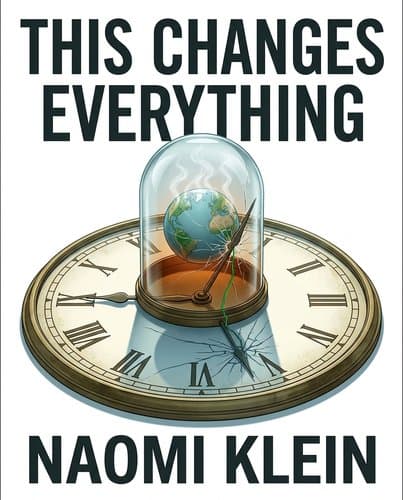
21913812_this-changes-everything
by Naomi Klein
Climate denial isn't ignorance—it's a rational defense of capitalism, because fossil fuel extraction and free markets are structurally incompatible with…
In Brief
Climate denial isn't ignorance—it's a rational defense of capitalism, because fossil fuel extraction and free markets are structurally incompatible with survival. Klein reveals why three decades of climate policy failed and why only a movement challenging extractivism at its cultural roots can succeed.
Key Ideas
Ideological collision shaped climate policy deadlock
The 1988 collision of timelines — climate science demanding massive public investment and regulation at the exact moment market fundamentalism declared those tools heretical — is the structural explanation for three decades of failed climate policy; any solution that doesn't confront this incompatibility will reproduce the same failure
Self-interest drives climate denial, not ignorance
Climate denial by conservative elites is not ignorance — it is a correct reading of the economic implications; effective climate advocacy requires offering a compelling alternative worldview, not better data
Corporate partnerships compromised green movements
The 'insider' strategy of Big Green — merging with corporate interests, endorsing market mechanisms like carbon offsets and cap-and-trade, waiting for billionaire philanthropists — has protected the status quo rather than challenging it; the organizations most trusted to fight fossil fuels have often been funded by them
Values transformation needed for post-extraction world
Extractivism is not just an energy policy but a civilizational story about human mastery over nature; replacing it requires changes at the level of values and cultural narrative, not just technology and regulation
Depletion creates coalitions across old divides
As conventional reserves deplete, fossil fuel extraction expands into formerly 'safe' communities, breaking the sacrifice zone bargain and creating conditions for unprecedented coalitions — 'Cowboys and Indians,' ranchers and Indigenous tribes, white suburbanites and frontline communities — that wouldn't have formed otherwise
Indigenous sovereignty demands partnership, not strategy
Indigenous land title is the most legally powerful tool available to stop fossil fuel infrastructure; treating Indigenous rights as a legal strategy rather than a genuine partnership (including financing economic alternatives) reproduces the extractive relationship activists claim to oppose
Fossil fuels deserve abolition moral rhetoric
The carbon reserves that must stay in the ground to avoid catastrophic warming are worth roughly $10 trillion — comparable to the value of slave property at the start of the Civil War; the climate movement needs the moral vocabulary of abolitionists, not the technocratic vocabulary of policy optimizers
Who Should Read This
Science-curious readers interested in Climate Change and Sustainability who want to go beyond the headlines.
This Changes Everything
By Naomi Klein
14 min read
Why does it matter? Because the system solving climate change is the same one causing it.
Most people think climate change is a problem of denial, or messaging, or the right technology not quite arriving yet. Naomi Klein spent years believing some version of that too. Then she looked at the dates. The scientific consensus demanding radical emissions cuts crystallized in 1988 — the same year Canada and the United States signed the trade agreement that would become NAFTA, launching the era of deregulated global capitalism. Not close to the same year. The same year. Every solution climate science actually requires — massive public investment, aggressive regulation, localized trade — was precisely what the reigning economic ideology had just declared heretical. The problem was never ignorance. The system generating the crisis was handed the job of solving it, and it responded the way any system does when asked to shrink itself: with delay, market mechanisms, and the illusion of action. This book is Klein's attempt to follow that collision all the way down — through trade law, billionaire saviors, green compromises, and centuries of extractivism — and report back on where the exits actually are.
The Worst Possible Timing: Why 1988 Changed Everything
In the summer of 2012, a US Airways jet bound for Charleston sank into the Washington, D.C. tarmac. The pavement had softened in record heat, swallowing the plane's wheels like wet cement. The airline sent a tow truck. Not powerful enough. They sent a bigger one. It worked, and the plane finally departed — burning the same fuel that had melted the ground beneath it.
Klein uses this scene as the book's opening metaphor, and it's the right choice: our response to climate disruption has been to call in heavier machinery, not to question the machinery itself. Fracking, tar sands, deepwater drilling — each is a more powerful tow truck, each buying a little more time on a runway that keeps getting softer.
The deeper argument Klein makes is about timing, and it's genuinely disorienting. In June 1988, NASA scientist James Hansen testified before Congress that he had near-certainty about a real human-caused warming trend. Months later, hundreds of scientists gathered in Toronto to discuss the first emissions targets. The United Nations formed its climate science body that November. The scientific establishment had delivered its verdict.
Also in 1988: Canada and the United States signed the free-trade agreement that would become NAFTA, launching the era of corporate globalization. The two processes — climate diagnosis and market revolution — were born in the same year, and they were structurally incompatible from the start.
The solutions climate science demanded were precisely what neoliberalism had just forbidden. Massive public investment in infrastructure? The era's gospel was privatization. Heavy regulation of industry? Derided as Soviet-style interference. Localized production to shorten supply chains? Protectionism — illegal under the new trade rules. Every tool the atmosphere required had just been ruled out of bounds.
The consequences showed up in the emissions data. During the 1990s, while the trade system was being assembled, global emissions grew around one percent annually. By the 2000s, as China became the workshop — and coal chimney — of the globalized world, that rate tripled to 3.4 percent per year.
This is what makes climate failure so hard to fix with better messaging or smarter technology. The obstacle was never ignorance. It was architecture.
The Right Understands the Stakes Better Than the Center Does
Here is the uncomfortable truth Klein arrives at early in the book: the people who most aggressively deny climate science understand its implications more clearly than the moderates who accept it. They are wrong about the facts. They are not wrong about the stakes.
Consider Joseph Bast, the president of the Heartland Institute, the Chicago-based think tank that has spent decades manufacturing doubt about climate science. Bast studied economics at the University of Chicago and describes his life's purpose as freeing people from the tyranny of other people. When Klein sits down with him, he is disarmingly honest: he and his colleagues did not start with the science and arrive at skepticism. They started with the economic implications and worked backward. If climate change is real, everything Heartland has spent forty years defending — deregulation, privatization, minimal government, unfettered markets — becomes not just wrong but catastrophically wrong. The atmosphere does not negotiate. It doesn't accept a carbon offset or a market mechanism as a substitute for actual emission cuts. Real climate action requires exactly what Bast has built his career opposing: binding regulations, massive public investment, and state intervention on a scale that makes the New Deal look modest. He sees this clearly. That's why he fights the science rather than the policy.
Yale researcher Dan Kahan found that giving people more scientific data on climate actually increased polarization — those with hierarchical worldviews became more skeptical, not less. The problem isn't a deficit of information. It's that the information feels like a threat to an entire way of life.
Klein's point cuts against the entire liberal strategy of better charts and clearer messaging. You can't communicate your way past a survival response.
Big Green Sold the Movement to the People Destroying the Planet
In 1995, Mobil handed over 2,300 acres on Galveston Bay, Texas, to The Nature Conservancy — one of the last breeding grounds of the Attwater's prairie chicken, a bird already so rare that its mating ritual, a staccato stomp and a guttural boom from inflated yellow neck sacs, had become something almost no one alive had witnessed. TNC named it the Texas City Prairie Preserve and declared the bird's recovery its highest priority. Four years later, the organization commissioned a new gas well on the preserve. Of all the places to sink a drill, they chose the spot closest to where the birds nested and performed their booming displays. When a pipeline delay pushed back the annual release of captive-bred chicks by three months, all seventeen died — likely picked off by raptors that had been waiting. By 2003 the known prairie chicken population had dropped from thirty-six to sixteen. In November 2012, the last one disappeared.
The environmental movement became this story. Through the 1980s, as Ronald Reagan rebranded basic pollution regulation as Soviet-style control, the major green groups faced a choice: fight the ideological shift alongside labor and civil rights groups, or adapt to it. Most adapted. The Environmental Defense Fund, which had built its reputation suing polluters, pivoted under new leadership to creating profit opportunities for them instead. The resulting strategy — carbon markets, voluntary partnerships, industry coalitions — reframed climate action as a financial instrument. Rather than demanding that powerful emitters stop, Big Green began offering them mechanisms to keep going while appearing to address the problem. Drexel sociologist Robert Brulle argued that reducing environmentalism to market-based technocracy had stripped the movement of any coherent political vision, replacing it with a closed circuit of specialists and executives.
The billionaire saviors didn't do better. Richard Branson, after a personal PowerPoint from Al Gore in 2006, pledged three billion dollars to develop clean fuel — money that would come directly from Virgin's transportation profits. By 2014 he had invested perhaps three hundred million, while launching three new airlines and adding roughly 160 planes to his fleet. Virgin America's emissions rose 177 percent in four years. Branson called the original pledge a 'gesture.' The profit motive keeps winning, not because these men are cynical, but because the system they operate inside demands it. Voluntarism and enlightened self-interest were always going to lose that race. The atmosphere doesn't grade on a curve.
The Hidden Engine of the Crisis: Extractivism as a Civilization, Not Just an Industry
In the 1970s and 1980s, Nauru had the world's highest per capita income. The source was phosphate — ancient seabird guano, hardened over millennia into rock, then ground into fertilizer for Australian and New Zealand farms. The money flowed so freely that residents threw thousands of dollars in cash at one-year-old babies at birthday parties, and the police chief bought himself a yellow Lamborghini. But seen from the air, the island's forested interior was disappearing, strip-mined down to a lattice of jagged coral spires. By the 1990s, 90 percent of the land was ecologically dead. The government laundered seventy billion dollars for Russian organized crime — roughly a thousand times the country's entire annual GDP — through phantom banks, then turned its remaining coastline into a detention camp for asylum seekers, where refugees sewed their mouths shut with paper clips to protest the conditions. Nauru had been designed, by its colonial extractors, to disappear. And it was disappearing — from the inside out through mining, and from the outside in through rising seas driven by the same industrial model that had built its brief, absurd wealth.
Klein argues that Nauru is not an exception. It is a diagram. The mindset that treated a living island as an ore deposit to be emptied and abandoned is the same mindset that has governed the global economy's relationship to the atmosphere. She traces its intellectual roots to Francis Bacon, who in the early seventeenth century urged Britain's elites to abandon any reverence for nature and treat the earth as something to be 'hounded,' penetrated, and made to yield. The decisive machinery came later: James Watt's perfected steam engine, introduced in 1776, freed factory owners from rivers and wind. Water wheels required fast-moving water, rural locations, scattered workforces. Coal moved everything to cities, where workers were replaceable and nature's rhythms were irrelevant. The steam engine didn't just power factories — it installed a story. Growth could be infinite. Geography was a technicality. The physical world was an obstacle engineering had finally overcome.
What makes this more than a history lesson is Klein's insistence that the story transcended capitalism. Soviet central planners devoured resources just as voraciously; Czechs and Russians had higher per-capita carbon footprints than Australians before the Berlin Wall fell. Left-wing governments in Bolivia, having genuinely slashed poverty rates through extractive revenues, found themselves drilling deeper into the Amazon to fund the next round of social programs. The extractivist logic — take without reciprocating, treat land and people as inputs — is not a corporate pathology. It is a civilizational inheritance, shared across ideologies, that climate change now forces us to name and relinquish.
When the State Disappears, People Die in the Dark
Ten days after Superstorm Sandy hit the Rockaways — a narrow strip of seaside communities in Queens housing New York's poorest and most forgotten residents — a thirty-year-old organizer named Nastaran Mohit commandeered a storm-wrecked furrier's storefront and turned it into a clinic. Animal pelts still hung from the ceiling while volunteer doctors wrote prescriptions and treated wounds beneath them. Mohit had come to hand out supplies. She stayed because no one else was providing medicine to anyone.
Volunteers going door-to-door in the neighborhood's darkened high-rises found what the state hadn't bothered to look for: cancer patients out of medication, diabetics without insulin, oxygen tanks empty, people too sick to navigate unlit stairwells in buildings without power. Not one knock had come from the city Housing Authority, the Health Department, or the Red Cross since the storm made landfall. The National Guard was present — enforcing curfew. The Peninsula Hospital Center, one of only two hospitals serving the area, had closed six months earlier when the state declined to intervene. The Rockaways had been stripped of public infrastructure long before the floodwaters arrived. Sandy didn't hollow out the public sphere. It just made the hollowing visible.
Klein wants you to absorb this before you start thinking about solar panels and wind turbines: the same political logic that dismantled public services also makes a rapid green transition structurally impossible. E.ON, one of Germany's largest private utilities, spent years lobbying against renewables targets while paying out billions in dividends — it will not voluntarily quadruple clean-energy investment when fossil fuels remain more profitable. The International Energy Agency says that quadrupling is exactly what's required by 2030.
Which makes the German story worth sitting with, because it shows what the alternative looks like. The country's transition from 6 to 25 percent renewables in thirteen years wasn't driven by utility giants. It was driven by roughly 900 energy cooperatives, farmers, and municipalities. Where Hamburg's grid had been privatized, residents voted in 2013 to buy it back — explicitly so they could join that transition.
The through-line is not technical. The people left dying in the dark in the Rockaways and the communities unable to exit coal because a private monopoly controls the switch are casualties of the same decision: that markets should govern what communities cannot survive without.
Sacrifice Zones Don't Stay Where You Put Them
The fossil fuel industry made a strategic error it cannot walk back: it ran out of easy oil and went looking for more in places that would fight back.
For most of the carbon age, a quiet bargain held. The poisoning happened in places where the poisoned had no leverage — the Niger Delta, Appalachian hollows, Indigenous territories in northern Alberta. People in prosperous, politically connected places could pretend the costs of their comfort were being paid somewhere invisible. Then conventional reserves depleted, commodity prices spiked, and the industry broke the bargain by going everywhere.
Rail cars carrying crude multiplied more than forty times in five years — from roughly 9,500 to an estimated 400,000 by 2013. The odds caught up with Lac-Mégantic, Quebec, a town of tidy storefronts and postcard streets, when a train hauling 72 tank cars of fracked Bakken oil rolled unattended down a grade, derailed, and exploded, killing 47 people and flattening the downtown. The town was not a sacrifice zone. It was a destination. Suddenly hundreds of communities across the continent discovered they sat in the path of what one former state governor called 'oil bombs on wheels.' Ranchers in South Dakota went to court to block a Canadian pipeline company from their family land. Goat farmers in Montana made common cause with Indigenous tribes. Klein calls this coalition Blockadia — not a place but a posture, adopted by people who had assumed they were on the safe side of the sacrifice-zone line and discovered they were not.
What surprised the industry was how much harder these new opponents were to manage. Communities economically dependent on extraction can be exhausted into compliance; communities with working farms, clean rivers, and a functional tourist economy have something concrete to protect — and no need for the company's checks. The Lummi Nation in Washington State strapped a hand-carved cedar totem pole to a flatbed truck and drove it through eight communities threatened by coal trains and tar sands pipelines, planting it finally at the Pacific with a vow to fight together. Goldman Sachs read the political weather and quietly sold its stake in the largest proposed coal export terminal in the Northwest, apparently concluding that no investment survives indefinitely against people who are not for sale.
Indigenous Land Rights Are the Most Powerful Legal Weapon Against Fossil Fuels
In 2004, two Indigenous leaders walked into the Manhattan offices of Standard & Poor's to argue that Canada's AAA credit rating was a lie. Arthur Manuel, a former British Columbia chief turned international land-rights strategist, had spent months corresponding with the agency's sovereign ratings director, Joydeep Mukherji, making a specific and unnerving case: Canada was carrying an undisclosed liability worth trillions of dollars. Wealth extracted from Indigenous land since 1846 — land whose title had never been legally surrendered — was a debt the country had simply declined to put on its balance sheet. Manuel brought Guujaaw, president of the Haida Nation, to present the Haida's registered court claim against British Columbia for degrading lands the Crown had never actually acquired. Mukherji listened carefully. He did not dispute the facts. Then he explained, as diplomatically as possible, that the agency had concluded Indigenous peoples lacked the power to enforce their rights — so those liabilities, however real in principle, didn't affect the rating. Klein walked out hearing the subtext clearly: we acknowledge you never sold the land. But you and what army?
That question had a different answer by 2013. In New Brunswick, the Mi'kmaq Warrior Society — the same organization that had defended Mi'kmaq fishermen against violent attacks by white fishing communities thirteen years earlier — lit a ceremonial fire and explicitly invited Acadian and Anglo neighbors to join them in blocking a Texas company's seismic testing for fracking. They came. The demographics of the protest made the legal logic visible: Mi'kmaq treaty rights, affirmed by Canada's Supreme Court, guaranteed the right to fish and hunt on ancestral lands. Industrial contamination of the watershed violated that right regardless of what any provincial government decided. For non-Native neighbors who had watched elected officials flip on fracking the moment industry money arrived, those treaty protections were suddenly the most durable thing available — rights that couldn't be traded away by the next administration because they predated every administration. 'Our treaties are the last line of defense to save the clean water for future generations,' one Elsipogtog member said. Non-Native protesters understood he was speaking for them too.
But Klein refuses to let that coalition become another extractive relationship — one where non-Natives harvest Indigenous legal standing without addressing the poverty that makes dirty development tempting in the first place. On the Northern Cheyenne Reservation in Montana, where 62 percent unemployment gave coal companies a ready audience, a Lakota solar entrepreneur named Henry Red Cloud trained community members to install solar heaters on reservation homes, cutting heating bills by half and building what he called solar warriors. Firefighter Vanessa Braided Hair framed renewable energy as a continuation of what her ancestors had always taught: take what you need, then put back into the land. Within a year, young Cheyenne who had seemed ready to accept the mines were showing up at regulatory hearings in 'Beyond Coal' shirts, telling officials simply: 'You understand no. No.' The army S&P had been looking for wasn't an abstraction — it was people who finally had something to say yes to.
Climate Action Is the Successor to Abolition — And That Reframes Everything
What would it take for the political class to accept the forced retirement of the most profitable industry in human history? History offers one precedent close enough to be instructive.
At the start of the Civil War, the monetary value of enslaved people in the United States exceeded the combined worth of every bank, factory, and railroad in the country — journalist Chris Hayes puts the figure at roughly ten trillion dollars in today's terms. Slavery was not a regional quirk or a moral embarrassment tucked into the margins of the economy. It was the economy's beating heart, the asset class everything else depended on. And yet abolitionists demanded its surrender without compensation, and eventually got it — not through persuasion alone, but through a mass movement that refused to accept the profitability of an atrocity as a reason to perpetuate it.
Hayes notes that the figure is eerily comparable to the estimated value of carbon reserves that must stay in the ground if warming is to remain below two degrees Celsius. Klein builds on this parallel not to flatten history but to make a specific claim: the climate movement is not asking for a policy adjustment. It is asking the most powerful economic interests on earth to accept the stranding of their core assets. That has happened exactly once before in the modern era, and it required a moral reckoning, not a market mechanism.
The parallel also reveals where the movement is most likely to stall. Martin Luther King Jr. observed that desegregated lunch counters cost the powerful nothing — the harder test was always redistribution, the demands that carried an actual price tag. The same fault line runs through climate politics. Carbon taxes and regulatory wins are achievable without disturbing the underlying structure of wealth. But the full demand — fossil fuel assets left underground, revenues redirected, debts to frontline communities acknowledged and paid — looks more like abolition than like a filing with the EPA. It will require the same refusal to treat an ongoing harm as an inherited entitlement.
Geophysicist Brad Werner asked the American Geophysical Union in 2012 whether Earth was, in his words, f**ked. His answer: the only force capable of creating enough friction to slow the destabilization of earth's systems is social movements operating outside the logic of capital. Not protest as gesture, but resistance as a physical mechanism — the thing that actually slows the machine. Klein ends the book on that word. The various movements that have built throughout these chapters — Blockadia, Indigenous land defense, the push to reinstate public energy — are not separate campaigns awaiting coordination. They are the movement, and climate change is what gives them a shared deadline and a common moral language. Abolitionists did not win by moderating their demand to something the slaveholder could live with. The climate has no interest in what the fossil fuel industry can live with either.
The Crisis That Forces the Question We've Been Avoiding
Every previous generation that won a moral argument about forced economic surrender — abolitionists, anticolonial movements — won it slowly, partially, with the wound still visible in the aftermath. Klein is honest that she doesn't know how this one ends. What she insists on, and what's hardest to shake after following her argument this far, is that climate change removes the luxury of a long slow argument. The atmosphere doesn't wait for consensus to build gradually toward decency. That's what makes this historical moment genuinely different from every analogy we reach for — the deadline is physical, not political, and it makes the moral question and the economic question the same question. Which means the real thing this book asks of you isn't whether you believe the science. It's whether you understand what it would mean to act like you do.
Notable Quotes
“freeing people from the tyranny of other people.”
“an affront to their deepest and most cherished basic faith: the capacity and indeed the right of ‘mankind’ to subdue the Earth and all its fruits and to establish a ‘mastery’ over Nature.”
“such a thought is not merely mistaken. It is intolerable and deeply offensive. Those preaching this doctrine have to be resisted and indeed denounced.”
Frequently Asked Questions
- What is This Changes Everything about?
- This Changes Everything argues that capitalism and climate change are structurally incompatible, explaining why three decades of market-friendly climate policy have failed. Klein traces how extractivism, corporate environmentalism, and market fundamentalism have blocked meaningful climate action. The book contends that only a broad social movement challenging economic assumptions at their root can deliver the necessary transformation. Klein criticizes insider strategies adopted by major environmental organizations, including their embrace of market mechanisms and partnerships with fossil fuel interests, as insufficient to confront the underlying structural incompatibility.
- Why does Klein argue climate denial is not based on ignorance?
- Climate denial by conservative elites is not ignorance — it is a correct reading of the economic implications. These elites understand that addressing climate change would require massive public investment and regulation, tools that contradict market fundamentalist ideology. Klein argues that effective climate advocacy requires offering a compelling alternative worldview to replace market fundamentalism, not simply providing better scientific data. This structural insight reframes climate denial as economically rational within capitalism's logic, demanding systemic economic transformation rather than scientific persuasion.
- What does Klein say about Indigenous rights and climate activism?
- Indigenous land title is the most legally powerful tool available to stop fossil fuel infrastructure. However, Klein warns that treating Indigenous rights merely as a legal strategy rather than a genuine partnership reproduces the extractive relationship that climate activists claim to oppose. True alliance requires financing economic alternatives and genuine cooperation. Recent coalitions between diverse groups—ranchers and Indigenous tribes, white suburbanites and frontline communities—formed as fossil fuel extraction expands into previously protected areas, breaking the traditional sacrifice zone bargain.
- What is the structural explanation for decades of failed climate policy?
- The 1988 collision of timelines is the structural explanation for three decades of failed climate policy. Climate science demanded massive public investment and regulation at the exact moment market fundamentalism declared those tools heretical. This fundamental incompatibility between capitalism's ideological trajectory and climate science's requirements means any solution that doesn't confront this tension will reproduce the same failures. Klein argues that conventional policy approaches—carbon offsets, cap-and-trade, insider negotiations—cannot resolve this structural conflict, requiring instead a movement that challenges economic assumptions at their foundation.
Related Book Summaries

Read the full summary of 21913812_this-changes-everything on InShort