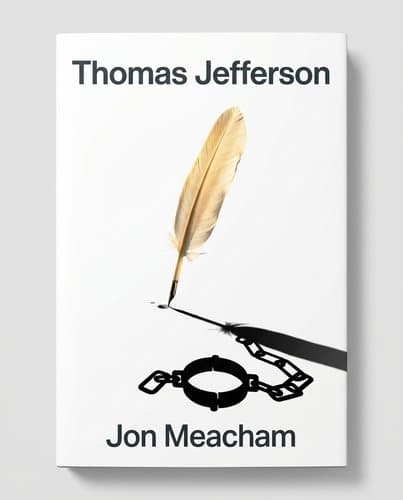
13533740_thomas-jefferson
by Jon Meacham
Jefferson's genius and his moral catastrophe share the same root: an absolute refusal to admit helplessness that reshaped a nation and made slavery's reckoning…
In Brief
Jefferson's genius and his moral catastrophe share the same root: an absolute refusal to admit helplessness that reshaped a nation and made slavery's reckoning permanently deferrable. Meacham reveals how America's most contradictory founder created a legacy every generation can claim but none can fully own.
Key Ideas
Jefferson's power: the private dinner over podium
Power operated through intimacy for Jefferson: his most effective tool was the private dinner, not the public speech. Control the room, not the podium.
Constitution as strategic tool, not constraint
Constitutional principles, for Jefferson, were instruments rather than constraints — he invoked strict construction when out of power and set it aside when national opportunity demanded. Understanding this makes his career coherent rather than hypocritical.
Republican simplicity was calculated power display
Jefferson's 'republican simplicity' — the worn slippers, the casual dress, the accessible manner — was a calculated performance of status, not the absence of it. Only those secure enough in their position can afford to forgo its symbols.
Control obsession: Jefferson's greatness and ruin
The same psychological trait that made Jefferson great (an absolute refusal to admit helplessness, a need to control every outcome) is what made his failures permanent. He deferred every confrontation he couldn't win cleanly, including slavery, until deferral became its own catastrophe.
Unresolved contradictions held in creative tension
Jefferson's legacy is not a monument to resolved contradictions but to unresolved ones held in creative tension — which is why every subsequent American generation has been able to claim him, and why none has been able to fully own him.
Who Should Read This
History readers interested in Political Figures and World History who want a deeper understanding of how we got here.
Thomas Jefferson
By Jon Meacham
14 min read
Why does it matter? Because the man who wrote 'all men are created equal' was also the man who mastered the art of keeping contradictions alive.
We know the face on the nickel, the phrases carved into marble, the philosopher who wrote that all men are created equal while owning two hundred human beings. We think we understand the contradiction. We think it damns him. But Jon Meacham's Jefferson is something more difficult than a hypocrite — he's a man who wanted power with the same intensity he wanted liberty, and who was brilliant enough to convince himself, and most of the country, that those two appetites were actually the same thing. A man this specific, this physical, this shrewd deserves a closer look than the monument allows. The slippers worn to the heel. The mockingbird eating from his lips. The scrap paper used for hygiene, carefully preserved in the Library of Congress.
The Turkey in the Pen: Jefferson's Politics Began Before He Knew What Politics Was
A ten-year-old boy stands alone in the Virginia woods with a gun and nothing to show for it. His father sent him out here with a clear expectation: come back with proof you can survive on your own. The trees press in. The game won't cooperate. Then, through sheer persistence and luck, he spots a wild turkey already caught in a pen. He doesn't philosophize about fairness. He ties the bird to a tree with his own garter, shoots it, and walks home in triumph — exactly the result his father, a man who reportedly righted two-thousand-pound tobacco hogsheads by hand, had expected him to find.
That's the Jefferson most people miss. We tend to picture him at a writing desk — the cool rationalist, drafting elegant sentences about self-evident truths. But the instinct that defined him showed up long before he had a political philosophy: when the path forward closes, look for the unexpected opening. When you find one, use it without hesitation.
What makes the turkey story more than charming folklore is how precisely it maps onto the next six decades. Jefferson spent 36 years in or adjacent to power — burgess, governor, secretary of state, vice president, president — and the pattern kept repeating. Cornered or blocked, he'd wait, improvise, and take whatever opening presented itself. The means would vary. The instinct never did.
Here's the contradiction worth sitting with: this same boy's first memory, by his own account, was being lifted onto horseback and carried on a pillow by an enslaved man. Infant master, tended by someone who owned nothing, not even his own movement through the world. The future author of universal liberty was formed, from the very beginning, inside a system that made his confidence possible. Both things are true — and one does not soften the other.
The Philosopher Who Never Lost a Fight He Cared About Winning
Here's what you don't expect when you study Jefferson closely: the man almost never won a public argument. He rarely spoke at length in large assemblies, avoided confrontation in face-to-face settings, and let other men carry the rhetorical fight. John Adams noticed this early and considered it genius. Speaking rarely, Adams believed, meant you never gave your opponents anything to push against — you never became 'familiar,' never accumulated the quiet enemies that eloquence inevitably creates.
The sharpest lesson came before Jefferson had any real power at all. In May 1765, a twenty-two-year-old Jefferson stood at the doorway of the House of Burgesses and watched Patrick Henry electrify the room with his argument that Virginia alone had the right to tax Virginians. Henry pushed through the boldest resolution by a single vote, twenty to nineteen. Then he left town. The next morning, Jefferson arrived early to discover a senior legislator quietly searching the records for a procedural tool that could undo the previous day's result. By the time the session opened, Henry's victory had been rescinded. Jefferson filed that away: rhetoric without tactical control of the aftermath is just noise. The man who moved the crowd and then went home lost. The man who stayed and worked the procedures won.
The positive model came from the dinner table of Governor Francis Fauquier, the royal governor of Virginia, who regularly gathered a small circle that included the Scottish professor William Small and the lawyer George Wythe. Jefferson was invited to make a fourth. Those dinners weren't purely social — science, music, political philosophy, and the frank exercise of power all unfolded in the same room, among men who treated those things as inseparable. Jefferson absorbed both the substance and the method. For the rest of his life, he deployed the strategic dinner the same way: not to debate enemies, but to cultivate allies, to shape the terms of a question before it ever reached a public floor.
The pattern this created is the one you need to understand to make sense of everything else: Jefferson did his most consequential work in committee rooms and private correspondence, then let others deliver the result in public. He drafted; others declaimed. He shaped; others signed.
He Wrote 'All Men Are Created Equal' While Grieving His Mother and Dreading His Wife's Death
Picture Jacob Graff's rented house in Philadelphia, June 1776. Jefferson has taken two rooms — a bedroom and a small parlor across the staircase landing. He writes at a portable desk of his own design, in longhand, breaking every few minutes to check the door for a letter from Virginia that doesn't come. His wife Patty had suffered a dangerous miscarriage. He doesn't know if she's recovering or dying, and Philadelphia is three hundred miles away.
His mother had died six weeks earlier, in late March, a sudden stroke that felled her at fifty-five. Jefferson's grief came out sideways: a migraine so severe he couldn't read or think for weeks. He rode to Philadelphia in May with the headache still on him.
This is where the Declaration of Independence was written.
John Adams put Jefferson behind the pen for reasons that had nothing to do with the quality of his prose. When the two men met to discuss who should draft the document, Jefferson suggested Adams do it. Adams refused, and he was blunt about why: Jefferson was a Virginian, and a Virginian needed to appear at the head of this. Adams, a Massachusetts man, was already seen as too radical, too northeastern, too easy for wavering delegates to dismiss as a regional agitator. Jefferson was selected the way a campaign manager selects a spokesperson — for political geography first, eloquence second.
Jefferson understood his assignment. He later said he wasn't trying to invent new principles or unearth novel arguments. The goal was to put the common sense of the American position in language direct and forceful enough to bring undecided colonists along — and soldiers who needed a reason to keep fighting, and potential European allies who wanted ideological cover before backing a rebellion. The Declaration was always a political document. The philosophy was real, but it was also a tool.
Then Congress got hold of it. Jefferson sat and watched as the Committee of the Whole worked through his draft over two days. Most changes were minor. One was not: the entire passage condemning the slave trade — Jefferson's most passionate indictment, framed as a crime Britain had forced upon unwilling colonists — came out entirely, cut to avoid losing South Carolina and Georgia. Jefferson registered the deletion with something close to physical pain. He'd written the Declaration's most personal moral argument, and the coalition needed to make independence real simply couldn't accommodate it.
The version that survived was still his — the rhythm, the logic, the compression of Enlightenment thought into a sentence most people alive today can still recite. But the version that survived was also a negotiated document produced by a grieving, headache-ridden man who was in the wrong city, written to a specific brief, and edited by committee to hold together a fractious coalition.
The words outlasted every compromise that shaped them.
The Same Man Who Demanded Obedience from His Slaves Wrote That Governments Derive Power from the Consent of the Governed
What do you do with a man who wrote the philosophical foundation of human freedom and then went home to three hundred people who couldn't leave? The usual answer is hypocrisy — Jefferson failed to live up to his own ideals. But that framing misses something. Look at the same character trait running through both the ideals and the slaveholding, and you start to see a different picture: not a man who betrayed his principles, but a man whose deepest need — for absolute control over his environment — produced both.
Consider Jupiter. He was the enslaved man responsible for Jefferson's horses, which meant he occupied a role that touched something Jefferson genuinely loved. One day Jefferson ordered Jupiter to bring around a carriage horse. Jupiter refused. Jefferson asked again. Jupiter refused again. What followed, according to the family's own account, was a rebuke so total that neither Jupiter nor anyone watching ever forgot it — delivered, a grandson wrote, 'in tones and with a look' that registered less like anger than like a force of nature reasserting itself. Jefferson did not shout as a rule. He prided himself on composure. But composure, for Jefferson, was the form control took when everything was going correctly. When it wasn't — when someone in his ordered world simply declined to comply — something else surfaced, something that had always been there under the calm.
This is the same man who checked his horses' shoulders with a white handkerchief before mounting, sending them back to the stables if he found dust. The same man who designed Monticello over decades to eliminate any visible sign of the labor that made it function — dumbwaiters hidden in the dining room walls so guests would never see who was serving them. Control wasn't incidental to Jefferson's character. It was the architecture of his entire life, literal and otherwise.
That insistence on rational, legible order — that's where the politics come from too. Jefferson's argument that governments derive their authority from the consent of the governed wasn't a repudiation of this need; it was the same logic scaled up. A world where power was arbitrary and unchecked was a world where Jefferson himself could be controlled by someone else. The Enlightenment case for self-governance was, at one level, a case for the same thing Jefferson demanded from Jupiter: that authority be rational and answerable to something beyond brute will. He meant it for himself. That he couldn't extend it outward is the contradiction he lived inside every day — and never resolved.
A Private Treaty in Paris: The Moment Jefferson's Power Ran Out
Imagine you are at the peak of your authority — you have just spent weeks renegotiating the debt obligations of an entire nation, dealing with European banking houses accustomed to treating American diplomats as polite supplicants. Then you come home to discover that a teenage girl holds a card you cannot override.
In 1788, Sally Hemings was in Paris with Jefferson, roughly fourteen when she arrived and pregnant by the time this confrontation unfolded. France's legal climate made slavery effectively unenforceable — any enslaved person who petitioned French courts could claim freedom simply by standing on French soil. Sally knew this. And when the moment came to board a ship back to Virginia, she refused.
Madison Hemings, the son born from this relationship, later described what happened with precise plainness: his father made her a set of specific promises to bring her home. Extraordinary privileges for herself. And a solemn guarantee that every child she bore him would be freed at twenty-one. Sally accepted. Madison would later describe the arrangement with a phrase that cuts through every available euphemism: 'We all became free agreeably to the treaty entered into by our parents before we were born.'
Hold that word — treaty. It's the word Madison chose, and it's doing real work. Treaties are negotiated between parties who each have something the other needs. Jefferson needed Sally to come back voluntarily; Sally needed her children to have a future that didn't belong entirely to someone else. Jefferson, to his credit in the narrowest sense, kept the deal.
What Paris revealed was something more specific: the same man who had spent years engineering every social situation to his advantage, who designed Monticello to make the labor that sustained him invisible, who preferred to negotiate through letters rather than expose himself to face-to-face reversal — that man found himself in a position where someone with no legal standing, no property, and no public voice held the leverage. And his response was to negotiate in good faith and honor the terms.
Which means the question isn't simply whether Jefferson was a hypocrite. It's this: he knew, in at least one specific moment, exactly what he owed. He just couldn't extend that knowledge past the walls of his own household.
The Strict Constructionist Who Bought a Continent and Didn't Ask Permission
Jefferson's constitutional philosophy was always a weapon, not a principle. When he was out of power, strict construction of the Constitution was the blade he used against Federalists building a centralized state. Once he held the presidency, he set it down whenever the nation — or a staggering opportunity — demanded.
The sharpest proof arrived in the summer of 1803. Napoleon was in a cologne-scented bath when he announced he was selling Louisiana — not just New Orleans, which Jefferson had been negotiating over, but the entire territory, roughly 828,000 square miles, for fifteen million dollars. Jefferson read the news on the evening of July 3 and immediately began calculating acreage on paper, stunned by the arithmetic of what had just fallen into his hands.
Then came the private reckoning. Jefferson knew, and admitted to his allies, that the Constitution contained no clause authorizing the federal government to absorb foreign territory. His first instinct was to propose a constitutional amendment — he even drafted one, wanting formal legal cover before proceeding. But when word arrived that Napoleon was already wavering, that the offer might evaporate if Congress moved too slowly, Jefferson abandoned what he called his 'metaphysical subtleties' without a visible moment of anguish. He quietly told allies to ratify the treaty as fast as possible, to proceed without raising constitutional doubts, to act — in his own phrase — 'sub silentio' (in silence, without debate). The man who had spent the previous decade arguing that broad construction of federal power was the first step toward tyranny had just urged his congressional allies to purchase a continent and not ask too many questions about whether they were allowed to.
The pattern repeated at the other end of his presidency. In 1807 he signed the Embargo Act — a total shutdown of American trade, nothing in, nothing out, with enforcement powers that reached into the daily economic life of every citizen. Jefferson privately acknowledged that the law surpassed even the Alien and Sedition Acts, which he'd spent a decade calling the death of American liberty, in its intrusions. Now he wielded something broader, signed it, and enforced it with troops.
The point isn't hypocrisy, exactly. Hypocrisy implies the principle was sincere and the deviation shameful. What Jefferson's record actually shows is something more coherent and more unsettling: he believed in limited government the way a contractor believes in building codes — as the right framework for normal conditions, not as a constraint that survives contact with emergency or once-in-a-generation opportunity. The continent was sitting there. He took it. The logic was consistent. The constitutional philosophy was not.
The Government That Was 'Neither Seen Nor Felt' — and the Man Who Ran It in Worn-Down Slippers
All of which makes it stranger, and more characteristic, that Jefferson's daily mode of power looked like the opposite of power.
A French traveler returns home after spending time with President Jefferson and finds himself summoned before Napoleon. What kind of government, the emperor wants to know, do the Americans have? 'One, Sire,' the traveler says, 'that is neither seen nor felt.' Jefferson, when he heard this, considered it precisely the right description — and precisely the effect he had engineered.
The slippers are where you start. Jefferson received diplomats, senators, and foreign ministers in ancient velveteen breeches and shoes worn flat at the heel, looking as though he'd wandered in from the stables. British and French envoys found this disorienting, even offensive. Jefferson found their discomfort clarifying. He understood something the diplomats didn't: only the genuinely secure can afford to dress badly. The man who signals authority through gold braid has less of it than the man who greets you in the clothes he rode in. The slippers weren't modesty. They were a demonstration — the power is so settled it requires no costume.
The dinners worked the same way. Jefferson governed almost entirely through personal conversation, feeding legislators his views in intimate settings where disagreement felt less like opposition and more like ingratitude toward a generous host. Senator William Plumer of New Hampshire arrived in Washington as a committed Federalist who dismissed the Jefferson administration as 'feeble and nerveless.' Then he started accepting dinner invitations. By 1806 he was writing that the more carefully he examined Jefferson's character, the more he respected the man's integrity — still disagreed with the policies, but the hostility had drained away. Jefferson had given him pecans to plant at home, told him it would take twenty years for the trees to bear, and turned a political adversary into something closer to an admiring neighbor. The partisan never fully disappeared, but he'd been softened past usefulness to the opposition.
The Wolf by the Ear: Why Jefferson Left the Wound He Spent His Life Describing
By the time Jefferson composed his 'wolf by the ear' letter in the 1820s, he had spent forty years living with mixed-race children at Monticello — children he fathered, watched grow up alongside his white grandchildren, and never publicly acknowledged. He wrote, in those same decades, that two races living freely inside one government was simply unimaginable, that mixing white and Black bloodlines produced only degradation. The contradiction is so stark it demands explanation, and here is the one that holds: Jefferson had spent his entire adult life operating on the belief that his personal control over a situation changed the situation's rules. The chaos he predicted for a multiracial republic couldn't happen at Monticello because Monticello was his. The debt he refused to address wouldn't destroy him because he would find a way. The slavery problem would be solved — gradually, practically, eventually — because the alternative was too terrible to accept as permanent.
The 'smooth handle' philosophy — never force a confrontation when a deferral will do — let him hold fractious political coalitions together, manage rivals without making enemies, and keep every difficult personal encounter at arm's length until conditions changed. Move that same habit of mind to the question of the 130 enslaved people on his land, and the conclusion it produces is identical: the practical obstacles to their freedom were simply too large to overcome right now. The deferral that was genius in a cabinet meeting was catastrophe across a lifetime.
When he died in 1826, his will freed exactly five people, all Hemingses — Burwell Colbert, John Hemings, Joe Fossett, and two others. His debts, somewhere between one and two million modern dollars, had grown beyond any solution he'd been willing to adopt while he still had options. Monticello itself eventually had to be sold. The people he hadn't freed were auctioned off to satisfy his creditors — families divided, names recorded in estate ledgers, scattered across Virginia. The man who had maneuvered Napoleon out of a continent couldn't maneuver his way out of what compound interest had done while he wasn't looking.
Henry Lee visited Jefferson's deathbed in late June 1826 and noticed something small and precise: Jefferson was waving flies away from his alcove himself, refusing to let anyone else do it. His daughter told Lee afterward that this was his habit — his strategy, she called it, for fighting old age off by never once admitting helplessness. That's the whole man in a single gesture. He held on to every task he could still perform himself, right to the edge. It's why he was magnificent. It's exactly why, on the one question that mattered most, he left the wound open for someone else's generation to close.
What Adams Got Wrong in His Final Words
John Adams spent his final hours — the same July 4, 1826, that Jefferson was dying in Virginia — believing Jefferson had outlasted him. He was wrong about the man, but right about everything else. What Meacham leaves you with, quietly, without quite saying it, is that the architecture Jefferson built was always going to carry both the dream and the damage forward, because they came from the same source. The same absolute refusal to accept limits that pushed him to write equality into the founding document also let him look at the people he enslaved and find a thousand practical reasons to defer. These weren't contradictions. They were the same will, aimed in different directions. So when you claim Jefferson as a hero, you're right. When you name him as the architect of a moral catastrophe, you're also right. The unsettling thing is that you cannot separate those verdicts — which is precisely why every American generation inherits both of them.
Notable Quotes
“Why will you not? You ought to do it.”
“What can be your reasons?”
“Reason first, you are a Virginian, and a Virginian ought to appear at the head of this business. Reason second, I am obnoxious, suspected, and unpopular. You are very much otherwise. Reason third, you can write ten times better than I can.”
Frequently Asked Questions
- What is Thomas Jefferson by Jon Meacham about?
- Thomas Jefferson by Jon Meacham examines the life and legacy of America's third president through his central contradiction: the same drive for control that made him a visionary statesman also made his failures, particularly on slavery, permanent. The book provides readers a coherent framework for understanding how Jefferson's ideals and hypocrisies shaped American national identity and political development. Meacham's deep historical research reveals both his greatest achievements and most troubling legacies, exploring the psychological roots of his contradictions.
- How did Thomas Jefferson exercise power?
- "Power operated through intimacy for Jefferson: his most effective tool was the private dinner, not the public speech. Control the room, not the podium." This approach reveals Jefferson's sophisticated understanding of political influence. Rather than relying on grand public oratory, he cultivated personal relationships and controlled intimate settings to shape policy and opinion. This strategy allowed him to exercise remarkable influence among elites and decision-makers who gathered at his table, making it his primary instrument of governance.
- How did Thomas Jefferson view constitutional principles?
- "Constitutional principles, for Jefferson, were instruments rather than constraints — he invoked strict construction when out of power and set it aside when national opportunity demanded." Understanding this makes his career coherent rather than contradictory. Jefferson wielded constitutional arguments strategically, adapting his interpretive philosophy based on political circumstances and national needs. This pragmatic flexibility allowed him to navigate between his ideological commitments and practical governance demands, explaining apparent inconsistencies in his positions throughout his political career.
- What is Thomas Jefferson's enduring legacy?
- "Jefferson's legacy is not a monument to resolved contradictions but to unresolved ones held in creative tension — which is why every subsequent American generation has been able to claim him, and why none has been able to fully own him." This framework explains why Jefferson remains simultaneously revered and contested in American history. His contradictions between ideals and practice, vision and failure, remain unresolved, allowing each generation to interpret and claim him according to their own needs and values.
Related Book Summaries
Read the full summary of 13533740_thomas-jefferson on InShort