13533727_tiny-beautiful-things
by Cheryl Strayed
Radical empathy—pressing your own broken places against someone else's pain—is the only real cure for modern loneliness. Through raw advice letters, Cheryl…
In Brief
Radical empathy—pressing your own broken places against someone else's pain—is the only real cure for modern loneliness. Through raw advice letters, Cheryl Strayed proves that honest storytelling beats comfort, grief has no shortcut, and fully inhabiting your life requires mourning the one you didn't choose.
Key Ideas
Share Your Worst Moment, Not Advice
When someone is in real pain, the most useful thing you can offer is not advice but the specific, honest story of your own worst moment — detachment reads as abandonment.
Wanting Out Is Reason Enough
'Wanting to leave is enough' — you don't need a catastrophic reason to end a relationship, because staying out of obligation fails both people.
Healing's Final Bridge Is Yours Alone
Healing is always a solo act in the final stage: others can witness, but only you can build the bridge across from where you are to where you need to be.
Grieve the Road Not Taken
The life you didn't choose — the sister ship — deserves to be mourned, not suppressed; grieving it honestly is what allows you to fully inhabit the life you did choose.
Accept Grief's Exact, Unmeasurable Length
Stop trying to crack the code of grief. There is no code. Accept the exact length of the life that was lived: 'My son's life was twenty-two years long. There is no twenty-three.'
Question Whose Pain You Center
The 'safe' lie is often more dangerous than the risky truth — but the right question is not 'should I be honest?' but 'whose pain am I centering when I decide?'
Creative Block Demands Grounded Action
Creative paralysis is arrogance disguised as self-loathing: you're up too high (expecting to already be a master) and down too low (believing you're uniquely inept). Get on the ground and dig.
Tiny Beautiful Things Are Always Yours
You have a right to tiny beautiful things even in your worst moments — especially then. The purple balloon was always yours to take.
Who Should Read This
People working on personal growth in Memoir and Relationships, especially those tired of generic motivational advice.
Tiny Beautiful Things
By Cheryl Strayed
14 min read
Why does it matter? Because the advice that actually helps is the kind nobody wants to give you.
Most advice keeps the advisor clean. You dispense the wisdom, the sufferer receives it, and everyone maintains the polite fiction that the person holding the lantern has never been lost themselves. Cheryl Strayed destroyed that arrangement completely. Writing anonymously as Sugar, she answered letters not from a position of expertise but from the wreckage of her own life — her mother dead at forty-five, her marriage dissolved, her body running on heroin and grief. When someone wrote to her in pieces, she didn't reach for a framework. She reached for a story, usually the most embarrassing or devastating one she owned, and handed it over without flinching. What emerged wasn't a self-help column but something closer to a revelation: that the only advice capable of actually reaching another person costs the giver something real.
Bromides Are a Form of Abandonment
Imagine you write to an advice columnist at your lowest point — your marriage is fracturing, or your grief has become a room you can't leave — and back comes a response full of measured perspective and gentle encouragement. It's competent. It's kind. And you're still completely alone with it, exactly as before, as if the response passed through you without making contact.
Steve Almond, the writer who created the Dear Sugar column for The Rumpus, understood this eventually, but too late to fix it himself. He had conceived of Sugar as a character — a witty woman with a rough edge and a sharp tongue — and for a year he played her, substituting cleverness for genuine contact. He quit because something essential was missing, though the column was technically fine.
When Cheryl Strayed took over, a young man wrote in with nothing but three letters and a period: WTF. As a comment on daily life's absurdity, it was practically a throwaway. Any practiced columnist would have riffed on the existential comedy of modern confusion and sent him on his way.
Strayed opened her response by disclosing that her paternal grandfather had forced her to masturbate him when she was three, four, and five years old. Not as a confession made carefully, with emotional distance, but sensorially — the way her small hands couldn't find a rhythm, the specific nausea that still rose in her throat decades later when she recalled it. She described carrying the memory in silence for years, hoping it would dissolve, finding instead that it moved through her like an underground current that surfaced everywhere: during sex, in dreams, and once, shockingly, while she pressed a dying baby bird to its end inside a paper bag, feeling the creature struggle against her hands in a way that was physically identical to what her grandfather had made her feel.
The point wasn't shock. It was proof. Strayed was showing the letter-writer — and every person reading — that a casual, ironic WTF and a lifetime of unanswerable damage are made of the same material. The question deserves to be taken seriously because the world that generates it is genuinely brutal. Detachment doesn't honor that. Only someone willing to press their own wound against yours can get to you where you actually are.
Your Last Word to Someone Is Already Spoken — You Just Don't Know It Yet
Cheryl Strayed is in a hospital hallway, putting on her coat. Her mother is in the room behind her, too far gone to tolerate being touched, so the usual goodbye — the press of lips to forehead — has already been refused. Strayed says she'll be back in the morning. She says the three words. Her mother is silent until Strayed is almost through the door, and then from the bed comes a single syllable: love. Not a sentence. Just the word, stripped of its pronouns, offered the way you'd extend a hand when you no longer have the strength to stand.
By the time Strayed returned the next morning, her mother was dead.
That word has been ringing inside her ever since, she writes — an iron bell someone strikes at dinnertime, over and over. It became the origin point of everything she would later tell strangers in pain: say the thing now, because now is what you have.
A Christmas near the start of her twenties: her mother presented her with a winter coat she'd spent months saving to buy. The young Strayed held it up, evaluated it with the clear-eyed authority of someone who has never earned anything, and delivered her verdict: too long, too puffy, probably too warm. Her mother was dead by spring. The coat was the last gift.
Every conversation carries the possibility of being the final one, and the people who understand this viscerally are the ones who say the difficult, true thing when it's sitting in front of them. The ones who don't are left with an iron bell and no way to stop the ringing.
No One Is Coming to Save You — and That's the Beginning, Not the End
The saving you've been waiting for isn't coming. That's not despair — that's the beginning of actual motion.
When a woman wrote to Strayed having lost a baby girl at six and a half months, she was drowning on two fronts: the grief itself, and the cultural pressure to be done with it. People around her had decided the loss was minor — 'just a miscarriage' — which left her pretending to be fine at work while privately starving herself, bingeing and purging, grinding herself into exhaustion on a treadmill because a doctor had told her that her weight caused the death and part of her believed him. She signed her letter 'Stuck.' The word was exact. She wanted someone to reach in and pull her out.
Strayed doesn't offer a hand. She offers something harder: a story from her time as a youth advocate at a middle school, working with thirteen-year-old girls whose home lives were so catastrophic she'd close her office door after sessions and cry. One girl's mother's boyfriend would hold her face under a garden hose in the backyard until she nearly drowned, then lock her outside in November. Strayed called the police. She called Child Protective Services, day after day. Nobody came. When she finally got someone at CPS to explain why, the answer was bureaucratic and absolute: the state had no funding for teenagers who weren't in immediate danger. Over twelve, not actively dying — your name goes on a list. Maybe someone checks eventually, if there's ever time and money. The good news, the woman said, was that teens tended to run away when things got bad enough, and there was more funding for runaways.
Strayed hung up feeling like her chest had split open. Then the girl walked in and told her another horrible story. And this time Strayed told her the truth: no one is coming. It will probably keep happening. Your only option is to want your way out of it more than you've ever wanted anything — to reach for every good thing, to put as much distance as possible between yourself and the bad, to build the bridge out of your own desire to cross it. Six years later, Strayed walked into a Taco Bell near the old school and a woman in uniform recognized her. It was the girl — grown now, on the verge of an assistant manager promotion. Not a fairy tale. Just an unglamorous, breathing, still-standing life, which is precisely what survival looks like when you build it yourself.
The witnesses help. The bridge is still yours.
The Truth That Will Set You Free Is Not the One You Think
Most people assume radical honesty means confessing everything — dragging every secret into the light as an act of love, treating silence as cowardice.
A young man writes to Strayed from inside a fundamentalist household where his parents hide the internet modem at night so he can't be 'reinfected' by gay material. He's twenty-one, financially dependent, and exhausted from performing a straight identity for his family while living honestly only with friends and coworkers. He frames it as a navigation problem: how do you manage two sides pulling in opposite directions? Strayed dismantles the framing. There are not two sides, she tells him. There is one: the real you. The lie you are living to stay safe is not safe. It is consuming you. She makes a pointed distinction about the 'It Gets Better' movement: for all its genuine power, things didn't simply improve with time for the people in those videos. They made it better — by choosing, at some terrifying moment, to say who they were even at the risk of losing everything. The truth here isn't a grenade you throw at someone. It's the only ground solid enough to stand on.
Then a stay-at-home mother writes from what sounds like the opposite situation. She had an online flirtation that went too far — born of boredom, a mild midlife crisis, and hurt feelings after discovering her husband's own digital wandering. She ended it. She wants to stay married. Now a spiritual advisor is telling her that what you hide owns you, and she feels the pressure to confess. Strayed tells her not to. The confession would transfer her discomfort onto her husband without giving him anything useful in return. There was no sex, no pattern, no erosion of love — only a mistake she has genuinely learned from. The real truth, Strayed argues, isn't the one spoken aloud but the one you carry forward in how you actually live.
The difference between the two cases isn't about honesty. It's about whose existence is at stake. The closeted young man's silence is slowly erasing him. The married woman's silence, held with real integrity, protects someone she loves from pain that serves no one. Strayed's position is that truth isn't something you owe the people around you as a kind of moral settlement. It's more like oxygen — necessary when someone is suffocating, unnecessary to pump into a room where everyone can already breathe.
Grief Has No Code to Crack — There Is No Twenty-Three
A fifty-eight-year-old man sits down to write a letter and finds he cannot do it. He can't form paragraphs. He can't construct an argument. He can barely hold sentences together. So he writes a list instead — each item a fragment of his life since a drunk driver ran a red light and killed his twenty-two-year-old son four years earlier. He calls himself Living Dead Dad. The name is accurate. He has a girlfriend he loves, a job, good friends, a therapist. He is also thoroughly destroyed. Some nights he simply lies in bed and wails.
The standard cultural story about grief gets this wrong: it treats obliteration as a phase. A difficult passage between the person you were and the person you'll be once you've 'processed' things. Strayed's response to Living Dead Dad refuses that entirely. She points out that obliterate comes from Latin roots meaning 'against the letters' — against writing itself. The man couldn't write a letter because he no longer lives in a world where letters are possible. He lives somewhere else now, a place she calls the obliterated place, and the real task is not to escape it but to learn how to build a life inside it.
What she gives him is almost unbearably simple: the son's life was twenty-two years long. Breathe in. The son's life was twenty-two years long. Breathe out. There is no twenty-three. Everything the father is suffering — the inability to meet his dead son's former boyfriend's new partner, the imagined futures that keep surfacing like objects floating up from a wreck — comes from measuring the twenty-two years against the fifty or sixty he expected. The expected life doesn't exist. It never did. There is only the life that actually happened, and the love that ran through all of it, and the fact that this love belongs to the father and cannot be taken.
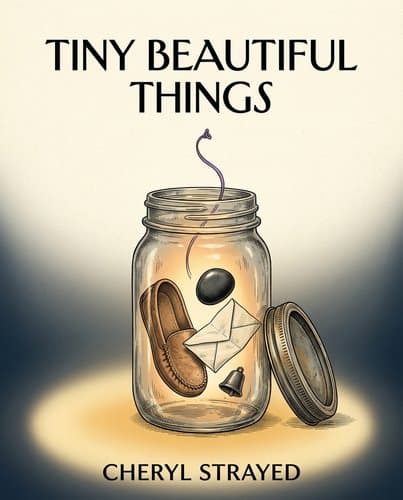
Strayed reaches for the same insight when she describes her own search, after her mother's death, for an object that would crack grief open and let her through to the other side. A half-empty tin of peppermint mints from the glove compartment. Worn moccasins that still held the shape of her mother's feet. A jar of smooth black stones she and her siblings had pressed into their mother's hands over years of childhood. She handled each one the way a person tests a lock — hoping this combination, this artifact, would redeem everything. It didn't. There was no combination. The locked door wasn't a puzzle to be solved; it was the permanent new geography of her life.
You cannot solve your way out of profound loss. What you can do — the only thing — is accept the exact dimensions of the life that existed and carry the love forward into the life that remains. That means becoming, slowly and without guarantee, the person the dead would have wanted you to be. That's not consolation. It's a different kind of demand entirely.
The Work Is Always on the Ground, Never in Your Head
Think of a person standing at the base of a mountain, insisting they cannot climb it — not because their legs don't work, but because the summit is too far and the effort too humiliating for someone who once imagined they'd be carried there. That's the particular paralysis Strayed diagnoses in Elissa Bassist, a twenty-six-year-old writer who sends her a letter composed largely face-down on a bed. Bassist names the problem as depression, self-doubt, fear that her female-centric subject matter will be dismissed. Strayed agrees those are real layers. Then she peels them back and names what's underneath: arrogance. The misery comes from being simultaneously too high and too low — convinced she should already be a master, and equally convinced she's uniquely broken. Neither position gets any work done. Both are ways of not touching the ground.
The word Strayed reaches for is humility, and she's deliberate about its Latin root: humus, meaning earth. To be humble is to be down low, on the ground, in the dirt. She describes finishing her own first novel at thirty-five — a book she'd known was inside her since before she believed people like her could write books at all — and collapsing straight onto the cool tile floor the moment she typed the last word. Not because it was finished and brilliant, but because she had finally stopped measuring it against a version of herself that didn't exist yet and just done the labor. She'd wasted years in her twenties nursing grandiose ideas about what she'd produce, reading voraciously, journaling copiously, writing in intermittent bursts — everything except the sustained, humble work of actually making the thing.
Coal miners don't stand around discussing how hard it is to extract coal. They mine. The creative block isn't a wound requiring treatment; it's a refusal to lower yourself to the work. Get your face off the bed, Strayed tells Bassist, not because the fear goes away but because staying paralyzed is a choice — and the more honest name for it is pride.
What You Call Protecting Yourself Is Often Just Making Your Life Smaller
Ian was burned almost entirely by a gas explosion at twenty-five — nose, ears, and fingers reduced to nubs, his skin roughened and glazed like something industrial. He received a settlement large enough to remake his life and did: fine art on the walls of expensive lofts, twenty-dollar tequila shots, clothes that fit like they were made for him. By the time Strayed met him, he was thirty-one and genuinely happy about all of it. He used to say the fire was the best thing that had ever happened to him, that he wouldn't go back and unlight the match. He had everything, he said — except romantic love. That, he had decided in the hospital before his wounds had even closed, was simply not available to a man who looked like him. No argument could move him. When Strayed insisted people could and would love him, he said she didn't understand, and closed the subject. He made do with occasional visits to prostitutes. He played a fire-breathing monster for Strayed's children one Thanksgiving, crouching under the bed while they shrieked with delight, and the adults laughed because the joke was that he had made his own monstrousness into a performance. A week before Christmas, at forty-four, he killed himself. No note.
Strayed's reading of that death is precise: the fire didn't kill him. The decision did. Not the accident — the choice, made years earlier, to treat his appearance as disqualifying evidence and withdraw his candidacy for love before anyone had the chance to vote. He protected himself so completely from the specific pain of romantic rejection that he cordoned off the whole territory and called it wisdom.
That self-protective voice in your head — what Strayed calls the crazy lady, the one who always has a reason you shouldn't try — presents withdrawal as foresight. If you never let anyone in, they can never leave. If you never ask, you can never be refused. The problem is that the life you're left with after all that protection is just smaller. Ian had the art and the lofts and the money and the friends who loved him. What he never tested was whether one person might love him differently. He decided the answer before the question was asked, and lived — and eventually didn't — inside that decision.
The withdrawal feels like self-preservation. It's actually the wound itself.
The Sister Ship Is Real — and You Have to Let It Go
Think of a ship that sails alongside yours, just over the horizon, always matching your speed. It carries everyone you might have become — the version of you who took the other job, stayed in the other city, said yes instead of no. Most of us try very hard not to look at it. We assume that mourning it is a form of ingratitude, that if we were truly committed to our choices, the sister ship would quietly sink and leave us in peace.
Strayed refuses that bargain. Responding to a forty-one-year-old man paralyzed by the decision of whether to become a father, she borrows an image from the poet Tomas Tranströmer: every life has a sister ship, one that charts a different course entirely. The man's letter is careful and honest — he loves his quiet, his unscheduled weekends, his freedom from obligation. He also loves his partner, who is forty and running out of time. He wants clarity before he decides. Strayed tells him to let clarity go. She admits that she only decided to have children because her desire to try something everyone called profound was, by the thinnest margin, stronger than her terror. During her pregnancy, she and her husband did not have bright conversations about the joy ahead. They had low, uneasy talks about whether they had destroyed the life they'd built — the silent reading on facing couches, the unplanned travel, the bicycle trip across Iceland they'd never stopped wanting to take. They proceeded anyway, without certainty, into the irrevocable.
Her son arrived and the clarity came — not before, after. His body against hers was the answer the thought experiment could never have produced. And yet the sister ship didn't disappear. She still honors the phantom life, the unslept-in apartment, the unridden road.
That honoring is the point. Grieving the life you didn't choose isn't a failure of commitment — it's proof that you lived with your whole self in the one you did. You don't salute the ghost ship because you regret your choice. You salute it because it was real, and it deserved that much.
The Tiny Beautiful Things Are the Whole Point
The actual argument of this book is almost embarrassingly simple: the tiny things are the whole thing. Not symbols of something deeper. Not consolations pointing toward larger meaning. The thing itself.
Consider the moment Strayed describes during her worst years, strung out on heroin, riding a bus and privately cataloguing her own worthlessness. A small girl boards and offers her one of two purple balloons she's carrying. Strayed declines. She has decided, with the certainty of someone in genuine freefall, that she has forfeited her right to that kind of uncomplicated beauty. The correction Strayed offers her younger self is four words: you're wrong, you do. Not a framework for recovery. Not a reason to believe things will improve. Just: the balloon was yours to take, and refusing it was an error. The right to small beautiful things is not something you earn back after you've fixed yourself. It was never conditional.
That thread runs taut across every letter. When a mother writes from a pediatric ICU while her infant daughter is in surgery, Strayed doesn't offer a God who intervenes in operating rooms. She offers something stranger and more durable: the image of strangers' emails — paltry, brief, arriving from everywhere — forming a raft just barely large enough to hold one terrified woman's weight through the night. The hand on the child's body. The shaft of light through the window. These are not evidence of anything beyond themselves. They are the grace, and that's all there is.
The useless days add up. The waitressing jobs. The long walks. The hours spent reading dead people's diaries. Your becoming is already happening inside the ordinary hours you're trying to escape. That's not a comfort. It's a command: be present for the small thing in front of you, because it is, without irony, the whole point.
What the Iron Bell Actually Says
Here is what the book finally asks of you: not to be braver or wiser or less broken than you are, but to be here — in the specific, unrepeatable day you are actually living. Strayed's mother didn't say I love you. She said love, alone, subject and object stripped away, just the thing itself hanging in the air of a hospital room. What would you say if you knew it was the last word you'd get? And more to the point — what are you waiting to say right now, in the ordinary Tuesday you're currently treating as a rehearsal? Take the purple balloon. It is already the thing you were saving yourself for. Say thank you for the coat that's too long and too puffy. Let the light come through whatever window is actually in front of you. The tiny beautiful things — one word, one balloon, one shaft of light — are not pointing toward a life more fully lived. They are it.
Notable Quotes
“loaded with promises and commitments”
“We don’t know how many years we have for our lives. People die at all ages.”
“limitations, insecurities, jealousies, and ineptitude”
Frequently Asked Questions
- What is Tiny Beautiful Things about?
- Tiny Beautiful Things is a collection of Cheryl Strayed's advice column responses that centers on navigating grief, relationships, and self-doubt through radical empathy. Rather than offering conventional wisdom, Strayed demonstrates how sharing your own worst moments with others is more healing than detachment. The book draws on her personal experiences with failure and loss to show readers that honest, personal engagement with pain—both your own and others'—creates genuine connection. By refusing to distance herself from the messy realities of human suffering, Strayed models an approach to advice-giving that treats vulnerability as strength. Each essay guides readers toward self-compassion and deeper understanding of what it means to move through difficulty.
- What does Tiny Beautiful Things say about leaving a relationship?
- According to Strayed, "wanting to leave is enough"—you don't need a catastrophic reason to end a relationship. In Tiny Beautiful Things, she challenges the belief that relationships should only be abandoned in cases of abuse or infidelity, arguing instead that obligation itself can become toxic. Staying in a relationship out of duty fails both partners, preventing authentic living and growth. Strayed emphasizes that the desire to leave is a valid signal worthy of respect, even without dramatic justification. By honoring this insight, readers learn that they have permission to prioritize their own wellbeing and pursue lives that genuinely serve them, rather than remaining trapped by guilt or convention.
- How does Tiny Beautiful Things approach grief?
- Strayed teaches that grief has no code to crack and no timeline to follow. Rather than searching for rules or patterns in loss, you must accept exactly what occurred: the specific length of the life that was lived. She illustrates this with a powerful example: "My son's life was twenty-two years long. There is no twenty-three." This acceptance doesn't minimize pain but instead stops you from wasting energy fighting reality. Strayed also emphasizes that while others can witness your grief, healing ultimately requires solo work—building your own bridge from pain toward acceptance. The book encourages readers to stop trying to "get over it" according to external timelines and instead honor grief's true, ungovernable nature.
- What does Tiny Beautiful Things teach about creative paralysis?
- Strayed identifies creative paralysis as arrogance disguised as self-loathing, where perfectionism keeps you stuck between thinking you should already be a master or believing you're uniquely inept. Her solution: "Get on the ground and dig." Start small, start messy, start anywhere—just begin. This perspective cuts through the perfectionism that masquerades as humility, revealing how waiting to be "ready" is ultimately a form of self-importance. The book also reminds readers that you deserve tiny beautiful things even in your worst moments, offering permission to claim small joys and beauty as acts of resistance and self-care. Done and imperfect beats perfect and never-started every time.
Related Book Summaries
Read the full summary of 13533727_tiny-beautiful-things on InShort