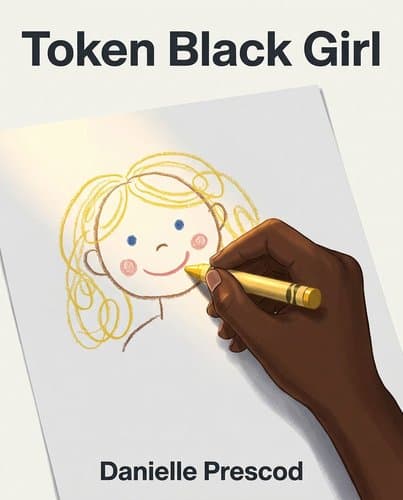
59537947_token-black-girl
by Danielle Prescod
Racism doesn't need slurs—it arrives through magazine covers, playground casting, and beauty rituals that feel like personal choice, quietly training Black…
In Brief
Racism doesn't need slurs—it arrives through magazine covers, playground casting, and beauty rituals that feel like personal choice, quietly training Black girls to assist in their own erasure. Danielle Prescod's forensic self-examination exposes how the Token Black Girl role makes complicity the system's most elegant weapon.
Key Ideas
Conditioning Masquerades as Cultural Choice
Racial self-hatred does not require a slur to take root — it arrives through children's books, magazine covers, role assignments in playground games, and beauty rituals that feel like pleasure and personal choice. The conditioning works precisely because it disguises itself as culture.
Tokenism Shields White Institutional Spaces
The Token Black Girl role is a function, not a social accident: its purpose is to shield white groups from accountability for their own racial homogeneity. Anyone who fills the role is also trained to assist in her own erasure — including issuing racism passes she has no authority to give.
Race Shapes Eating Disorder Origins
Eating disorders in Black women can have a distinct racial dimension. Body minimization is a survival strategy in spaces where Blackness is perceived as threatening or excessive. Understanding the disorder's origin — not just its symptoms — changes what recovery looks like.
Complicity Makes Systems Self-Perpetuating
Complicity is how systems survive without enforcement. Prescod didn't create the bagel comment, the colorism at InStyle, or the Timberland erasure — but she repeated the comment, worked within the policy, and took the byline. Damage passes through people who were themselves damaged by it.
Visibility Creates Illusion of Power
Visibility and power are not the same thing. Being the only Black person in the room — on a magazine masthead, at the Met Gala, in a school brochure — gives an institution the appearance of inclusion while leaving the person who fills that slot without structural protection.
Recovery Requires Ongoing Honest Witness
Recovery from internalized racial self-hatred is not a fixed destination — it is an ongoing practice of honest self-witnessing. The book's model is not perfection achieved but the willingness to say, out loud, the things that are still true and still painful.
Who Should Read This
Readers who connect with first-person stories about Memoir and Social Issues and want to see the world through someone else's eyes.
Token Black Girl
By Danielle Prescod
8 min read
Why does it matter? Because the racism that does the most damage never calls itself racism.
The damage doesn't arrive with a slur. It arrives as a Sweet Valley High novel, as The Craft, as a truth-or-dare game whose rules assumed you were white. Danielle Prescod spent her childhood inside the white American cultural machine and her early career helping run it, which gave her a precise view of how it operates: not through announced hatred but through omission, casting choices, and a thousand ambient signals that accumulate in the body as chemical burns from a decade of relaxers and starvation. This book is her forensic autopsy. The question isn't whether she was harmed. It's who designed the curriculum — and what it cost her to finally see it.
Learning You're Black Is Not the Damage — the Damage Is How You Learn It
In a kindergarten classroom in Westchester County, Danielle Prescod finishes her self-portrait and steps back, satisfied. The girl in the picture has blonde hair and blue eyes. Her name, "Danielle P.," is printed neatly at the bottom. When her mother visits and asks, gently, "Is this what you look like?", Prescod answers without hesitation: of course it is.
The external confirmation arrives a few years later. A classmate's careless remark, overheard on a three-way call and relayed to the entire fourth grade, tells Prescod that a girl in her class doesn't like her "because she's Black." It's the first time anyone has used that word to describe her. Her response is not anger. It is logistics: she tries to figure out how to undo being Black. That word — "undo" — shows how deep the damage already runs. By the time "Black" lands on Prescod as a label, she has already absorbed enough about what it means that her instinct is to escape it, not defend it. No instruction was required. The portrait was drawn years earlier.
What follows is how a nine-year-old manages shame with no language for it. Prescod steals a classmate's journal, reads his private crush on a girl in class, and distributes the information to everyone in the grade. The boy sobs. Her mother was called. She was disciplined. She is not sorry: the class moves on to a new scandal and forgets about her Blackness. She had redirected the spotlight. She had gotten what she needed. She did not become kinder after this. She became more strategic — which, for the next twenty years, turned out to be nearly the same thing.
The Books You Read as a Child Were Not Stories — They Were Instructions
The books you loved as a child were not entertainment. They were a curriculum.
Prescod grew up in 1990s Scarsdale (horse girls, bookstore trips as prizes for straight A's) reading everything her school and parents approved. The Sweet Valley High series was essential: over 150 novels about blond, blue-eyed California twins with perfect tans. In one installment, Jessica stands before a mirror and the prose delivers the word "perfect" twice in a single sentence — she looked perfect, she knew it. The text doesn't invite Jessica to wonder. It installs her certainty as the reader's certainty: this is what it looks like when you deserve to feel beautiful.
The contrast arrives in a V.C. Andrews novel called Rain, which Prescod pulled from the library shelf because a dark-skinned, curly-haired girl was on the cover. Rain Arnold was among Prescod's first Black protagonists, and Rain describes herself with the precision of a police report: her complexion is light and caramel-toned, her hair finer and straighter than most, her eyes pale and narrow-set. A white woman wrote that inventory. It carries the same racial hierarchy as Sweet Valley, only from the opposite direction. The qualities that make Rain valuable are the ones that edge closest to white. Her darker-skinned sister, fuller-bodied and more conspicuously Black, gets labeled a tramp. The girl who emerges from that inventory is afraid to want things. Good fortune has to arrive by accident, or it shatters. Jessica Wakefield knows she is perfect. Rain is afraid to hope.
Jessica Wakefield's certainty and Rain Arnold's terror are two answers to the same question: what is a girl allowed to believe about herself? The answer depends entirely on what she looks like.
The First Perm Was Not a Beauty Ritual — It Was a Surrender Ceremony
By the time Prescod sat down for her first chemical relaxer at age ten, she was ratifying a verdict she had already accepted. The specific instruction had arrived that same year, from a 1996 horror film called The Craft. A white character picks up a hairbrush, inspects it, and delivers her assessment of a Black classmate's hair, calling it nappy with the casual dismissiveness of someone noting a pest. Prescod's response was not anger. It was a plan: change her hair so no one could say that about her.
So when she finally sits in the salon chair, a thick white cream goes onto her scalp. The instruction: the longer she sits, the straighter her hair will become. She is not experimenting. She is completing a project. Cool water rinses out her coils and replaces them with long, straight strands. She likens it to a baptism, but better. Under the dryer, she doesn't think about how her hair will look. She thinks about the new life awaiting her on the other side. The perm is not a hairstyle. It is a rebirth document.
The devastation lives in the word liberation. Prescod genuinely felt free: the exhilaration was real, the near-tears were real, the excitement for Monday morning was real. That's what makes it so hard to look at. A child who had spent years absorbing the message that her natural hair was evidence of something wrong with her finally felt the anxiety lift. She was "finally free to become pretty." She wasn't deceived. She was right — in the world she had been handed, the perm worked. It bought her something. The system delivered on its promise. Which is why she would spend the next decade scratching her burned scalp, lying to hairdressers about it, and calling the whole arrangement a fair trade.
The Token Black Girl's Primary Function Is to Make White People Feel Safe
What does a white friend actually get from having a Black best friend?
The answer Prescod works out: immunity. Not friendship, exactly (though the friendship can be real), but a standing defense against the one accusation that costs everything in a white social world. You can't be racist if your best friend is Black. The Token Black Girl is the receipt.
In fall 2002, a white classmate calls Prescod to recount a dance incident. A Black boy grabbed her, she pushed him away, and he accused her of rejecting him because of his race. Her defense to him: "That is definitely not true. My best friend is Black." She told Prescod this as evidence, clearly expecting something. What Prescod gave her was exactly what she needed: confirmation. She agreed. She defended her friend. She issued the racism pass.
Prescod tells this as a confession, not an accusation. She knew it was wrong while she was doing it. She knew the friend had probably rejected the boy because he was Black. She chose the friendship over the integrity of the moment, and she names exactly why that math made sense: her entire social position depended on this one white girl's proximity. Remove the friendship, and everything she had spent years constructing — the quietness, the right clothes, the carefully neutralized accent — collapses anyway.
The dynamic is structural: Prescod had nothing real to give. She had been built inside white supremacy; she was its product, not its corrective. She describes herself as shaped by the system and then deployed to extend its reach. The racism pass works only because of the racist logic that installed her as the acceptable version of Blackness in the first place — quiet, well-dressed, conveniently adjacent. The pass doesn't disprove racism. It is produced by racism.
For a Black Girl in White Spaces, Starving Yourself Was a Rational Strategy
In seventh grade, a boy kissed Danielle Prescod during truth-or-dare, and she read his willingness as approval. Days later, his verdict arrived via Nextel relay: her butt was so large it looked like she permanently wore a diaper.
She already knew about her butt. She had worn a sweatshirt knotted around her waist in dance class, clenched her glutes while walking, tucked her pelvis forward whenever she remembered. None of it worked. What the comment revealed was not the butt itself but the stakes: she had mistaken compliance for attraction, and the correction arrived as a crude joke relayed by phone. She decided to get rid of the butt or face a lifetime of social exile.
Prescod eventually works out that the butt was never just a shape. It was a signal. The opening of "Baby Got Back" — before the famous hook — has two white women cataloguing a Black woman's body and concluding: "She's just so... Black." The butt was already racialized in the culture before it was hers.
The eating disorder that followed wasn't separate from her racial strategy; it was the strategy, applied to her body. She had already learned that the version of herself most likely to be accepted was the one who took up the least space, socially, culturally, racially. Becoming physically smaller was just that logic made literal. If her butt was legible as Blackness, and Blackness was the thing that got her excluded, then the body had to go. She was not wrong about this: the world she was navigating would reward her for it, and it did. At 14, she collapsed on the staircase at school and was taken by ambulance to Greenwich Hospital, having not eaten for days. A diary entry from age twelve reads plainly: she feels fat, she should be skinnier, maybe not eating is the answer. She had already solved the equation before the collapse made it visible.
For most of its clinical history, the eating disorder framework tracked white, affluent women, so when Black women developed them, the cause often went unrecognized. Prescod's was specific: she had been told, clearly and repeatedly, that her Black body was a problem to be managed. She agreed, and she got to work.
You Can Understand How the System Works and Still Be Running It
Understanding how a system works does not immunize you against running it. Prescod spends years mapping fashion's thinness mandate, tracing it through chain-of-command cruelty, through sample sizes and starving assistants, and then passes it forward herself, without meaning to, with perfect fidelity.
At W Magazine, an assistant she idolized spots Prescod eating a bagel in the fashion closet and delivers one observation before walking out: a bagel is six slices of bread. Prescod stops eating bagels for seven years — and immediately starts saying the same thing to everyone she sees holding one. She has metabolized the logic: bagels are excess, excess is shameful, the body must be managed. Now she is the carrier. The damage required no malice to travel. It required only a social environment where the logic felt true, which fashion provided with the enthusiasm of a full-time employer: sample sizes and starving assistants. Understanding the chain didn't break it. Prescod was a link.
What the system never delivers is the promised arrival: the place where thinness finally converts into safety. Prescod follows the rules for fifteen years and arrives at thirty having gained thirty pounds (weight that accumulated after IVF forced her to stop restricting) and discovers that without the constant distraction of hunger, her fuse isn't so short. She becomes, as the weight increases, less mean. The armor was not protecting her. It was her.
The honest accounting comes at the end: she still wears shaping undergarments with almost everything, still feels disappointment when she goes up a size, is never satisfied with her reflection. The list does not perform contrition. It models what self-witnessing looks like when the system's logic is still running in the background: acknowledged, tracked, and refused the last word.
What You Would Never Say to a Four-Year-Old
There is a therapy exercise near the end: find a photograph of yourself at three or four and say aloud what your inner critic says about your body, your worth, your lovability. Say it to the child in the picture. You can't. That's the point.
In 2020, a video circulated of a four-year-old Black girl catching her reflection mid-hairdo and announcing, with complete conviction, that she was ugly. Prescod recognized her. She wasn't the only one. The doll test (where Black children consistently chose white dolls as the "good" ones, first documented in 1940 and replicated in 2010) found that girl again.
The question Prescod takes as her epigraph — Malcolm X's 1962 challenge, "Who taught you to hate the race you belong to?" — has a very long answer, almost all of it delivered warmly, through things that were supposed to be pleasurable.
The book ends with a list: things Prescod still does, still feels, still can't shake. Not a confession of failure. A model of honest self-witnessing. Look at the photograph. Refuse to look away.
Notable Quotes
“Danielle's butt is so big, it always looks like she's wearing a diaper.”
“always looks like she's wearing a diaper!”
“Oh my God, it's for you!”
Frequently Asked Questions
- What is Token Black Girl about?
- Token Black Girl examines how white supremacy operates through cultural conditioning rather than overt racism, using Danielle Prescod's own experience as a Black woman raised in predominantly white spaces. The book traces how the token role functions as a system—training its occupant to enable her own erasure—and provides a framework for recognizing internalized racial self-hatred. Prescod demonstrates that racial self-consciousness isn't built through slurs alone but through everyday cultural messages in children's books, magazine covers, and beauty rituals that feel like personal choice rather than deliberate conditioning.
- What are the key takeaways from Token Black Girl?
- The book identifies several interconnected themes: racial self-hatred arrives through seemingly innocent cultural messaging; the token role serves a specific function—shielding white groups from accountability; and those who fill it are trained to participate in their own erasure. Prescod explores how visibility differs from power, using institutional examples. She examines how eating disorders in Black women can have a distinct racial dimension, with body minimization functioning as survival strategy. Throughout, she emphasizes that complicity—rather than enforcement—allows systems to survive without requiring individual acts of racism.
- How does Token Black Girl explain the token role?
- "The Token Black Girl role is a function, not a social accident: its purpose is to shield white groups from accountability for their own racial homogeneity." Prescod shows that those filling this role are systematically trained to assist in their own erasure, including issuing racism passes they have no authority to grant. This isn't about individual malice but structural design. She demonstrates how "damage passes through people who were themselves damaged by it," and traces how complicity sustains systems through everyday decisions like repeating harmful comments or accepting problematic policies.
- What does Token Black Girl say about recovery from internalized racism?
- According to Prescod, "recovery from internalized racial self-hatred is not a fixed destination — it is an ongoing practice of honest self-witnessing." Rather than presenting perfection as the goal, she models willingness to articulate what remains true and painful. Understanding the origin of harm—not just symptoms—fundamentally changes recovery work. Recognizing that eating disorders may stem from body minimization as survival strategy shifts therapeutic approaches. Prescod emphasizes that dismantling internalized racism requires continuous honest reflection rather than achieving a final healed state.
Related Book Summaries

Read the full summary of 59537947_token-black-girl on InShort