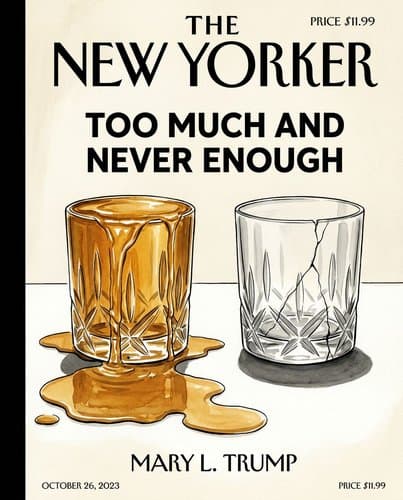
54081499_too-much-and-never-enough
by Mary L. Trump
Behind the self-made billionaire myth lies $413 million in transfers, a father who punished vulnerability, and a family machine that absorbed every…
In Brief
Too Much and Never Enough (July) examines how the Trump family's dysfunction shaped Donald Trump's psychology and public behavior. Written by his niece, a clinical psychologist, it traces how conditional love, financial enabling, and suppressed failure produced a personality incapable of accountability — and shows how the same dynamic plays out at the national level.
Key Ideas
Childhood Wounds Calcify Into Lasting Personality Patterns
Childhood attachment wounds don't fade with age — they harden into personality structures. Donald's inability to acknowledge failure, tolerate criticism, or feel empathy traces directly to a toddler's experience of needing comfort and receiving contempt. Understanding the origin doesn't excuse the behavior, but it explains why confrontation alone will never change it.
Conditional Love Creates Lifelong Performance Dependency
Conditional approval is a trap that outlasts the person who set it. When love is available only as a reward for performance, you spend your life performing for an audience of one — Freddy trying to win Fred's respect with a flying career, Donald trying to win it with Manhattan towers — even after that audience is dead.
Enablers Bear Greater Responsibility Than The Enabled
The person doing the enabling is often more responsible for the damage than the person being enabled. Fred, the banks, the media, and the Republican Party all played the same role: absorbing the consequences of Donald's failures so he never had to face them. Each rescue guaranteed the next failure would be larger.
Self-Made Myth Obscures Inherited Resources and Advantages
Any claim that Donald built a self-made empire is the myth the empire ran on. $413 million transferred from Fred, properties funded by Fred's relationships, a presidential run made viable by a television show that presented fiction as biography — the brand was always the product, and Fred was always the manufacturer.
Systems Without Consequences Enable Escalating Risk-Taking
Systems that never say no guarantee escalation. The logic is simple: if you learn that failure has no lasting consequences because someone always steps in, you have no incentive to change — and every incentive to take larger risks, since larger risks produce larger rescues and larger attention.
Who Should Read This
Readers interested in Memoir and Political Figures, looking for practical insights they can apply to their own lives.
Too Much and Never Enough
By Mary L. Trump
10 min read
Why does it matter? Because Donald Trump isn't a mystery — he's a machine's output, and this book explains exactly how the machine works.
In the White House, the shampoo is TRUMP. The bathrobe is TRUMP. Mary Trump writes that she poured it down her Trump throat. His niece — a clinical psychologist who watched the family machinery for four decades at close range — starts somewhere smaller and older. A house in Queens. A father who withheld warmth the way a landlord withholds heat: strategically, without remorse. A boy who reached for comfort at exactly the wrong moment and learned never to need anything again. The damage did not begin with a campaign or a television show. It began before he could speak. What she traces is not a political mystery. It is a system — and once you see how it consumed one family, you cannot stop watching it consume a country.
The Damage Was Done Before Donald Could Speak
One night in 1952, twelve-year-old Maryanne woke to find her mother, Mary Anne, unconscious on the bathroom floor, blood everywhere. She ran to her father at the other end of the house. Fred assessed the situation, called in a favor at the hospital (he had the connections to ensure the best doctors would be waiting), and before leaving told his daughter two things: go to school tomorrow, and I will call if there's a change. She understood exactly what "change" meant.
Mary Anne survived. She spent six months in and out of the hospital, eventually losing her ovaries along with her uterus, which brought progressive bone loss and chronic pain. She never fully recovered — for years afterward, her children would find her wandering the house at odd hours, or lying unconscious in unexpected places.
Donald was two and a half years old when this happened.
Donald's niece Mary L. Trump, a clinical psychologist, applies the term "high-functioning sociopath" to Fred Sr. without apology. No empathy, casual facility with lying, complete indifference to other people's needs. Fred worked twelve-hour days six days a week and regarded child-rearing as beneath him — not a softened value, but a categorical belief. Under ordinary circumstances, a toddler's crying would have irritated him. In 1952, with Mary Anne hospitalized and the youngest children in genuine distress, their need only intensified his contempt. Every biologically normal attachment behavior — reaching, crying, clinging — triggered the opposite of comfort. For Donald and his baby brother Robert, needing something came to mean provoking rejection.
This is the window. Not Manhattan, not the casinos, not the presidency. A toddler whose primary source of comfort disappeared without warning, left entirely dependent on a man constitutionally incapable of responding to distress, at the age when a child is still learning whether the world can be trusted. The grandiosity, the hostility, the performed invulnerability that would define him for the rest of his life — those weren't ambitions he developed. They were the only defenses available to a three-year-old boy no one comforted.
The Same Father Destroyed Both Sons — Just in Opposite Directions
Fred Trump didn't raise two sons with different fates. He ran one machine that processed them in opposite directions.
The window order scene captures this. Freddy had been working at Trump Management for several years, trying to demonstrate competence. He made what should have been a routine call: replace the windows in one of the older buildings. When Fred found out, he erupted in front of the office staff, not a private correction but a public one, in front of people Freddy would someday be expected to manage. "Donald is worth ten of you. He never would have done anything so stupid." Donald was still in high school.
Freddy's time at the company had worked this way: Fred expected results but never acknowledged them; errors were catastrophic and public; apologies were mocked rather than accepted. Punishment without reward. Donald operated under opposite conditions. Fred barely watched him (too absorbed in the business, too focused on Freddy), and when he did notice Donald's bullying, he found it admirable. Donald registered this early. Each act of aggression was a demonstration that he was exactly what Fred wanted: the tough one, the killer. Nothing he did earned discipline, so he stopped moderating himself at all.
The asymmetry is precise enough to be clinical. Freddy received too much — too much expectation, too much public humiliation, sustained devaluation from every direction — until what remained was shame and a compulsion to seek approval from a man who had already decided he wasn't worth it. Donald received too little — no correction, no consequence, no one willing to hold him to account — until his understanding of acceptable behavior became permanently warped. Fred's rules were the only framework Donald internalized: strength is everything, admitting error is weakness, there can be only one winner. When he encountered a world that operated differently, he didn't adapt. He kept applying Fred's rules everywhere, because they had always worked.
Fred had invoked a teenager who'd never managed anything as proof that his firstborn had failed. That was the whole move. He wasn't evaluating Freddy. He was using Donald as a weapon to complete Freddy's destruction. Both sons were instruments of the same project, and neither came out intact. Freddy lost himself. Donald lost something harder to name: the capacity to experience the full range of what other people feel, to read what the world actually is rather than what his father told him it had to be. Different wounds. Same hand.
When Your Tormentor Is Also Your Only Source of Comfort, You Cannot Leave
Why didn't Freddy just leave?
The question seems fair. He was talented enough to earn a spot on TWA's elite Boston–Los Angeles route at twenty-five, one of only two men in his training class without military flight training. He had a career. He had distance. He had every reason to stay gone. And behind him in New York was a father who had already delivered his verdict. Fred's phrase for it was "bus driver in the sky," and it came north in every letter and phone call.
The answer is a decision Freddy made two months in. TWA offered a promotion: training on new 727s in Kansas City. He turned it down. The official reason was a lease on the Marblehead cottage. The real reason, Mary Trump writes plainly, was that Freddy was already losing hope his father would accept him as a pilot, and without that acceptance he couldn't continue. He was measuring his career by a single question: whether Fred Trump approved.
The trap has a specific architecture. Fred had built Freddy's entire childhood around conditional approval, granted only by becoming what Fred wanted and lost by being anything else. That currency was the only tender Freddy had ever known. Nothing external could replace it. The need for his father's approval wasn't a preference he could override with willpower. It was the operating system.
When eighteen-year-old Donald drove up to the Marblehead cottage in the sports car his parents had bought him for graduation (Freddy had received luggage at his own) and delivered Fred's verdict at the dinner table — "Dad's right about you: you're nothing but a glorified bus driver" — Freddy's face drained of color. His wife Linda slammed a plate. The brothers left the next morning. Freddy's drinking got worse.
Donald's words landed because they confirmed what Freddy already couldn't stop believing: the only person who had ever mattered still saw him as a failure. A promotion, a prestigious route, a career earned on merit: none of it could answer that verdict. Only Fred could, and Fred never would. Across town, a younger son was learning a different lesson from the same man.
The Self-Made Man Was Always Fred's Most Expensive Fiction
The money came from Fred. The image came from Donald. The self-made businessman was the fiction where the two things met.
Fred had spent decades trying to break into Manhattan, the outer-borough landlord blocked by his own manner, his immigrant-son restraint, and a mother who regarded any display of wealth as inappropriate. Donald had none of those limits. He was comfortable with image, indifferent to facts, and constitutionally incapable of embarrassment. Fred understood his son couldn't run a business, but he could front one. So Fred worked the back channels (the political relationships, the financing arrangements, the expertise that only decades in the industry build) while Donald stood before cameras claiming sole authorship of deals he hadn't structured. A New Jersey housing project for the elderly shows how it worked. Fred secured a federal loan covering ninety percent of construction costs at near-zero interest. Donald contributed nothing. He received consulting fees anyway, along with management pay for a property that already had full-time staff. The underlying story, the one that actually explained every deal, was always Fred's.
A 2018 New York Times investigation put numbers to the arrangement: $413 million transferred from Fred to Donald, through loans never repaid, investments that never matured, and gifts shielded from taxation through structures of questionable legality. Even that didn't capture everything. In 1992, the four surviving Trump siblings created a company called All County Building Supply and Maintenance, which funneled money out of the family's rental business by disguising gifts as ordinary business expenses. When Fred died in 1999, the family claimed his estate was worth roughly $51.8 million. Four years later, they sold the same portfolio for more than $705 million — and the banks financing the buyer valued it at nearly a billion dollars.
Fred's money was the maintenance mechanism; after Atlantic City failed and the $170 million from his estate ran out by 2004, there was nothing left to sustain the myth but the image itself. Mark Burnett built a replacement from television. The Apprentice took a man who had just survived four casino bankruptcies and presented him to tens of millions of weekly viewers as the definitive American dealmaker. It did what Fred's money had always done: sustained the fiction long enough for the next chapter.
Every Institution That Should Have Said No Said Yes Instead
Fred Trump was having a lucid day, rare by then, when his two longest-serving employees arrived with documents to sign. Irwin Durben was his lawyer. Jack Mitnick was his accountant. They presented the paperwork as though Fred had originated the idea himself.
He hadn't. Donald had approached both men in secret and enlisted them to draft a codicil to Fred's will giving him complete control of the estate after Fred died. His siblings would need Donald's personal approval for any transaction, no matter how small.
Fred sensed something was wrong. He couldn't name it exactly. He refused to sign, told his wife, who called Maryanne. An attorney was brought in. The scheme unraveled quickly.
The will was rewritten. Maryanne later said that without that intervention, Elizabeth "would have been begging on a street corner" — the siblings would have needed Donald's approval to buy a cup of coffee. Sheer luck, she said, that they'd caught it in time.
Then the family gathered for every holiday as if nothing had happened.
The audacity wasn't even the worst part. The worst part was what followed. Donald had tried to steal his father's estate by corrupting two men with actual fiduciary obligations. He was caught. The consequence was a rewritten document. No rupture. No price. The machine absorbed the betrayal the same way it had absorbed every failure before it: by continuing to run.
The Trump family wasn't unusual in its cruelty. It was the first institution in a longer chain, and every link ran the same way. The banks absorbed his Atlantic City collapse rather than let it land, subsidizing the lifestyle that kept his name viable because his name secured their collateral. The tabloids ran his divorce on the front page while leaving the debt story unprinted. Every institution chose the same option: protect the image, defer the consequences, let someone else pay later.
If you insulate someone from the cost of failure long enough, you don't prevent the next failure. You make it inevitable, and larger, because nothing in the record has suggested limits. Every bailout was instruction. Every absorbed consequence confirmed that the rules didn't apply. None of it — not the codicil, not the casino bankruptcies, not the banks' endless patience — was the end of anything. They were rehearsals. The scale would change. The logic wouldn't. The people who would eventually pay for what all of that training produced weren't family members or creditors or tabloid readers. They were everyone else.
Donald Isn't the Disease. The System That Made Him Is.
A compass needle doesn't know it's been moved to a new room. You can carry it anywhere — a nicer building, a more complicated one — and it still points where it was calibrated to point.
The rules that governed the House in Queens arrived in the Oval Office intact. Vladimir Putin, Kim Jong-un, and Mitch McConnell understood this when most didn't. Mary Trump identifies them as men who share Fred's particular instinct: the ability to locate someone's need for approval and apply pressure there. In Donald's case, one technique suffices. Repeat his own phrases back to him. He's the smartest, the greatest, the best. Fred had spent decades installing this mechanism. These men needed only to operate it. The family had used it to keep Donald functional; global actors used it to get sanctions lifted, alliances abandoned, economic legislation gutted. Same lever. Different stakes.
When COVID-19 arrived, the calibration's cost became legible in body counts. Every adequate response required exactly what Fred had taught Donald would get him destroyed: projecting alarm, acknowledging uncertainty, telling the public to be afraid. At rallies, he told crowds the numbers were going down — reporters asking about testing were doing it for political reasons. At briefings, he minimized, then rationalized, then promised it would disappear by April. He could not stand behind the ventilator shortage or the PPE scramble or the mortality projections his own scientists were releasing. Not strategically. Structurally. The man who hadn't been comforted at two and a half couldn't broadcast fear at seventy-three. The needle pointed where it had always pointed.
Blaming Donald for the wreckage assumes he made choices. The choices were made for him: by a family that built him, institutions that shielded him, a media that amplified him, and world leaders sophisticated enough to operate him. Donald is what the system produced. The system is still running.
The Damage Travels Until Someone Names It
When Mary Trump handed nineteen boxes of family documents to three reporters at a loading dock, that was naming — what it looks like after decades of enforced silence. She had watched the same mechanism destroy her father. The unsayable thing, said precisely enough, is what a good clinician does: documentation clear enough that denial becomes untenable. But the question the book leaves open isn't really about Donald. It's about you — the banks, the networks, the voters, everyone who absorbed a consequence or ran a flattering headline or looked away from something they understood. Every institution that failed to say no was practicing Fred's skill: keeping the story intact so no one had to reckon with what was underneath it. That machine doesn't need a Trump. It only needs the rest of us to keep playing our part.
Notable Quotes
“Yes, Donald, this plane is great.”
“Trump, you need to call home,”
“You need to call your mother.”
Frequently Asked Questions
- What is Too Much and Never Enough about?
- Too Much and Never Enough examines how the Trump family's dysfunction shaped Donald Trump's psychology and public behavior. Written by his niece, clinical psychologist Mary L. Trump, it traces how conditional love, financial enabling, and suppressed failure produced a personality incapable of accountability. Childhood attachment wounds don't fade with age — they harden into personality structures. Donald's inability to acknowledge failure, tolerate criticism, or feel empathy traces directly to a toddler's experience of needing comfort and receiving contempt. The book extends this family dynamic analysis to show how the same patterns play out at the national level.
- How does conditional love affect personality development according to this work?
- Conditional approval is a trap that outlasts the person who set it. When love is available only as a reward for performance, you spend your life performing for an audience of one. The book illustrates this through Fred Trump's sons: Freddy pursued a flying career while Donald built Manhattan towers — both seeking approval from their father, even after his death. This dynamic creates deeply entrenched personality structures that persist regardless of changed circumstances. Individuals trapped in these systems continue seeking validation through performance long after the person who originally withheld approval is gone, driving repetitive patterns of behavior.
- Who is most responsible for enabling destructive family behavior?
- The person doing the enabling is often more responsible for the damage than the person being enabled. Fred Trump, along with banks, media, and the Republican Party, all played the same role: absorbing the consequences of Donald's failures so he never had to face them. Each rescue guaranteed the next failure would be larger. This framework challenges assumptions that enablers are passive helpers; instead, they actively facilitate escalation by preventing natural consequences. Without facing the results of failures, individuals lose incentive to change and gain every reason to take larger risks, since larger failures produce larger rescues.
- What does the book reveal about Trump's claimed self-made empire?
- Any claim that Donald built a self-made empire is the myth the empire ran on. The book documents that $413 million transferred from Fred, with properties funded by Fred's relationships and a presidential run made viable by a television show that presented fiction as biography. By preventing Donald from experiencing consequences of failures, this financial infrastructure removed his incentive to change. The absence of refusals combined with unlimited capital created a system where escalation became inevitable. Without limits, individuals have no motivation to alter behavior and every incentive to take larger risks.
Related Book Summaries
Read the full summary of 54081499_too-much-and-never-enough on InShort