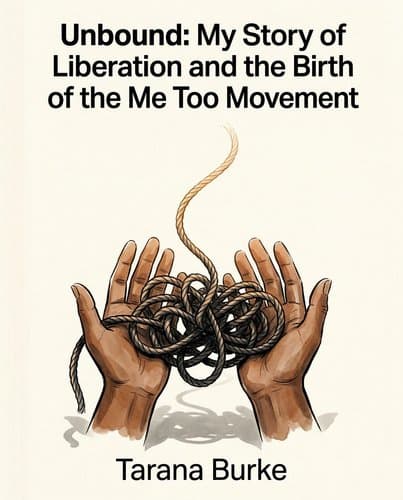
57351643_unbound
by Tarana Burke
For twenty years, Tarana Burke freely gave empathy to every wounded girl she met while silently condemning herself for her own abuse — and the moment she…
In Brief
Unbound: My Story of Liberation and the Birth of the Me Too Movement (2021) traces Tarana Burke's path from childhood sexual abuse to founding Me Too.
Key Ideas
Silence makes shame louder than truth
When there is no language for what happened to you, your mind supplies its own verdict — and it will be harsher than anything your abuser said. Burke held herself responsible for decades partly because no one around her ever said the words 'rape' or 'abuse' aloud.
Teaching empathy before offering self-compassion
The ideology you most deeply believe is often the one you apply last to yourself. Burke proved that empathy heals for twenty years — in workshops, with Heaven, with Diamond, with her own daughter — before she could offer it to her own story. The gap between what you teach and what you practice is not hypocrisy; it is where the real work lives.
Protection without words abandons children
Protection without explanation can deepen a wound. When Burke stayed silent at seven to protect Mr. Wes, it was an act of love — and it cost her decades of self-blame. Adults who protect children from consequences without giving them language for what happened often leave the child alone with the weight.
Movements born from personal failures
'Me Too' was not born from strategy or vision. It came from watching a twelve-year-old named Heaven walk away with her armor back on after Burke failed to meet her at the moment of her courage. Social movements often begin as the answer to a private failure, not a public opportunity.
Truth-telling within community heals it
Black women carry the second-highest rate of sexual violence in the U.S. and were largely excluded from the viral moment built around their experience. Naming harm within your own community is not a betrayal of that community — avoiding it is.
Witness from loved ones liberates
Liberation does not require public confrontation, legal victory, or even recognition from the person who harmed you. It can arrive in an ordinary moment when someone who loves you refuses to let you minimize what was done to you — and gives you a sentence that finally fits.
Who Should Read This
Readers who connect with first-person stories about Memoir and Social Issues and want to see the world through someone else's eyes.
Unbound: My Story of Liberation and the Birth of the Me Too Movement
By Tarana Burke
10 min read
Why does it matter? Because Me Too didn't begin where you think it did.
You think you know this story. The hashtag. October 2017. Alyssa Milano's tweet, the Hollywood confessions, the magazine covers. You know the moment Me Too went global.
What you don't know is the failure that started it.
Tarana Burke spent twenty years building a movement for survivors of sexual violence, offering empathy, language, and refuge to girls who had survived what no one in their lives would name. She could walk into a room of closed-off teenagers and make them feel seen. What she could not do, for most of those two decades, was turn that same grace on herself.
Unbound is the story of that gap — and of the summer camp hallway in 1996 where a twelve-year-old named Heaven tried to tell Burke what had been done to her, was deflected, and walked back into silence. That moment, not a tweet, is where this movement begins.
The Viral Story Was Born Twenty Years After the Real One
On a Sunday morning in October 2017, Tarana Burke was nursing a hangover in her Harlem apartment when her phone filled with notifications. A friend had tagged her in a post. Another sent a screenshot of tweets. Her nineteen-year-old, Kaia, walked her through how to search a hashtag. When she did, hundreds of thousands of posts reading #metoo flooded the screen. She slammed the laptop shut.
The panic wasn't what you'd expect from someone watching a global movement take off. She called her friend Yaba, crying. Once white women ran with this hashtag and it went huge, no one would go looking for the Black woman from the Bronx who'd spent years building the same movement, using those exact words. It would simply be over.
Burke wasn't afraid of the hashtag. She was afraid of being erased by it. Since 2005, she had been running a project built around "me too" as a phrase of empathy between survivors of sexual violence — quietly, with almost no resources. Workshops, T-shirts, whatever space anyone would give her, mostly with young Black and Brown girls in places like Selma, Alabama. For twelve years, almost nobody outside her community had heard of it.
What shifted that night was a stranger's blog post. Burke was still scrolling when she found a tweet linking to a woman's account of a college assault she'd kept secret for years. The woman wrote that seeing #metoo posts had, for the first time, made her feel less alone. Burke sat up crying, not for her movement but for that woman. The question she'd been asking all day, whose work is this, dissolved into a different one: "Was I going to be who I said I was?"
The date most people know as the start of Me Too is the night Burke decided what to do with twenty years of work no one knew existed.
Without the Word 'Rape,' a Child's Mind Invents Its Own Verdict
Tarana Burke was seven the first time she was raped. She didn't have the word "rape." Walking back to her building afterward, she ran through the list she knew by heart: never go off without permission, never be out of sight, never come home late, stay away from the older boys. She had broken every one. What she knew for certain was that she was in big trouble.
When you lack the word for a color, you reach for the nearest one — that's what Burke did, except the nearest available framework wasn't "crime." It was the rules she'd just broken. Absence of language doesn't produce neutrality. It produces a verdict, assembled from whatever vocabulary is on hand. The architecture of the wound isn't the assault itself; it's the interpretive vacuum it left, and what filled it.
By the time Burke was eleven, a second neighborhood boy had spent years using Polaroid photographs of abuse to blackmail her back to his apartment. She hated what happened there. But the picture she had built of herself was already fixed: a gross, fast, ugly girl with dark secrets — the opposite of the good girl her family believed her to be.
Her mother's eruption over a dishrag confirmed the verdict without knowing it existed.
Burke was at the kitchen sink, rinsing soap from a rag, when she idly dared herself to taste a drop. Her mother walked in and exploded, cataloguing every filthy thing that dishrag had touched, then landing the question: "Is that what you are? A dirty, nasty, used-up dishrag?" Her tone softened almost immediately, sensing she'd overreacted. But it was too late. Burke wasn't crying from the yelling. She was crying because the words matched exactly what she believed about herself. No one had to tell her she was dirty. She had arrived at that conclusion years earlier, alone, in the silence where a word should have been.
The older women in Burke's life told her to protect her private parts but never said why. The why stayed empty, and a child's mind doesn't tolerate an empty why. She filled it herself: she broke the rules. She was wrong. The verdict required no jury.
You Can Build a Movement on Empathy You Don't Believe You Deserve
Heaven corners her in a camp hallway the morning after Sister to Sister, the annual gathering where girls in pajamas shared stories that started with boys and usually ended somewhere heavier. The twelve-year-old has been tracking Burke down since the night before, when Burke watched her go perfectly still in the middle of someone else's testimony. She recognized the posture because it was her own: the practiced art of becoming invisible when the confessions got too close. She'd done it at every one she'd ever attended, sitting with other girls' stories while keeping hers sealed.
Now Heaven had her by the hand and would not let go.
She said she needed to tell Burke something, and she'd never told anyone. Her voice had softened. This was the same girl who'd arrived at camp announcing she didn't take orders, who sounded like someone's aunt who'd smoked a pack a day and had opinions about everyone. The fierceness was gone. She named her mother's boyfriend. She kept talking.
Burke heard only fragments. The words for disgust and fear. She didn't need the rest. She cut Heaven off mid-sentence, said this wasn't her area, directed her to another adult down the hall.
Heaven's expression didn't break — it closed. Something left her face and didn't come back. She turned and walked away, and Burke watched the armor click back into place with each step.
Burke didn't chase her. She let camp end, looked for Heaven on the final day, couldn't find her, and went home carrying the weight of what she'd done — not to a stranger, but to a child she had personally promised was family, one she'd told she loved.
Her accounting is pitiless: she wasn't thinking about what she had to give Heaven. She was thinking about what she needed to keep from her. You can hold a story so tightly for so long that sharing it stops feeling like generosity and starts feeling like self-destruction. Heaven had tried to do the thing Burke had never managed — speak the truth aloud to someone who would understand — and Burke had fled. The only thing she felt compelled to say, underneath all of it, was that the same thing had happened to her. She said nothing.
This is the contradiction the movement was built inside. By 1996, Burke had already spent years organizing around the idea that young Black and Brown people deserved to be seen, heard, and valued. She had led camps and founded chapters. She believed in the power of someone saying I understand to a person who had never heard it — she knew this firsthand. Reading I Know Why the Caged Bird Sings as a teenager, the first time she encountered a Black woman's account of childhood sexual violence written without shame, had given her the word "survivor" before she could use it. She understood, in theory, that her story was not only her shame. She just couldn't make herself believe it in the one moment it mattered.
Heaven walked away worse than she arrived. Burke had spent years building exactly the kind of space that should have made that conversation possible — and could not use it for herself.
The Movement Was Born in a Bathroom Mirror, Not a Workshop
Burke drove to the rape crisis center in Selma with a specific request: resources for girls in her youth programs who were disclosing sexual abuse. What she found was an iron-gated door and a white-haired woman who opened it a few inches, phone to her ear. No walk-ins — file a police report first, get a referral, then come back. The woman returned with a handful of brochures and closed the gate.
Burke sat in her car and fell apart. She had brought girls into her own home, stood up to mentors she'd spent years trusting, asked for help from people she would never have approached a year before. Every door had closed. She pounded the steering wheel. She asked God what she was supposed to do.
The stillness that followed delivered an answer she couldn't argue away: It's you.
That night she forced herself back into the memories she'd spent two decades sealing away — the assault at seven, the years of subsequent abuse. She walked through each one until it stopped frightening her and started informing her. She wrote a workshop: the names of famous Black women who had survived sexual violence, the definitions she wished she'd had at twelve, the categories she'd learned to name — grooming, shame, disclosure. Then she opened a blank steno pad and wrote two words at the top of the first page: me too.
The phrase that would reach hundreds of millions of people was not born from strategy. It came from a parking lot breakdown and a night of making herself remember.
A few years before the 2017 hashtag, Burke was doing her child Kaia's hair on a Saturday afternoon in Philadelphia when something made her stop. She told Kaia that no secret, no action, could separate them from her love. She handed Kaia a notepad. Kaia went to the bedroom. When the door opened, she returned chin to chest and passed the note over without making eye contact.
Burke opened it. Kaia had been assaulted at age five, at a community summer program. The note ended: I'M SORRY MOMMY.
The apology hit harder than the disclosure. Kaia believed what Burke had believed at twelve: that it was her fault. Burke had spent years building a movement to dismantle that belief in other people's children. She had never told her own child that it had happened to her too.
She sat Kaia down and told her. The movement she had built for everyone else turned out to be something her daughter had needed first.
The Women Me Too Was Built for Were Never Allowed to Use It
Burke watched the 2017 hashtag explode and noticed what mainstream coverage missed: Black women weren't showing up in the wave of public disclosure. The explanation, she found, was consistent: the stakes were higher.
Cicely Tyson made this visible. Shortly before she died, she told journalist Gayle King about the day she first met acting coach Paul Mann — the man who had launched the careers of Sidney Poitier and Harry Belafonte. He attacked her. She went back anyway, completed the classes, pursued her dream. It was the first time she had cried about it since the day it happened. Burke heard this and recognized something specific: Tyson had to keep showing up to the same room, because no version of her future ran around that man. When survival depends on maintaining access to the person who harmed you, disclosure becomes impossible — and so, for decades, it was.
When Burke appeared in the Surviving R. Kelly documentary to center this dynamic, her own community attacked her. Violently. She holds both truths at the same time: America's history of weaponizing accusations against Black men is real, and Black women carry the second-highest rate of sexual violence in the country. She quotes Carrie Fisher: resentment is like drinking poison and waiting for the other person to die. The fury reveals a wound inside the attackers that runs from this subject wherever it lives.
Liberation Arrived in a Cab, Not a Courtroom
The block party in Highbridge, her Bronx neighborhood, is going exactly as it should. There are childhood friends, laughter, a commemorative T-shirt listing fathers the neighborhood has lost. Big Wes's name is on it, as it is every year; he was a neighborhood friend her family had been mourning for years, and his name is reason enough for Burke to have made the trip. Then, across the park, she sees a man in all white with wireframe glasses. Her feet stop working.
He is the man who raped her at seven years old. He stands near a table set up by his mother, Ms. Dot, a friend of her mother's, looking in her direction. She freezes, staring, like a child who has just made out the shape of something in the dark. Then she realizes: he isn't looking at her. He is looking past her. He doesn't recognize her at all.
That non-recognition is the detonator. The man cannot place her face, and that indifference breaks something loose. Her body fills with rage. She wants to scream. She wants to hurt him. She does neither. She moves toward the exit, finds her mother halfway across the park, and breaks down: "He's here, Mommy. He looked right at me and didn't even know me."
In the taxi home, Burke offers herself a small comfort: maybe he didn't recognize her because so much time had passed, because she was so young when he last saw her. Her mother won't take it. "No," she says. "He didn't recognize you because you turned out to be a smart, beautiful, accomplished woman despite him trying to take that from you."
Burke cries quietly the rest of the way. What settles in isn't victory — it's something more durable. The man she'd carried in her nightmares for decades had not won. She had. The book's dedication is addressed not to a mentor or a cause but to Burke herself: For you Tarana, so that you finally know freedom. It is what her mother said in the cab, made permanent.
The Sentence the Movement Had Been Building Toward
What Burke's story quietly insists is that the hardest recipient of your own empathy is you. She spent twenty years handing other people exactly what she needed and could not ask for — a sentence that fit, a witness who stayed, the plain statement that none of it was their fault. She built the infrastructure of that gift before she could walk through its own door. What she finally gave herself looked identical to what she'd given thousands of strangers: a witness who stayed, a sentence that fit, the plain confirmation that none of it was her fault. Not a confrontation. Not vindication. Just the same quiet act of belief she'd offered in gyms and church basements and online comment threads, turned inward for the first time. Who are you still withholding it from?
Notable Quotes
“The anger and desperation finally broke through in my voice.”
“I shouted. Another image popped in and I shouted again more forcefully,”
“I heard the unmistakable sound of footsteps slowly making their way across the long living room of our loft apartment. I threw my hands over my mouth and gripped it tightly to keep another scream from coming. And then I slid my hands down just enough to speak clearly.”
Frequently Asked Questions
- What is Unbound by Tarana Burke about?
- Unbound documents Tarana Burke's journey from childhood sexual abuse through founding the Me Too movement. The book traces how Burke spent decades extending empathy to others while withholding it from herself, and how closing that gap became the foundation of both her personal liberation and a global movement against sexual violence. Burke reveals how she overcame decades of self-blame rooted in silence and lack of language for her trauma, ultimately transforming her private pain into a public reckoning centered on Black women's experiences.
- What does Unbound reveal about how silence affects trauma survivors?
- "When there is no language for what happened to you, your mind supplies its own verdict — and it will be harsher than anything your abuser said." Burke held herself responsible for decades partly because no one around her ever named what happened with the words 'rape' or 'abuse' aloud. This absence of language created a vacuum that shame filled. The book shows how naming harm directly with clear language is essential for survivors to release the weight they carry alone. Withholding language extends and deepens trauma's impact across years.
- How did the Me Too movement originate according to Unbound?
- "'Me Too' was not born from strategy or vision." It came from watching a twelve-year-old named Heaven walk away with her armor back on after Burke failed to meet her at the moment of her courage. This personal failure sparked a global movement, not calculated public strategy. Burke explains that social movements often begin as answers to private failures rather than public opportunities. Me Too emerged from Burke's determination to never again abandon someone in their moment of vulnerability, transforming inadequacy into a foundation for worldwide collective healing.
- In Unbound, what does Burke reveal about extending empathy to yourself?
- "The ideology you most deeply believe is often the one you apply last to yourself." Burke spent twenty years offering empathy to others—in workshops, with survivors like Heaven and Diamond, with her own daughter—before extending that same compassion to her own story. "The gap between what you teach and what you practice is not hypocrisy; it is where the real work lives." Burke's journey demonstrates that converting belief into self-compassion requires sustained, intentional practice. This gap is where genuine transformation occurs.
Related Book Summaries
Read the full summary of 57351643_unbound on InShort