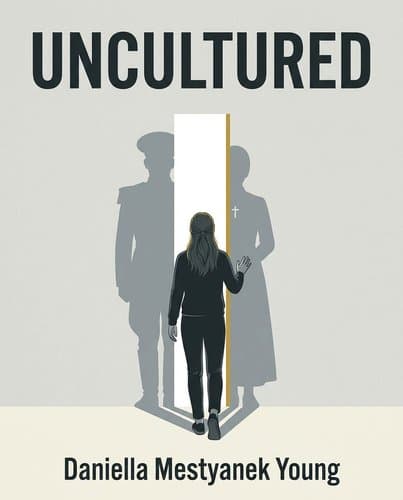
59808316_uncultured
by Daniella Mestyanek Young
Born into a cult and then enlisted into the US Army, Daniella Mestyanek Young discovers the same machinery of control running through both — and teaches you to…
In Brief
Uncultured (Sept) traces one woman's path from childhood in the Children of God cult to the US Army — and her discovery that both institutions use the same mechanics of control.
Key Ideas
Protections as minimums enable systematic harm
Any formal protection in a controlling system can become a floor for harm rather than a ceiling: when the Children of God's Charter set six swats as the maximum, six swats became the automatic punishment for any infraction. Watch for this inversion in any institution that codifies your rights while retaining interpretive authority over them.
Dissociation accumulates trauma until physical crisis
Dissociation — the ability to mentally 'leave' during unbearable circumstances — is a real survival technology, not simply damage. But the cost is deferred: the body accumulates what the mind successfully escapes, and eventually presents the bill in ways that look like physical illness.
Naming control reveals institutional dark patterns
The techniques used to build cult loyalty have formal names (isolation from outside information, prescribed identity and wardrobe, cadences and repetition, punishment for independent thought, untouchable leaders). Learning to name these techniques is the first step to recognizing them in institutions you currently belong to.
Rules protect untouchable institutional leaders
The most dangerous leaders in controlling institutions are consistently described as protected and untouchable — in the cult it was Uncle Jerry; in the Army it was Colonel Maxwell. Formal rules do not change this pattern; they provide cover for it by giving the institution something to point to.
Absorbing institutional blame signals membership
When you find yourself being asked to absorb an institution's failures to protect its structures — to 'take one for the team,' to keep quiet about what you saw, to accept punishment for someone else's conduct — you are being asked to perform the defining act of cult membership, regardless of what the institution is called.
Who Should Read This
Readers who connect with first-person stories about Memoir and Organizational Behavior and want to see the world through someone else's eyes.
Uncultured
By Daniella Mestyanek Young
9 min read
Why does it matter? Because the cult you're afraid of might be the institution you already trust.
You're about to read what looks like a story about escaping a cult. A girl born into the Children of God — group spankings at five, sexual abuse by seven, apocalypse drills before bed — who gets out, joins the US Army, becomes an officer, goes to war. Classic survival arc, trauma resolved, freedom earned.
Except Daniella Mestyanek Young isn't writing a survival story. She's writing an intelligence assessment. Because somewhere between Afghanistan and her second deployment, she noticed something that wouldn't let go: the machinery running her childhood commune and the machinery running the United States Army were the same machine, differently badged. Isolation. Unquestioned hierarchy. Leaders shielded from consequences. Punishment for independent thought.
You don't escape cults by leaving. You escape by learning to read the code — and finding it everywhere.
When You Already Know How to Follow Orders Before the Drill Sergeant Finishes Shouting Them
Fort Jackson, South Carolina. A bus of recruits stops and drill sergeants start screaming before anyone's feet hit the ground. Daniella Mestyanek Young stands in formation, fifty-pound duffel above her head, knuckles white. Around her, seventeen-year-olds are crying. She is not.
This is not bravery. She already knows how to do this. She knows to keep her eyes down, fix her mind on one meaningless detail, and wait. She knows that if they were going to hit her, they already would have. She has been living inside this logic since before she could read.
She grew up in the Children of God, a cult founded in 1968 by a failed California preacher who taught that God loved sex and that children needed to be broken young. She stood in communal food lines. She was always watched, always next to a minder. At nine, standing on a beach in Brazil, she stared across the Atlantic and calculated whether she could swim to Angola. A white van waited on the shore to return the children to the commune's gray walls.
She couldn't swim. She couldn't escape. So she learned to be present without being there — to find the place behind her eyes and go. The drill sergeants are trying to build that skill in the recruits around her. She arrived with it already installed.
When the screaming peaks and the bag gets heavier, a thought cuts through: Did I just join another cult?
You might read that as dark comedy. She means it as a field assessment — the first time she has language for the pattern she has been living inside her whole life. The Army did not give her a new life. It gave her a new name for the one she already had.
Six Swats Was Supposed to Be the Maximum — It Became the Automatic Minimum
Formal rules don't limit abuse in closed systems. They standardize it.
When the Children of God's founder died, his successor, who went by Mama Maria, announced a new governing Charter, the group's first written code of conduct. For Daniella, the document read like deliverance. Maximum six swats per punishment for children her age. No silence restrictions for the very young. No signs hung around necks. Most critically: sexual contact with a minor would earn excommunication. For the first time in her life, someone had put in writing what she had always known in her body: that what was being done to her was wrong.
Then the six-swat rule settled into practice. Before the Charter, some infractions earned one swat, maybe two, depending on the adult and the day. After the Charter, six became the automatic punishment for any infraction, large or small. Nobody questioned whether six was excessive. It was right there in the document. The ceiling had become the floor, and the floor had been raised.
The sex rules worked the same way. Auntie Dora, the commune's leader, read the new child-protection provisions aloud to the assembled group. As she named which acts would now warrant excommunication, her husband Uncle Jerry — a man who had been taking children alone into his room and closing the door for years — sat a few feet away with a serene expression. Unconcerned.
She Built a Box in Her Mind with a Key Only She Could Turn — and Then It Got Too Full
The door to the soundproofed basement room clicks locked. Upstairs, in the same building, Daniella's father works at his drafting table producing the comics and broadcasts that spread the Prophet's teachings. Down here, Uncle Jerry spends most of a day beating and sexually assaulting his seven-year-old charge for asking, during a classroom telephone game, whether the Bible could possibly be accurate if it was passed down by word of mouth for five hundred years.
She does not fight back. Instead she reaches for the only instrument available: a piece of cult scripture. The Children of God published illustrated devotional comics for girls. One taught that a girl who surrendered herself completely could not be harmed by what was done to her — by the cult's accounting, the act stopped counting. Daniella applies this deliberately. She finds an internal switch, flips it, and stops being present in her body while remaining physically inside the room. In her own accounting, it worked. The cult that designed the trap handed her the single tool that made the trap survivable.
That night, Auntie Jade (the sixteen-year-old who has waited up for her, eyes red) draws two lipstick smiley faces on Daniella's cheeks with a hidden tube. Lying in her bunk afterward, Daniella builds something: a jeweled box in her mind, with a golden key that belongs to no one else. She loads it with everything that cannot be said aloud: she does not believe in God; she will leave someday even if it costs her eternity. She locks it and stores it where the commune cannot reach. The cult could surveil her speech, her behavior, her friendships. It could not open that box.
This is not a coping mechanism. It is a containment system, engineered for an environment of total surveillance. The distinction matters because it names what will later go wrong.
Six years later, a casual sentence on a rainy walk reveals that her biological father is a fifty-year-old cult official who impregnated her fourteen-year-old mother. She finds a photograph, maps her own face onto his, and arrives at the only thought available: her mother was raped, it was wrong, and she is the evidence. She returns to her bunk and tucks a stolen bottle of bleach beside the mattress.
It is too full. The key is gone.
The Techniques Had Names in Intelligence School — She Had Already Lived Every One of Them
If you want to know whether two buildings share an architect, you don't need blueprints. You need one person who has lived in both.
When Daniella arrived at Fort Jackson for basic training, her body recognized the architecture before her mind could name it. The isolation from outside news stretched weeks: no books, no phone, no contact. It was meant to be disorienting. She laughed out loud when a drill sergeant announced Michael Jackson had died, certain it was a psyop to test their information discipline. That laugh was involuntary. It came from sixteen years inside a system that used manufactured uncertainty as standard operating procedure. In the Children of God, outside news was outsider propaganda (the cult's word for it was "Systemite"). In basic training, it was distraction. The mechanism was the same. She would later encounter clinical names for all of it in intelligence school: social isolation protocols, group cohesion tactics, SERE conditioning. She recognized every one as childhood vocabulary.
The Army's version included rhythmic group chants drilled into marching formations until soldiers recited them without thinking. She had done this since childhood, to different lyrics, down communal hallways at midnight. She had stood in prescribed formations, worn prescribed clothing, obeyed adults whose authority was unchallengeable. Her body fell into the routine with a strange kind of ease. It should have been alarming. It felt like home.
But the machinery becomes most visible at the memorial for the ten Pathfinder soldiers in her unit killed in the ambush, among them First Lieutenant John Runkle, who had been treating her as a peer rather than the liability her commanders had decided she was. Standing in formation under the Afghan sun, she felt her mind divide. On one side: the patriot who believed the ceremony's words, who had earned the right to be standing in that row. On the other: the survivor who recognized the identical grammar. They died for what they believed in. We are on the right side of history. She had heard it before. The Children of God called its dead martyrs for God's Army. The U.S. Army called its dead Heroes. Both phrases did the same grammatical work: closing the question before anyone could ask it.
Then Captain Madison appeared at the memorial to warn her that her visible grief was generating rumors. People were asking why she was taking it so hard. It could damage her career. She said "You're right, Sir" and went numb. The transaction was familiar: displaying emotion that didn't align with the group's official position was a form of dissent, and the correction was the same in either case — fall back into line, absorb the cost alone, stay invisible.
She had escaped one closed system by joining another. The uniforms were different. The operating code was not.
The Air Force Surgeon Closed His Door and Asked the Only Question That Was Actually a Diagnosis
What happens when the only tool you have is the one that's been destroying you?
At Bagram Airfield in April 2014, Daniella wins the Shadow Boston Marathon, Bagram's unofficial parallel to the real race, finishing first among roughly 600 runners. The brigade commander she had spent two tours trying to prove herself to looks through her like she isn't standing there. There is nothing left to prove, to him or anyone.
Then the body starts sending the bill.
In two months she loses 30 pounds on a frame that had none to spare. Her hands shake so badly she can barely hold her coffee. She stops sleeping. Her breasts begin producing milk, a pituitary symptom she doesn't yet recognize. One morning she wakes completely blind. She calls a subordinate to her room (a potentially career-ending move at war) and says "help me." At Landstuhl, a CT scan shows lesions around the pituitary and brain swelling. The Air Force surgeon prepares her for surgery, the tumor almost certainly benign.
Then the MRI comes back clean. No tumor.
Her response is panic, not relief. A tumor had an explanation and a treatment, something that could be cut out. Without one, she knew what would happen: the doctors would conclude she had invented the symptoms, and send her back.
The surgeon closed his office door — calmly, like someone not always monitoring who might be watching — and asked her a single question: what had been happening in her unit that could bring someone in her physical condition to his operating room looking like she was dying?
That question was the diagnosis. Since age seven she had been running a containment system (the jeweled box with the golden key) built to store trauma where no institution could reach it. It worked. She graduated valedictorian, commissioned as an officer, survived a cult, a war, multiple rapes, and years of institutional punishment for reporting them. The mechanism was so effective she had mistaken it for strength.
The body doesn't make that mistake. Twenty-seven years of compressed trauma had to go somewhere. It went into the pituitary. Into the visual cortex. Into thirty pounds of lost muscle. Her mind kept telling her she was strong enough to keep running. Her body had stopped believing it.
The First Rule of Every Cult Is That You're Never In One
The first rule of every cult is that you are never in one. Your group has legitimate reasons for everything it asks of you.
Daniella writes the book's epilogue from a rooftop deck on the East Coast, surrounded by wind chimes and tiki bar woodwork her husband built during his own military transition. On the bar countertop: two decades of challenge coins, valor citations, combat patches, air medals (hers and his) sealed permanently under resin. Not displayed. Encased. The distinction is precise: she is not honoring the identity or repudiating it. She is finishing it.
Then she asks the question the whole memoir has been building toward: what exactly is the difference between the Children of God and the U.S. Army? Both demanded she surrender herself to the mission. Both used isolation, hierarchy, punishment, and ceremony to build loyalty that didn't require her consent. Both told her she was part of something larger than herself, which was true, and that this justified anything asked of her, which wasn't. She was raised in a cult and then volunteered for one, and the second felt like home because it was structurally the same house.
Her answer: no difference in kind, only in degree and outcome. She arrived at this not as theory but as pattern recognition. The challenge coin ceremony, the way it marks who belongs and who doesn't, is the same mechanism as anything the Children of God used. Nobody signs up for a cult. People join organizations they believe will fix something broken in the world or in themselves. The leader, the mission, the insiders are not cult-specific features. They are group features. Every group has them. The question is whether the code gets written wrong.
She means the ones you're in right now — the company, the movement, the faith community, the family — the groups that feel like the good ones, the legitimate ones, the ones with real reasons for what they ask. Nobody inside a cult believes they are in one. The only way past that is to read the code before the code reads you.
First-Generation Freedom Doesn't Mean the Flinch Goes Away
At seven, she built a locked box in her mind to survive. Eventually it filled, and her body paid the debt. The memoir is what she built instead. Same container, open now, written for you.
She did not escape a cult and accidentally join another one. She escaped, recognized the grammar in the next institution, and joined it anyway. You do the same. The question is not whether the group you belong to has the architecture — isolation, hierarchy, ceremony, untouchable leaders, punishment for visible doubt. It does. The question is whether the code has been written wrong, and whether you will read it before the next institution hands you a uniform and calls it freedom.
The box is open — and this time, nobody else holds the key.
Notable Quotes
“I'm going to spank you again. I need to make sure that the Devil isn't still in you.”
“with each swing. Then, finally, there was a moment when the swatting paused. I tried to swallow my whimpers but they were so loud in the silent room.”
“he said, and I scrambled onto the dirty mattress. He stared me down.”
Frequently Asked Questions
- What is Uncultured about?
- Uncultured traces one woman's path from childhood in the Children of God cult to the US Army — and her discovery that both institutions use the same mechanics of control. It draws on memoir and structural analysis to give readers a framework for recognizing coercive systems anywhere they appear. The work examines how institutions use identical control techniques—from wardrobe rules and scripted identity to untouchable leaders. By analyzing the author's experiences in both environments, the book demonstrates that cult dynamics aren't unique to obvious cults but operate within mainstream institutions using the same psychological and social mechanisms of control.
- What are the key takeaways from Uncultured?
- The book identifies how any formal protection in a controlling system can become a floor for harm rather than a ceiling—when rules are codified but interpretive authority remains with leaders, maximum punishments become automatic. Additionally, dissociation serves as survival technology with deferred costs paid by the body. The work teaches readers to recognize specific cult techniques—isolation from outside information, prescribed identity and wardrobe, cadences and repetition, punishment for independent thought, untouchable leaders—operating in any institution. Finally, it warns that being asked to absorb institutional failures to protect its structures constitutes the defining act of cult membership, regardless of institutional labels.
- How does Uncultured help recognize cult dynamics in institutions?
- Uncultured provides a framework by naming specific techniques that create cult loyalty: isolation from outside information, prescribed identity and wardrobe, cadences and repetition, punishment for independent thought, untouchable leaders. Learning to recognize and name these techniques is the first step toward identifying coercive systems. The book demonstrates that the most dangerous leaders in controlling institutions are consistently described as protected and untouchable and that formal rules often provide institutional cover rather than genuine protection. By analyzing these structural patterns across institutions, readers can identify coercive control operating within military organizations, religious communities, workplaces, and other formal systems, recognizing how cult dynamics operate outside traditional cult definitions.
- What does Uncultured reveal about dissociation and institutional harm?
- The book frames dissociation as a real survival technology, not simply damage. It explains that while dissociation enables mental escape during unbearable circumstances, the cost is deferred: the body accumulates what the mind successfully escapes, and eventually presents the bill in ways that look like physical illness. This insight reframes trauma response as adaptive strategy while acknowledging deferred bodily costs. The book further emphasizes how coercive systems harm people through legitimate-seeming structures: codified protections become automatic punishments, institutional failures get absorbed by members to protect reputation, and formal rules provide cover for abuse. Understanding these mechanisms reveals how harm operates.
Related Book Summaries
Read the full summary of 59808316_uncultured on InShort