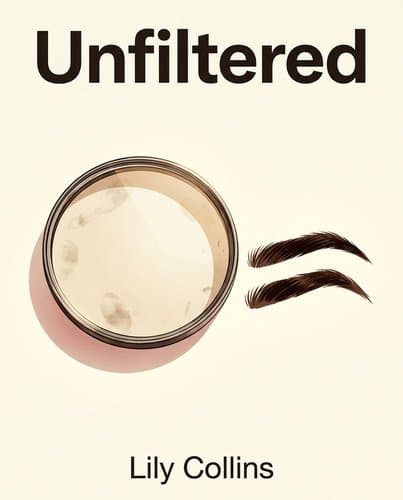
32737127_unfiltered
by Lily Collins
The wounds you've spent years hiding—the eating disorder, the absent father, the relationship that broke you—aren't obstacles to your identity.
In Brief
Unfiltered (Marc) is a collection of personal essays by actress Lily Collins examining how shame, eating disorders, an absent father, and toxic relationships shaped — and ultimately clarified — her sense of self.
Key Ideas
Distinctive traits conceal your real power
The specific things that make you feel most wrong — the eyebrows, the accent, the face that ages too slowly — are usually the compressed form of your most distinctive asset. The question isn't whether to change them but whether you'll let others' discomfort with them shape your own relationship to them before you find out what they're for.
Insight and behavior change require separate skills
Insight and behavior change are separate skills. You can hear a clarifying truth, feel it click, and still need multiple interventions to act on it — not because you're weak, but because emotional attachment operates on a different clock than intellectual understanding.
Watch what you make appear effortless
The most dangerous phase of an eating disorder isn't the visible one. It's the high-functioning concealment phase, where the disorder co-opts your intelligence and social awareness to perform wellness. Watch for what you work hardest to make appear effortless.
Sometimes exit matters more than articulation
When your instincts and your voice keep failing to produce change in a relationship, the problem may not be how you're communicating — it may be who you're communicating with. Some situations require exit, not better articulation. The most honest form of belief in someone is sometimes refusing to stay while they're not available to be believed in.
Recovery is recognizing your own voice
Recovery isn't a state you reach — it's a daily act of distinguishing between the voice that's actually yours and the voice of whatever has been running in its place. The goal isn't to silence the unhealthy voice; it's to become fluent enough in your own that you can tell them apart when they're both speaking at once.
Who Should Read This
Readers who connect with first-person stories about Memoir and Mental Health and want to see the world through someone else's eyes.
Unfiltered
By Lily Collins
10 min read
Why does it matter? Because the wounds you've been hiding are probably your most interesting material.
Self-acceptance gets sold as an arrival — you do the work, you get there, you stay. Lily Collins got the message at six: your oddities are the point. She believed it. Then she spent a decade hiding diet pills around her bedroom and eating just enough to pass a school weigh-in she'd sabotaged with Starbucks pastries on the way there. This isn't a story about a woman who found herself and kept her. It's about a woman who found herself, lost her, and found her again — through an abusive relationship, through a film role that forced her back into the mindset she'd spent years escaping, through a Seoul hotel room where she looked at the body she'd once dreamed of having and chose, quietly, not to want it. The wounds she concealed the longest are the only reason she has anything worth saying.
The Quirks You've Tried to Fix Are the Only Parts of You That Are Actually Yours
At twelve, Lily Collins took a pair of tweezers to her own eyebrows before dinner. Kids had been mocking them for months. Thick and bushy in an era when thin brows were fashionable, they'd marked her as wrong. So she plucked. She stood back and felt proud. She kept quiet the whole car ride to the restaurant, anxious for her mom's reaction. When they were finally seated across from each other, her mom stared and asked what had happened to her face. Collins insisted they looked great. Her mom told her she'd plucked half of them off — two thin lines straight across her forehead. Collins went to the bathroom to check. She was right. She sulked back to the table. Her mom tried to soften it, then added they might never grow back, which made everything worse.
The bathroom mirror is where it turns: pride collapsing into humiliation, then defensiveness, then slow recognition that she'd made exactly the mistake her mom feared. She'd taken something distinctly hers and tried to sand it down to fit in.
The brows grew back. And then something stranger happened: they became her trademark. Strangers asked to touch them, like rubbing a Buddha's belly for luck. Internet trolls still tell her to shave them. She laughs.
Her mom had a line for it. The harder question, the one the rest of the book keeps circling, is why knowing something true about yourself and actually living it can be a decade apart.
Knowing It's Wrong and Leaving Are Two Completely Different Skills
Why is it that understanding exactly what's happening to you — naming it, feeling the recognition land — still doesn't guarantee you'll leave?
Collins spent two years in an emotionally abusive relationship with someone she never names. The pattern followed a familiar rhythm: honeymoon phase, verbal escalation, love-bombing to reset. He called her stupid, dumb, a whore, controlled what she wore, discouraged her friendships, eventually isolated her from almost everyone including her mother. She developed panic attacks, rashes, acne. When they spent time together, he kept the blinds drawn.
A friend who'd survived a similar relationship delivered the Maya Angelou line: when someone shows you who they are, believe them. Collins describes this as a click: instant recognition, not gradual realization. She left. And then, weeks later, she let him talk her into meeting face-to-face to work through it. He'd done his own self-reflection, he said. She had things she wanted to change too. They tried again.
She knew. She left. She went back. Not because she was confused. The love-bombing cycle is specifically engineered to reset the emotional baseline. After the cruelty came the letters about how he didn't know what he'd do without her. After the isolation came the assurance that nobody would ever love her this strongly. By the time the abuse resumed (and it did, exactly as before), the version of him she was trying to hold onto was the one who'd written those letters, not the one who'd been cruel. The two had been so thoroughly entangled that leaving one meant abandoning the other.
The sharpest moment in the whole account is also the quietest. His hand closed around her neck, and she follows that description immediately by saying she finds it strange even using the word choking, because she can't imagine the person she loved doing such a thing. Read that slowly. She is, in the same breath, describing an act of physical violence and explaining why she hesitates to name it. That hesitation isn't confusion. It's what happens when you've so thoroughly absorbed a relationship's logic that your own account of the harm still runs through its filter.
The Angelou click wasn't enough. It took a second intervention to produce the final break: a phone call with her mother and friends who, in her words, reminded her of who she was. Clarity, it turns out, is step one of a process. The rest requires people who remember you.
The Smartest Thing About a Disorder Is How Good It Gets at Hiding
The most dangerous phase of an eating disorder isn't the one where people around you can see what's happening. It's the one where you're too smart to let them.
When Collins's school counselor required a doctor's note certifying she was at a medically safe weight (the alternative was being kept out of school), Collins had a problem. The appointment was the kind of thing that should have triggered relief: an intervention, someone finally seeing. Instead it triggered logistics. On the way to the doctor's office, she stopped at Starbucks and ate enough pastries to push her weight up. She arrived heavier than she would have been. She cleared the threshold. She went back to school with the note in her hand, having turned a medical intervention into one more tool for the disorder.
That move required understanding exactly how the assessment worked and engineering a workaround before she walked in the door. The disorder didn't dull her judgment — it recruited it. Whatever intelligence she had was running at full capacity in the wrong direction.
At the worst of it, she found herself asking her brothers, toddlers around three years old, whether she looked fat. One sentence in the book, almost in passing. But it shows you the perimeter of the distortion: the obsession had spread past meals, past the mirror, past her internal monologue, into conversations with children who didn't have the language for what they were being asked to evaluate. That's not someone who has lost self-awareness. That's someone whose self-awareness has been entirely co-opted by a single question.
The concealment was so thorough that her mother, her best friend, the person she'd told everything, didn't know the full picture for years. Not from inattention. Because Collins had become skilled at performing okayness at exactly the level required to forestall suspicion. When her mother began dating and her focus shifted, Collins describes stepping up that performance specifically to fill the gap. The disorder grew during the cover.
Secrecy wasn't a side effect of the illness. It was the mechanism.
The Accent You Killed to Fit In Becomes the Instrument You'll Need Later
Imagine spending years erasing a part of yourself so thoroughly that you forgot it was ever there. Then imagine the exact thing you erased turning out to be the most valuable tool in your professional kit.
Collins moved to LA from England at six with what she calls the strongest, cutest British accent. The accent got mocked immediately. She did what any six-year-old does when something about her draws ridicule: she killed it. She listened to classmates, mimicked how they spoke, and drilled Peter Pan dialogue until she sounded less like herself and more like everyone else. It worked. The accent disappeared.
More than a decade later, playing a character in Love, Rosie who needed to sound English, she reached back for it. It returned faster than she expected, and something else came with it: a feeling of recognition she hadn't felt in years. She describes this moment as the first time on screen she felt fully like herself — not performing "Lily Collins the actress" but just being the girl from the countryside she'd tried so hard to stop being.
The insecurity didn't fade over time and eventually become usable. It ran in exactly the opposite direction of what she wanted, which made it precise. Because she'd worked so hard to eliminate it, she knew the original with unusual clarity: what it sounded like, where it lived in her body. The suppression preserved it.
Collins makes the same move with her face. Looking young cost her roles throughout her teens and twenties — executives dismissed her in boardrooms, casting directors compared her to older contemporaries who "looked" the right age. She absorbed years of feedback suggesting her appearance was a defect to be corrected. Then she lists, almost offhand, the characters that defect made possible: Collins Tuohy in The Blind Side, Snow White in Mirror Mirror, Clary Fray in The Mortal Instruments. None of those roles belonged to a face that had aged on schedule.
The wounds don't get left behind. They get converted. Not automatically, not comfortably, and the conversion takes long enough that it's genuinely hard to see coming from inside the pain. But the specific humiliation is also the specific credential. What you tried to fix was the only part that was precisely, irreplaceably yours.
She Had the Right Words for This Situation — She Was Just Using Them on the Wrong Person
The conversion of wounds into wisdom has an assumption underneath it: there has to be someone on the other end capable of receiving what you're saying.
Collins loved an alcoholic who, at his best, was genuinely trying. He had gone fully sober months before they met, his own decision, and their relationship during that period was good. When he reintroduced alcohol, the erosion was specific: he couldn't stop at one or two drinks, and excess produced paranoia and insecurity he took out on her, requiring constant reassurance that nothing she said could fully provide. When she finally encouraged him to get outside help, he felt abandoned and ended contact.
That was hard. What came after was harder. He pursued sobriety seriously, acknowledged his alcoholism, and Collins saw him again and believed in the change — not wishful thinking, she recognized real clarity in him. So they tried again. The relapse signal wasn't dramatic. He started drinking nonalcoholic beers. Same quantities, same compulsive pattern, same underlying reasons. Collins recognized it immediately — she draws a direct line to her own history with food, knowing what it looks like when you swap one compulsion for another without touching what's underneath. She named it. She encouraged him to return to professional support. He disappeared and never contacted her again.
She could have spoken sooner. More clearly. With better timing. None of it would have mattered, because the problem — the line Collins eventually lands on — is that she was never actually talking to him. She was talking to his addiction, and it refused to hear her.
That sentence is doing something precise. The tools this book teaches are real, but they work on problems within reach of language. An addiction isn't a misunderstanding that better communication can resolve. The most honest form of belief in someone in that situation isn't staying and speaking more skillfully — it's recognizing that your love alone cannot substitute for their self-love.
The Real Victory Isn't Recovery — It's Learning Which Voice Inside You to Trust
She left that relationship more fluent in addiction's logic than when she'd entered it. Just not her own yet.
Seoul, 2016. Collins is in her hotel room between shoots. She's just wrapped To the Bone, playing an anorexic character, a role that required real weight loss and a deliberate step back into the disorder's mindset. She stands at the mirror looking at her very thin body. The thought arrives almost on its own: ten years ago, this was exactly what she'd wanted. She would have called this her dream.
She doesn't let it stay.
For years she hadn't recognized the disorder as a voice at all. It had just sounded like her — like the girl who genuinely preferred not to eat, who felt better this way, who trusted her own body and was simply listening to it. There was no gap between the voice and herself. She'd tracked the same thing in the people she loved: the boyfriend whose addiction spoke in his own voice, insisting it was just how he was; the ex whose cruelty arrived in the language of care. She'd learned to hear the space between a person and what had taken them over. She just hadn't turned that ear on herself.
In Seoul, that changed. Through the recovery she was doing alongside the Okja film shoot (eating new foods, gaining back weight deliberately, sitting with the fear rather than engineering around it), she says she met the voice of her own addiction for the first time. Distinct, loud, controlling, and fluent in her own reasoning. What changed wasn't its presence. It was her ability to hear it as a separate thing.
Recovery is still underway when the book closes. She's still working to regain weight. She's still calling her mother from Seoul when the fear gets loud. She's still sitting in a hotel in a foreign country trying to write an ending she doesn't know how to write. What she arrives at is discernment — the daily practice of one question: whose voice is this?
That's a smaller claim than a triumphant arc, and a truer one. The cookie she baked alone at twenty-four and the mirror she stood at in Seoul are the same moment at different scales — a choice made in the open instead of in hiding. She sees what would have defined her at sixteen, names it as past tense, and turns away. The voice is still there. She's learned, finally, whose it is.
The Stories You Keep Secret Are the Ones You End Up Passing Down
Near the end she says she doesn't want to hand her children her problems — she wants to hand them her stories. A wound kept secret stays a wound. Spoken aloud, it becomes something a stranger can pick up and feel, maybe for the first time, that someone got it exactly right.
The question the book leaves behind isn't whether you've healed. It's what you're still keeping quiet, and who might need to hear it instead.
Notable Quotes
“I could attain. I was afraid of getting fat. Of no longer having that”
“that had helped me justify putting up with his abuse. His old habits trumped any security his love letters provided and he was back to telling me what I could and couldn't do, should and shouldn't wear—everything I did was”
“a word that still haunts me to this day. He yelled at me, calling me horrible things like dumb, blind, stupid, selfish, and a whore. I was made to feel unworthy, less than, and, frankly, like a piece of shit. He told me to”
Frequently Asked Questions
- What is Unfiltered by Lily Collins about?
- "Unfiltered is a collection of personal essays by actress Lily Collins examining how shame, eating disorders, an absent father, and toxic relationships shaped — and ultimately clarified — her sense of self." The book demonstrates "how naming the experiences you've worked hardest to conceal is the mechanism by which a coherent identity gets built, and offers an honest account of what recovery and self-ownership actually look like in practice." Collins uses her personal journey to illustrate how confronting difficult truths enables genuine self-understanding and transformation, providing readers with practical insights about building authentic identity through vulnerability and honest reflection.
- What does Unfiltered reveal about high-functioning eating disorders?
- "The most dangerous phase of an eating disorder isn't the visible one. It's the high-functioning concealment phase, where the disorder co-opts your intelligence and social awareness to perform wellness." Collins cautions readers to "watch for what you work hardest to make appear effortless," as this deceptive functioning can mask serious psychological struggles. By examining her own experience with eating disorders, Collins illustrates how the very skills that make someone successful—intelligence, discipline, and social awareness—can become tools for deeper concealment. She emphasizes that recovery requires recognizing this insidious masking pattern and understanding that apparent wellness isn't the same as actual health or healing.
- How does Unfiltered address toxic relationships and knowing when to leave?
- "When your instincts and your voice keep failing to produce change in a relationship, the problem may not be how you're communicating — it may be who you're communicating with." Collins notes that "some situations require exit, not better articulation." She adds that "the most honest form of belief in someone is sometimes refusing to stay while they're not available to be believed in." Through her experiences, Collins demonstrates that recognizing when to leave isn't a failure in communication but a crucial act of self-preservation. The book teaches readers to distinguish between problems requiring better communication and those requiring complete exit—sometimes walking away as an act of self-respect.
- What does Unfiltered teach about recovery and finding your voice?
- "Recovery isn't a state you reach — it's a daily act of distinguishing between the voice that's actually yours and the voice of whatever has been running in its place." Collins emphasizes that "the goal isn't to silence the unhealthy voice; it's to become fluent enough in your own that you can tell them apart when they're both speaking at once." Rather than framing recovery as reaching a final destination, she presents it as an ongoing practice of recognizing and separating authentic thoughts from internalized shame, criticism, or conditioning. This perspective redefines success—not as perfection, but as cultivated awareness and the daily choice to listen to your authentic self amid competing internal narratives.
Related Book Summaries

Read the full summary of 32737127_unfiltered on InShort