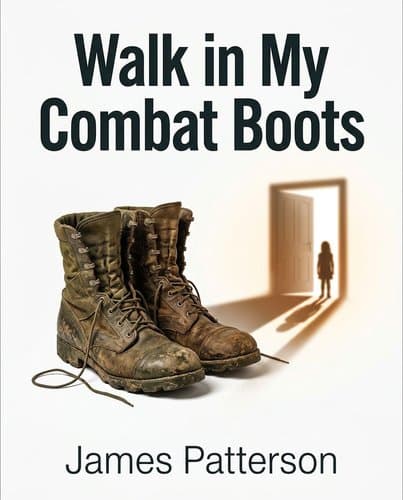
53915317_walk-in-my-combat-boots
by James Patterson
Eighteen real veterans speak in their own words about impossible choices—families at checkpoints, orders that forced harm, moral wounds that outlast every…
In Brief
Eighteen real veterans speak in their own words about impossible choices—families at checkpoints, orders that forced harm, moral wounds that outlast every homecoming. This is the unbridgeable gap between a nation's gratitude and what it actually costs to go to war.
Key Ideas
Shame from forced choices creates moral injury
Moral injury — shame and guilt from decisions made under impossible conditions — is distinct from PTSD and may resist treatments aimed at trauma symptoms. Many veterans are haunted not by what happened to them but by choices they made or were forced into.
Duty and harm become inseparable geometry
Rules of engagement can produce situations where following orders and causing harm are the same act. The men and women who had to sit under fire without authorization to respond, or stop a car that turned out to hold a family, carry that geometry for the rest of their lives.
Families bear war's true deepest costs
War's deepest costs land on people who never deployed. The oxygen leaving a room when soldiers knock on a door, a bullet hole found at the funeral home, a blue star in a dead son's pocket — these are the true endpoints of combat.
Redemption and destruction coexist in service
Veterans who say they would volunteer again and veterans who nearly died by suicide are often the same person. Service does not sort neatly into damage and redemption; the paradox is the most accurate description the book can offer.
Specificity bridges military and civilian divide
The gap between military and civilian life narrows only through specificity — not gratitude, not policy, but asking what it was actually like and being willing to hold the answer. These narrators keep returning to the specific (a song on a radio, a broken cigarette, a child's question at a doorway) because abstraction fails them.
Who Should Read This
History readers interested in Memoir and Military History who want a deeper understanding of how we got here.
Walk in My Combat Boots
By James Patterson & Matt Eversmann & Chris Mooney
9 min read
Why does it matter? Because the war stories you already know aren't war.
Reading war testimony is supposed to close the distance. If veterans speak honestly enough, the country that sent them will finally understand what it asked. This book refuses that comfort, not by withholding, but by being more honest than the premise allows. Forty-six narrators will tell you everything they can: a medic applying a tourniquet to a stump while a dying soldier asks if his junk is still there, a dentist treating Saddam's broken tooth alone in a small Camp Victory clinic, a captain who turned away a fourteen-year-old boy bleeding out at the gate and thinks about it every day. And then, quietly, show you exactly where the telling stops. That's where this book lives: in the gap between what gets said and what gets carried.
War Is Too Specific to Become a Story
At 2 a.m. in Kuwait, a squad leader named Jackson opens his duffel bag and removes three large Gatorade bottles — vodka, gin, and bourbon, the good stuff, not the cheap. He finds an engineer in the dark and makes an offer: the bottles in exchange for plate armor welded to the doors and underside of a soft-shell Humvee, plus sandbags across the floor. Five hours later, the unit drives north toward Baghdad in a vehicle that exists only because someone thought to bring premium liquor into a war zone.
That detail is not dramatic. It doesn't symbolize anything. It just happened.
Medic Mike Levasseur is flown out on a Black Hawk to collect two soldiers hit by a roadside bomb near Samarra. One of them, Armando Hernandez, is twenty-two years old and missing a leg. Levasseur drops to his knees to apply a tourniquet. Hernandez looks up and asks his first question — not about whether he'll live, not about his leg, but about whether his genitals are still there. Levasseur tells him yes. Gallows humor, he explains. The only thing that keeps them sane.
He keeps Hernandez alive for the flight back, alive through the ER doors. Then a combat surgeon finds him: the wounds were unsurvivable. Walter Reed wouldn't have made a difference.
Levasseur says he believed that. He also says some part of him refused to. Both statements appear on the same page and neither one cancels the other out. He showers in cold water and scrubs off Hernandez's blood.
That's where the chapter ends. Not with grief processed and understood, but with blood washing down a drain and an open question about what to do with the fact of it. The PTSD and brain damage and broken sleep come later, catalogued with the same flat precision Levasseur uses to describe the bribe and the tourniquet and the question about Hernandez's body.
The Worst Moments in Combat Are Not Tactical—They Are Moral
Military training prepares you for the firefight. It cannot prepare you for standing in the wreckage of a decision you made correctly.
In February 2005, Marine captain Andy Brasosky is running a foot patrol through a built-up area of Iraq when word comes that a vehicle-borne IED has hit an adjacent platoon. His unit moves to support. Then another vehicle appears on the horizon, heading straight toward them, and it will not slow down.
Brasosky follows procedure. He orders his sniper to shoot the tires. The car keeps coming. They hit the engine block. Still coming. They hammer the windshield with rounds. The car finally stops.
The driver climbs out screaming. The Army's bomb disposal team (EOD) clears the vehicle. Brasosky approaches and sees a dead woman in the passenger seat and a dead child in the back.
Then the interpreter relays the driver's message: he wants to know who is going to replace his vehicle.
What Brasosky writes next is not grief or rage — it's a precise accounting of the restraint required not to do something he cannot take back. Every bullet landed where it was supposed to. The protocols were followed. The civilians died anyway, and the man in front of him is asking about his car. No after-action report has a category for that: the cost of maintaining discipline when discipline ends with a dead child in the back seat.
The heaviest chapters are the ones where the decision is not made but forced. Army captain Nate Harlan is running a forward base in Iraq when a father arrives at the gate with his fourteen-year-old son, shot in the abdomen several days earlier. Insurgents had paid the family five hundred dollars for the boy to dig a hole for an IED. An American patrol saw the shovel, drew the wrong conclusion, and left. The medic tells Harlan the kid is dying but somehow still upright.
Harlan's orders are explicit: no treatment of Iraqi patients. He tells the father he cannot help and walks away.
He comes home with PTSD and traumatic brain injury. The wound he names specifically is not a firefight. It's a gate, a father, a boy with swollen ankles, and the order he followed. He has his own fourteen-year-old son. He returns to the decision every day.
Physical Wounds Heal. The Decisions You Made Don't.
What is the difference between a wound that heals and one that doesn't? The answer isn't about severity. Greg Stube loses half his intestines, his right foot and ankle, and thirty percent of his body to third-degree burns in a single IED strike in Afghanistan's Panjwayi Valley. That is about as severe as a body can survive. Yet what stays with him is not the blast.
Stube had been a Special Forces medic and then an instructor — sharp, relentlessly driven, and by his own accounting, arrogant. He trained the wave of recruits who flooded into Special Forces after 9/11, and he was hard on them. One student, a medic named Riley Stevens, failed Stube's surgical course and had to repeat it from scratch. Stube stiff-armed him and moved on.
Then in 2006, on day five of Operation Medusa, Stube drives a weapons truck up a hill to provide covering fire and hits a remotely detonated IED. Among the teammates who rush to him is Riley Stevens — the medic he failed and forced to repeat the course. His first thought is contemptuous: there's no way these people can save my life. His second thought follows immediately, and it is the one that lasts: whose fault is that? Mine.
Stevens stabilizes him. Stube survives eighteen hours of vascular surgery in Kandahar, weeks of burn treatment in Germany, and months at Fort Sam Houston — where, unable to control his bowels, he spends his days being cleaned by strangers who do it without complaint. He describes watching those strangers work and understanding for the first time that strength might mean something different than he'd spent his career believing.
What Stube names as his failure is not tactical. He just couldn't see what Stevens was capable of until Stevens's capability was the only thing standing between him and death. The greatness was there the whole time, he writes. He chose not to look.
Stevens is killed in Afghanistan not long after.
War's Reckoning Happens in Someone Else's Doorway
Don Stevens boards a small plane to El Paso: a chaplain, a commander, one other officer beside him. Danny Sanchez, a combat controller Stevens trained at the Special Tactics Training Squadron, was shot in the back of the head on his first mission off the helicopter. The next of kin haven't been told yet.
They land, change into dress blues inside a Suburban, and drive into Danny's neighborhood at dusk. Neighbors are already watching from their doorways. Everyone in a community like this knows one of their own is deployed overseas, and a car like this means one thing. Stevens knocks. A small boy answers, turns back into the house, and calls out that soldiers are standing at the door.
Stevens writes what follows in one sentence: the air seemed to leave the house, replaced by a single gasp — a woman understanding what had happened before she reached the threshold.
That sentence carries the chapter's full weight. Not the ambush outside Bagram where Stevens ran uphill through active fire to reach high ground and call in two F-18s. Not the IED that rattled his skull. Not even the young enemy fighter he killed at close range, a death he needed weeks to process. What breaks through all of it is a child's voice in a hallway and a mother's intake of breath.
War presents itself as a tactical problem: a sniper's call, a fire direction, a hillside to take. The people trained to solve those problems carry that training home. What no training touches is the transfer — the moment the cost crosses from a hillside in Afghanistan to a residential street where neighbors peer out and a small boy has no idea what his words just did to the woman in the next room.
The notification at the door is one form of this transfer; sometimes the official account that travels home with the coffin is the second one.
Ginny Luther's son Bart, an Army lieutenant, is killed off-base while trying to talk a troubled soldier through a crisis. The Army tells her he was shot in the chest. At the funeral home, her husband finds a bullet hole behind Bart's ear. There were five. The Army knew and said nothing, and never explained why. In Bart's pocket: a small glass star she had pressed into his hand the night before his deployment, certain he had long since discarded it.
The battlefield has an end. The reckoning in doorways and funeral homes does not.
The Same Deployment That Nearly Destroyed Them Is the One They Would Volunteer For Again
Service doesn't produce two kinds of people — the broken and the strengthened. It produces one kind: people carrying both things at once.
Rory Hamill loses his right leg below the knee to a pressure-plate IED in Afghanistan. He picks up his own stump and pins it to his chest while waiting for the helicopter. He flatlines twice on the flight out and describes the experience as total peace, like being one with the universe. He wakes at Walter Reed, the same hospital where he was born, and within a week his wife confesses to affairs conducted while he was deployed. He gets a prosthetic leg, gets discharged, parties with other veterans without discussing anything that happened, drinks too much, watches two marriages end, and eventually finds himself outside an Atlantic City marsh in his car, holding a pistol against his head. He lowers it because his children flash through his mind for maybe half a second. He disassembles the weapon and throws it out the window.
That's the trajectory of a man who says, in the same chapter, that he would go back. That if he can help one person every day through his story, then everything he went through was worth it. You can read both statements as contradictory. The book treats them as the same truth said twice.
What the testimonies here refuse is the clean partition most people want: the broken ones and the strengthened ones. Nick Black, who went to Johns Hopkins and volunteered for Afghanistan, comes home to learn that an intel soldier attached to his unit drove two exits past Fort Bragg and shot himself. Black then receives a statistic: more service members die by suicide than are killed by the enemy. He made it. He also lives with the knowledge of how narrow that margin is.
The distance between military and civilian life is not a failure of either side. It's real, it's permanent, and it doesn't respond to good intentions. The only thing that narrows it, across every chapter in this book, is the specific act of telling someone what it was actually like — not the version that turns into a war movie or a lesson, but the version with all the wrong details still in it. Hamill in a parking lot. The pistol he threw out the window. The half second his kids bought him.
That's all there is. That's everything.
The Only Thing That Crosses the Distance
Forty-six people spoke into this book, and what they share isn't a wound or a medal — it's the attempt to hand something across a gap that may not close. Don Stevens writes one sentence about a mother's breath leaving her before she reached her own door. Shivan Sivalingam, a veteran whose parent asked if it had been worth it, answers with a single word: No. Because the honest answer would have cost something. Elsewhere in these pages, a daughter holds a uniform and asks what it was like. That question, asked without an expected shape for the answer, is the only instrument that works. Not a bumper sticker. Just a willingness to ask something specific and then go quiet. The distance is real. It isn't anyone's fault. You narrow it one conversation at a time.
Notable Quotes
“I say, my voice weak.”
“I watch him go to work on me.”
“I've called in a medevac.”
Frequently Asked Questions
- What does the book say about moral injury in veterans?
- Moral injury — shame and guilt from decisions made under impossible conditions — is distinct from PTSD and may resist treatments aimed at trauma symptoms. Many veterans are haunted not by what happened to them but by choices they made or were forced into. Rules of engagement can produce situations where following orders and causing harm are the same act. The book reveals that this distinction is crucial because typical trauma therapies may not address the core source of suffering.
- What is Walk in My Combat Boots about?
- Walk in My Combat Boots collects first-person accounts from U.S. veterans to show the true human cost of war. The book features unfiltered stories that reveal moral injury, impossible decisions under fire, and the lasting damage carried by families at home. Through these specific narratives, it closes the gap between military and civilian experience and gives readers a clearer understanding of what service actually demands and destroys. The gap between military and civilian life narrows only through specificity — not gratitude, not policy, but asking what it was actually like and being willing to hold the answer.
- How does Walk in My Combat Boots address the impact of war on families?
- The book reveals that war's deepest costs land on people who never deployed. It emphasizes specific, devastating moments that mark a family's loss: "The oxygen leaving a room when soldiers knock on a door, a bullet hole found at the funeral home, a blue star in a dead son's pocket — these are the true endpoints of combat." These vivid details illustrate how families carry the war's burden in ways civilians often don't recognize. The book argues that truly understanding military service means acknowledging the invisible weight families bear.
- What paradox does the book highlight about veteran experiences?
- Walk in My Combat Boots explores a fundamental contradiction: veterans who say they would volunteer again and veterans who nearly died by suicide are often the same person. The book notes that "service does not sort neatly into damage and redemption; the paradox is the most accurate description the book can offer." This means healing is not linear and damage and meaning coexist in individual veterans' lives. Understanding veterans requires holding space for these contradictions where both harm and purpose matter equally.
Related Book Summaries
Read the full summary of 53915317_walk-in-my-combat-boots on InShort