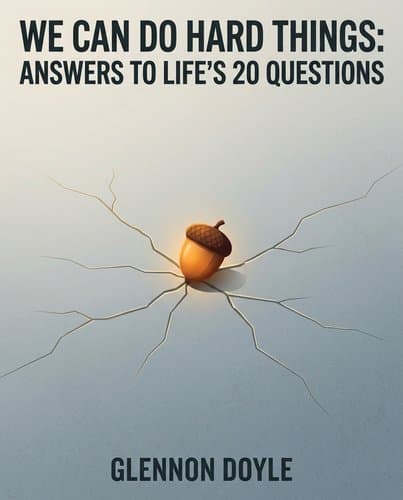
217481325_we-can-do-hard-things
by Glennon Doyle, Abby Wambach, Amanda Doyle
Every self-destructive pattern you've tried to fix is actually a childhood survival strategy still running in the background. Learn to decode what your…
In Brief
We Can Do Hard Things: Answers to Life's 20 Questions (2025) reframes self-destructive patterns, emotional struggles, and relationship conflicts as survival strategies formed in childhood rather than personal flaws. Drawing on psychology and personal experience, Glennon Doyle, Abby Wambach, and Amanda Doyle offer practical tools for decoding those patterns, setting boundaries, and making choices aligned with what you actually want.
Key Ideas
Ask what patterns protect you
When a self-destructive pattern appears, ask 'What was this protecting me from?' instead of 'How do I stop this?' — the answer will tell you what the part needs to finally update its information.
Your body knows what you want
To find out what you actually want, stop polling other people. Flip a coin, then notice which outcome your body is rooting for before it lands — the wish is already there.
Weathering aftermath is boundary practice
Before setting a boundary, prepare for what comes after the words: the guilt, the cold shoulder, the gossip. The boundary itself is easy. The 'strong little tree in a storm' part is the practice.
Sometimes you need a different life
Check whether you're looking for a better coping strategy or a different life. If everywhere you turn it hurts, no amount of breathwork fixes the briar patch.
Audit the brakes before accelerators
If low desire is the issue, audit the brakes before the accelerators: stress, mental load, body shame, and dissociation are the usual culprits — not a broken libido or insufficient love.
Reclaim your future through boundaries
Forgiveness doesn't require the other person. It requires you to stop handing them control over the shape of your future. The boundary comes first; the softening follows.
Body signals what's worth struggling for
The distinction between hard things worth staying for and hard things that require self-betrayal is the central navigation question. The body knows the difference — the jaw, the chest, the warmth or restriction.
Body is the tool, not the art
Your body is the brush, not the painting. Every hour spent managing its appearance is an hour not spent on the actual canvas of your life.
Who Should Read This
People working on personal growth in Self-Improvement and Mental Health, especially those tired of generic motivational advice.
We Can Do Hard Things: Answers to Life's 20 Questions
By Glennon Doyle & Abby Wambach & Amanda Doyle
13 min read
Why does it matter? Because the patterns you've been fighting as flaws are actually survival strategies — and that changes everything.
Here's the embarrassing thing: most of us spend years convinced we're the problem. The people-pleasing, the numbness, the inexplicable rage at someone watching a movie while you quietly dissolve — it all feels like evidence of some fundamental flaw. But what if none of it is a flaw? What if every exhausting pattern you've developed — the shrinking, the controlling, the running, the staying too long — was written by a kid who needed to survive a room that wasn't safe? We Can Do Hard Things starts there, with that reframe, and then goes somewhere most self-help books are too polite to follow: into the actual operating system. The one running quietly underneath every choice that feels like it's freely made. The question isn't what's wrong with you. The question is what that behavior was once protecting — and whether it still needs to.
Your Most Embarrassing Patterns Were Written by a Child Trying to Survive
Glennon Doyle spent years trying to quiet the part of herself that wouldn't let her eat — dismissing it, drowning it, willing it gone. Then one day she tried something different: she actually listened to it. And the part spoke. It said, roughly: your childhood home wasn't a safe place to have an appetite, so I kept us small and safe. That was my job. I was trying to protect you.
What Schwartz keeps finding, across decades of Internal Family Systems work, is counterintuitive: our most destructive patterns aren't character flaws. They're protection strategies built by a child who had no better tools. The eating disorder, the people-pleasing, the compulsive need to control everything in a ten-foot radius — these behaviors showed up because they worked. They were intelligent responses to real conditions. Then we grew up, the conditions changed, and the patterns didn't get the memo. They're still running rules from a house that is no longer unsafe, still standing guard over a person who is no longer a child.
Schwartz calls these patterns 'parts,' and when you try to silence one, it doesn't leave — it gets louder. It flails. It doubles down, because the only thing it knows how to do is protect you, and now you're also threatening it. The move that actually works is the one that feels least intuitive: turn toward it, ask what it's trying to protect, tell it you hear it. Parts that feel seen tend to relax. Parts that get suppressed tend to run the show from the basement.
You've probably felt this. The resentment you swore you were over that resurfaces the moment someone else gets to rest. The version of you that reaches for something numbing at the exact moment you needed to ask for help instead. None of that is you being broken. It's a small, frozen part of you doing its best with information that's thirty years out of date.
The path through isn't to fight it. It's to update it.
The Version of You Underneath All the Adaptations Is Intact
Sonya Renee Taylor opens with an image that's hard to shake. An acorn doesn't have to be taught to become an oak tree — everything it needs is already encoded inside it. It just needs fertile ground. The problem isn't that we were born incomplete. It's that enough people told us we'd make a better parking lot. Skin-lightening creams, media landscapes where you don't exist, family systems that rewarded compliance and punished need — these aren't character-building. They're paving. And now you're standing on concrete wondering why nothing grows.
The good news is that pavement isn't permanence. The acorn is still in there.
Richard Schwartz, the therapist who developed Internal Family Systems, arrives at the same place through a different image. Picture a long conference table. Every anxious, controlling, hiding, performing part of you is there, all talking at once, each convinced it should be running things. At the head of the table sits someone who has been quiet this whole time — your capital-S Self. Not a goal to work toward. Not an improved future version. Already there, already whole, running on curiosity and compassion rather than fear. This is the part that was never traumatized. The one no adaptation has managed to touch.
If you can notice a thought, you aren't the thought. The one doing the noticing — that quiet observer beneath the noise — is the self that no label, no role, no wound has ever actually reached. You've been in there since you were seven, looking out. The project isn't to become someone new. It's to stop paving over what was already good.
You've Already Lost Yourself — Here's How You Know
When did you last feel genuinely excited about something — not relieved it was finished, but actually lit up in anticipation of it? If you're struggling to answer, that might be the whole answer.
Glennon Doyle names a specific moment when she knows she's gone: when there's no longer any difference between catching up with a friend and completing a work project. Both are just items on the list. Both require something of her. Both get crossed off. That's the flat gray Groundhog Day test — when joy has been replaced entirely by relief, when every moment is a demand and there's no finish line in sight.
The 'digging deep' reframe is the detail that lands hardest. There's a version of this loss that wears a productivity badge — the person who always finds more capacity, who never says no, who somehow handles everything. Glennon used to tell herself she was someone who digs deep. What she eventually saw was that digging deep is just a flattering name for stealing soil from where it actually belongs: from sleep, from marriage, from peace, from the parts of yourself that aren't useful to anyone. You're not resilient. You're excavating your own foundation.
The clearest sign it's a pattern rather than a rough week: resentment starts showing up as a compass. Glennon found herself furious at Abby for watching a movie at two in the afternoon — a low-stakes, completely ordinary thing. The anger didn't make sense until she followed it. What it was pointing at, with a flashing arrow, was her own desperate need for permission to rest. Resentment, she realized, almost never concerns the other person. It concerns the thing you're starving yourself of and watching someone else enjoy.
The numb edge every evening, the life that requires constant coping — that's not stress. That's a pattern. And patterns don't fix themselves by working harder.
You Don't Need a Better Coping Strategy — You Need a Different Life
Imagine a turtle in a briar patch. Every direction it turns, thorns. So it develops strategies — ways to curl up, angles of movement that minimize the damage, workarounds that make the situation survivable. Now imagine a therapist watching all this and asking: 'Have you thought about getting out?'
That's the moment Brené Brown describes. She'd given up alcohol, cigarettes, overwork, the apple fritter — every coping mechanism she'd been using to tolerate her life — and found herself raw and exposed, every edge suddenly sharp. She went to her therapist and said: I'm a turtle without a shell in a briar patch. I'm going to need something. And her therapist, instead of handing her a better shell, pointed at the thorns themselves. The briar patch, she said, was partly the world — but it was also the relationships, the family dynamics, the environments she was choosing. You don't have to just survive it.
The entire self-care industry is premised on better shells: morning routines, journaling practices, breathing techniques, supplements that make the thorns sting less. But if the life underneath the coping is the actual problem, every strategy just keeps you functional enough not to change it.
Glennon found this out through alcohol. A glass or two in the evening took the edge off — the itchy, uncomfortable feeling that settled in when the day finally slowed down. Relief. But that edge, she eventually understood, was data. It was the sensation trying to tell her something needed to change — a relationship, a direction, a pattern. Numb it every night and you don't just lose the discomfort. You lose the signal. The edge that was pointing toward a different life goes quiet, and you stay.
The unlived life accumulates its own cost — and when you show children that love means slowly ceasing to exist, that's the inheritance you hand them. They learn what they're allowed to want.
Your Body Already Knows What You Want — You've Just Been Trained Not to Ask It
A woman was paralyzed between two futures — stay on the partner track at her law firm, or blow it up and go back to school. A friend held up a coin. 'Heads, you go to grad school. Tails, you stay. Call it.' The coin went up. Before it came down, the woman yelled: 'HEADS!' The coin never landed. It didn't need to. Her body had already voted.
That's the whole mechanism. The coin toss didn't generate the answer — it created a moment of pressure where the body couldn't wait for the mind to finish deliberating. The longing got loud before the logic could intervene.
Glennon describes a version of this she ran for years in reverse, shopping as some imagined future self who loves kale and parties and sequin jumpsuits. She'd RSVP yes to things the real her had never once wanted to attend, pack clothes she never actually wore, watch kale rot in the fridge. She thought she was being aspirational. She was refusing to ask herself the honest question. When she finally started RSVPing as the person who actually shows up — the one in sweatpants, skipping the party, eating Doritos — she got happier.
The work, then, isn't excavating some buried truth through years of careful reflection. It's shorter than that. Martha Beck's instruction: drop into the body. Not the brain running its cost-benefit analysis, not the group chat full of well-meaning people projecting their own fears. The body. What feels warm? What feels like a slow constriction? The right answer, Beck argues, produces a physical release — something settles, locks click, pieces fit. You can feel it if you haven't been trained out of feeling it.
The coin toss accelerates that process by force. It doesn't tell you what to want. It just yanks away the cover — the 'I'm still deciding,' the hedging, the polling — long enough for the body to speak before the mind can shush it.
The Hard Thing Worth Doing Is Different From the Hard Thing You've Always Done
Not all hard things are worth doing. That sounds obvious until you realize how much of your life might be organized around the belief that they are.
There's a particular kind of person — maybe you've met her, maybe you are her — who treats endurance as a virtue in itself. She stays. She pushes through. She has done every hard thing put in front of her, and the reward for all that staying has been more things to stay for. The insight that actually changes something isn't 'do the hard thing.' It's the one underneath: there are two entirely different kinds of hard, and only one of them is taking you somewhere worth going.
Glennon's friend Ashley walked into a hot yoga class and was told, within the first few minutes, that no matter how uncomfortable she felt, she was not to leave the room. So when the walls started closing in, when her vision went black twice, when she spent ninety minutes close to hyperventilating and swallowing back tears, she stayed. She did the hard thing. The moment class ended and the door opened, she ran to the bathroom and vomited. While cleaning up the floor on her hands and knees, she had the thought that landed like a small earthquake: the door was never locked. She had suffered voluntarily, silently, and for nothing — because an authority figure told her that leaving meant failing.
That story holds both lessons at once. Glennon calls the thirties version of herself a 'stay on your mat' person — and that was right then, because the discomfort of staying was building something, teaching her to tolerate difficulty rather than run from it. But the forties version learned something different: 'stay on your mat' becomes a trap when the room itself requires you to abandon your own body's signals. The hard thing worth doing builds you. The hard thing not worth doing requires you to stop trusting yourself in order to finish it.
The test is simpler than it sounds. Brené Brown's framework for boundaries makes it concrete: the hard part of setting one isn't the words — it's staying rooted while everyone around you has feelings about it. That discomfort, staying planted while the storm moves through, is the hard thing that leads somewhere. The discomfort of silencing what your body is telling you so that no one is inconvenienced — that's the other kind.
The question stops being 'why can't I push through this?' and becomes 'which kind of hard is this?' You'll need to answer it more than once.
Your Body Is Not Your Masterpiece — It's the Brush You Paint With
Body shame feels personal — the private reckoning between you and a mirror, a discipline failure, something to be worked through with enough acceptance practice or willpower. Here's what's actually true: it was engineered. It has a paper trail.
The BMI, the number that has made countless doctors lecture countless patients and justified decades of private dread, was invented by a Belgian astronomer in the 1800s. He wasn't measuring health. He was trying to mathematically define the 'ideal man,' using height and weight data collected from white French and Scottish soldiers. That's the whole dataset. Around the turn of the twentieth century, American insurance companies needed a mechanism to charge certain customers higher premiums, and the astronomer's formula gave them a respectable-sounding justification. The number moved from fringe statistical curiosity to medical gospel — and it remains there today despite being accurate at detecting obesity only about half the time, even among white people, the group it was built from. For Black and brown people, the margin of error is worse. The instrument doesn't measure what you think it measures. It measures whether you would have made a cost-effective insurance customer in 1900.
Once you see that, the emotional stakes of buying into it shift entirely. Your body shame isn't a failing that discipline or better self-acceptance work will fix — it's a rational response to being marinated since childhood in a system specifically designed to make you feel deficient. That's not your character. That's a product with a manufacturer.
The recalibration this suggests is less about loving your body and more about redirecting your attention. Your body isn't the masterpiece. It's the brush you use to paint your life — the instrument that carries your presence into rooms, makes things, loves people, shows up.
The Reason You Can't Enjoy Sex Has Nothing to Do With Desire
What if the absence of desire has nothing to do with how much you love someone — and everything to do with whether you're still on the clock?
Sex therapist and researcher Emily Nagoski offers a framework that reframes this almost instantly. The brain runs two parallel systems when it comes to sex: accelerators, which register signals coded as potentially erotic, and brakes, which register everything coded as threat — stress, shame, distraction, a to-do list that never ends. Most people, when desire goes quiet, assume broken equipment, a missing spark, something that used to be there and isn't anymore. What's almost always actually happening is simpler and more fixable: the brakes are on.
Hotel sex tends to be good sex. Not because a change of sheets unlocks desire, but because a hotel room contains none of the physical cues that keep the brakes engaged at home — no laundry pile, no school lunches un-packed, no bathroom that's been silently judging you for three weeks. Remove the environmental pressure and the system responds. The desire was always there. It just couldn't get past the weight.
There's a second distinction that's equally clarifying. Roughly three-quarters of men experience what researchers call spontaneous desire: a stray thought, a glance, and the brain signals interest before the body is even involved. About eighty-five percent of women experience desire the other way — it starts in the body, in response to pleasure that's already happening. Amanda Doyle, Glennon's sister and co-host, describes assuming for years that something was off with her because she didn't experience the spontaneous version. That assumption is almost universal among women, and almost universally wrong. Responsive desire isn't low desire. It's a different ignition sequence entirely — one that requires the brakes to be sufficiently off before it can run at all.
Forgiveness Is Not Something You Do for Them
For years after the affair, Glennon moved through the motions of forgiving her first husband — therapy, date nights, retreats, the whole recommended curriculum. And she waited. For the anger to dissolve, for something to click into place. But her body wouldn't cooperate. Every suggestion of intimacy produced an involuntary recoil she couldn't override. The loop in her head was relentless: how could he do this to me? Then one morning, the question shifted without warning. How can I do this to me? The betrayal she couldn't forgive, she realized, was her own. He had done his damage. She was the one still choosing to stay in a situation her entire body was rejecting. Divorce wasn't giving up on forgiveness — it was the condition that finally made forgiveness possible. Once she created that distance, the rage began to lift. Real softness returned. Not because he'd changed, or apologized differently, or done anything at all. Because she'd stopped betraying herself.
That's the whole mechanism. Forgiveness isn't something you perform toward the other person — it's something you do inside yourself, and it almost always requires a boundary first. Author and therapist Prentis Hemphill makes the structure exact: a boundary is the distance at which you can love both the other person and yourself at the same time. Without that distance, it's rage at yourself dressed up as tolerance.
What protective distance do you need before you can stop being at war with yourself? That's a question you can actually answer. The other person doesn't need to be in the room. They don't need to have apologized. They don't even need to know. The work is entirely yours, and so is the release.
Grief Doesn't End — It Moves In and Changes the Floor Plan
Think of grief the way you'd think of a house after a flood. The water recedes. But the house itself has changed — the foundation has shifted, and sometimes you'll open a door you haven't opened in months and find it still damp. You don't fix a flooded house by pretending the water was never there. You learn to live in the altered structure.
Carson Tueller, paralyzed from the neck down after an accident, spent years calling the day he was injured his 'death day.' The language had its own gravity — loss, derailment, the life he was supposed to have. Then his thirteen-year-old sister suggested something almost throwaway: what if we called it your rebirth day? He dismissed it on the spot. By the time he'd driven home, it had broken something open. He realized that the only thing that had objectively happened was that certain bones moved and hit his spinal cord. Everything else — the tragedy, the deviation, the stolen future — was interpretation he'd layered on top. And if he'd applied that interpretation, he could replace it. This is Plan A, he decided. The moment he meant it, entire behaviors became available to him: dating again, taking risks, walking up to strangers and asking them to carry him up stairs so he wouldn't miss something worth seeing. Not because anything external changed, but because the story he'd chosen to live inside of changed.
That's not toxic positivity — not a command to feel fine. Grief is real. Loss is real. And still: you get to assign what it means for what comes next. Grief doesn't leave. But the question shifts from 'when will this be over?' to 'what do I do with this, today?' That's the practice. Not once. Daily.
The Question Beneath Every Question
Here's what the whole book is quietly asking: not whether you can hold it together, but whether you can stop treating yourself like the problem. The parts frozen in old fear, the desires you've been polling other people about for years, the boundary you've been rehearsing since Tuesday — none of it needs a solution so much as it needs a witness. Someone, preferably you, to look at it and say: I see why you did that. What do you need now?
That's the practice. Not a finish line you cross once and stop. Something you return to tomorrow, and the day after, when the old pattern surfaces again and you catch yourself mid-reach for the glass. The question shifts — from why am I like this? to what do I do next? Small. Daily. Entirely yours.
Notable Quotes
“I trust that you are trying to help. What are you trying to protect? What are you trying to say?”
“You have to live every day as if it’s your last day.”
“What’s wrong with ordinary? Because I really, really want ordinary.”
Frequently Asked Questions
- What is "We Can Do Hard Things" about?
- "We Can Do Hard Things: Answers to Life's 20 Questions" reframes self-destructive patterns, emotional struggles, and relationship conflicts as survival strategies formed in childhood rather than personal flaws. The 2025 book by Glennon Doyle, Abby Wambach, and Amanda Doyle draws on psychology and personal experience to offer practical tools for understanding these patterns. Readers learn how to set healthy boundaries, decode limiting behaviors, and make life choices aligned with their authentic desires. The authors guide readers through recognizing that our struggles often stem from adaptive responses developed in childhood, which can be updated as adults.
- How should I reframe self-destructive patterns according to this work?
- When encountering self-destructive patterns, ask "What was this protecting me from?" instead of "How do I stop this?" The answer reveals what the affected part needs to finally update its information. This reframing shifts the focus from self-blame to understanding the protective function your pattern once served. Rather than viewing the pattern as a personal failure, this approach recognizes it as a survival mechanism developed during childhood. By identifying what threat or situation the pattern was guarding against, you can address the underlying need and consciously choose whether that protection is still necessary or helpful.
- What guidance does the book offer about setting boundaries?
- Before setting a boundary, prepare for what comes after the words: "the guilt, the cold shoulder, the gossip." The boundary itself is easy; the real challenge is maintaining it—being the "strong little tree in a storm"—through consistent practice. The book emphasizes that most people underestimate resistance that follows. Additionally, "forgiveness doesn't require the other person. It requires you to stop handing them control over the shape of your future. The boundary comes first; the softening follows." This reveals that effective boundaries combine clear communication with emotional resilience.
- How can I figure out what I actually want in life?
- To discover what you actually want, "stop polling other people. Flip a coin, then notice which outcome your body is rooting for before it lands—the wish is already there." This method bypasses overthinking and social conditioning by tuning into your body's immediate response. Your body knows your authentic desires before your conscious mind articulates them. Rather than seeking external validation or endless deliberation, this exercise trains you to recognize your inner knowing. The authors emphasize that clarity about desires emerges through connecting with bodily intuition, not through analysis.
Related Book Summaries
Read the full summary of 217481325_we-can-do-hard-things on InShort