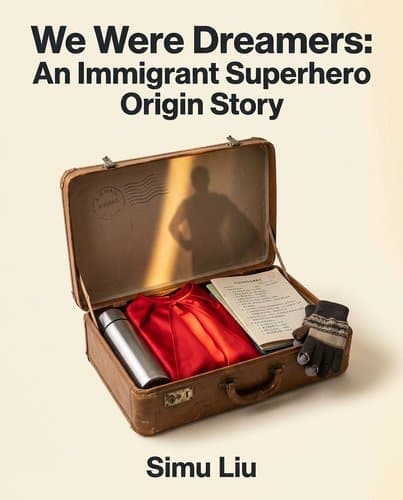
55507037_we-were-dreamers
by Simu Liu
Simu Liu maps the silent language of immigrant love—where "have you eaten?" means "I'd die for you"—and the terrifying freedom that arrives when you finally…
In Brief
We Were Dreamers: An Immigrant Superhero Origin Story (2022) traces Simu Liu's path from abandoned child of immigrants to Marvel superhero, exposing the hidden grammar of immigrant parenting and the cost of pursuing a life that was never yours.
Key Ideas
Read love encoded in parental action
Immigrant parents often encode love in action and imperative rather than words — 'have you eaten,' 'put on a jacket,' 'call me when you land.' Learning to read that frequency, rather than waiting for the words, prevents a lifetime of feeling unloved by people who never stopped trying.
What produces relief reveals career truth
When you perform competence in a career that feels wrong, your nervous system keeps score even when your conscious mind doesn't. Notice what you'd do for free, and what produces relief rather than pride when it ends — that gap is more reliable career data than any aptitude test.
Objective observers see your gifts clearly
The early evaluators who correctly read your natural strengths are often more accurate than the people who love you most. The assessor who told Simu's parents 'he could be a great writer' was right. The people who dismissed it were wrong. Pay attention to what consistently lights you up, not what you were trained to pursue.
Losing everything clarifies authentic ambition
Rock bottom clears the scoreboard. When you have nothing left to prove to anyone, you finally hear what you actually want — Simu felt immediate relief the morning after he was fired. That response told him more than four years of business school ever had.
Your community's belief precedes mainstream validation
Building a career in a space where people who look like you are systematically invisible requires finding the community that already exists before the mainstream validates it. That community's belief is unconditional in a way that studios, networks, and gatekeepers cannot replicate.
Your path honors your parents' deepest bet
Becoming yourself is not a betrayal of what your parents sacrificed for you. It may be its deepest fulfillment — what they actually wagered on was not a specific career path but the belief that their child could build a life worth living. Hold them to the spirit of the bet, not the letter of it.
Who Should Read This
Readers who connect with first-person stories about Memoir and Career Change and want to see the world through someone else's eyes.
We Were Dreamers: An Immigrant Superhero Origin Story
By Simu Liu
11 min read
Why does it matter? Because the people who loved you most and the people who shaped your deepest wounds are almost certainly the same people — and what you do with that is everything.
He has just been cast as Marvel's newest superhero. His friend mouths "say I love you" from off-camera. He says it twice. His parents don't say it back. All three of them laugh anyway.
What kind of love responds to "I love you" without saying it back? And why does a child shaped by that particular silence end up more driven, more hungry, and more himself than almost anyone raised on easy warmth?
This is the story of a family that sacrificed everything and said nothing — and a son who had to dismantle their dream of success to discover he'd been living their actual dream all along. It's devastating. It's also very, very funny. Sometimes those are the same thing.
Before You Were Born, Your Parents Had Already Bet Everything
On a December morning in 1977, Simu Liu's future mother, Zhèngzheng, arrived by open tractor at a testing facility outside Beijing, fifteen minutes late, her hands too frozen to grip a pencil. She'd traveled to that camp three buses and a dirt-path hike away, spent two years harvesting wheat, hauled textbooks on every trip back, and studied by flashlight under her blanket after lights-out. Her campmates laughed at her for it, telling her she was dreaming above her station. The exam she was about to take was the gaokao — China's national university entrance test, reinstated after a decade-long suspension — and her one shot at reclaiming the life her teachers had said she was born for. She bit back tears, breathed warmth into her fingers, and started writing.
She passed. One of four from her camp to be accepted, and the only woman.
Her future husband Zhenning got in through a different kind of gauntlet: his school pre-screened over three hundred students, selected eight, and drilled them in the principal's office for six weeks while classmates crowded the doorway at lunch to watch. Four were admitted. His verdict, decades later: "I was like a celebrity. It was the proudest moment of my life."
Simu — who would go on to play Marvel's first Asian lead — pressed him on that. "Prouder than when you found out your son was a literal superhero?"
"Oh yeah. For sure."
We Were Dreamers presents itself as an immigrant-kid-makes-good memoir, then spends its opening chapters insisting you look at who placed the original bet. Two specific people, with specific stakes, risked everything on a single exam before Simu Liu existed to inherit any of it. The superhero story comes later. This one mattered first.
Immigrant Parents Don't Say 'I Love You' — They Say 'Have You Eaten?'
July 2019. Simu Liu is on his kitchen floor in Toronto, FaceTiming his parents, his best friend Jason filming from just off-camera. His father has already taken the Shang-Chi news the way you'd take news that the dry cleaning is ready: "Oh... okay! That's good!" They discussed money. Now Jason mouths two words from behind the camera: Say I love you.
Simu knows what's coming. He says it anyway — twice, just to be sure. His mother: "Yes, go go go." His father, in the background: "Thank you for letting us know." Call ends. Both burst out laughing.
Liu's explanation is careful. His parents don't say those words. They express love by telling him to put on a jacket, by asking if he's eaten, by yelling when he doesn't study hard enough. He had made peace with this long ago, and then says, in the same breath, that it still would've been pretty nice to hear.
The gap between what immigrant parents give and what their children need to hear isn't a gap in love. It's a gap in frequency. Liu's parents left careers, language, family, and a country behind — the slow grinding sacrifice of two people betting everything on a better life for their kid. That sacrifice arrived in the form of imperatives, logistics, and presence rather than the three words the kid kept hoping for. The warmth is real. So is the distance.
The Same People Who Loved You the Most Can Hurt You the Most
Simu is sixteen and crying on his bed. He almost never allowed himself this — by that point he'd come to treat home like a battlefield, where showing feeling meant giving his parents leverage. But the arguing had gone on for days and he had nothing left. His father walked in, paused, surveyed the scene, and then dropped into a baby voice, bent toward him in a mock embrace: poor little boy, poor poor baby. Patting his back like he was burping an infant. Then left.
The adult Simu reaches for the generous read immediately: his father grew up genuinely hungry, in a country that demanded grit, and probably saw a spoiled Canadian teenager staging a breakdown for sympathy. Their adolescent hardships were not remotely comparable. But Simu also refuses to let the generous read do the whole job. No beating before or after hit as hard as that moment. His father saw him at his most raw and found a punchline.
Those were not indifferent parents, and this is where the story gets genuinely hard to hold. They had run a gauntlet before Simu was born: the gaokao, the immigration, years of graduate school poverty, a bamboo ceiling (the unspoken cap on how far Asian professionals could rise) that made them run twice as fast for the same ground. They bought Simu a Sega Genesis at full retail price when a kid down the hall got one first. They bought him a Thunder Megazord — five separate toys packaged as one — just because he wanted it. The love was real.
It was also structured entirely as a conditional. Liu renders this literally: his parents operated on an IF/THEN logic with no unconditional branch. Good marks, do nothing. Bad marks, berate. The system doesn't fail when it meets these inputs; it just misclassifies them as something it already knows how to process.
So when Simu lay on that bed and reached out the only way he could, by not performing, by just being a kid who was hurting, his father's system received an input it wasn't built for and returned a mockery. Not cruelty, exactly. Just a system with no other output available.
Performing Someone Else's Dream Is Easier Than Admitting You Have Your Own
There's a specific kind of lost that looks nothing like being lost. Simu Liu didn't stumble into accounting because he was lazy or obedient. He couldn't tell what he wanted, because years of conditional approval had trained him to mistake approval for desire. By the time he reached Ivey Business School, he was so fluent in performing the right answers that he had lost the ability to hear the wrong ones.
At the Ivey interview, the managing partner asks him to explain a 55 in corporate finance. He doesn't apologize. He walks through what went wrong, what he did about it, what came of it — then closes with the argument: the ideal hire isn't someone who never failed, it's someone who caught it and turned it around. He called this CARB — Context, Action, Result, Bring it back home — a fourth step he invented because CAR alone wasn't going to explain a 55. They called the next day with an offer. He'd answered selectively and would have been better suited for almost any other career. Neither fact interfered.
The trap snaps shut when the performance works. Once it works, there's nothing to interrupt the loop. He got the offer, moved into a downtown condo his parents helped finance, and showed up on his first day in a brand-new Hugo Boss suit. He lasted less than a year.
His Deloitte timesheet — reconstructed from memory, because the real ones contained too much honesty — documents the collapse in real time: "0937 to 1030: Went downstairs to pick up (and slowly eat) breakfast burrito." He was built for stages, someone who'd spent his adolescence chasing talent shows and microphones. Accountants are detail-oriented and machine-efficient. He wrote those timesheets with the same precision he could never apply to actual accounting. He was good at narrating his own failure, not preventing it.
During those same Deloitte months, he found a Craigslist posting wedged between ads for adult films and mud wrestling: ASIAN EXTRAS NEEDED FOR HOLLYWOOD FILM. He drove to a Toronto soundstage, got spray-painted blue, earned less per hour than his Deloitte rate, and would have paid double for the privilege. He forgot to confirm availability for the second shoot day and lost his spot. Same paperwork problem that was erasing him at the office, except this time he cared.
Losing Everything Was the Only Way to Stop Losing Himself
The night Deloitte fired Simu Liu, he stood on his forty-sixth-floor balcony and ran a ledger. He was twenty-two years old, had lasted eight months at one of the world's largest accounting firms, and had just destroyed everything his immigrant parents spent two decades building. The numbers organized themselves with the kind of precision he'd never managed at work: $250,000 in education costs. $410,000 for the downtown Toronto condo, down payment fronted entirely by his parents. $500 per month he'd been sending them toward the mortgage — what he now describes as "stupidly little." He couldn't even cover that anymore. Standing above the city, he wondered whether he'd lose consciousness instantly if he hit the pavement below, or lie there for a while.
Then he went to sleep.
The next morning, he woke up, remembered he didn't have to go to work, and felt immediate relief. Not grief. Not panic. Relief. By noon, he was scanning Craigslist for acting gigs.
This is the thing about living a life that isn't yours: you can tell yourself any story you want about why you're staying, but your nervous system keeps the actual record. Simu had spent years performing the son his parents needed: the Ivey Business School graduate, the Hugo Boss suit, the audit spreadsheets. His nervous system had been filing a counter-argument the entire time, and the moment the external structure fell away, it surfaced in about twelve hours. He didn't decide to become an actor. He just stopped being forced to be anything else, and noticed what he reached for first.
What he reached for was an audition for something called Bike Cop Begins. An indie film by a guy named Jeff who shot on a DSLR and planned a franchise. Simu played a Japanese mob boss delivering gibberish dialogue in a fake accent that he admits sits somewhere between Mickey Rooney's infamous yellowface turn in Breakfast at Tiffany's and full catastrophe. Jeff laughed. For the first time in a year, the math of Simu's life felt correct. Within weeks, two bookings arrived — a telecom commercial, two lines on the CW show Nikita — and he'd made more than $10,000 in ten days.
His father called about a large deposit in their linked bank accounts. That was the severance package. Simu said it was a study-leave bonus. His father mentioned he'd been worried about a layoff. "I've never been better," Simu said.
Both things were true. He had just lost everything his parents had built for him. For the first time in his life, he was building something for himself.
Becoming Yourself Is a Collective Act, Not a Solo Journey
What finally gave Simu Liu permission to stop proving he deserved to be there? Not a better audition, not one more year of hustle. A stranger who responded to a cold Twitter DM within minutes.
In 2017, during his first LA pilot season, Simu knew virtually nobody. Two years of institutional rejection had already stacked up: visa rules that killed booked jobs, an agency partner who fetched him water and disappeared, a casting note relayed through several hands that he lacked an "it factor." The industry kept delivering the same message his family always had: you haven't earned the right to take up space here.
Then Simu messaged Ken Jeong on Twitter, figuring he had nothing to lose. Jeong responded within minutes — not with a vague "let's chat sometime," but with parking instructions and a drive-on pass to Sony Pictures in Culver City. Show up whenever. Rehearsals, table reads, live tapings. After audience nights, Jeong's assistant would text Simu to come to the dressing room. Simu says Jeong was the kindest presence he encountered during those dark months. Then he adds that he has never actually told Ken that directly.
Sit with that for a second. The thing that mattered most, he couldn't say aloud: the same gap as every FaceTime call home, except running the other direction. What Jeong gave him wasn't a networking favor. It was recognition without a prerequisite. Every studio gatekeeper who had left him waiting in a boardroom was running the same conditional logic his family ran: earn it first, then you belong. Jeong's text came before any of that.
From Jeong the network expanded to an Asian Pacific entertainment coalition, then Philip Wang of Wong Fu Productions. Wang had built three million YouTube subscribers by going around the studios entirely: no development deals, no network notes, no waiting for permission. His audience funded the work directly. What that showed Simu wasn't a business model. It was a reframing. Asianness wasn't a handicap to smooth over for mainstream acceptance. It was, as Wang put it, a superpower. The three million subscribers were the proof.
His family had always required him to justify his presence: grades, promotions, achievements, something concrete to show for taking up space. This community started from the opposite assumption — that he was already enough, and that the work would follow. That's what it cost them to do it: nothing. Which is exactly what made it so hard for him to name.
The Immigrant Dream and the Superhero Dream Were Always the Same Dream
The people who finally gave him unconditional space were strangers. And once he had it, he could hear what his parents had been saying all along. The immigrant and the dreamer look like opposites — one speaks sacrifice and survival, the other passion and risk. The immigrant drills their child in piano and calculus. The dreamer sneaks off to auditions. The whole book reads like a standoff between these two impulses, until the night before the Shang-Chi screen test, when Simu calls his parents from a New York hotel room and they collapse into exactly the same thing.
He'd been running the numbers all night: not the tallest, most handsome, buffest, or best martial artist of the candidates. Seven years of auditions and he still didn't know what made him worthy of the biggest role in his industry. He called his parents, told them everything: the callbacks, the Marvel secrecy, the stakes. Their response wasn't inspiring. It wasn't a speech. His father said they'd be by his side no matter what. His mother said it was only a matter of time. The words were so plain they almost passed unnoticed.
But they steadied him. His parents hadn't suddenly learned eloquence. He'd finally learned to listen. Every exam crammed by flashlight. Every dinner assembled from whatever they could afford in Kingston. Every year worked under a bamboo ceiling (the unspoken limit on how far Asian professionals could rise, regardless of their record) that rewarded less than it owed. All of it was a bet on a future they couldn't see, made by people with no guarantee it would pay. They didn't call it faith. They called it logistics.
The next morning, when Simu stood on a Brooklyn soundstage with the Avengers soundtrack in his headphones, he wasn't defying his parents' dream. He was executing it. That bet (two continents, sixty years, meals from the discount section) had always pointed here: everything staked on an impossible future, by people stubborn enough to believe it could be real.
He took a breath. The director called action.
The Bet Your Family Made Before You Were Born
Awkwafina leans over on that Brooklyn soundstage and tells him he's gonna fucking rock it. The director calls setup. Sixty years of family history — Harbin winters, Kingston apartments, ground beef from the discount bin — compresses into the two seconds before action.
You already know what his parents couldn't say. Some families say it. His family did it. The wager placed in Harbin, doubled in Kingston, and cashed in on a Brooklyn soundstage — three generations of the same impossible bet, finally paid.
Notable Quotes
“It's so good to meet you, Simu! You're gonna fuckin' rock it, dude.”
“I take a deep breath, fill my heart with gratitude . . . and prepare to face my destiny.”
“Hey, Simu. Have a seat.”
Frequently Asked Questions
- What is 'We Were Dreamers' about?
- This memoir traces Simu Liu's transformation from an abandoned immigrant child to Marvel superhero, exposing the hidden grammar of immigrant parenting. The book teaches readers how to read love encoded in action rather than words, recognize the career your body already knows you want, and understand that becoming yourself fulfills—rather than betrays—your parents' sacrifice. Liu weaves personal narrative with practical wisdom about identity, belonging, and the immigrant experience in America.
- What does 'We Were Dreamers' teach about finding your true career?
- According to Liu, when you perform competence in a career that feels wrong, 'your nervous system keeps score even when your conscious mind doesn't.' Instead of relying on aptitude tests, 'notice what you'd do for free, and what produces relief rather than pride when it ends — that gap is more reliable career data.' Early evaluators who correctly read your natural strengths are often more accurate than family members. Pay attention to what consistently lights you up.
- What does 'We Were Dreamers' reveal about immigrant parents and love?
- Immigrant parents often encode love in action and imperative rather than words—'have you eaten,' 'put on a jacket,' 'call me when you land.' 'Learning to read that frequency, rather than waiting for the words, prevents a lifetime of feeling unloved by people who never stopped trying.' Liu emphasizes that this hidden grammar is crucial for second-generation immigrants. Recognizing this pattern helps validate that parents who never spoke affection were always trying to care for you.
- Is pursuing your own path a betrayal of your parents' sacrifice?
- No. According to Liu, becoming yourself is not a betrayal of what your parents sacrificed for you. What parents wagered on was not a specific career path but the belief that their child could build a life worth living. 'Hold them to the spirit of the bet, not the letter of it.' When 'rock bottom clears the scoreboard,' 'when you have nothing left to prove to anyone, you finally hear what you actually want.' Liu felt immediate relief after being fired, revealing his true direction.
Related Book Summaries
Read the full summary of 55507037_we-were-dreamers on InShort