44288534_what-is-a-girl-worth
by Rachael Denhollander
Predators don't succeed because they're impossible to stop—they succeed because the institutions around them quietly decide silence is cheaper than…
In Brief
Predators don't succeed because they're impossible to stop—they succeed because the institutions around them quietly decide silence is cheaper than accountability. Rachael Denhollander's decade-long fight to expose Larry Nassar is a precise, devastating account of how that calculation gets made, and how one person can force it to break.
Key Ideas
Action matters more than belief
When you hear an abuse disclosure, the relevant question isn't 'do I believe them?' — it's 'what am I going to do with this information?' Jackie believed Rachael. She still sent another girl to Nassar.
Grooming weaponizes trust against witnesses
Grooming doesn't isolate victims from witnesses — it turns witnesses into unwitting validators. A parent in the room can be used as proof the abuse isn't happening, if trust has been weaponized correctly.
Silence indicates effective institutional cover-up
The absence of prior complaints should raise suspicion, not provide reassurance. When an abuser has institutional power, prior complaints get buried. Silence is evidence of effective cover, not of innocence.
Healing language replaces actual accountability
Any institution can invoke the language of healing, forgiveness, and moving forward to avoid accountability. Real accountability requires specific named changes — not expressions of sorrow that include no admission of wrongdoing.
Last reporter's fate reveals institutional priorities
When evaluating whether to trust an institution with vulnerable people, ask: what actually happened to the last person who reported abuse here? The answer reveals more than any policy document.
Structural change requires more than courage
Individual courage can stop one predator. Only structural change — mandatory reporting laws, independent oversight, removal of self-investigation — prevents the next one. Conflating the two lets institutions claim credit for survivors' work without doing their own.
Who Should Read This
Readers who connect with first-person stories about Memoir and Social Issues and want to see the world through someone else's eyes.
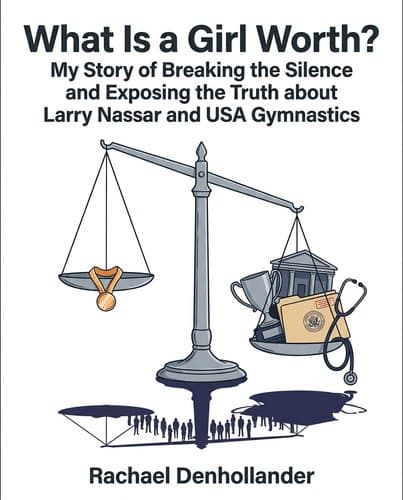
What Is a Girl Worth?: My Story of Breaking the Silence and Exposing the Truth about Larry Nassar and USA Gymnastics
By Rachael Denhollander
10 min read
Why does it matter? Because the question "why didn't she speak up?" is how institutions stay protected while survivors stay silent.
The question most people ask about abuse cases is the wrong one. Why didn't she say something sooner? That assumption, that speaking up was the missing piece, is exactly what this book dismantles. Rachael Denhollander spoke to a gymnastics coach. She spoke to that coach's boyfriend, a police officer who ran every available channel. Sixteen years later she sent an email to a newspaper. She was never silent. What she encountered, each time, was a quiet trade-off: the cost of accountability against the cost of looking away, decided consistently in favor of silence. This book is the forensic record of how that bargain operates — from the teenager who can't name what's happening to the county prosecutor who tries to trade every sexual assault charge for a plea deal. By the end, you won't be asking why no one spoke. You'll be asking who was listening.
She Did Speak Up — the Problem Was Never Silence
Rachael Denhollander went to her coach Jackie and described what Larry Nassar had done in precise clinical detail: he had groped her bare breast while her mother sat in the room; he'd had an erection he'd managed to hide. She was a gymnastics coach herself by then, and one of her young gymnasts was scheduled to see Nassar, a USA Gymnastics team doctor who had abused Rachael for years under the cover of medical treatment. She chose Jackie deliberately: credibility in the gymnastics community, and a boyfriend in law enforcement who understood how predators operated. Rachael had been trained from childhood to use her voice. Her parents gave her scripts for confronting bullies and made her practice until the words came automatically.
Mike ran every channel available to him. He found zero prior complaints about Nassar. He and Jackie took that as reassurance.
They sent the child to see Nassar anyway. Jackie then warned Rachael not to say anything further — the gym owners were close with Nassar, and speaking up could go badly for her.
What Mike's search actually found wasn't evidence that Nassar was innocent. It was evidence that every other person who had spoken up had also been shut down. The absence of complaints was proof of a system working exactly as designed. Rachael cared about these girls. Jackie and Mike cared about doing right. And still nothing moved. That was the real story — not one predator, but the network of people who heard, weighed the cost of acting, and stayed quiet.
He Did It With Her Mother Watching
She was sixteen. Rachael's mother was sitting two feet away, chatting with Larry Nassar about chemistry homework, when Rachael felt something was wrong.
She was lying face-down on the exam table during what she understood to be soft-tissue treatment for her back. Nassar had been treating her for over a year — this Olympic team physician who had diagnosed injuries five other doctors had missed, who greeted patients with hugs and walked them to the waiting room himself. He was not a predator anyone worried about. He was the doctor parents prayed their daughter could see.
Then he moved her. Without explanation, he slid her body away from her mother's line of sight and rotated her to face him. His breathing had changed: faster, audible. His face was flushed. She looked down and registered what she saw in his clothing. Her mind ran through the only framework she had: He's the doctor USA Gymnastics trusts with the Olympians. He does this every single day. If there was something wrong, someone would have stopped him. Wouldn't they?
That logic wasn't naivety. It was the product of eighteen months of constructed evidence. Nassar had remembered her coach's name, praised her boots, asked after her siblings' science lessons. He'd diagnosed a stress fracture an orthopedist had missed twice. He'd once waived a bill because she needed the help. He'd brought his newborn daughter to the office so Rachael could hold her. Every act of genuine warmth served the same function: it made the idea that anything was wrong feel like the paranoia of an overwrought teenager. Only a dirty mind would sexualize a medical exam, Rachael told herself when her mother later asked pointed questions.
Her mother's presence in the room was the final piece. The exam wasn't hidden: lights on, parent seated two feet away. This is what grooming achieves at its most sophisticated level: not secrecy, but a framework so thoroughly built that everyone in the room interprets what they observe through the abuser's lens. Nassar could abuse Rachael with her mother watching because he had already taught both of them what they were supposed to be seeing.
Some months later, Nassar treated a teammate with Rachael in the room. She could see his right hand working across the girl's back while his left moved beneath a towel, out of sight. Her reaction was relief — she hadn't realized how discreet he could be. The concealment read as professionalism, a physician protecting a patient's privacy during sensitive treatment. Someone who had been abused repeatedly watched it happen to a person she cared about, and experienced it as evidence of his competence.
That is what a closed system looks like from the inside.
Good Intentions Are Not the Same as Protection
Years later, after a newspaper investigation made formal reporting possible, Rachael called Jackie to warn her that investigators would need to speak with her. Jackie's response: she'd always believed Rachael. She'd just figured that if it were really serious, Rachael would have done something about it.
Rachael didn't say what she was thinking: I did. I told you. Through you, I told a police officer. And you sent another gymnast to him anyway.
"Believed" is the tell. Jackie believed Rachael but still acted as though she didn't — because the framework she was using made the abuse, however real, inconsequential. Serious wrongdoing produces complaints. No complaints means nothing serious. She had applied the logic correctly. The problem was the logic itself. Nassar's power lay in building a system where no complaint could survive — which means "no prior complaints" was evidence of the system working, not of innocence.
Jackie wasn't covering for a predator. Mike wasn't corrupt. They cared. They checked. They acted on the evidence available, through the only framework they had — and a child was placed in a room with a man Rachael had told them abused her. Good intentions inside a broken framework produce the same outcome as malice inside a working one.
Every Institution Did the Math and Chose Silence
On October 4, 2016, Rachael Denhollander was helping a friend choose homeschool books and managing three small children when a county prosecutor in Michigan slid a case file across a conference table and said he couldn't pursue it — it was full of holes. His proposal: let Nassar plead guilty to child pornography charges under state law, lighter penalties, and in exchange, every sexual assault charge would disappear. All of them. For every woman who had come forward. It would be clean, he argued. Quick. Survivors, he added, might not be strong enough to withstand a trial anyway.
A calculated institutional decision doesn't look like an oversight or a missed report. It looks like a room full of people who understood exactly what they were doing and chose the path that required the least from them.
Police Chief Jim Dunlap refused. He picked up the phone and called the state attorney general directly, who sent a prosecutor named Angela Povilaitis. She read through the files and said she would take every case. Michigan State University's president, separately contacted by the local prosecutor who wanted Dunlap to stand down, told him to proceed however he needed to. The case moved to the attorney general's office, and Nassar eventually faced the full weight of every charge.
Rachael didn't know any of this was happening. She found out about developments in her own case from journalists.
That gap, between what was being decided and who was told, was its own kind of institutional choice. While Nassar was under investigation, Michigan State University paid hundreds of thousands of dollars to PR firms to monitor survivor social media accounts. The university also hired private investigators: not to understand how a predator had flourished on its campus for decades, but to contact survivors' former partners, disclose their identities to employers, and falsely threaten subpoenas to pressure women into naming other victims. MSU had received formal complaints about Nassar in 1999 and 2000 and cleared him both times. The same institution was now running an organized campaign to discredit the women who had finally been believed.
Michigan State wasn't the only institution running that calculation. In 2015, the FBI received a criminal referral about Nassar and sat on it for fourteen months, long enough for him to treat hundreds more patients. The agent overseeing the case, Jay Abbott, was applying for a job with the US Olympic Committee while the investigation stalled, with USA Gymnastics CEO Steve Penny's recommendation.
The question each institution kept trying to answer was not what happened here? It was how do we contain this? Those are not the same investigation, and they don't produce the same result.
Getting Believed Requires You to Know the Law Better Than Your Abuser Knew Medicine
When the Indianapolis Star made contact and formal reporting became possible, she was awake until 2 a.m. pulling up the Michigan Penal Code. She discovered she had miscategorized the crime for sixteen years. She had always understood what Nassar did as groping — still serious, but subject to a ten-year statute of limitations she'd already watched expire. The penetration changed everything. It made the assault first-degree, and Michigan had removed the statute of limitations on first-degree criminal sexual assault before her original reporting window closed. She could still file.
Rachael Denhollander's path from survivor to complainant required something most people don't consider: she had to become an expert in the law governing her own assault and the medicine surrounding the alleged treatment, while raising three children under five.
She spent weeks building the case she expected to need: she located two physical therapists with expert credentials in pelvic floor treatment, both of whom confirmed independently that nothing Nassar had done resembled legitimate therapy. She filed both a police report and a parallel Title IX complaint (the federal rule requiring universities to investigate sexual misconduct), then drove to MSU's campus for a forensic interview in which she had to answer questions like "how many times did he penetrate per minute" with sustained eye contact and clinical precision.
Then she reviewed the materials Nassar submitted in his own defense: videos, PDFs, and a PowerPoint slide deck from his medical lectures. The techniques were external and explainable. Nothing she'd experienced. The slide deck ended with a video set to Star Trek's theme music, his own title card reading "Pelvic Floor — The Final Frontier... To boldly go where no man has gone before (in most of our young gymnasts — hopefully)." A joke, in a medical lecture shown at conferences, with photos of barely-clothed girls on every slide.
And then the answer to something she hadn't thought to research: Nassar denied ever performing internal pelvic floor therapy. Not claiming it was legitimate. Saying it never happened. Which meant only one thing — he had never been trained in it, never qualified to perform it.
She had spent sixteen years wondering at what point she crossed from patient to victim. She had her answer: from the very first moment.
The Sentencing Was Real Justice. The Systems Are Still Standing.
On the last day of the sentencing hearing, nearly forty minutes into her turn at the podium, Rachael stopped addressing Larry Nassar and turned to face the watching world.
This is what it looks like when adults don't respond properly to disclosures of abuse. This is what it looks like when institutions build cultures where predators operate without fear. This is what it looks like when enablers face no accountability.
The repetition was calculated, prosecutorial. For seventeen months Rachael had catalogued every institutional failure: the Title IX coordinators who cleared Nassar, USAG that filed abuse reports in a cabinet instead of reporting them, the detective who never consulted an outside medical expert. The point was to strip away the alibi of ignorance. You've seen it. You can't unsee it.
Judge Aquilina sentenced Nassar to forty years minimum, up to 175. He would never treat another child.
That was real. Then the next chapter started.
Within a week, MSU installed former Michigan governor John Engler as interim president over faculty objections. In a private meeting with survivor Kaylee, Engler asked how much money she wanted: $250,000? When she said she wanted accountability, not a check, he told her that Rachael had already met with him and named a figure. Rachael had never met him. When mediation began, MSU's opening offer matched the exact number Engler had floated to Kaylee in private.
Rachael and a fellow survivor spent months moving a package of victim-protection reforms through the Michigan legislature. The Senate passed it. The House killed the most critical provisions the same day MSU reached a financial settlement with no admission of wrongdoing.
The calculation that had protected Nassar for decades — measure the cost of acting, choose the path of least exposure — hadn't changed. Only the names had.
The Answer to Ellianna's Question
The 150 women photographed together outside the courthouse after sentencing are not there because one man was unusually evil. They're there because, at each decision point — a coach weighing gym politics, a prosecutor eyeing a lighter plea, a governing body filing abuse reports in a cabinet drawer instead of reporting them as the law required — someone ran the numbers and found that protection cost more than silence. That math held for decades. What Rachael Denhollander spent her adult life insisting, from a law school couch where she first researched whether a prosecution could even exist to a courtroom microphone, is that the math is wrong — that goodness is real enough to anchor a different calculation entirely. Nassar will die in prison. The systems that produced him are mostly still standing. But 150 women are on record, named, believed. Rachael's daughter will grow up knowing their names. That's not enough. It's also not nothing.
Notable Quotes
“How does one get to be Larry? What makes a person become what Larry is?”
“A Blind Eye to Sex Abuse: How USA Gymnastics Failed to Report Cases.”
“Community protectionism. Everyone hates abuse and doesn't want it covered up—until it happens in their own community, and then it's”
Frequently Asked Questions
- What is 'What Is a Girl Worth?' about?
- Rachael Denhollander's 2019 memoir documents her fight to expose serial abuse by Larry Nassar and the institutional silence that protected him within USA Gymnastics. The book demonstrates how grooming implicates bystanders as unwitting enablers of abuse and argues that lasting protection requires structural reform—including mandatory reporting laws and independent oversight—rather than relying solely on individual courage. Through Denhollander's personal story, the book reveals how institutions manipulate language around healing and forgiveness to avoid accountability while survivors carry the burden of exposing wrongdoing.
- What does Denhollander reveal about how witnesses enable abuse?
- The book shows that grooming doesn't isolate victims from witnesses—it turns witnesses into unwitting validators. A parent in the room can be used as proof the abuse isn't happening if trust has been weaponized correctly. Denhollander illustrates this with the example of Jackie, who believed her account but still sent another girl to Nassar. The key insight is that when you hear an abuse disclosure, the relevant question isn't 'do I believe them?' — it's 'what am I going to do with this information?' Trust in the abuser becomes a tool against protective action.
- How does Denhollander explain the absence of prior complaints?
- Denhollander argues that the absence of prior complaints should raise suspicion, not provide reassurance. When an abuser holds institutional power, prior complaints typically get buried rather than documented. Silence is therefore evidence of effective cover-up, not proof of innocence. She challenges the assumption that a clean complaint history indicates safety. Institutions often rely on this reasoning to reassure the public, but Denhollander shows how structural incentives that protect powerful predators ensure complaints remain hidden. This reverses common institutional logic: a troubling history of silence suggests protection mechanisms are working to hide abuse.
- What does Denhollander say about institutional accountability versus individual courage?
- The book distinguishes between individual courage—which can stop one predator—and structural change needed to prevent the next one. Individual courage can stop one predator. Only structural change — mandatory reporting laws, independent oversight, removal of self-investigation — prevents the next one. Conflating the two lets institutions claim credit for survivors' work without doing their own. Real accountability requires specific named changes and admission of wrongdoing, not expressions of sorrow. She urges evaluating institutions by asking what actually happened to the last person who reported abuse there—the answer reveals more than any policy document.
Related Book Summaries



Read the full summary of 44288534_what-is-a-girl-worth on InShort