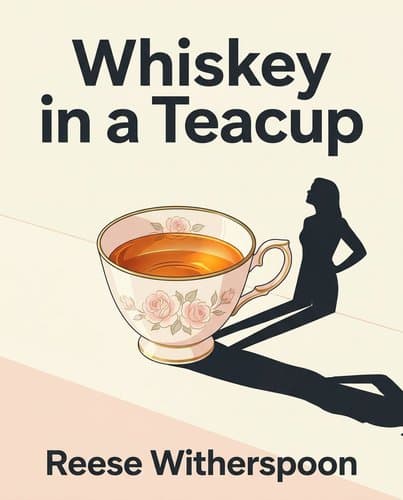
40009804_whiskey-in-a-teacup
by Reese Witherspoon
Southern hospitality isn't softness—it's infrastructure. Reese Witherspoon reveals how the recipes, rituals, and handed-down habits of gracious living aren't a…
In Brief
Whiskey in a Teacup (Sept) draws on Reese Witherspoon's Southern upbringing to argue that domestic rituals — hospitality, recipes, handed-down habits — are not a retreat from ambition but the foundation that sustains it. It offers practical guidance on hosting with genuine consideration, navigating grief with action over perfect words, and treating everyday traditions as seriously as any professional goal.
Key Ideas
Food sustains grief longer than flowers
When someone you know is grieving, bring food instead of flowers — flowers wilt and remind people of loss; food feeds the people who keep showing up at the door, and it can be frozen for later when the initial flood of visitors has passed.
Imperfect presence beats waiting for words
Make the condolence call before you have the right words. What matters is showing you care, not saying something perfect. Showing up imperfectly beats the silence of waiting until you're certain.
Recognizing wrong paths early is talent
Learning what you're bad at is as valuable as discovering your strengths. Being told to stop singing at thirteen freed Witherspoon to become the actress she was — recognizing the wrong path early is its own kind of talent.
Hospitality means noticing who feels unseen
Design your gatherings so every person feels considered — including the non-drinker who needs something festive in hand, the guest who arrived not knowing anyone. Hospitality is the practice of noticing who might be on the edge.
Treat domestic rituals as seriously as ambition
Treat the domestic rituals you keep with the same seriousness as professional ambition. They aren't consolation for public life — they are the infrastructure that makes public life possible.
Memory needs a container of joy
Find the cheerful thing that carries the people you've lost forward — a recipe, a restaurant booth, a Sunday afternoon ritual. Memory needs a container, and it doesn't have to be a solemn one.
Who Should Read This
Readers who connect with first-person stories about Memoir and Family and want to see the world through someone else's eyes.
Whiskey in a Teacup
By Reese Witherspoon
8 min read
Why does it matter? Because the recipes Reese Witherspoon's grandmother left behind are also her philosophy of how to be fierce in the world.
The recipes here have the weight of things that got made every Sunday: biscuits cut at the right angle, a tablecloth that earned its ironing, tea sandwiches pressed until the filling stays put. Pick this up expecting a Southern lifestyle primer (pretty tables, passed-down recipes, celebrity nostalgia) and you wouldn't be entirely wrong. Those things are here. But the phrase the whole book is built on didn't come from a brand. It came from a woman named Dorothea, who earned one of the first master's degrees given to a woman at Vanderbilt, believed in civil rights when that cost something, and spent her working life teaching first grade because the era shut every other door in her face. What she built at home — the rituals, the recipes, the habits she handed down — wasn't a consolation prize for ambition. It was its continuation. That's the book's quiet, radical argument. By the end, you'll look at a recipe card differently: not as nostalgia, but as a record of what one woman chose to carry forward.
The Voice That Saved You in the Boardroom Was Somebody Else's First
Late twenties. Reese Witherspoon is in a room full of men when someone asks how she wants to handle a difficult decision. Something surfaces — a voice she didn't know she had. She told them she was a lady, and she'd handle it like one. The men had never heard anyone say that before. Neither had she.
She traced the voice instantly. It belonged to her grandmother Dorothea.
Dorothea had a master's degree from Peabody College at Vanderbilt, one of the first women to earn one there. She believed in civil rights and had mapped out a life that would take her across the world. The era said otherwise. She became a first-grade teacher in Tennessee. She never traveled.
What Dorothea did instead was build a philosophy. She called it "whiskey in a teacup." Southern women, she said, look delicate on the outside, the surface all careful manners and warm hospitality, but the interior is strong and fiery. That hospitality, she insisted, was never performance or martyrdom. It was modeling: treat everyone with grace and respect, live by the Golden Rule, refuse to abide cruelty.
Typed out, it sounds like something you'd cross-stitch on a pillow. It wasn't. It was the worldview of a woman who had ambition for a large life and found herself in a small one, and who chose, instead of bitterness, to distill everything she knew into the people around her. The fierceness had to go somewhere.
It went into Witherspoon. So completely, so quietly, that it surfaced in a boardroom thirty-something years later before she consciously knew it was hers. She sat up straighter. She lifted her chin. And she handled it like a lady — which, in Dorothea's vocabulary, meant she handled it with both grace and iron. That's how the philosophy traveled: in a copy of Mrs. S.R. Dull's Southern Cooking inscribed Decatur, Georgia, May 1942, splattered from use, index cards in Dorothea's handwriting tucked inside for variant fried chicken recipes, looking like a cookbook right up until the moment it became something else.
Grief Needs a Container, and Southern Women Chose Pie
Every Thursday, when her parents worked late, a young Reese Witherspoon and her brother arrived at Miss Betty's, a small restaurant in Nashville's Sylvan Park, with their grandparents, always at five o'clock. The ritual had a fixed opening: "Miss Betty, what pies do you have today?" Miss Betty would recite eight, sometimes nine pies baked that day, lemon meringue to Mississippi mud, each one topped with a meringue that climbed impossibly high.
The chapter where this memory surfaces is technically about a layered chocolate trifle: Cool Whip, instant pudding, crushed Oreos, chocolate cake crumbles stacked in a fancy dish. Witherspoon flags the guilty pleasure upfront and waves off the snobs. The recipe is a carrier, not the cargo.
After her grandmother died, Witherspoon brought her own children to Miss Betty's. She'd held herself together until Miss Betty pulled her into a hug — and then something gave way. What undid her wasn't the embrace. It was what Miss Betty said: every Thursday since those dinners, she had been thinking about Witherspoon and her grandparents. All those years. That family had lived in someone else's memory long after the ritual ended.
Miss Betty has since died too. The restaurant is gone. What remains is the dessert, and now Witherspoon can't encounter a cheerful layered trifle without Miss Betty entering the room. The object carries the relationship.
Southern women encoded meaning into the act of making — a recipe, a fixed time, a ritual greeting — because that was a domain they controlled. The encoding holds. When Witherspoon makes the trifle now, she re-enters the relationship; Miss Betty is still present. A cheerful dessert is where the mattering lives.
The fried chicken chapter offers a different version of the same inheritance. Rummaging through old papers, Witherspoon finds her grandmother Dorothea's copy of a Southern cooking manual from 1942: worn, stained, stuffed with handwritten index cards of fried chicken variations in Dorothea's handwriting. The recipe Witherspoon now makes synthesizes all of them. Dorothea never handed it down in person. She left the cards, and following them is enough — a way of being in the kitchen together, across the decades, across death.
The Most Politically Significant Rooms in Southern History Were Called Beauty Parlors
The spaces where women gathered to fix their hair were among the most politically productive rooms in twentieth-century American history. Witherspoon makes this claim inside what looks like a chapter about hot rollers and a Steel Magnolias acting masterclass — which is part of why it lands so cleanly. Nobody was guarding the door.
She grew up watching her grandmother keep a standing Tuesday appointment at the salon, and she absorbed, sitting there, what women actually talked about when nobody expected them to matter: community plans, big dreams, fury, organizing. "It doesn't have to be true to be told," her mother said about salon conversation — but the historical record suggests plenty of it was true, and some of it changed the country.
Nashville is one case. Diane Nash, a Fisk University student, organized the nonviolent sit-ins in 1960 that desegregated downtown Nashville's lunch counters. Madam C.J. Walker built the first American female self-made fortune through hair care products for Black women, then turned that wealth toward a YMCA, the NAACP, and thousands of Black women employed as sales agents across the country. Tiffany Gill's Beauty Shop Politics documents exactly this: for the women who owned these salons, activism and community were the same thing. They planned companies, elected leaders, and built empires out of spaces everybody else had dismissed.
The suffragette lipstick story makes the same point more quickly. In the 1910s, American suffragettes marching for the vote adopted a shared shade of red so that every woman wearing it became a signal to every other woman. Something already in their bags became a collective political symbol. Pleasure didn't have to be surrendered for the cause. The cause ran through the pleasure.
Southern domestic knowledge — the rituals of beauty and food and hospitality — was never soft decoration around the serious business of a woman's life. It was the serious business. The teacup and the whiskey were always sharing the same table.
When a Woman Can't Live Her Dreams, She Teaches Them to the Next Person Who Can
What does a woman pass down when the world won't let her go where she planned?
When Dorothea read aloud to her grandchildren, she didn't do it quietly. She gave every character a different voice, a different accent, leaning into A. A. Milne and Margery Williams with full theatrical commitment, performing the books rather than reciting them. Witherspoon, sitting on her lap at four years old, watching this woman inhabit character after character, absorbed something she wouldn't name for years: what it felt like to make a story live in a room.
That's where the acting came from. Not from a class, not from an audition, not from some innate gift discovered in isolation — but from a grandmother who had the intelligence and the range for a much larger stage, and who aimed all of it at the children on her lap. By the time Witherspoon stood in front of a camera, she was already drawing on something Dorothea had built.
What Witherspoon says about her career lands differently once you know Dorothea's story. She doesn't take a single opportunity for granted, not because opportunities are rare but because someone before her wanted these exact ones and was turned away. That's not gratitude in the ordinary sense. It's inheritance.
The southern domestic inheritance (the recipes, the beauty rituals, the hospitality, the way you hold yourself in a room) was never just custom. It was a delivery system. Women who found their ambitions blocked by marriage, by era, by the particular cruelties of their time, encoded what they knew into the people closest to them and sent it ahead. Witherspoon running a production company, making films about women who'd been left out of the story — that's Dorothea's degree, Dorothea's civil rights conscience, Dorothea's appetite for the world, finally arriving somewhere.
The Southern Ethic Is Not Grace Under Pressure — It's Showing Up Before You're Certain
On Christmas mornings, Witherspoon's grandfather Jimmy didn't just write a check. He brought her and her brother along on the deliveries — food and toys, door to door, to families in the neighborhood who needed it. His philosophy, stated plainly and often: if you encounter someone who needs help, reach into your wallet, pull out whatever's there, and hand it over. Not what you planned to give. Not a calculated amount. Whatever's there.
He meant it. Jimmy funded nursing scholarships, served with the Boys & Girls Clubs, Big Brothers Big Sisters, the American Legion, and the March of Dimes, and regularly bagged vegetables from his garden for the food bank. What connects all of it isn't generosity as a personality trait — it's the refusal to wait until conditions were right. You give before you're certain it's enough.
The comic proof is the Kroger donut boycott. Witherspoon's grandmother, around eighty, walked her morning circuit through the store one day and picked up what she took to be a sample donut. The manager disputed this, loudly, in the aisle. Her grandmother, who was not someone you argued with, gave him the full force of her opinion. She came home outraged. That was the end of it: the entire Witherspoon family stopped going to that Kroger. The incident was around 1990. The boycott is still active.
She finds this absurd. She also won't go in. Loyalty at this scale doesn't wait for permission or proportion. Someone you love was disrespected, and you just hold the line. The same reflex that puts vegetables in a bag for the food bank shows up at a grocery store entrance. Whatever's there.
The Teacup Is Real — and Sometimes It Wins
Guests arrive at eleven in the morning for a brunch Witherspoon has planned, and hours later they're still there: swimming, asking for snacks, staying for improvised dinner, staying for after-dinner drinks. By 11:30 that night, she's still in host mode: replenishing glasses, finding food in the refrigerator, doing the emotional labor of a party that ended six hours ago. She can't ask them to leave. It's not politeness exactly — it's a reflex she can feel but not stop, the accumulated weight of Southern hospitality working on her whether she wants it or not. The same ethic that made her the best hostess those guests will ever have is also what's keeping her trapped in her own kitchen at midnight.
Her husband Jim, who never absorbed this particular inheritance, simply stands up, says he's going to bed, and walks upstairs. The guests leave. The spell breaks. Witherspoon collapses.
She finds it funny. She also finds it a little horrifying: the recognition that a cultural inheritance operates on you whether or not you've consciously endorsed it. That's the tension the book never quite resolves. The same Nashville culture that gave Witherspoon the voice in the boardroom also gave Dorothea a first-grade classroom instead of the world she'd planned. The teacup that looks like decoration turns out to have real walls.
The epilogue earns its optimism by knowing this. When Witherspoon insists the South is really about rowdy backyard parties and kids loose on Easter morning in their pajamas, she's not prettying up the argument — she's correcting it. The culture she's celebrating is the messy, loud, imperfect version, not the refined one the metaphor implies. What gets passed forward isn't just the whiskey. It's also the obligation to notice what the teacup cost the women who carried it before you did.
What Five Words on a Cookbook Page Can Hold
The cookbook is worn and stained, splattered with the evidence of actual use. Inside the front cover, in clear cursive: Dorothea Witherspoon, May 14, 1942, Decatur, Georgia. Tucked between the pages, index cards in the same hand — fried chicken variations, each one a small argument about how to do it better. Five words and a date, and inside them: an entire life's worth of intention, passed forward to someone who wasn't born yet.
That's what you're looking at in any inheritance worth having. Not tradition for its own sake, but evidence that someone was here, paid attention, and decided you deserved to know what they'd figured out. The question isn't whether you grew up Southern. It's whether you're doing it deliberately — leaving something for the people who come after you — or just hoping they'll pick it up anyway. The teacup is yours to fill however you like. The whiskey part is non-negotiable.
Notable Quotes
“How do you want to handle this?”
“Well, I'm a lady, and I'm going to handle it like a lady.”
“things like cooking or fashion is mutually exclusive with”
Frequently Asked Questions
- What is Whiskey in a Teacup about?
- Whiskey in a Teacup draws on Reese Witherspoon's Southern upbringing to argue that domestic rituals—hospitality, recipes, and handed-down habits—are not a retreat from ambition but the foundation that sustains it. The book offers practical guidance on hosting with genuine consideration, navigating grief with action over perfect words, and treating everyday traditions as seriously as professional goals. Witherspoon shows how these rituals, grounded in Southern wisdom and personal experience, become the essential infrastructure that enables public achievement, personal fulfillment, and lasting connections with others.
- How should you respond when someone is grieving?
- When someone is grieving, bring food instead of flowers and make condolence calls even if you don't have perfect words ready, because presence matters more than eloquence. "Flowers wilt and remind people of loss; food feeds the people who keep showing up at the door, and it can be frozen for later when the initial flood of visitors has passed." Similarly, "Make the condolence call before you have the right words. What matters is showing you care, not saying something perfect. Showing up imperfectly beats the silence of waiting until you're certain." Grief requires action and intention above all else.
- What does Whiskey in a Teacup say about hospitality and hosting?
- Witherspoon believes that "Hospitality is the practice of noticing who might be on the edge"—it's about attending to individual needs. "Design your gatherings so every person feels considered—including the non-drinker who needs something festive in hand, the guest who arrived not knowing anyone." Genuine hospitality means thinking through small details that make isolated guests feel included and valued. It's less about elaborate entertainment and more about demonstrating through thoughtful action that each person belongs. This intentional approach to gathering transforms hosting from mere entertainment into a meaningful practice of care.
- What does Whiskey in a Teacup say about domestic rituals and ambition?
- Witherspoon argues that "Treat the domestic rituals you keep with the same seriousness as professional ambition. They aren't consolation for public life—they are the infrastructure that makes public life possible." Daily practices like cooking, hosting, and maintaining traditions aren't distractions from achievement but essential systems that sustain you. She also advocates finding ways to honor and carry forward the people you've lost through meaningful rituals: "Find the cheerful thing that carries the people you've lost forward—a recipe, a restaurant booth, a Sunday afternoon ritual." These practices root us in continuity and purpose.
Related Book Summaries

Read the full summary of 40009804_whiskey-in-a-teacup on InShort