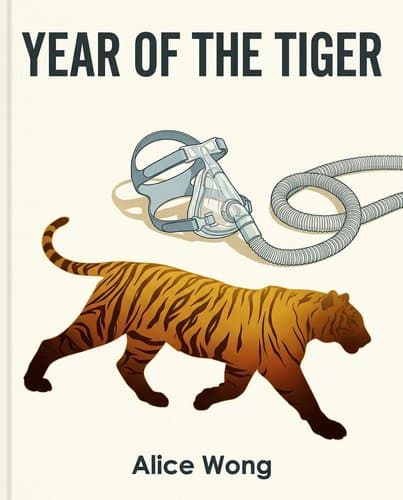
59900658_year-of-the-tiger
by Alice Wong
Living in a body the world treats as expendable gives Alice Wong x-ray vision into systems everyone else accepts as neutral—exposing how disability rights…
In Brief
Living in a body the world treats as expendable gives Alice Wong x-ray vision into systems everyone else accepts as neutral—exposing how disability rights exist only on paper, how "impossible" accommodations became standard overnight when nondisabled people needed them, and why interdependence is the only honest alternative to a society built to let you die.
Key Ideas
Rights need resources to become real
The Americans with Disabilities Act has no enforcement mechanism — there is no ADA inspector who checks on businesses. Rights that exist on paper require individual litigation to become real, which means they belong most to those with the most energy and resources to fight.
Asset limits determine living situations
Medicaid recipients in the United States are typically limited to $2,000 in combined savings to maintain eligibility. Understanding this changes what 'entitlement reform' actually threatens: not dependency, but the thin margin between community living and forced institutionalization.
Accessibility was never technically impossible
Remote work, online conferences, and multi-format accessibility — denied to disabled people for decades as 'too difficult' — became standard in weeks once nondisabled people needed them during COVID. The barrier was never technical. It was political will.
Productive anger drives systemic change
Anger at systemic discrimination is accurate calibration, not dysfunction. Wong describes it as 'productive' and 'formative' — the engine of her life's work. 'Stay angry' is a prescription, not a consolation.
Interdependence replaces toxic individualism
Interdependence — directing your own care, building mutual-aid networks, treating caregiving as public infrastructure — is a concrete political alternative to the toxic individualism that makes disabled lives perpetually precarious. It is not charity. It is architecture.
Harmed people diagnose systems best
The people most systematically harmed by a system are typically its most accurate diagnosticians. Centering their analysis — not their suffering, their analysis — is what it means to actually learn from a crisis rather than just survive it.
Who Should Read This
Readers who connect with first-person stories about Memoir and Social Issues and want to see the world through someone else's eyes.
Year of the Tiger
By Alice Wong
9 min read
Why does it matter? Because Alice Wong was never supposed to reach the age she wrote this book.
You pick up a disability memoir expecting the shape of the thing: difficult beginning, turning point, hard-won peace. Alice Wong knows you're coming. Before the first chapter opens, she names the genre itself as a corporate decision and refuses every convention, including explaining herself to a default nondisabled reader arriving for empathy points. She was born with muscular dystrophy, uses a ventilator full time, and wrote this at the age her doctors said she'd never reach. What she recorded is what you see when your survival is a policy question: the cold arithmetic of who gets the ventilator, whose quality of life becomes someone else's budget line, what "most of us will recover" was quietly assuming all along. The math was never neutral. She has the receipts.
The Publishing Industry Decides Which Disabled Lives Are Worth Reading — Wong Refuses to Let It Decide Hers
Alice Wong names her imagined reader before her first chapter: assumed white, nondisabled, cisgender — someone who picks up a disability memoir to peer into a life they find fascinating and unimaginable, then closes it feeling like a good ally.
That's the zoo exhibit model. The animal is interesting precisely because it's contained.
Wong refuses containment. Before her narrative begins, she lists what the book is not: not a harrowing-then-triumphant account of discrimination, not an immigrant parent story, not a disclosure of her deepest traumas staged for the reader's benefit, not a meditation on whether she's Chinese enough or disabled enough. The refusals aren't disclaimers. They're her identifying the exact product the industry wanted and declining the commission. She acknowledges being entangled in the same machinery she's critiquing: she wrote the memoir, after all. But naming the entanglement is its own kind of resistance.
What she delivers instead is scattered and deliberate: essays, photographs, commissioned art, conversations, graphics. The photographs and commissioned art don't owe the reader an arc — they sit on the page without resolving into anything. A standard memoir can't do that: its form requires sequence, consequence, a direction of travel. Wong builds a book that doesn't have one.
What Happened at Earlham College in 1992 Was Still Happening in California in 2021
Earlham College, Richmond, Indiana, fall 1992. Alice Wong is the only wheelchair user the school has ever admitted. She gave them twelve months of advance notice to prepare. What they built was one accessible bathroom, in one dorm. The other bathrooms, the other dorms: inaccessible. She couldn't visit friends in other buildings. Staff rerouted her schedule around rooms she couldn't reach.
Inclusion, two years after the ADA passed.
She enrolled anyway. Then she got sick, took a year off, recovered. When she was ready to return, Indiana had cut her Medicaid service hours. Budget pressures, the kind that happen sometimes. With fewer hours, she couldn't live independently on campus. Her family couldn't absorb both private tuition and out-of-pocket personal care. She transferred home and commuted to Indiana University Indianapolis instead.
That's the mechanism: no villain, no confrontation. An institution scrambles to include someone when forced, builds the minimum viable accommodation, and then a different part of the same system — funding, policy, administrative discretion — provides the reason to stop. The ADA was law. It didn't prevent any of this.
Twenty-nine years later, California's governor announced that high-risk disabled people under 65 would be removed from the vaccine priority queue in favor of a simpler age-based rollout. Wong, who had not left her apartment in almost a year, went to a press conference and stated it plainly: if she contracted COVID-19, she would die. The statement wasn't a personal disclosure. It was the same argument she'd been making since she was sixteen, when she wrote a letter to Time Magazine, 24 days before the ADA was signed, saying the problem was never the disabled person's body; it was the people with closed minds.
The California rollout reversed, partly, after advocacy. Wong eventually received a single-use code from a disability community contact and got her shot on March 13. The system had not changed. The fight had moved.
The ADA gave Wong a legal tool, not a guarantee. What she learned, at Earlham and every institution after, was that the tool requires someone willing to swing it every time, for every person, because the system will not swing it for you.
Every Detail of the Cyborg Body Is a Political Argument About Whose Survival Counts
On June 14, 2021, Alice Wong was scrolling Facebook when she learned that the ventilator keeping her alive was slowly poisoning her.
Wong calls it a cyborg body — the Trilogy100 isn't equipment she uses; it's part of what she is. The Philips Respironics recall notice described the hazard without softening it: sound-abatement foam inside her ventilator degrades over time, releasing particles and chemical compounds directly into the breathing circuit, potentially carcinogenic, inhaled straight into her airway. Users who could simply discontinue use were told to discontinue use. For someone who would die without the machine, Philips offered this: the benefit of continued use "may outweigh the risks." No replacement devices. No alternatives. The choice was particles or death.
Wong did the math herself. She had used ventilator devices at approximately 21 hours per day for seven years: 53,655 hours of potentially toxic particle inhalation, and she noted the estimate was conservative. The watery eyes she'd attributed to air pressure for years. The damaged nasal linings. The dry, irritated throat that woke her at night. She now had a possible explanation for all of it, and no way to act on it except to keep going.
The system's full response arrived in stages: her respiratory care agency could send extra bacterial filters. Then the FDA clarified that filters stop some particles but cannot capture chemical emissions, and may actually restrict airflow. A few extra filters and the instruction to keep breathing. That was all.
Wong tagged her fury #SuckYouPhilips and kept using the machine. The 53,655 hours would keep climbing. Breathing is not optional. The system had already decided that was acceptable.
Medicaid Is a Lifeline. It Also Caps Your Savings at $2,000.
Medicaid is not a safety net. It is the mechanism by which Alice Wong gets out of bed in the morning: the funding line that pays for personal care attendants who help her bathe, dress, and function in a day that would otherwise be impossible. Without it, she would be in an institution. That's not metaphor: states are required under Medicaid to fund nursing homes but can treat home and community-based services as optional. The pipeline toward institutionalization is built into the program's structure.
She opens one chapter by claiming the Republican slur: "I am a Medicaid moocher." Then she dismantles it with biography. As a teenager in an affluent Indianapolis suburb, she was indignant when her father told her to apply. Medicaid was for those people. She didn't know her family had been paying enormous monthly premiums to the only insurer in Indiana willing to cover her preexisting muscular dystrophy. The program she'd been taught to look down on had been subsidizing her family's survival while she looked away.
Once she stopped looking away, Medicaid gave her college, graduate school in San Francisco, work as a researcher, and eventually the waiver hours that kept her out of a nursing home as her disability progressed. Each of these was real. Each was also conditional.
Here is the condition: as of 2020, accumulate more than $2,000 combined in checking and savings and you lose eligibility. Two thousand dollars. Not a temporary hardship — the program's design, baked in. No savings for emergencies. No cushion for a bad month. No ability to build what every nondisabled peer around her is permitted to build. She asks it flat: is she really in the community if the community closes off every path toward security? No.
What she fears is not her body. What she fears is the policy — one budget cycle, one block grant, one redetermination away from losing the hours that keep her in her apartment instead of a nursing home.
The Correct Response to Disability Discrimination Is Not Resilience. It's Rage.
At the end of an early chapter, Wong writes to her nine-year-old self. Not be patient. Not it gets easier. Stay angry. The instruction is not consolation. It's the most honest thing she knows.
The evidence for why is a high school drama class. Wong earned a B in Drama One at Carmel High School and signed up for the next level. Her teacher, Ms. Tudor, didn't refuse her face to face — she sent Wong to a guidance counselor with the message: Drama Two had a pantomime unit, and Ms. Tudor had decided, without asking, that a wheelchair user couldn't fulfill the requirement. Wong proposed doing the pantomime from her chair — something like miming a meal. Ms. Tudor said no. Not physical enough.
Wong names the failure precisely: the teacher had no imagination and no willingness to be flexible. Not cruelty — something more ordinary. A person with authority looked at a disabled body, saw only limitation, and stopped there. The accommodation Wong proposed would have cost nothing except the willingness to try.
She didn't fight back hard enough at the time, and she knows it. But she also traces what happened next: lunch periods in the school library, books about Berkeley's disability culture and the independent living movement, the beginning of understanding her fury as information rather than dysfunction. The anger was not a problem with her character. It was a correct reading of a system designed to exclude her while blaming her body for the exclusion.
That distinction — anger as calibration rather than damage — is what she passes to the child in the photo. Two decades after Ms. Tudor's classroom, she stood at a press conference and refused to justify her claim to a vaccine on the grounds that her life deserved to continue. She already knew it did.
Disabled People Told You This Was Coming. You Started Listening When It Happened to You.
Wong can detect wildfires before most people can. Her diaphragm has been weakening for years, making her respiratory system unusually sensitive to particulates in the air — a built-in early warning instrument. She senses trouble before it's visible.
The same logic applies to everything else she writes about. Forced to navigate a world that wasn't built for her, Wong learned to read systems everyone else assumes are neutral. This is what she means by calling herself an oracle — not a mystical claim, but a structural one. Living outside the system's defaults means you read its failure modes before its intended users do.
The clearest example is remote work. For decades, disabled advocates requested what seemed like radical accommodations: remote options, online conferences, digital events. The answer was always that it was too difficult, or diminished the face-to-face experience. Then March 2020 arrived, San Francisco issued a stay-at-home order, and within weeks the infrastructure everyone had insisted was impossible was simply operating. The capability had always existed. What was missing was the will to build it for people who needed it.
That's the oracle insight at its clearest: disabled people already knew what was possible. Their analysis was correct. The pandemic didn't prove them wrong and then right — it simply made nondisabled people pay the same price for ignoring the analysis.
Wong gave it a name: the Disabled Oracle Society, a collective whose manifesto reads, "We are the past. We are the present. We are the future. We are forever." Their warnings persisted because the systems they diagnosed persisted. They were not behind the curve. The curve was behind them.
She Wrote Her Own Obituary. She Dies at 96, in a Punk Band, with Nursing Homes Abolished.
Wong writes her own obituary, set in 2070, the Year of the Tiger. She dies at 96.
By then, nursing homes have been abolished. Psychiatric hospitals too. Supported decision-making — collaborative alternatives to court-imposed guardianship — has replaced conservatorships. Successive pandemics reshaped the world and produced the largest population of disabled people in recorded history, and that confluence, rather than destroying the disability rights movement, finally dismantled the logic of enforced productivity.
In 2032, Wong joined a punk band called Rage Against the Ableism. Five records in twelve years. Her songs — "Ableism Is Trash," "Fuck You, Pay Me," "S.T.F.U. White People" — are still performed at karaoke nights across two planets. In 2045, she moved to a zero-gravity capsule on the moon with the second cohort of Crips in Space, the real disability-led collective. She is survived by her sisters and six holocats named Blueberry, Claude, Cinnamon, Meowmee Jr., Mittens, and Phil.
The obituary quotes her first memoir (this book) back at her: "good shit takes time." The line was true when she wrote it. By 2070, it's an epitaph and a proof at once.
The obituary does what every chapter before it does: names a world and insists on its plausibility. At a pandemic press conference, she refused to justify her right to a vaccine; in a recall notice, she calculated to the hour. Each time, she was writing herself into a future the world had decided she couldn't occupy. The 2070 obituary is the same method, scaled to ninety-six years and a moon colony. The form changes. The logic doesn't.
What a Six-Year-Old Asked Her Teacher — and What the Whole Book Answers
The six-year-old who stopped mid-hallway and asked her teacher if she was going to die already knew the question mattered more than the answer. The teacher said no. Forty years later, California's governor removed her from the vaccine priority queue. Those two moments are the same sentence, differently punctuated. What this book does — all of it, the grief and the fury and the punk records and the moon colony — is refuse to let the punctuation be a period. She asked if she was going to die. The real answer takes the whole book to arrive at: yes, eventually, at 96, in a band, in a world that finally ran the numbers correctly. She has been working toward that answer since she was small enough to ask it in a hallway. You have been living inside the wrong math longer than you know.
Notable Quotes
“There has to be checks and balances on hospitals and nursing homes. Otherwise, disabled people, especially people of color, are left alone in a system that already doesn't care about us.”
“Once Science Fiction, Gene Editing Is Now a Looming Reality”
“Hey @nytimes how DARE you have a writer who doesn't identify as DISABLED write about what CRISPR means for OUR community as part of your #ADA30 spread?!?! Your ableism really knows NO bounds.”
Frequently Asked Questions
- What is 'Year of the Tiger' about?
- Year of the Tiger is Alice Wong's memoir and political analysis written from inside a life the medical system predicted she would not reach. The work exposes how disability rights exist on paper but require individual litigation to become real, how COVID proved accessible infrastructure was always a matter of will, and why interdependence — not independence — is the practical architecture of a more just society. Wong combines personal narrative with systemic analysis to argue that the barriers disabled people face are fundamentally political rather than technical or inevitable.
- What are the main arguments in 'Year of the Tiger'?
- Wong argues that disability rights in America exist primarily on paper without real enforcement, that COVID proved accessible infrastructure was always a matter of political will, and that anger at systemic discrimination is productive and formative. She points out that "remote work, online conferences, and multi-format accessibility — denied to disabled people for decades as 'too difficult' — became standard in weeks once nondisabled people needed them during COVID." Wong positions this anger as "accurate calibration, not dysfunction" and describes it as 'productive' and 'formative' — the engine of her life's work. She further argues that interdependence, not independence, is the practical architecture of a just society.
- What does Wong say about the Americans with Disabilities Act?
- Wong argues that the Americans with Disabilities Act has no enforcement mechanism — there is no ADA inspector who checks on businesses. This means disability rights that exist on paper require individual litigation to become real, making them accessible primarily to those with energy and resources to fight. Understanding Medicaid's $2,000 savings limit reveals what 'entitlement reform' actually threatens: not dependency, but the thin margin between community living and forced institutionalization. For Wong, these structural gaps explain why disabled people's actual freedom depends less on written rights than on individual capacity to challenge violations.
- What is Wong's argument about interdependence?
- Wong argues that interdependence — directing your own care, building mutual-aid networks, treating caregiving as public infrastructure — is a concrete political alternative to toxic individualism. She emphasizes that this is not charity. It is architecture. Interdependence makes disabled lives less perpetually precarious by centering collective responsibility rather than individual resilience. Wong also contends that those most systematically harmed by a system are typically its most accurate diagnosticians. Centering their analysis — not their suffering, their analysis — is what it means to actually learn from a crisis rather than merely survive it. Interdependence is thus both personal practice and framework for systemic change.
Related Book Summaries
Read the full summary of 59900658_year-of-the-tiger on InShort