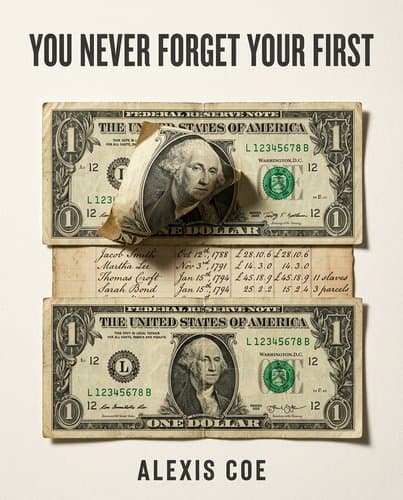
51239966_you-never-forget-your-first
by Alexis Coe
The Washington you learned in school was carefully manufactured—and Alexis Coe traces exactly who built it, what they invented, and which lives were erased to…
In Brief
The Washington you learned in school was carefully manufactured—and Alexis Coe traces exactly who built it, what they invented, and which lives were erased to make the legend stick. The real George Washington, information strategist and enslaver, is far more revealing than the myth.
Key Ideas
Verify biography's era and author values
Before trusting any presidential biography, check when it was written, who wrote it, and what narrative the era required — historians project their moment's values onto their subjects as reliably as Weems invented the cherry tree, and the further historians are from the subject's actual time, the more license they seem to take.
Propaganda skill rivaled military command
Washington's most consequential skill wasn't military command but information control: he personally directed propaganda operations, funded newspapers, collected atrocity accounts, and ran a sophisticated spy network. His career is a case study in the idea that controlling the narrative matters as much as winning the battle.
Washington rejected available abolition models
The claim that Washington 'freed his slaves in his will' is historically misleading and belongs to Mount Vernon's framing, not to the documentary record — Benjamin Franklin freed his slaves in 1785 and petitioned Congress to abolish slavery in 1790; Robert Carter III manumitted over 450 people starting in 1791. Washington had living, local models he chose not to follow.
Citation gaps reveal suppressed truths
Primary documents — ledgers, marginal annotations, letters — often tell a radically different story than the biographies that summarize them. When a biographer's dramatic scene has no source citation, or the citation points somewhere quieter than the drama suggests, that gap is where the most important history usually lives.
Enslaved people are the moral reckoning
The people erased from Washington's heroic story — Ona Judge, Hercules, Isaac and Kitty's family — are not footnotes to the main narrative. Their specific, documented fates are the moral accounting that the myth was designed to make impossible to perform.
Who Should Read This
History readers interested in Political Figures and World History who want a deeper understanding of how we got here.
You Never Forget Your First
By Alexis Coe
9 min read
Why does it matter? Because the Washington you learned about was assembled by people who needed you to believe it.
The wooden teeth aren't real. Neither is the cherry tree. You probably knew one of those things, maybe both — but here's the question Alexis Coe won't let you dodge: who invented them, and what were they distracting you from? The fabrications are easy to dismiss. The machinery behind them is harder. Washington didn't become the face on the dollar bill by accident. He was assembled, over two centuries, by a parade of biographers (Coe calls them the Thigh Men) who rhapsodized about his thighs while quietly skipping past his ledger, where the purchase of nine enslaved people's teeth is recorded in his own handwriting, paying two-thirds below market rate for teeth he'd use to fill his own dentures. Coe's book is a tour of that assembly line, with the receipts still on the floor. By the end, you won't miss the myth. You'll want to know the people it was built to hide.
Everything You Know About Washington Was Assembled by Someone With an Agenda
Spring 1755: George Washington is preparing to leave for a military posting when his mother appears at Mount Vernon. In Ron Chernow's 2010 Pulitzer Prize-winning biography, Mary Washington arrives "like the wrath of God" — family drama, a delayed departure, conflict. Then you look up the source Chernow cites: a letter Washington wrote explaining the delay to his military contact, the same one virtually every Washington scholar has cited. In it, Washington notes only that his mother appeared "alarmed at the report of my intentions." One worried parent, briefly mentioned. The wrath of God doesn't appear in the document. Chernow put it there.
The mechanism: a real source, a dramatic invention layered on top, and the authority of a Pulitzer Prize to discourage anyone from checking. Mason Weems was running the same play two centuries earlier. A traveling parson who sold books to survive, he promised his printer that a Washington biography stuffed with dramatic exclusives would "sell like flax seed." He wrote it the year before Washington died. He was right. Readers devoured it, embellished it, and passed it on. The cherry tree confession ("I cannot tell a lie") is his invention.
Different centuries, same decision. Weems needed a sellable hero. Chernow needed a domineering villain to explain his subject's drive. Washington's myths aren't accidents of collective memory — they're choices made by specific people who needed a particular version of him to be true. Once you see the mechanism, the question shifts: not just what we got wrong, but who needed it that way.
The Historians Who Called Mary Washington a Shrew Had Never Read Her Letters
Every era's Washington biographers needed Mary Ball Washington to be something particular.
In the early nineteenth century, President Andrew Jackson laid the cornerstone of a monument to her, and suffragists invoked her image as a model of republican motherhood. By the late nineteenth century, historians reversed course: Paul Leicester Ford cast her as the petty tyrant Washington spent his life trying to escape. The further historians got from her actual time period, the worse it got. By Chernow's 2010 account, she was shrewish, querulous, forbidding, slovenly, illiterate, crude, coarse — more than twenty adjectives, none flattering, most unmoored from any source citation.
Here's what the documents actually show. Mary was literate: her annotated devotional books survived, appeared later in Washington's personal library, and he quoted her favorite passages. She ran a tobacco farm alone after her husband's death, fought off British merchants who accused her of shorting her tobacco shipments, and won both times. And when Lawrence Washington and the Fairfax family conspired to place her fourteen-year-old son as a midshipman in the British Royal Navy, she read the situation clearly enough to stop it. The estate executor dismissed her objections as "trifling... such as fond and unthinking mothers naturally suggest." She proceeded anyway — Lawrence's own service letters had described disease and death, his brother-in-law had died in a naval battle, and midshipman was one of the lowest-ranking positions on any vessel. Roughly a third of recruits who enlisted at George's age didn't survive their first two years.
What biographers read as obstruction, documents read as pattern recognition. The obstacle was also the template. Washington and his mother were both tall, anxious, money-obsessed, litigious, and constitutionally unwilling to be talked out of a position once they'd formed it. The man biographers spent centuries crediting with unshakeable resolve learned it somewhere.
He Started a World War at 22, Then Buried the News Eight Paragraphs Deep
Dawn, May 1754. Washington and forty men, plus a dozen Seneca warriors led by Tanacharison — also known as the Half-King, a chief he privately called mercenary — surround a French camp in the Pennsylvania wilderness. Most of the Frenchmen are still asleep. Their muskets are wet from the previous night's rain. Fifteen minutes later, ten are dead and twenty-one are prisoners. Washington writes it up in a letter to Governor Dinwiddie.
He gets to it in paragraph nine.
The first eight paragraphs are about his salary. It was denying him "the pleasure of good Living," he explained. Only after exhausting that grievance does he mention, almost in passing, that his party had killed one Joseph Coulon de Jumonville, the French commander. What Washington didn't know was that Jumonville had been on a diplomatic mission identical to his own — carrying a letter demanding the other side withdraw. His delegation had no intention of fighting. The letter proving this was found on his corpse.
The French made Jumonville a martyr. Dinwiddie, covering himself with London, claimed it was the Half-King's doing. Washington, in a surrender ceremony shortly after, signed terms he later said he couldn't properly read — which is how his name ended up on a document confessing to an "assassination." British writer Horace Walpole: "The volley fired by a young Virginian in the backwoods of America set the world on fire." If the Revolution hadn't happened, Washington would be remembered today as the man who accidentally started the first world war.
What followed clarifies the kind of person Washington was. His men deserted on the march home. He quit his commission when colonial regulations permanently capped colonists at captain. But on the way out, he handed Dinwiddie his personal journal. The governor printed it in newspapers across the colonies as anti-French propaganda, and the British commissioned a special edition within months. Washington had accidentally triggered a world war, signed a surrender confessing to assassination, watched his army desert him, and quit his post. He came out the other side more famous than before. Disaster had a way of becoming celebrity when you knew how to work the printing press.
He Didn't Outfight the British — He Outspied and Out-Narrated Them
Washington's most consequential victories in the Revolution happened without weapons — through legal maneuver, manufactured narrative, and a spy network the British spymaster would eventually admit outclassed them entirely.
When Admiral Richard Howe arrived in 1776 with 400 ships and 32,000 troops (Britain's largest invasion force ever), Washington had roughly 19,000 poorly equipped men, no cavalry, no navy, and an army bleeding deserters. He chose a different kind of engagement. When Howe sent a letter addressed to "George Washington, Esqr.," Colonel Reed turned it away with one sentence: "We have no person in our army with that address." Acknowledging Washington's rank meant acknowledging American sovereignty. The British tried again with "George Washington, Esq, etc., etc." Same answer. When Colonel Paterson finally sat across from Washington at No. 1 Broadway and argued that "etc." signified Howe's deep esteem, Washington told him Americans hadn't offended and required no pardon. Paterson lingered for a message. Washington sent him back with his particular compliments to both brothers. That's the whole offer — from the commander of a starving, outnumbered army facing the world's foremost military power.
His spy network was what the British eventually credited for their defeat. It ran on proper infrastructure: invisible ink whose recipe even its inventor refused to share, Continental currency replaced with Spanish dollars and English crowns (paper could be traced; coins couldn't) to avoid incriminating operatives. Benjamin Tallmadge ran the Culper Ring out of his Long Island hometown, vetting recruits by personal loyalty rather than credentials.
Washington's staging of John Honeyman's capture in December 1776 turned intelligence directly into a battlefield outcome. During their interrogation, staged down to the soldiers' performances of outrage, Washington slipped Honeyman a jail key and briefed him on what to tell the Hessian colonel at Trenton: the Continental Army was starving, shirtless, spent. Colonel Rall believed it, celebrated Christmas with appropriate abandon, and was dead by December 26. British spymaster Major George Beckwith eventually said it plainly: "Washington did not really outfight the British. He simply outspied us."
The Man Who Spoke of 'Shackles of Slavery' Also Wrote 'Keep Him Handcuffed Till You Get to Sea'
How committed was Washington to the principle that enslaved people weren't cattle to be sold? Committed enough to say it out loud — and to do the opposite in writing.
In 1766, Washington gave a man named Tom to the captain of a ship called the Swift, with instructions to sell him in the Caribbean. Not to a Virginia family. Not to anyone who might treat him gently. The Caribbean meant sugar plantations, overseers with whips, and a life expectancy measured in years rather than decades. Washington knew this. He'd been corresponding with West Indies traders for years. The letter he handed Captain Thompson is specific in ways that leave nothing unclear: Tom was "exceeding healthy, strong, and good at the Hoe," Washington wrote, noting these qualities for the benefit of buyers. He acknowledged that Tom had tried to run, then directed Thompson, lest he try again on the voyage, to "keep him handcuffd till you get to Sea." In exchange for a human life, Washington requested molasses, rum, limes, tamarinds, and "good old Spirits." He listed them like a grocery order.
The Philadelphia years reveal the same architecture. When Attorney General Randolph advised Washington that Pennsylvania's Gradual Abolition Act applied to executive-branch slaves (any enslaved person in the state for six months could claim freedom), Washington's response was to rotate his enslaved workers out of the city before the deadline arrived. Not to free them. To reset the clock. He explained the logic in a letter to his secretary Tobias Lear: it "behoves me to prevent the emancipation of them, otherwise I shall not only loose the use of them, but may have them to pay for." His chef Hercules had been with him since roughly age fourteen. Washington sent him back to Mount Vernon anyway. Hercules escaped on Washington's sixty-fifth birthday, leaving his three children behind. Washington never found him.
Ona Judge tried a different approach. After she walked out of the Philadelphia house in 1796 and was spotted in New Hampshire, where slavery had been abolished in 1783, she agreed to return, but with conditions: freedom upon the Washingtons' deaths, no gifting, no selling. Washington's refusal is recorded in his own words. To grant her terms would be "to reward unfaithfulness with a premature preference" and would "discontent the minds of all her fellow Servants." Her compliance, in other words, was the very reason her freedom had to be withheld: every enslaved person who stayed put earned their continued bondage by not running. Her younger sister Delphy was given to the granddaughter Ona had been fleeing in the first place.
This is the system as it actually operated: not a tragic compromise but a closed loop, maintained deliberately, with the paperwork to prove it.
The Burial Ground He Never Mentioned in Thousands of Documents Is the Last Page of His Biography
Think of it as a balance sheet. Washington kept meticulous ledgers: the price of every fence post at Mount Vernon, the cost of his ivory dentures, what he paid for teeth pulled from enslaved people to fill the gaps. He filled twenty-nine pages of his will in his own careful hand, cataloging every acre and possession. He left thousands of documents.
None of that extends to the woods near his burial vault. Archaeologists have been excavating the area since 2014. It doesn't appear anywhere in Washington's surviving papers — not once. It is a cemetery for the people he enslaved, full of unmarked graves.
The standard account positions his 1799 will as an act of moral courage: Mount Vernon's official summary states he was "the only slave-holding Founding Father to free his slaves." Benjamin Franklin freed his enslaved people in 1785, then petitioned Congress to abolish slavery in 1790, while Washington was president. Robert Carter III, a prominent Virginian Washington almost certainly knew, began manumitting over 450 enslaved people in 1791, when it became clear Virginia's legislature wasn't going to act. Washington had a working model three counties away. He chose not to follow it.
The will freed 123 people — after Martha's death, which could be a decade away. Martha herself was motivated by something more immediate. After Washington's death, some enslaved people fled Mount Vernon; those who remained watched her closely, knowing her death meant their freedom. Abigail Adams wrote that Martha "did not feel as tho her Life was safe in their Hands." On December 15, 1800, Martha signed the deed of manumission. Self-preservation, not principle.
Then Martha died in 1802. The 150 dower slaves she controlled were divided among her four grandchildren. One family's trajectory makes the arithmetic human: Isaac had been freed under Washington's will; his wife Kitty and their nine daughters and seven grandchildren were dower property. The Custis grandchildren split them across five locations: Washington D.C., Georgetown, Woodlawn, Arlington. Each person's monetary value was noted beside their name. No evidence suggests any of them were ever reunited.
Washington obsessed over how he would be remembered. He cataloged everything he considered worth leaving behind. The cemetery in his backyard never made that list. Archaeologists are filling in what he chose to omit.
The Archive and the Unmarked Grave
Washington tracked everything. The exact cost of teeth purchased from enslaved people to fill his dentures. Fish caught on Sundays. The precise minute of his own death, noted as though accuracy might help. He dispatched men to recover his military commission so his grandchildren could hold it someday. His will runs to twenty-nine watermarked pages — every acre, every possession worth leaving behind.
The burial ground near his vault appears in none of it. But the burial ground doesn't need his documents. Excavations begun in 2014 are still turning up unmarked graves. People who died, who were buried, who existed entirely outside whatever Washington decided to write down.
That's not an oversight. That's a choice. Washington's archive records what he decided mattered. The people he enslaved didn't make the ledger. Read that silence the way you'd read any document: as evidence of intent. It tells you who the story was always written for — and who it was written against.
Notable Quotes
“Continue your enquiries, I pray you, after Herculas,”
“and if you should find it necessary, hire some one who is most likely to be acquainted with his haunts, to trace them out.”
“Washington is often quoted as saying”
Frequently Asked Questions
- What is You Never Forget Your First about?
- You Never Forget Your First traces how the George Washington myth was constructed over time. Alexis Coe examines how Parson Weems, subsequent biographers, and Washington himself shaped the president's public image through propaganda and narrative control. The book exposes what this mythology required erasing: the documented lives of enslaved people including Ona Judge and Hercules. By analyzing the sources behind presidential biography, Coe provides readers with critical tools to recognize whose stories get buried and how myth-making obscures historical truth about one of America's most mythologized figures.
- What are the key lessons for reading presidential biography critically?
- Before trusting any presidential biography, check when it was written, who wrote it, and what narrative the era required. Historians project their moment's values onto their subjects as reliably as Weems invented the cherry tree myth. The further historians are from their subject's actual time, the more interpretive license they take. This means examining primary documents—ledgers, letters, marginal annotations—often reveals stories dramatically different from published biographies. When a biographer's dramatic scene lacks source citations or cites something quieter than the drama suggests, that gap is where the most important history usually lives.
- Who were the enslaved people erased from Washington's heroic narrative?
- Alexis Coe centers the documented lives of enslaved people like Ona Judge and Hercules, whose stories were systematically erased from Washington's mythology. These individuals—including Isaac, Kitty, and their families—are not footnotes but represent the moral accounting that the myth was designed to obscure. Their specific, documented fates reveal the human costs underlying the Washington legend. Coe demonstrates how presidential biography systematically buries inconvenient truths about slavery and personal complicity. By foregrounding these erased narratives, the book forces readers to confront what heroic national stories require us to forget and whose lives must be sacrificed for myth.
- What role did George Washington play in controlling his own narrative?
- Washington's most consequential skill wasn't military command but information control. He personally directed propaganda operations, funded newspapers, collected atrocity accounts, and ran a sophisticated spy network. His career demonstrates that controlling the narrative matters as much as winning the battle. The claim that Washington "freed his slaves in his will" exemplifies this narrative control—it's historically misleading and belongs to Mount Vernon's framing rather than the documentary record. Benjamin Franklin freed his slaves in 1785 and petitioned Congress to abolish slavery in 1790; Robert Carter III manumitted over 450 people starting in 1791. Washington had local models he chose not to follow.
Related Book Summaries
Read the full summary of 51239966_you-never-forget-your-first on InShort